A Tale of Two Spring Beauties

Spring Beauty (Claytonia virginica) is one of the earliest of the spring wildflowers to appear in New Jersey, where I live. Its grass-like leaves emerge first, finding their way through their warm winter blanket of leaf mulch.

Spring Beauty (Claytonia virginica) leaves emerging from their winter blanket of leaf mulch.

Spring Beauty (Claytonia virginica) leaves emerging from their winter blanket of leaf mulch.

When temperatures are warm enough, flowers begin to bloom, offering an enticement to early spring pollinators.
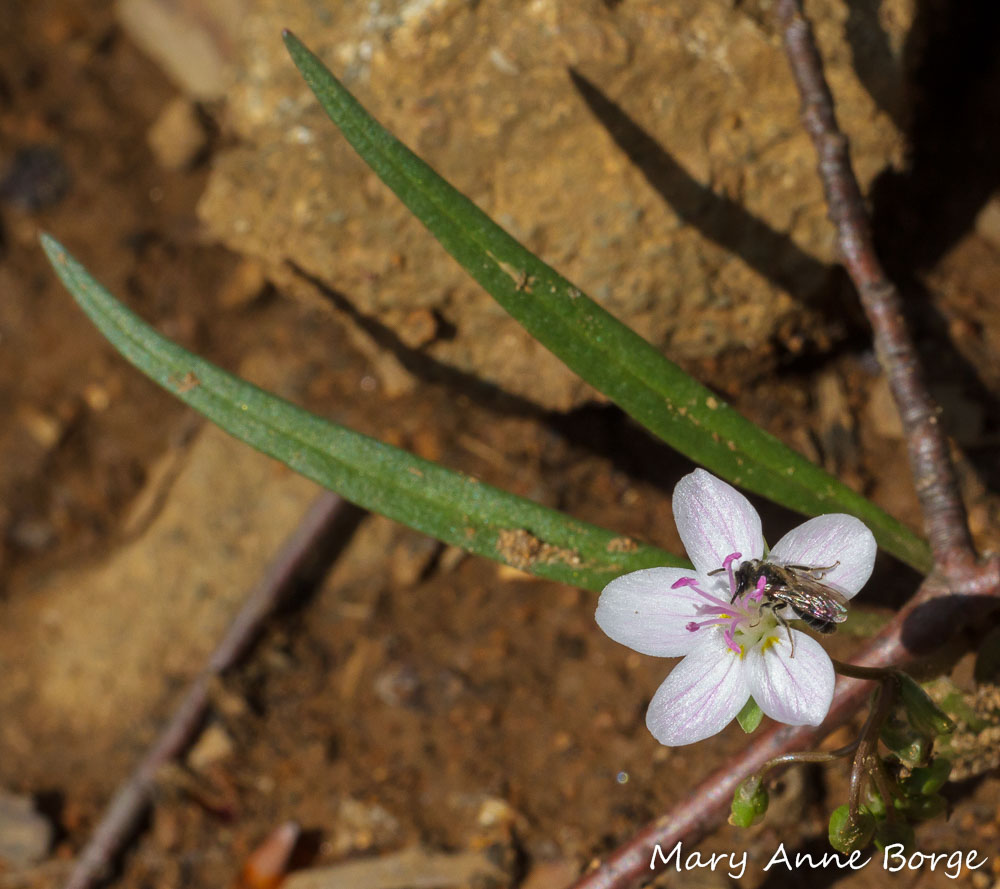
Spring Beauty (Claytonia virginica) with bee

Spring Beauty (Claytonia virginica) with bee

I knew there was another Spring Beauty species, Carolina Spring Beauty (Claytonia caroliniana), but I never encountered it until a recent trip to Stowe, Vermont.
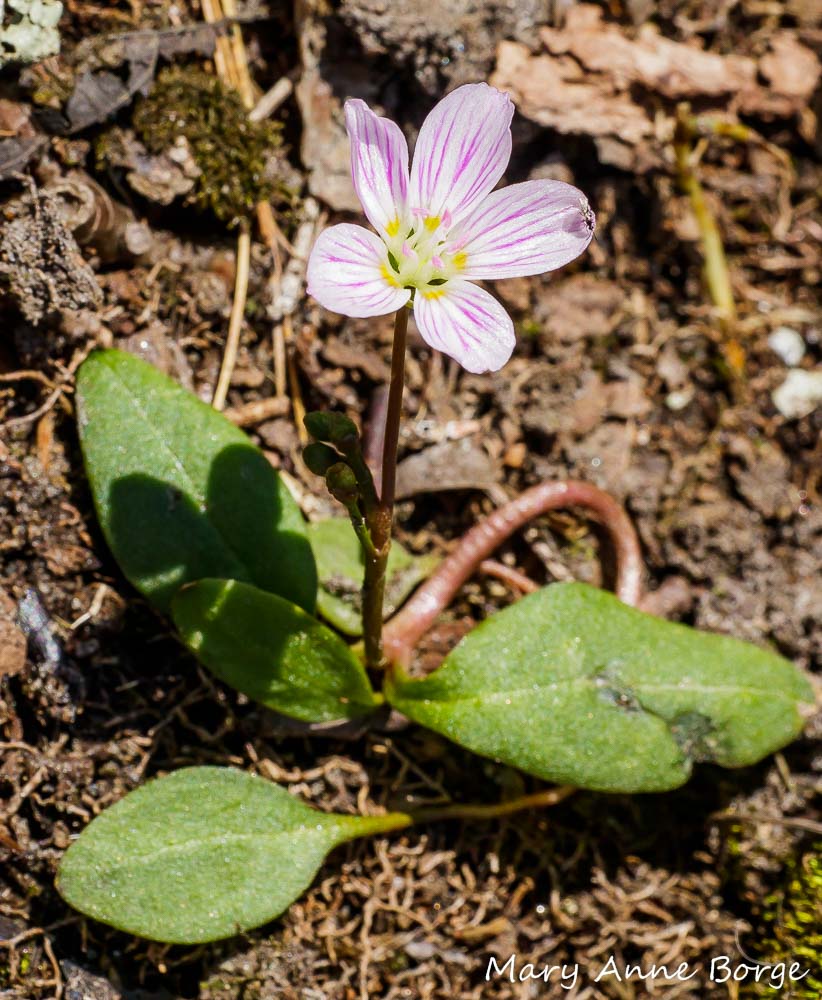
Carolina Spring Beauty (Claytonia caroliniana)

Carolina Spring Beauty (Claytonia caroliniana)

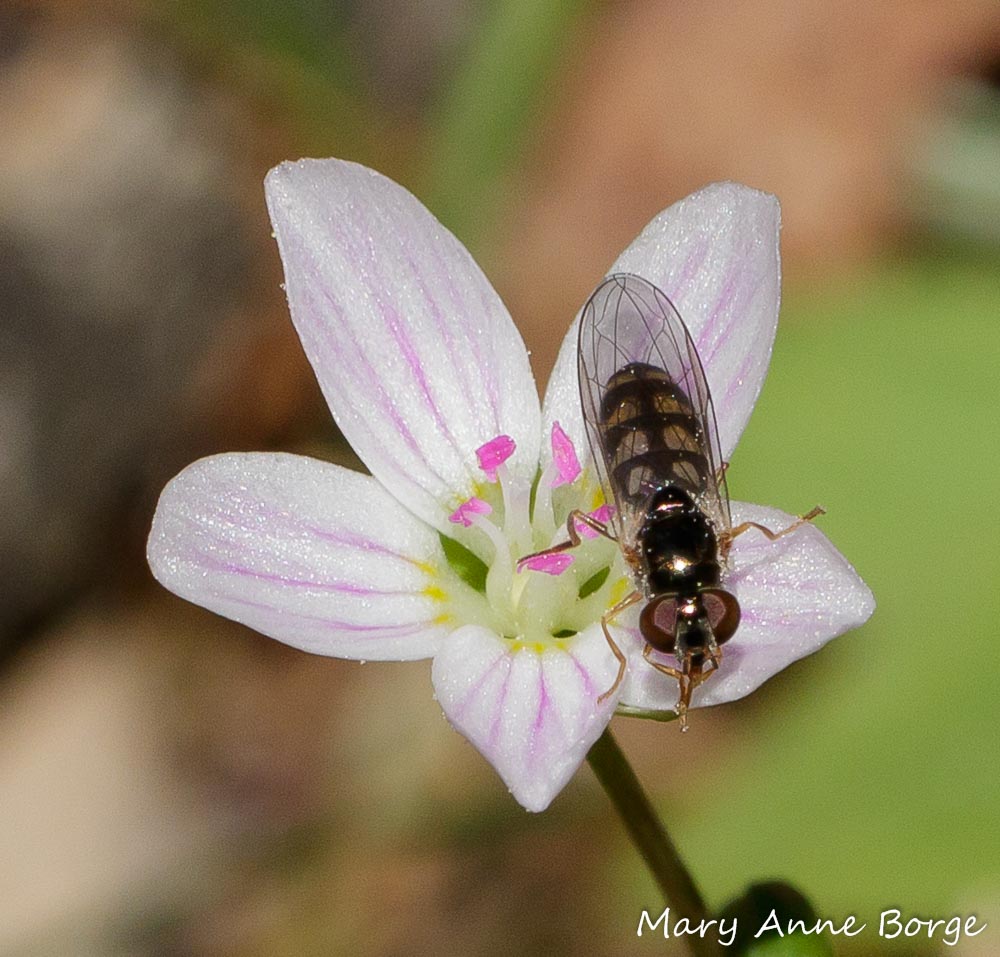
The flowers of the two Spring Beauty species look identical. Both have 5 white to pinkish petals, with nectar guides that vary from almost white to deep pink, striping the petals like the insect equivalent of airport runway lights, showing the way to a meal instead of a terminal.
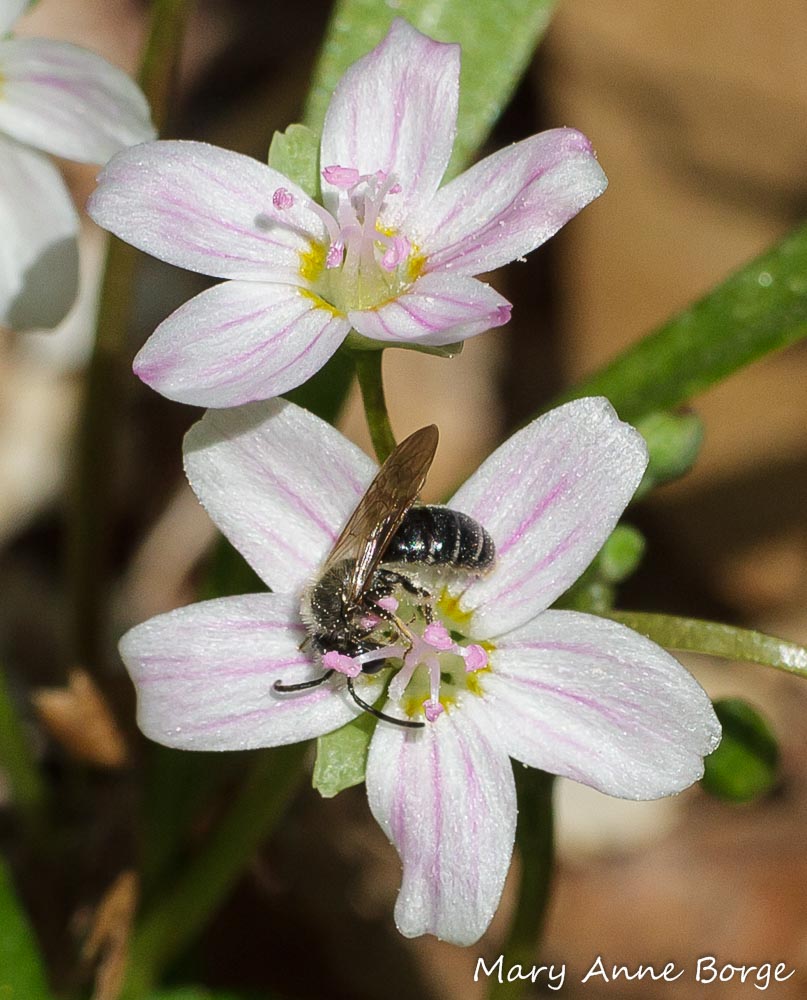
Spring Beauty (Claytonia virginica) flowers, with bee
Spring Beauty (Claytonia virginica) flowers, with bee

Carolina Spring Beauty (Claytonia caroliniana) flower, with flower fly

Carolina Spring Beauty (Claytonia caroliniana) flower, with flower fly

It’s the foliage of the two Spring Beauties that set them apart. In contrast to the long, narrow leaves of Spring Beauty,

Spring Beauty (Claytonia virginica)

Spring Beauty (Claytonia virginica)

Carolina Spring Beauty has a pair of paddle or spatula shaped leaves with very distinct petioles (leaf stems).
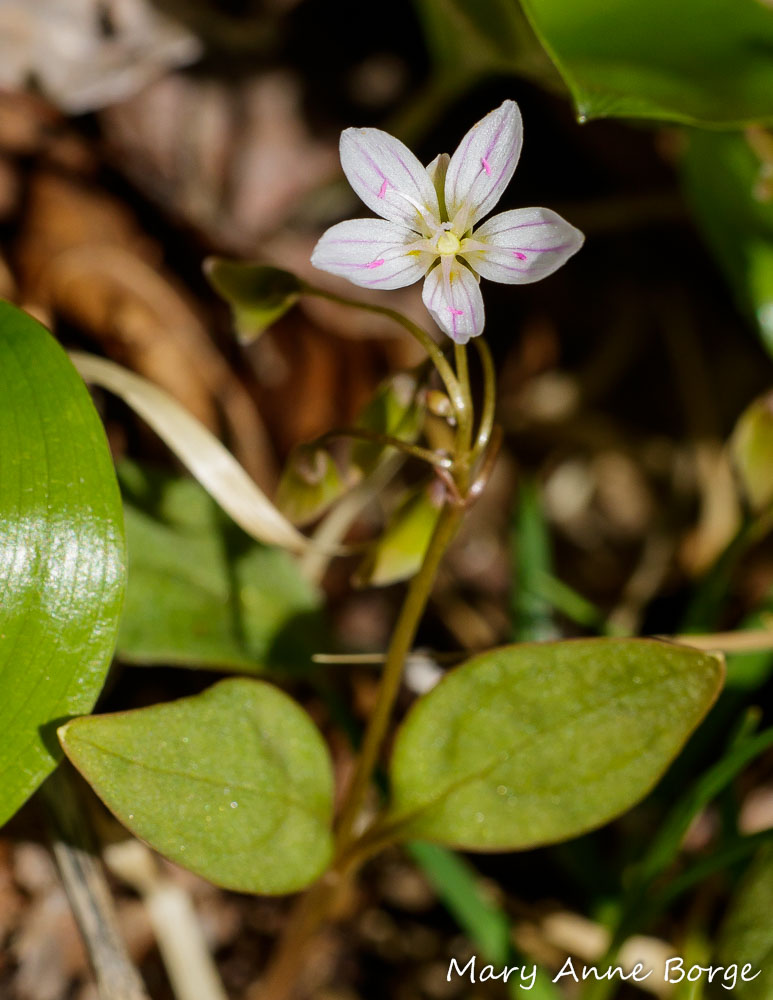
Carolina Spring Beauty (Claytonia caroliniana)

Carolina Spring Beauty (Claytonia caroliniana)

The leaves are succulent, helping the plants through any periods of moisture shortages in the upland habitats where they are most likely to be found, according to their USDA wetland status.
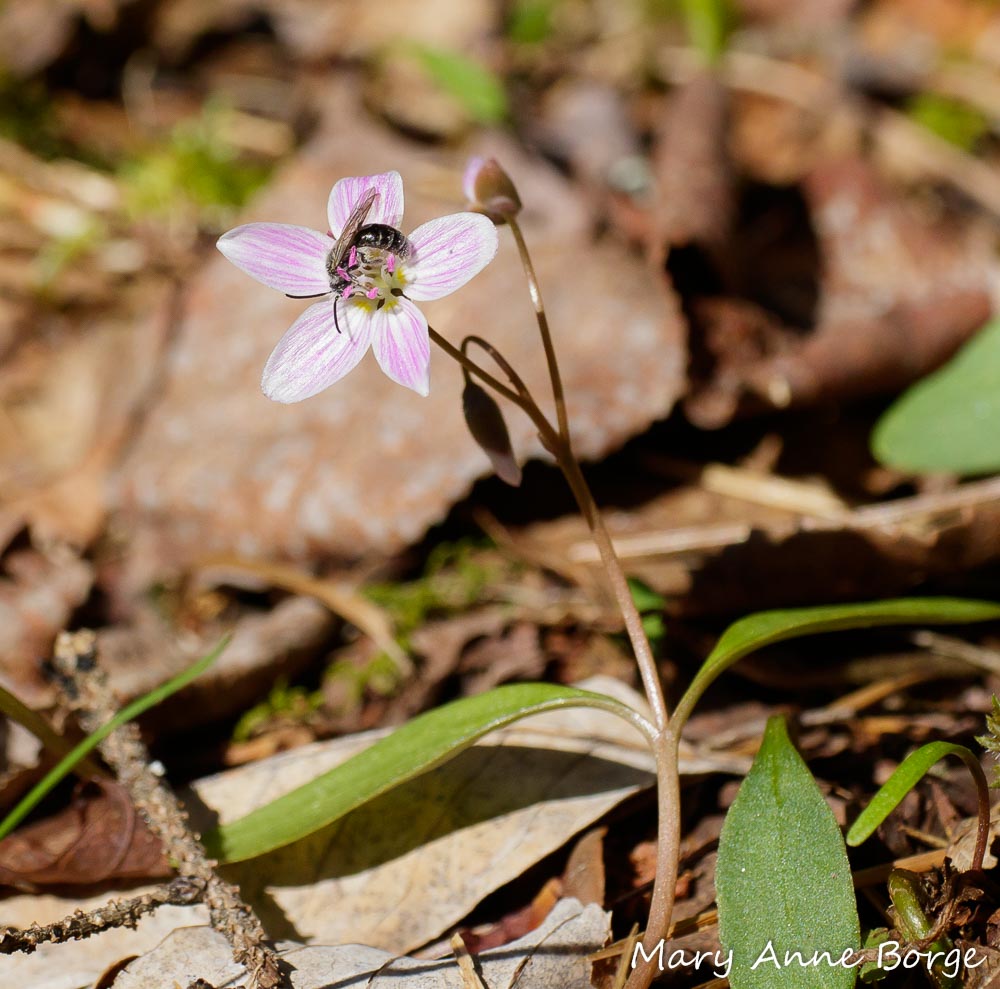
Carolina Spring Beauty (Claytonia caroliniana)

Carolina Spring Beauty (Claytonia caroliniana)

Carolina Spring Beauty’s firm leaves are the perfect solar panels for this plant, gathering energy from the sun during the few weeks they appear above ground each spring.
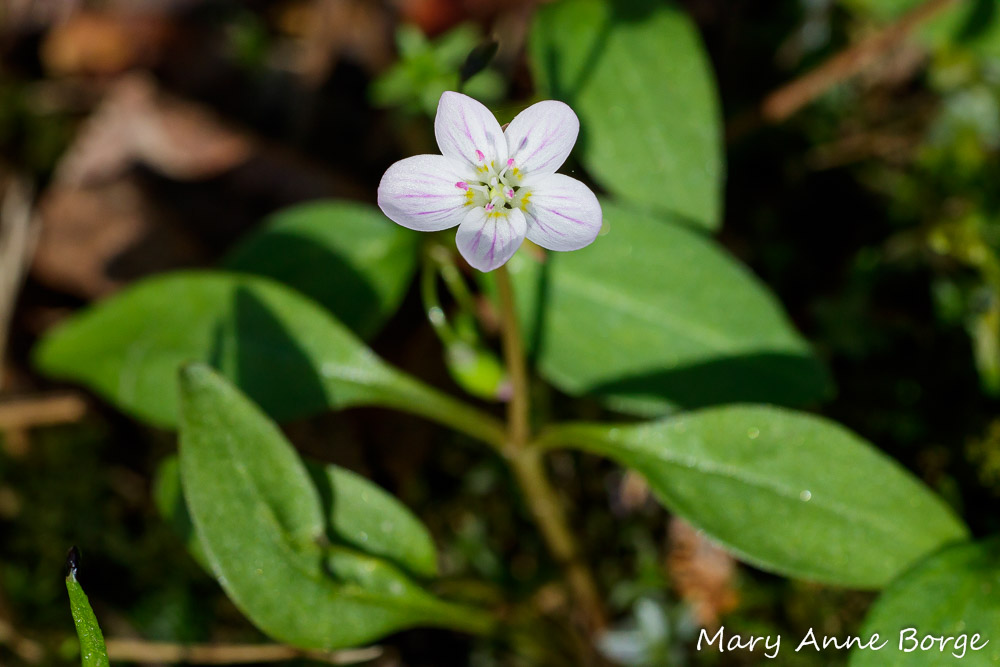
Carolina Spring Beauty (Claytonia caroliniana)

Carolina Spring Beauty (Claytonia caroliniana)

The leaves help Carolina Spring Beauty to make the most of the short spring of its native range, which is primarily northerly or in upland areas, from Ontario to Newfoundland and Nova Scotia in Canada, south to the New England states, through the Appalachian mountains as far south as Alabama and Georgia, and in northern Michigan, Wisconsin and Minnesota.  They are not found in the places I frequent in New Jersey or southeastern Pennsylvania, so it was pretty exciting to see them.
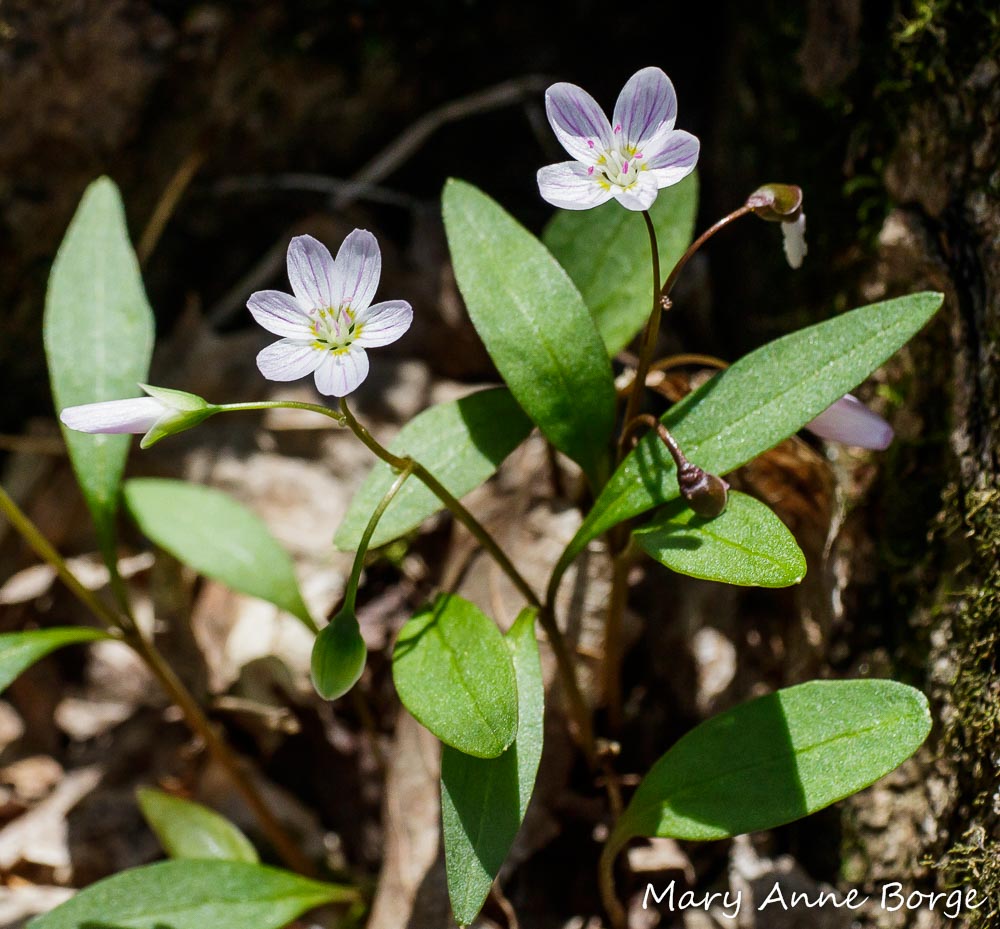
Carolina Spring Beauty (Claytonia caroliniana)

Carolina Spring Beauty (Claytonia caroliniana)

The other Spring Beauty (Claytonia virginica) has a more southerly range.  It is native in Canada only in Nova Scotia and southern Quebec and Ontario provinces, then south through the United States as far as Texas in the west and Georgia in the east.  The ranges of these two species rarely overlap.
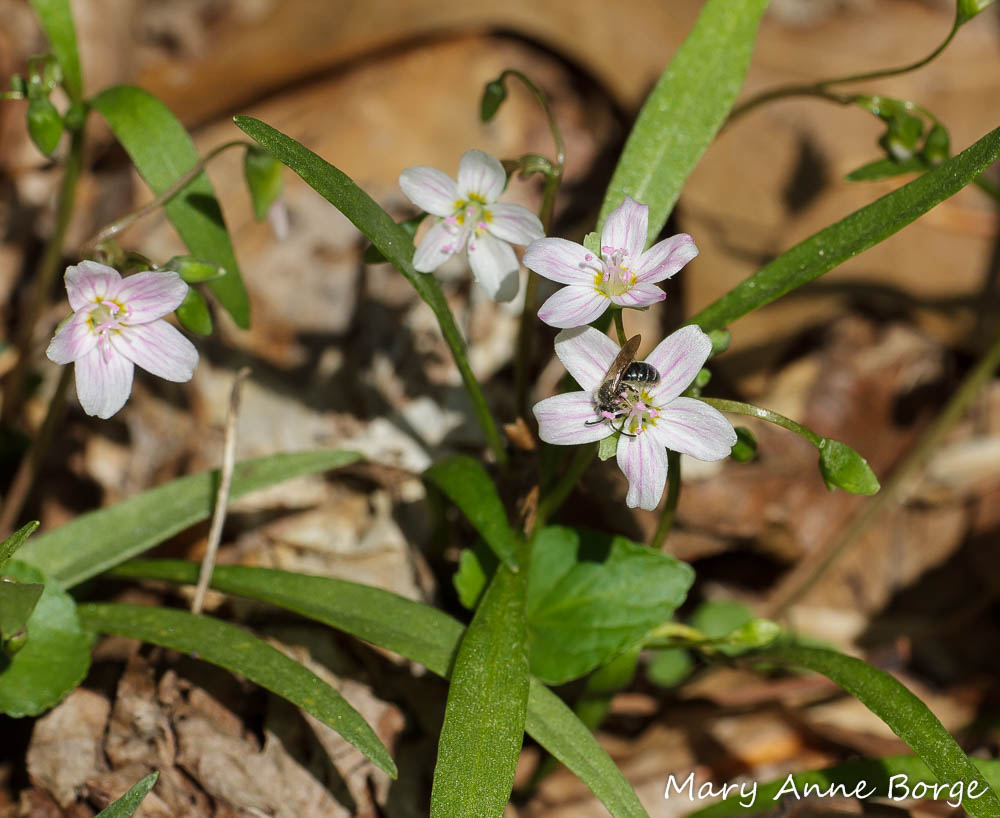
Spring Beauty (Claytonia virginica) with bee

Spring Beauty (Claytonia virginica) with bee

Look for these Spring Beauties for a few more days, before they disappear underground until they emerge again with the first warm days next spring.
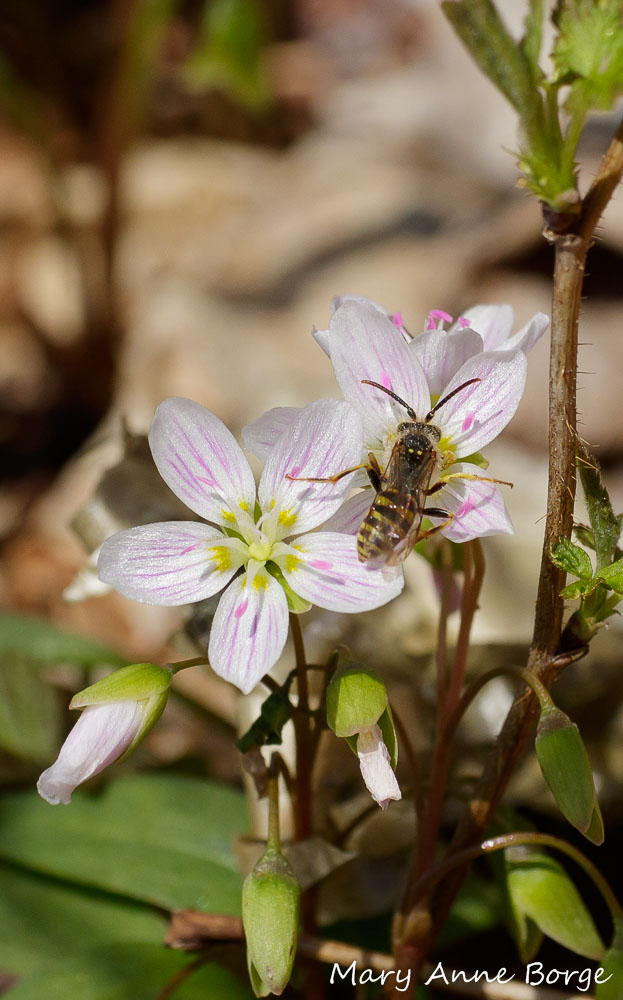
Spring Beauty (Claytonia caroliniana) with bee

Spring Beauty (Claytonia caroliniana) with bee

Related Posts

A Carpet of Spring Beauty, Woven by Ants

Signs of Spring – Mining Bees

Late Spring in Stowe, Vermont

Resources

Clemants, Steven; Gracie, Carol. Wildflowers in the Field and Forest. 2006.

Spira, Timothy A. Wildflowers & Plant Communities of the Southern Appalachian Mountains & Piedmont.  2011.

USDA Plants Database – Carolina Spring Beauty

USDA Plants Database – Spring Beauty

Evergreen Native Plant Database


Spring Azures

Spring Azures spent the winter as pupa, cozy in their chrysalises, poised to take the final step to adulthood when spring conditions were right, with longer days and warmer temperatures. Their fluttering flight showing flashes of azure began lighting up woodlands and gardens earlier than usual this year, when unseasonably warm March temperatures encouraged them to complete their metamorphosis and emerge as early as the last week of March.

Spring Azure butterfly

Spring Azure butterfly

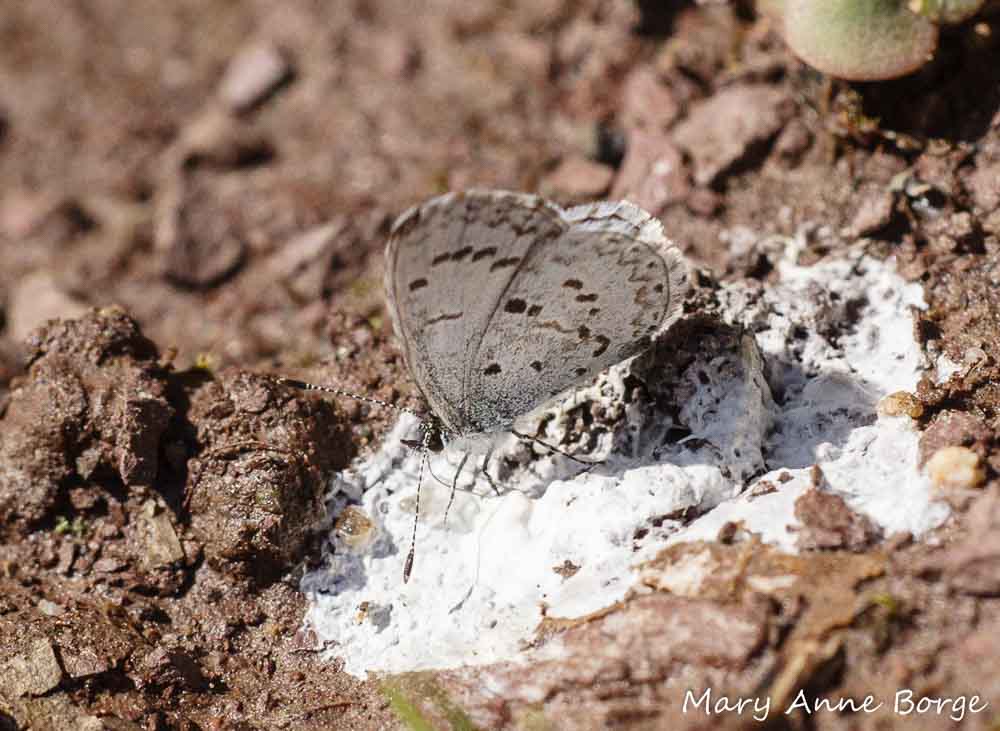
Nectar was scarce in those early days of emergence, especially when weather whiplash sent the temperatures in the opposite direction, dropping below normal. During the lean times, Spring Azures got their nourishment from a variety of mineral sources, including mud puddles, rocks, leaves, and even bird droppings.

Spring Azure getting nutrients from bird droppings

Spring Azure getting nutrients from bird droppings

As temperatures soared again, nectar supplies became plentiful.

Spring Azure dringing nectar from Wild Plum (Prunus americanus) blossoms

Spring Azure dringing nectar from Wild Plum (Prunus americanus) blossoms

Now their priority is reproduction – making sure their species has a future. After mating, female Spring Azures look for plants appropriate for egg-laying, plants whose leaves their caterpillars can eat and on which they will thrive.  Spring Azures evolved to use the newly emerging leaves, flowers and buds of a variety of woody plants as their caterpillars’ food, including viburnums, dogwoods (Cornus species), and New Jersey Tea (Ceanothus americanus). For the past week, I’ve watched Spring Azures flitting from plant to plant, and from leaf to bud of Maple-leaf Viburnum (Viburnum acerifolium), taking only seconds to lay each egg.

Spring Azure laying an egg on Maple-leaf Viburnum (Viburnum acerifolium) flower buds

Spring Azure laying an egg on Maple-leaf Viburnum (Viburnum acerifolium) flower buds

The eggs will hatch and caterpillars will emerge, nibbling on the newly developing leaves and buds. Not all of the caterpillars will complete metamorphosis to fly as butterflies, however.  Caterpillars are very vulnerable to predators, including other insects, spiders and birds.  Caterpillars are an essential source of food for birds, especially when they are feeding their young.  It may take thousands of caterpillars to feed a hungry clutch of growing birds.

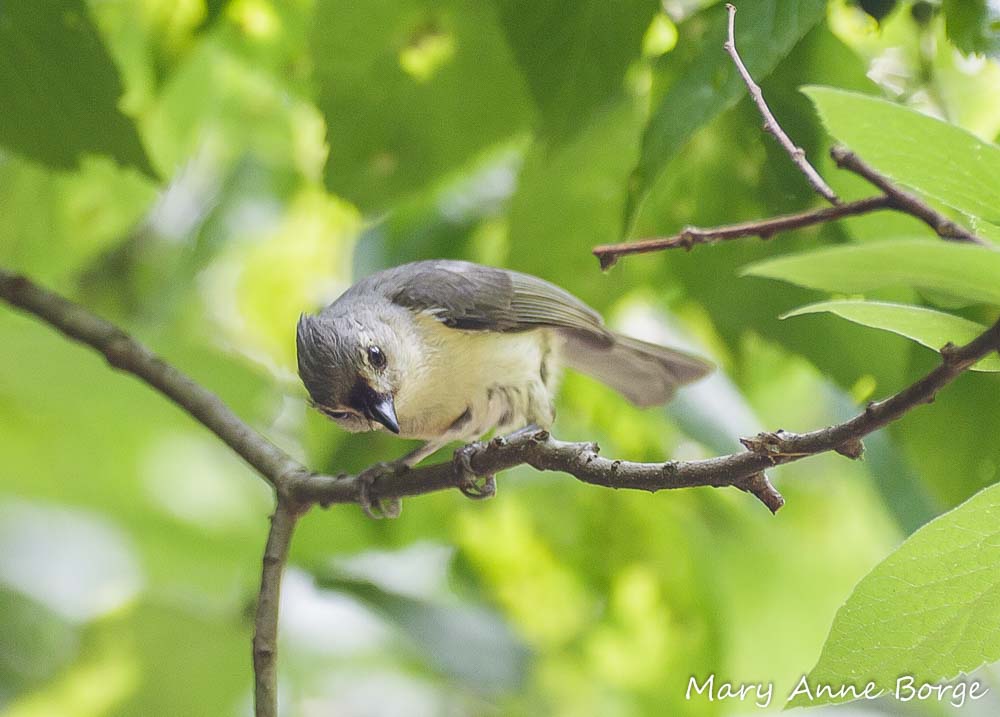
Hungry young Tufted Titmouse looking for food

Hungry young Tufted Titmouse looking for food

Normally, ants would be among the insects that would love to eat a tasty caterpillar treat. Even when fully grown Azure caterpillars are small, the perfect snack size for an industrious ant on the hunt.  To protect themselves, Azure butterflies have developed a way to enlist the ants to protect them rather than eat them.  Azures produce delicious honeydew that ants love.  The ants guard the Azure caterpillars, palpating them to trigger the honeydew payment.

Ant guarding/palpating an Azure caterpillar for honeydew. They're on New Jersey Tea (Ceanothus americanus).

Ant guarding/palpating an Azure caterpillar for honeydew. They’re on New Jersey Tea (Ceanothus americanus).

Ants will work for the highest bidder, and in this case they help some of those caterpillars live to become butterflies.

Spring Azure butterfly on Maple-leaf Viburnum (Viburnum acerifolium)

Spring Azure butterfly on Maple-leaf Viburnum (Viburnum acerifolium)


Related Posts

‘Will Work for Food’ – Extra-floral Nectaries

Maple-leaf Viburnum

Gray Dogwood for Butterlies, Bees and Birds

Resources

Butterflies and Moths of North America

Cech, Rick; Tudor, Guy. Butterflies of the East Coast.  2005.


Slippery Elm in Bloom

Color is slowly easing back into the deciduous woods.  Branches that were bare all winter are beginning to show the subtle reds, greens and yellows of early blooming trees and shrubs.

Slippery Elm (Ulmus rubra) in Bloom

Slippery Elm (Ulmus rubra) in Bloom

Slippery Elm (Ulmus rubra) is among the early flowering trees, often blooming sometime in March.  Before blooming, its rusty colored, fuzzy-hairy flower buds are visible throughout winter.

Slippery Elm (Ulmus rubra) Buds

Slippery Elm (Ulmus rubra) Buds

Slippery Elm blooms before its leaves appear, making it easier for the wind to carry Slippery Elm’s pollen to another flower, helping this species to achieve successful pollination. Wind pollination is a good evolutionary adaptation for an early blooming tree, since wind is a more reliable pollination partner in the usually cool blustery days of March than insects are.  (Although this spring is exceptionally warm in the Northeastern United States!)

Slippery Elm (Ulmus rubra) in Bloom

Slippery Elm (Ulmus rubra) in Bloom

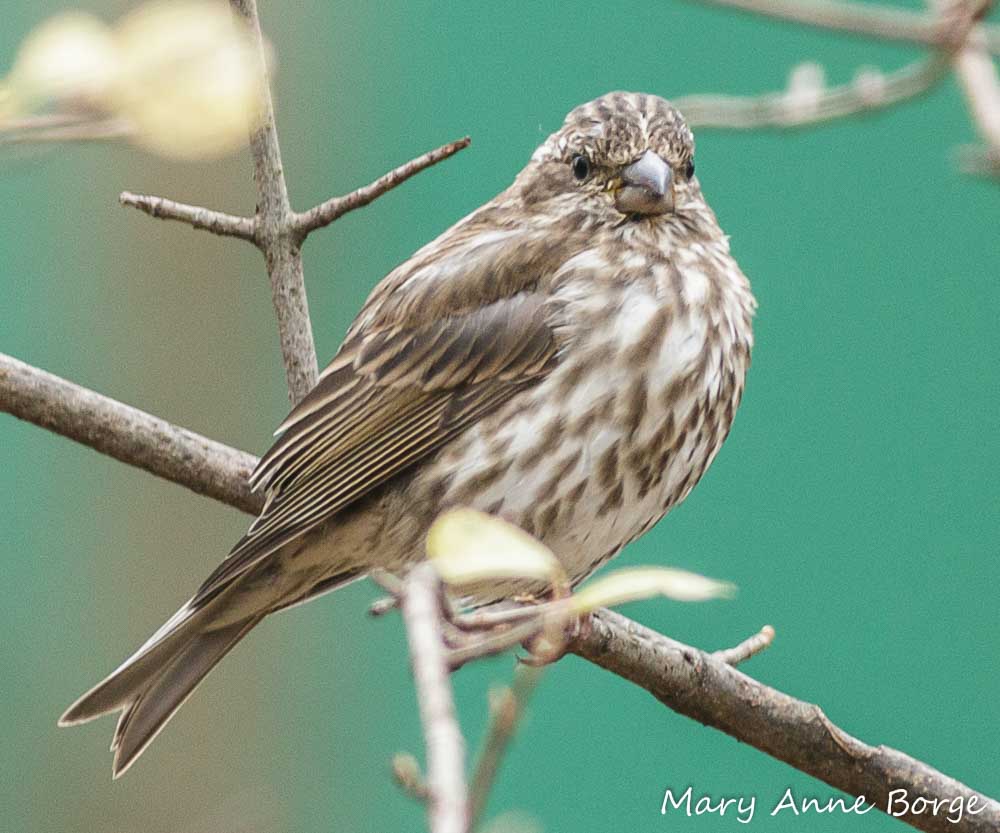
Flowers that are successfully pollinated produce fruits that many birds eat, including Carolina Chickadees, Rose-breasted Grosbeaks, and Purple Finches.

Female Purple Finch. Purple Finches are among the birds that eat elm seeds

Female Purple Finch. Purple Finches are among the birds that eat elm seeds

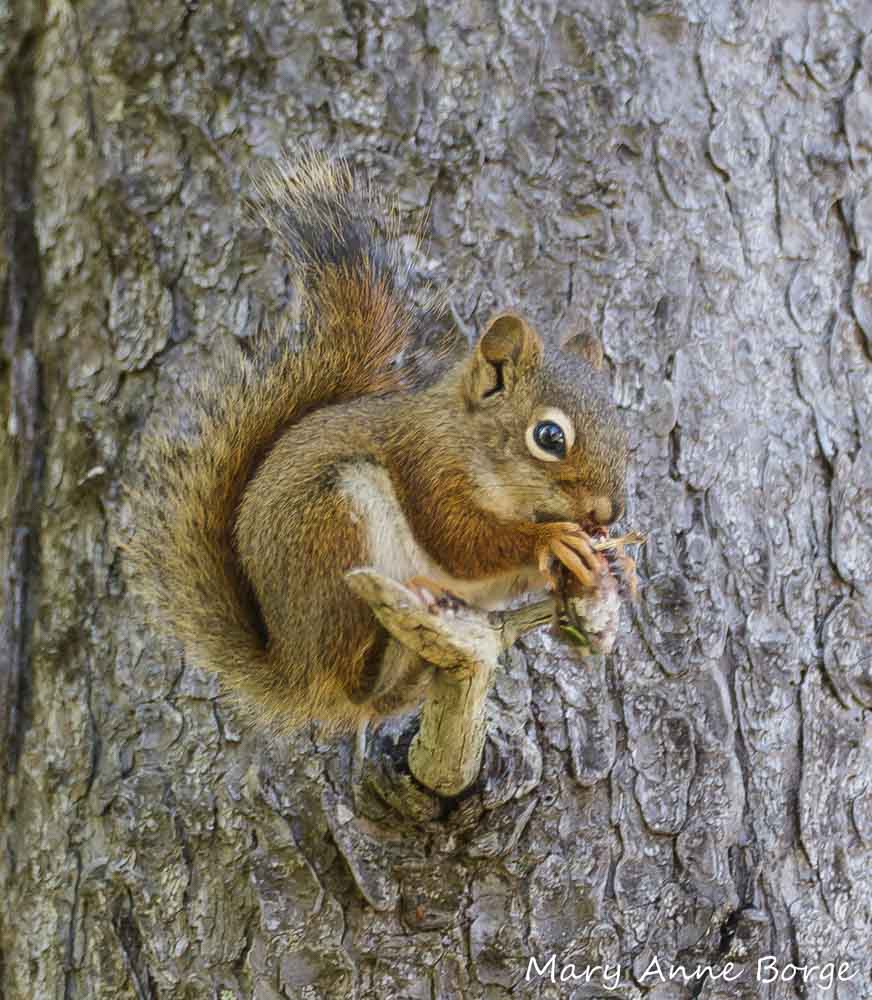
Squirrels and other small mammals also eat Slippery Elm seeds.

Red Squirrel - a consumer of elm seeds

Red Squirrel – a consumer of elm seeds

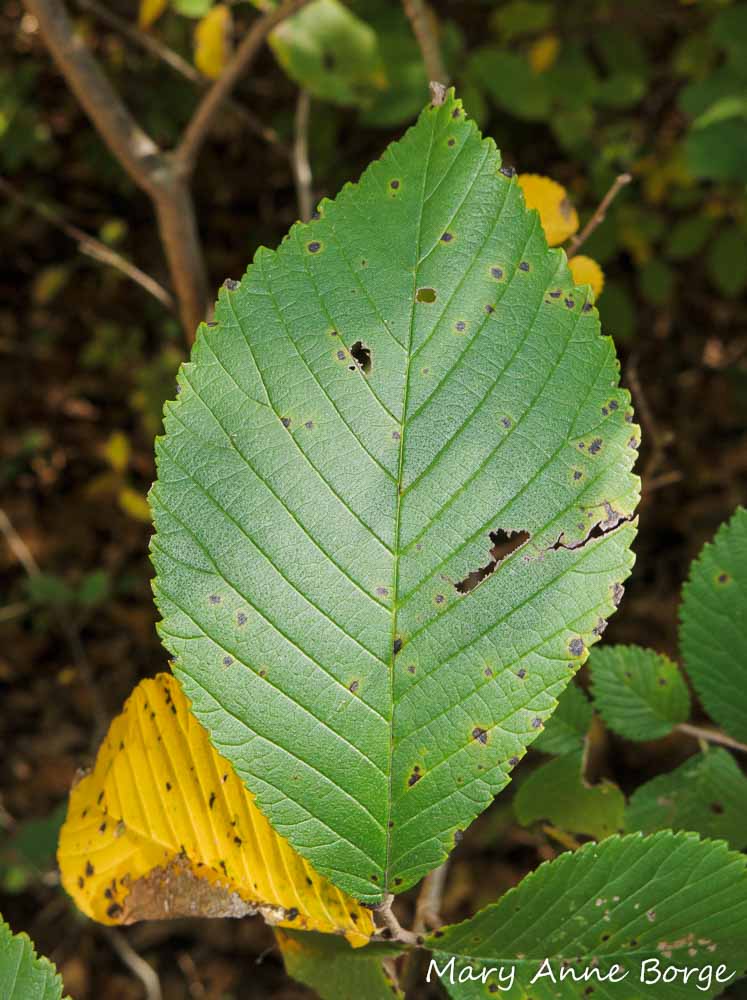
Slippery Elm leaves are large and rough, with distinctly toothed edges.

Slippery Elm Leaf

Slippery Elm Leaf

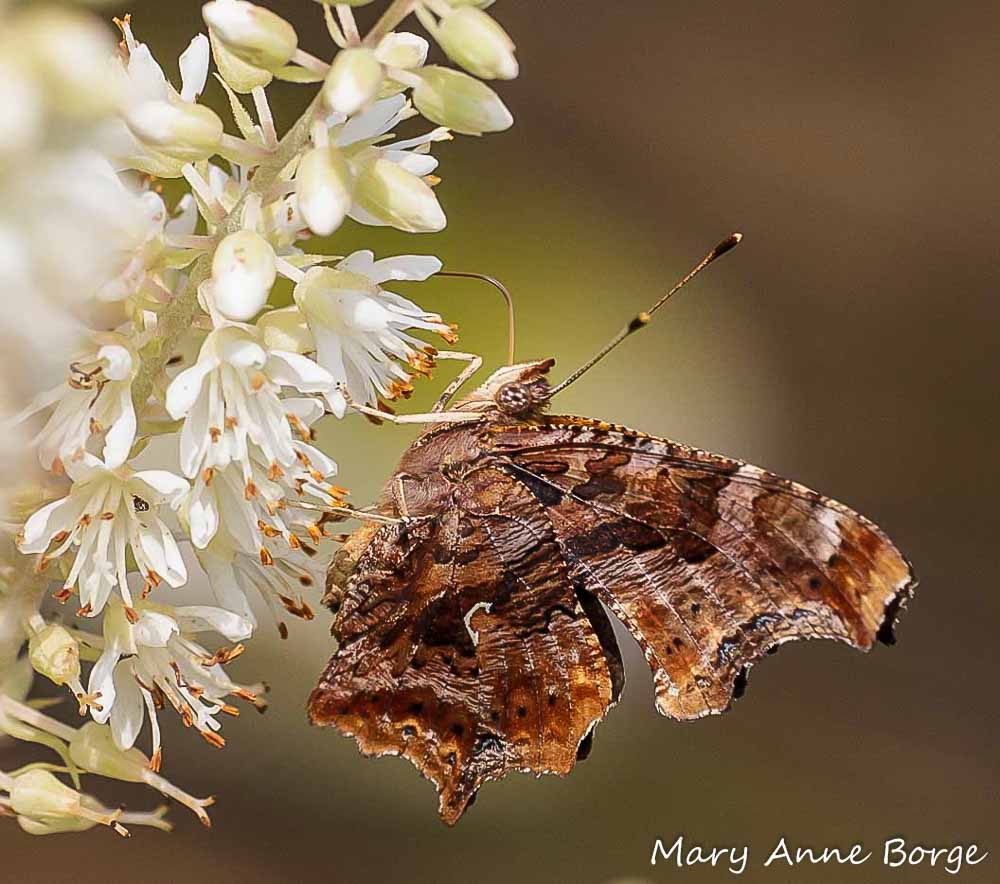
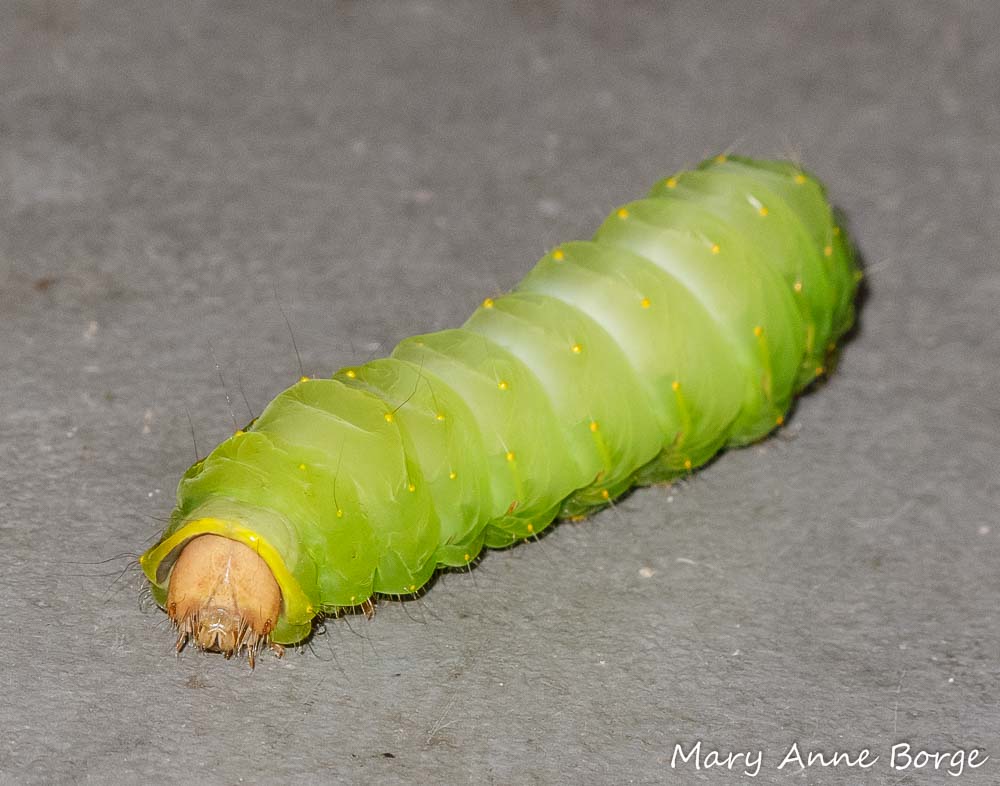
These leaves provide food for many insects that in turn provide pollination services for other plants, or food for other animals. Over 200 species of butterfly and moth caterpillars (Leipidoptera), including those of Mourning Cloak, Question Mark and Eastern Comma butterflies and Polyphemus moths may eat the leaves of Slippery Elm and its close relatives.

Eastern Comma Butterfly

Eastern Comma Butterfly

Polyphemus Moth caterpillar, looking for a place to pupate. What a plump, juicy treat for a hungry bird!

Polyphemus Moth caterpillar, looking for a place to pupate. What a plump, juicy treat for a hungry bird!

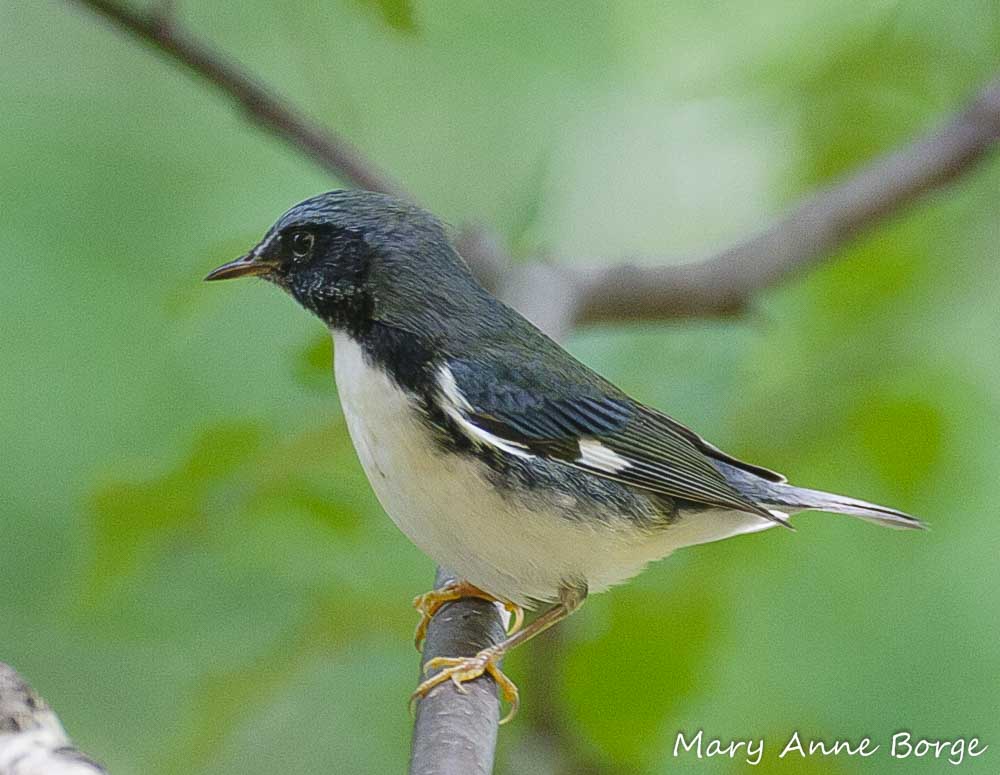
Birds depend on these insects as protein for themselves and their growing offspring.

Male Black-throated Blue Warbler. Warblers, Chickadees, Titmice and most other birds depend on insects for a large percentage of their diet.

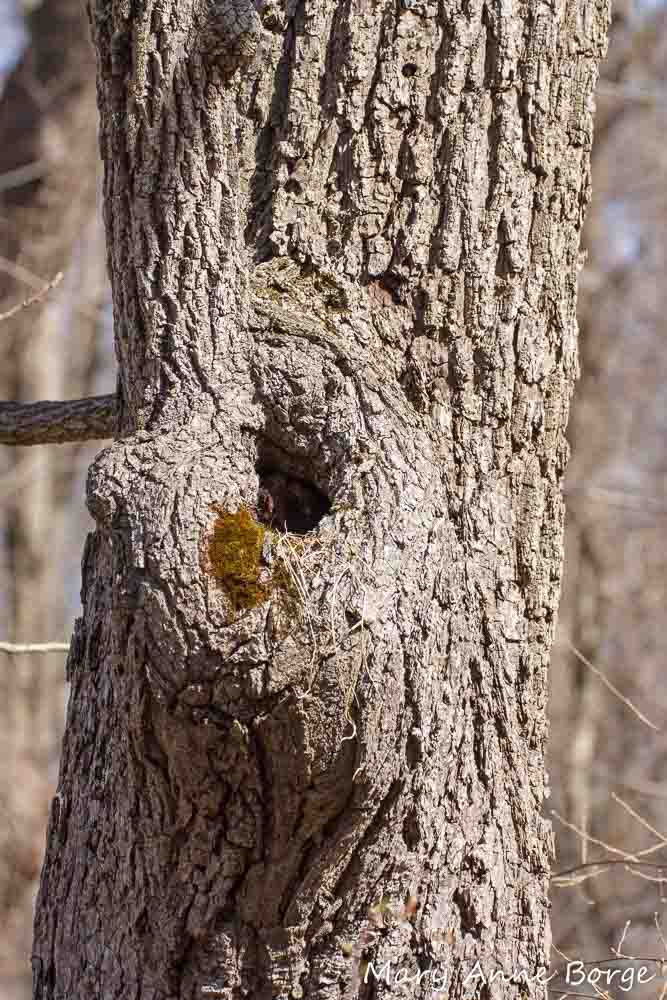
Cavity nesting birds or small mammals may find a suitable home site in Slippery Elm, while other birds, like Baltimore Orioles, may build their nests in its branches.

Natural cavity in a Slippery Elm. Some strings of nest material are draped below the opening.

Natural cavity in a Slippery Elm. Some strings of nest material are draped below the opening.

Slippery Elm gets its name from its inner bark (the phloem) which is part of the vascular system that transports food throughout the tree. Slippery Elm’s inner bark is mucilaginous (thick, sticky) and fibrous.  Indigenous North American peoples used the inner bark fibers to make rope or other cordage.

Slippery Elm’s inner bark has also been used to make a tea that is easy to digest and high in nutrients; it was given to people who had difficulty consuming food. The inner bark was also dried and ground to make a flour high in nutritional value.

Slippery Elm has many medicinal uses. As a demulcent it is well suited for treatment of inflamed mucous membranes throughout the digestive tract.  It also has anti-inflammatory and astringent properties, and has been used externally to treat skin problems including wounds, ulcers and boils.  Slippery Elm is available as an over the counter supplement, and has been approved by the Food and Drug Administration for use in throat lozenges.  Even plant-derived supplements can have unwanted side effects, so careful research or consultation with a physician should take place before consuming Slippery Elm.

Slippery Elm can be found in much of the eastern two-thirds of the United States and Canada, often in moist woods, stream banks, and woodland edges. Look for it blooming now in a natural area near you.

Slippery Elm (Ulmus rubra) in Bloom

Slippery Elm (Ulmus rubra) in Bloom


Resources

Beresford-Kroeger, Diana. Arboretum America: A Philosophy of the Forest.  2003

Eastman, John. The Book of Forest and Thicket.  1992.

Foster, Steven; Duke, James A. A Field Guide to Medicinal Plants and Herbs of Eastern and Central North America.  2000.

Hoffmann, David. Medical Herbalism.  2003.

Rhoads, Ann Fowler; Block, Timothy A. The Plants of Pennsylvania.  2007

Tallamy, Douglas W. Bringing Nature Home, 2007,

Illinois Wildflowers

USDA Database


Great Blue Herons Courting – Signs of Spring

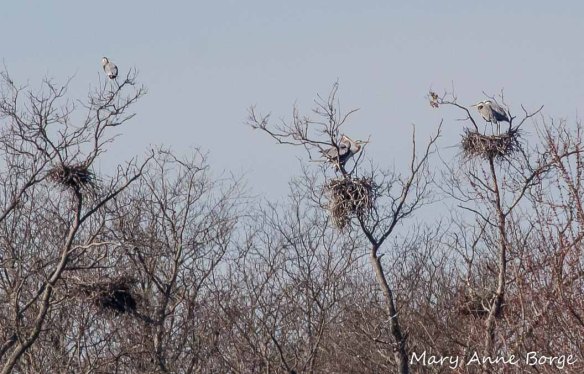
Courting Great Blue Herons at their rookery, Abbott Marshlands, Hamilton Township, New Jersey

Courting Great Blue Herons at their rookery, Abbott Marshlands, Hamilton Township, New Jersey

We first spotted the courting Great Blue Herons at their rookery in the Abbott Marshlands on February 21st.  Our vantage point was about a quarter mile from the heronry, far enough away that there was no chance we would disturb them.  The birds and their nests were clearly visible in the treetops above the marshes that separated us.

The graceful birds showed a variety of courtship behavior, rubbing their bills over their mates, crossing necks, and engaging in lip-locks (I mean bill-locks!) with their partners.

Courting Great Blue Herons at their rookery. Pair with locked bill tips on the middle nest is engaged in 'swaying' courtship display. Abbott Marshlands, Hamilton Township, New Jersey.

Courting Great Blue Herons at their rookery. Pair with locked bill tips on the middle nest is engaged in ‘swaying’ courtship display. Abbott Marshlands, Hamilton Township, New Jersey.

Great Blue Herons can be found throughout the year in New Jersey (home of the Abbott Marshlands) although many birds are thought to be migratory, with a small number of year round residents. This means that many of the birds seen here in winter are probably not the same birds who nest here in summer, but rather migrants from further north.

We’re accustomed to seeing Great Blue Herons during the winter months at the marsh.  But courtship behavior in February in New Jersey seems pretty unusual.  Our summer residents shouldn’t be back yet, according to local birding literature.  ‘A Guide to Bird Behavior’, copyright 1989 by Donald and Lillian Stokes, indicates that courting should be expected to begin the last week or so of March in this area.  More current references also refer to late March as the time migrants should be expected to return.

Is this year’s early courting just an anomaly, a result of the warm winter? Or is this the beginning of a new behavior pattern?  We’ll have to watch and see.

More Signs of Spring:  Hazelnuts Blooming

Resources

Boyle, William J.; Karlson, Kevin T. The Birds of New Jersey: Status and Distribution. 2011.

Eastman, John. Birds of Lake, Pond and Marsh.  1999.

Stokes, Donald W.; Stokes, Lillian Q. A Guide to Bird Behavior Volume III.  1989.

Cornell Lab of Ornithology All About Birds


Evening Primrose

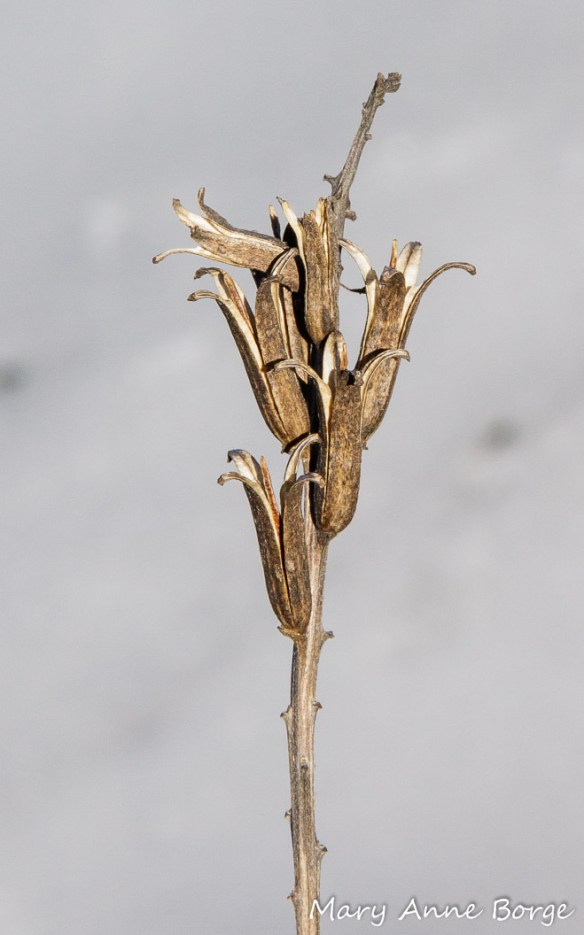
By late February, the spent stems of many herbaceous plants are beginning to fall to the ground and break down, adding to the nutrients in the soil, or making nesting material available for birds and other animals. Evening Primrose (Oenothera biennis) is an exception, with stems still upright, and fruit capsules still dispersing seeds – via wind, or scattered on the ground near parent plants.  Evening Primrose is a biennial, a characteristic reflected in its scientific name, ‘biennis’.  This means that it typically lives only two years, the first as a ground-level rosette of leaves.  If it gathers enough energy, the second year of life it will bloom, develop fruits, and die.  Replacing the parent plant with offspring in the same location is a good evolutionary strategy for the plant.

Evening Primrose fruit capsules

Evening Primrose (Oenothera biennis) fruit capsules

Not all seeds are destined to grow into another Evening Primrose plant, since some will become a snack for hungry birds. Evening Primrose can afford this loss.  There are plenty of seeds, with potentially hundreds produced by each fruit capsule.

Eastern Goldfinches eat Evening Primrose seeds.

Eastern Goldfinches eat Evening Primrose seeds.

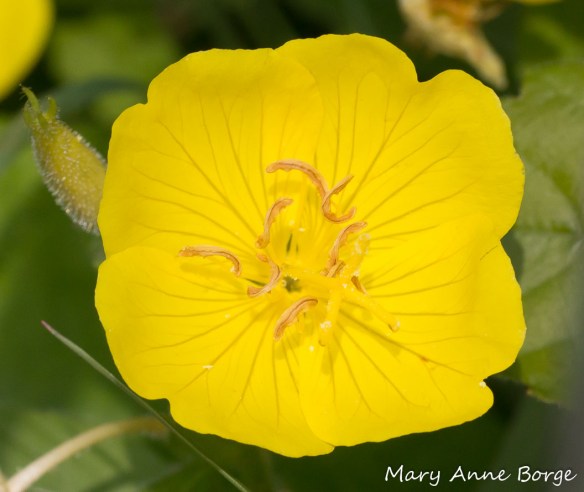
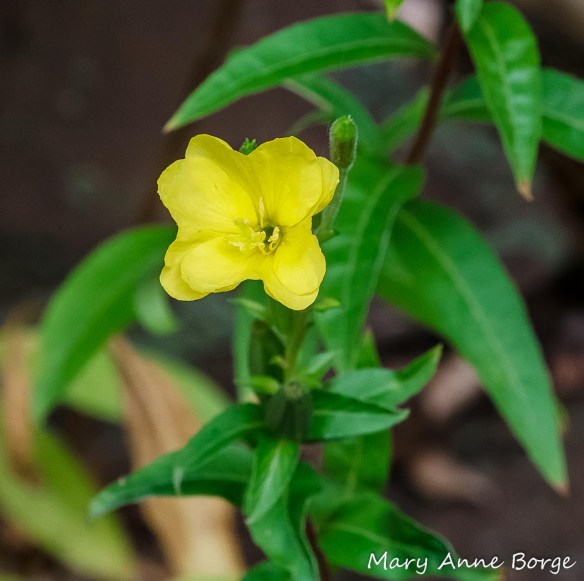
Evening Primrose can be found throughout most of the United States (some Rocky Mountain states are an exception) and Canada, blooming from late June through much of the fall, often in disturbed areas.  ‘Evening’ in this plant’s name refers to the fact that the flowers open late in the day, usually blooming from dusk until the early morning hours, although they may stay open longer on cloudy or overcast days.

Evening Primrose in bloom

Evening Primrose in bloom

Plant species that bloom at night have generally evolved to partner for pollination services with an animal that is active at night, usually moths or bats. The flowers are fragrant, which is another characteristic of night blooming plants.  Many moth species can detect fragrances from long distances, and will follow the fragrance to find their nectar reward.  Moths, particularly some sphinx moths, are among Evening Primrose’s pollinators.

During those daylight hours that the flowers are open, butterflies may drink nectar from Evening Primrose flowers.

Little Glassywing drinking nectar from an Evening Primrose flower.

Little Glassywing drinking nectar from an Evening Primrose flower.

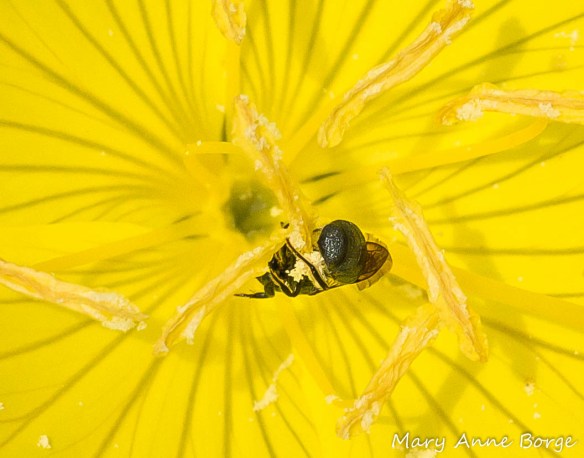
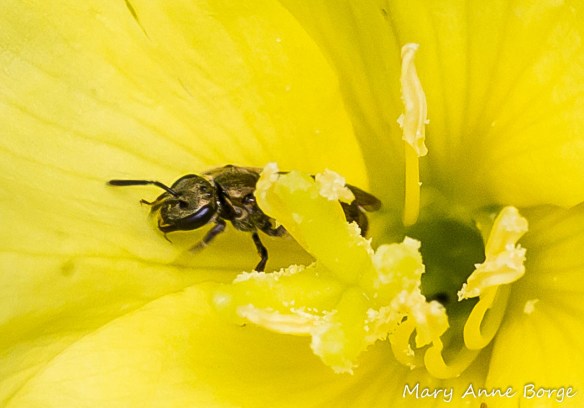
Many bee species also visit the flowers, including some that specialize on Evening Primrose and other related species.

Sweat Bee, probably Lasioglossum oenotherae, on Evening Primrose

Sweat Bee, probably Lasioglossum oenotherae, on Evening Primrose

Sweat Bee, probably Lasioglossum oenotherae, harvesting pollen from Evening Primrose. These bees have evolved scopa that are efficient for handling Evening Primrose's stringy pollen.

Sweat Bee, probably Lasioglossum oenotherae, harvesting pollen from Evening Primrose. These bees have evolved scopa that are efficient for handling Evening Primrose’s stringy pollen.

Some of these specialists are able to fly in dim light during dusk and dawn, and even into the night when there is enough moonlight. In addition to the large compound eyes on each side of their faces, bees have ocelli, simple eyes at the top of their heads.  Ocelli help the bee in positioning and orientation, with the aid of light from the sun or even a full moon. These specialist bees are aided by larger ocelli than the typical bee, so they can function in low light.

Sweat Bee, probably Lasioglossum oenotherae, on Evening Primrose.  These bees have evolved scopa that are efficient for handling Evening Primrose's stringy pollen.  Look for the ocelli (eyes) at the top of its head.  They look like  little dots.

Sweat Bee, probably Lasioglossum oenotherae, on Evening Primrose. These bees evolved scopa on their hind legs that are efficient for carrying Evening Primrose’s stringy pollen. Look for the ocelli (eyes) at the top of its head. They look like little dots.

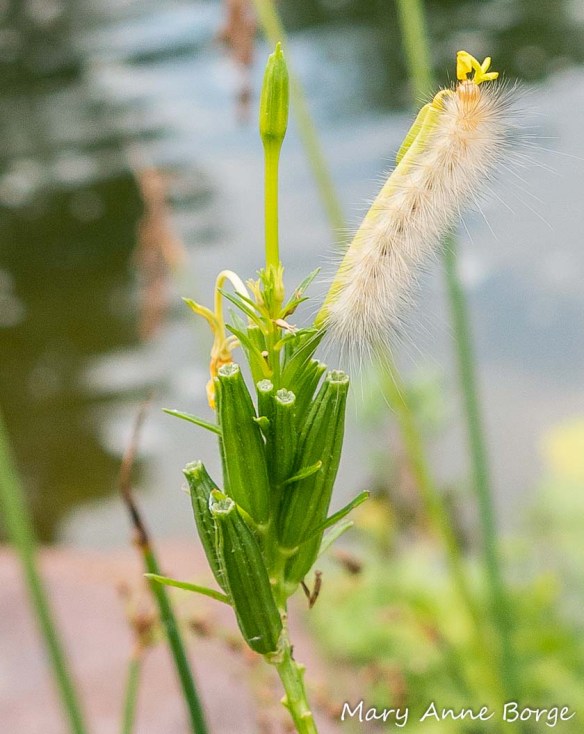
Caterpillars of several moth species feed on the leaves or flowers of Evening Primrose.

Yellow Bear (Virginian Tiger Moth) caterpillar on Evening Primrose

Yellow Bear (Virginian Tiger Moth) caterpillar on Evening Primrose

For human consumers, the young leaves, flowers, shoots and first year roots of Evening Primrose are edible, with the proper preparation. The leaves and roots are thought to have a peppery taste.   Evening Primrose is cultivated for its oil, which contains some essential fatty acids (Omega-6 fatty acid, linolenic acid and gamma-linolenic acid). Evening Primrose oil has been licensed in several countries for treatment of eczema and breast pain.  Native Americans used it to treat a broad range of ills.

Evening Primrose (Oenothera biennis)

Evening Primrose (Oenothera biennis)

Look for Evening Primrose fruit capsules now,

Evening Primrose (Oenothera biennis) fruit capsules

Evening Primrose (Oenothera biennis) fruit capsules

and watch for new plants blooming at nearby locations this summer.

Evening Primrose (Oenothera biennis) in bloom

Evening Primrose (Oenothera biennis) in bloom


Resources

Foster, Steven; Duke, James A. A Field Guide to Medicinal Plants and Herbs of Eastern and Central North America.  2000.

Peterson, Lee Allen. A Field Guide to Edible Wild Plants of Eastern and Central North America. 1977.

Wagner, David L.; Caterpillars of Eastern North America, 2005.

Wilson, Joseph S.; Carril, Olivia Messinger. The Bees in Your Backyard. 2016.

Illinois Wildflowers

Discover Life

USDA Plant Database

Mayo Clinic