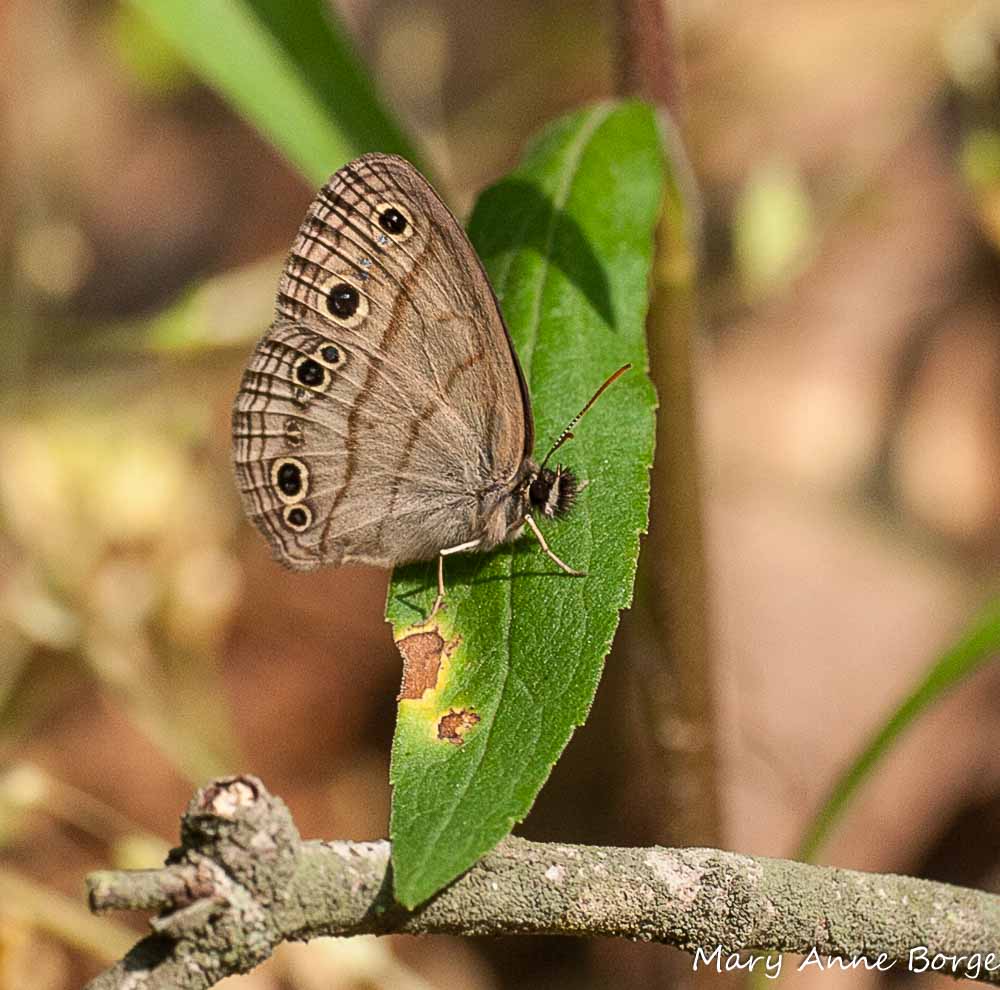
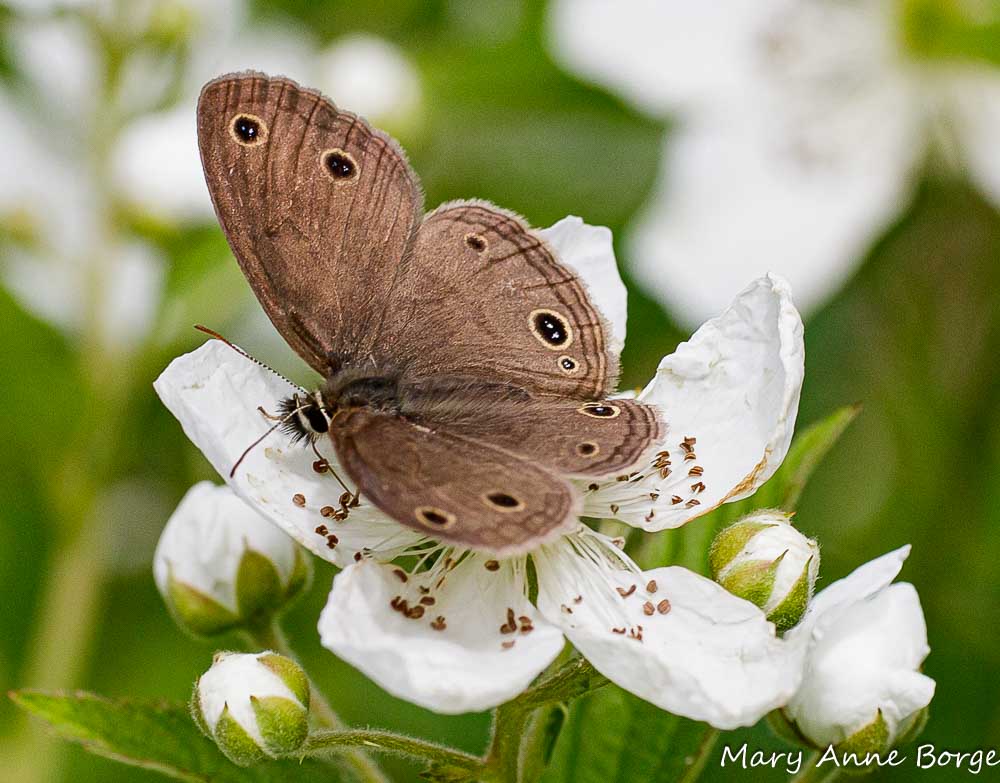
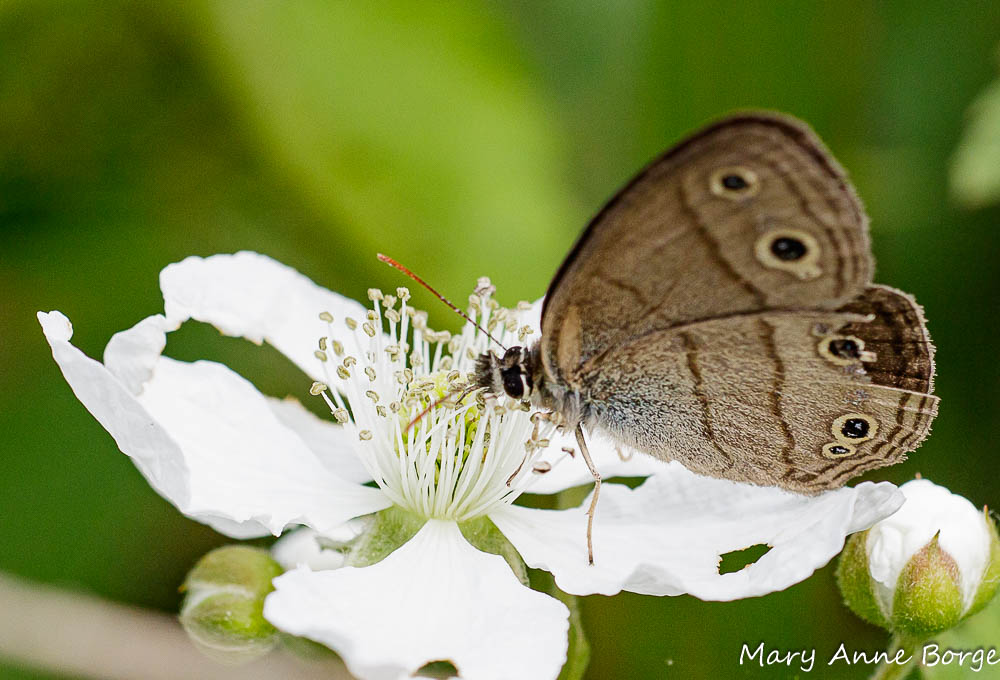
If you see a very active medium-sized butterfly, warm brown in color with darker brown lines across its wings, and eyespots near the outer wing edges, it may be a Little Wood-Satyr. This butterfly’s range includes most of the eastern two-thirds of the United Sates, and southernmost Quebec, Ontario, and Manitoba provinces in Canada.
Little Wood-Satyr (Megisto cymela)
Little Wood-Satyrs are usually seen in openings or clearings in deciduous woods especially where grasses are present, and in edge habitat, where a woodland meets a more open area like a meadow or field.
Adults typically feed on aphid honeydew (excrement), sap, decaying matter, and rarely, flower nectar.
Many butterflies specialize on a few closely related plants as their caterpillar food, often because of the chemical protection their chosen food provides them throughout their lives, from caterpillar to pupa to butterfly. Monarch butterflies are probably the most famous example of this specialization. Although Monarchs drink nectar from many different flower species, their caterpillars can only survive by eating milkweed (Asclepias species) leaves, buds, and flowers. Another example is the Pipevine Swallowtail, who specializes on pipevines (Aristolochia species) such as Dutchman’s Pipevine (Aristolochia macrophylla) as their caterpillar food. This specialization is a common strategy of many butterflies and moths.
Other butterflies, including Little Wood-Satyr, take a different approach. Little Wood-Satyr caterpillar food consists of various grasses, including Orchard Grass (Dactylis glomerata), Kentucky Bluegrass (Poa Pratensis), Blackseed Speargrass (Piptochaetium avenaceum), St. Augustine Grass (Stenotaphrum secundatum), and probably many others. Using grasses as its caterpillar food gives this butterfly a vast array of food choices, but on the down side, this diet doesn’t offer any chemical protection to the caterpillar and subsequent pupa and butterfly.
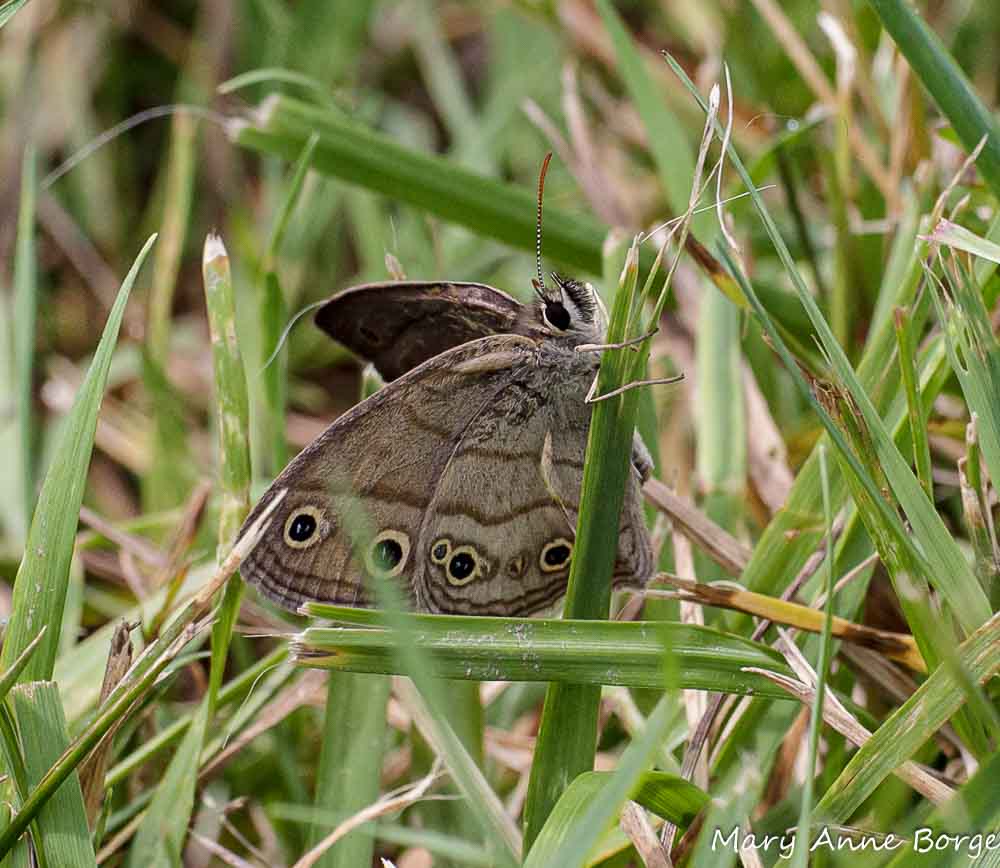
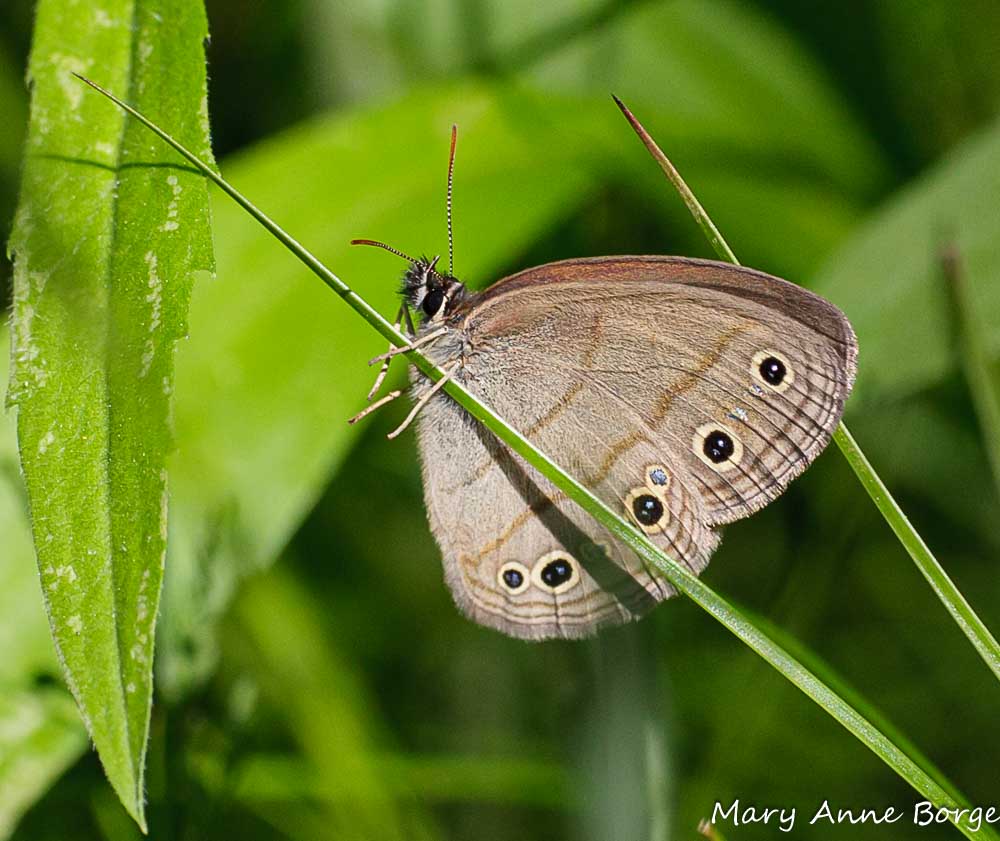
Little Wood-Satyr clinging to a blade of grass
Probably because of this, Little Wood-Satyr has evolved other strategies to discourage or elude predators. This energetic butterfly has an irregular flight that may look erratic, but is probably a deliberate attempt to evade predators. In addition, studies show that eyespots near the outer margin of the wings, such as those on display in Little Wood-Satyrs, can deflect the attention of predators away from the vulnerable body of the insect, and toward the wing edges. A butterfly can survive with some damage to its outer wing, but it needs an intact body. This strategy may be most effective in the low light of dawn and dusk when their most likely predators, birds, are active, and the butterflies are not.
Little Wood Satyr displays eyespots on the under (ventral) side of their wings.Little Wood Satyr also displays eyespots on the upper (dorsal) side of their wings.Little Wood Satyr undeterred by a significant piece of missing hindwing.
Little Wood-Satyrs are leaving me with questions.
Why is the group of butterflies to which the Little Wood-Satyr belongs called Satyrinae or Satyrs? A somewhat inoffensive description of the creatures of Greek mythology called satyrs is that they were lustful, drunken woodland gods who partied with Dionysus, also known as Bacchus, the Greek god of wine. (Descriptions of their appearance and behavior escalate from there.) I have yet to read anything that definitively explains why this group of butterflies would be named for them. The Satyrinae butterflies do frequent woodlands, and maybe their flight patterns give the appearance of drunkenness. Could that be the reason for this unlikely name?
Little Wood-Satyrs are present in my back yard this year, which includes a small wooded area with Bottlebrush Grass (Elymus hystrix). Do they use this plant as caterpillar food? I’m going to watch and see.
Little Wood Satyr with small pieces of both forewings missing, near the eyespots.
I love watching nature documentaries like those narrated by David Attenborough, but even more than that I love watching the natural wonders that surround me every day.
This post features a few of my favorite sightings from 2022.
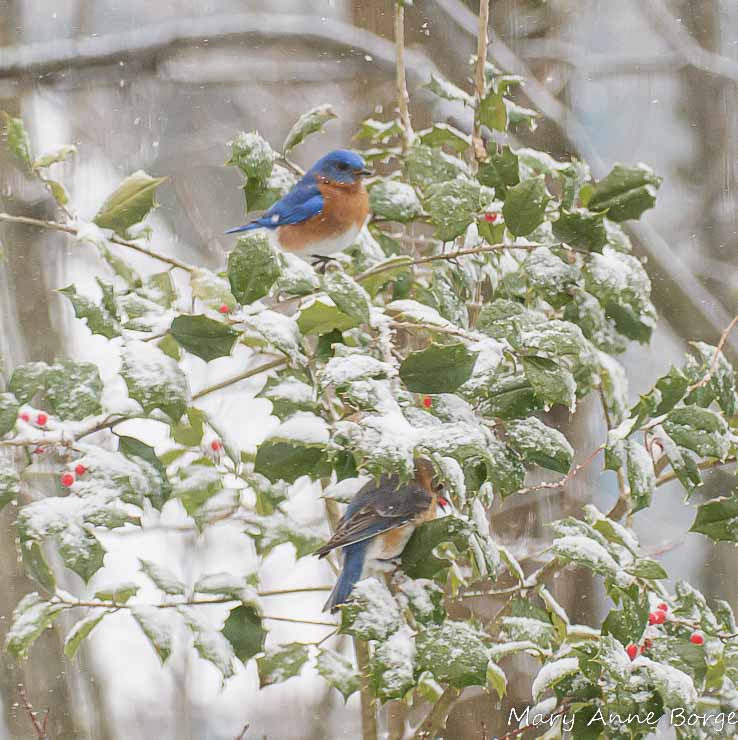
A pair of Eastern Bluebirds eating berries from American Holly (Ilex opaca)
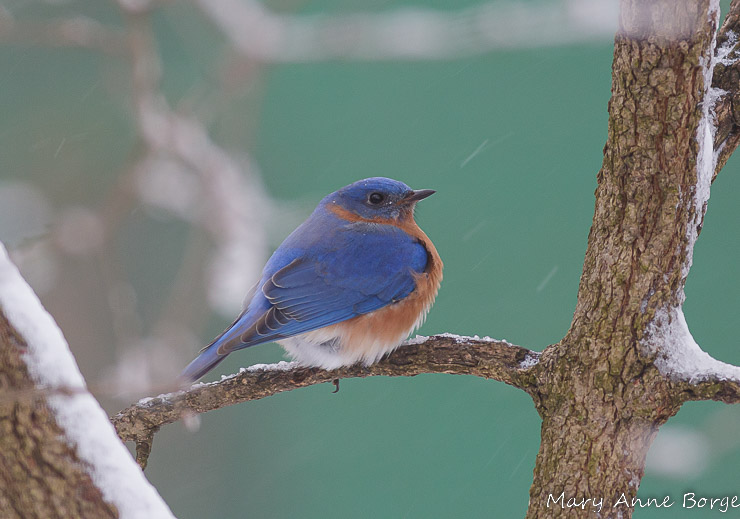
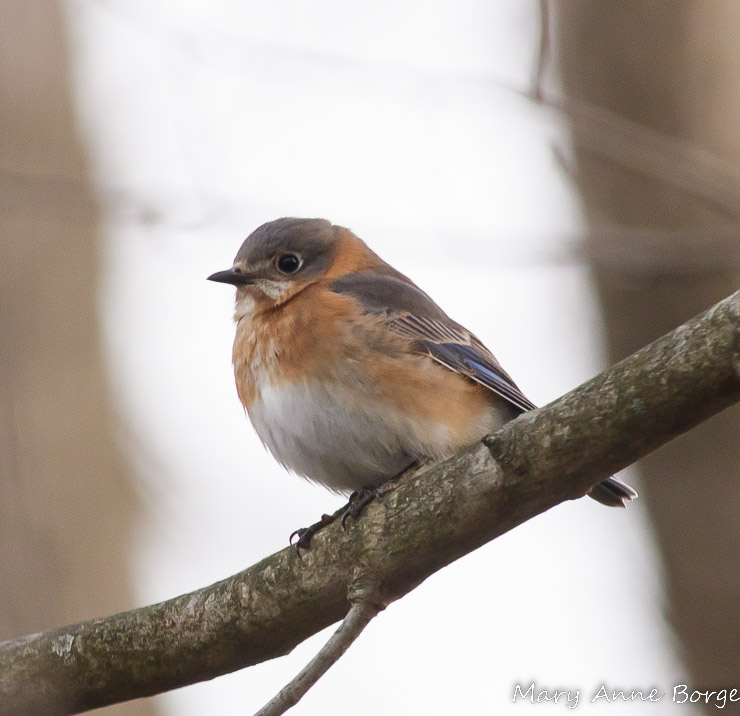
Eastern Bluebirds visit us more often in fall and winter than in spring or summer. In addition to holly berries, they love our heated birdbath, an important source of fresh water in the cold winter months.
Eastern Bluebird, Male Eastern Bluebird, Female
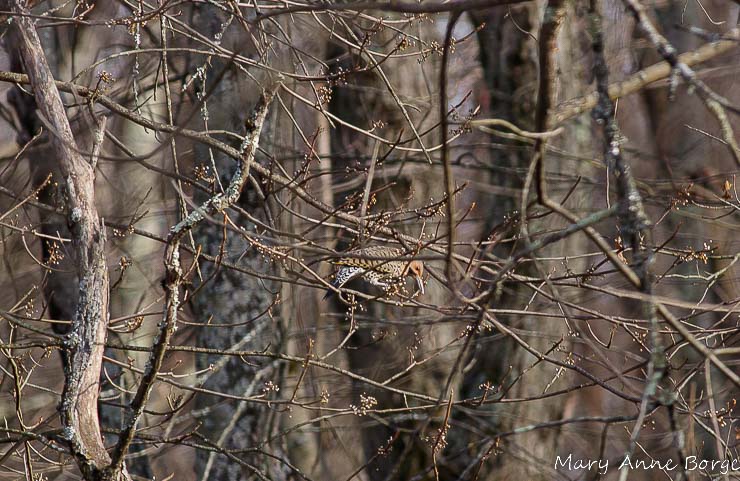
I always love it when an animal reminds me of the value of plants or other habitat that humans sometimes question. The male Northern Flicker (Yellow-shafted here in New Jersey) in the photo below did just that while enjoying Poison Ivy (Toxicodendron radicans) drupes, a berry-like fruit in the woods across from our house.
Northern flicker eating Poison Ivy (Toxicodendron radicans) drupes, a berry-like fruit in the woods across from our house
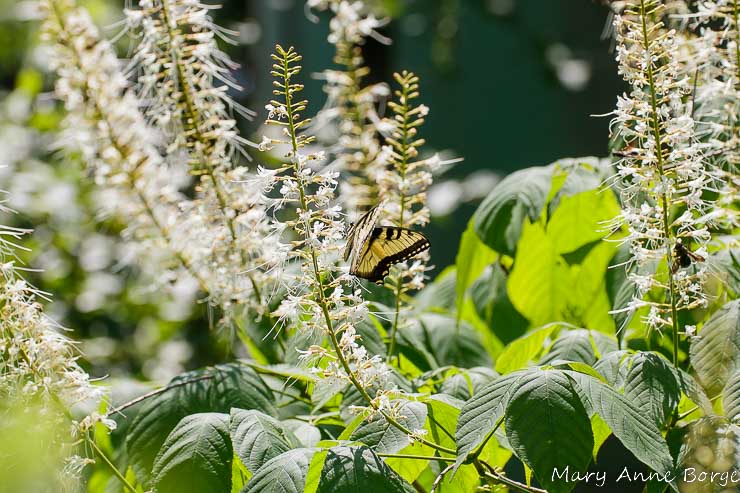
Bottlebrush Buckeye (Aesculus parviflora) is a constant source of entertainment when it blooms in mid-summer, attracting butterflies, Ruby-throated Hummingbirds, Hummingbird Moths, and many different bees and other insects to visit for nectar.
Eastern Tiger Swallowtail nectaring from Bottlebrush Buckeye (Aesculus parviflora)Dark form female Eastern Tiger Swallowtail drinking nectar from Bottlebrush Buckeye (Aesculus parviflora). She’s disguised as a Pipevine Swallowtail in an attempt to look unpalatable to potential predators such as birds.Hummingbird Clearwing Moth nectaring from Bottlebrush Buckeye (Aesculus parviflora). Notice the ant also visiting the flowers, foraging for nectar or other insects to eat.
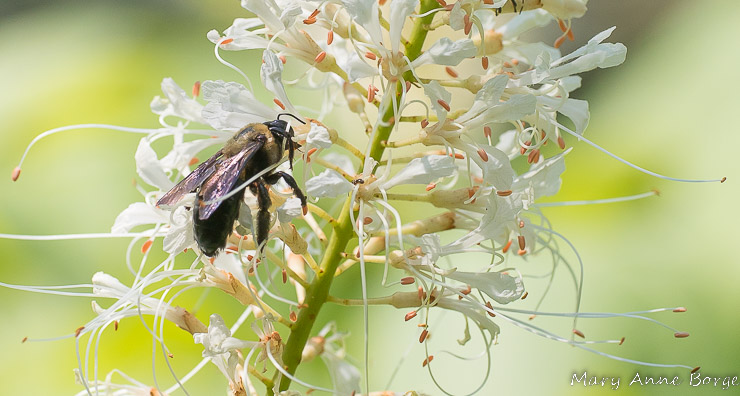
I understood why large long-tongued bees like Eastern Carpenter Bees visited the long, narrow, tubular flowers, but I puzzled over why so many tiny bees would buzz around the plant, since their anatomy isn’t a good fit for the flower size and shape.
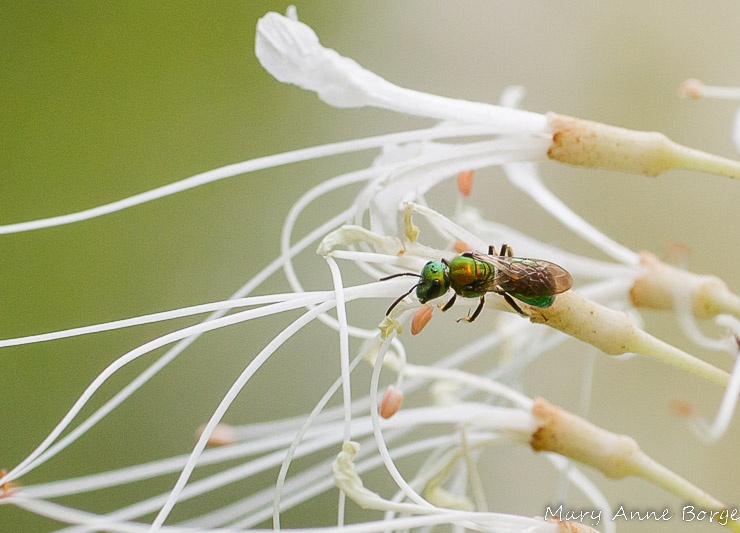
Eastern Carpenter Bee drinking nectar from Bottlebrush Buckeye (Aesculus parviflora) flowersSweat Bee harvesting pollen from Bottlebrush Buckeye (Aesculus parviflora) flower
As I watched more closely, I saw tiny sweat bees (Halictid species) landing on the anthers (the flower part from which pollen is dispensed) to harvest pollen, both for themselves and to bring to their nests to feed their larvae. Bees and some flies may visit flowers for pollen, an important food source for them. Both their athleticism and creative thinking was impressive.
An acrobatic Sweat Bee harvesting pollen to bring to her nest to feed her larvae. Notice the pollen she has packed on her hind legs perfectly matches the color of the pollen she is harvesting.A Sweat Bee taking an easier approach to harvesting the pollen she needs.
From a different access point, the sweat bees managed to drink nectar from the flowers, but without their bodies touching the flowers’ reproductive parts, so they weren’t likely to be doing the plant any favors in exchange for the nourishment provided.
Sweat Bee attempting to access this flower’s nectar. The bee’s body isn’t touching the flower’s reproductive parts, so it’s unlikely pollination will occur as a result of this transaction.
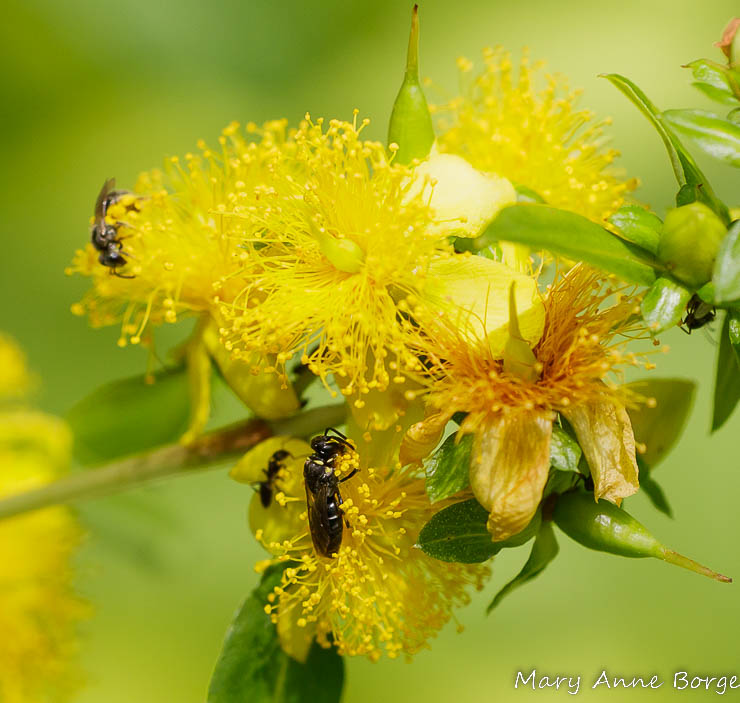
The starburst arrangement of abundant stamens (male reproductive parts) in the flowers of Shrubby St. Johnswort (Hypericum prolificum) are such a successful attraction to potential pollinators that this plant doesn’t waste any energy producing nectar.
Bumble Bee harvesting pollen from the profusion of anthers on a Shrubby St. Johnswort (Hypericum prolificum) flower.Many bees are attracted to Shrubby St. Johnswort (Hypericum prolificum) for the potential of harvesting ample pollen from its flowers.
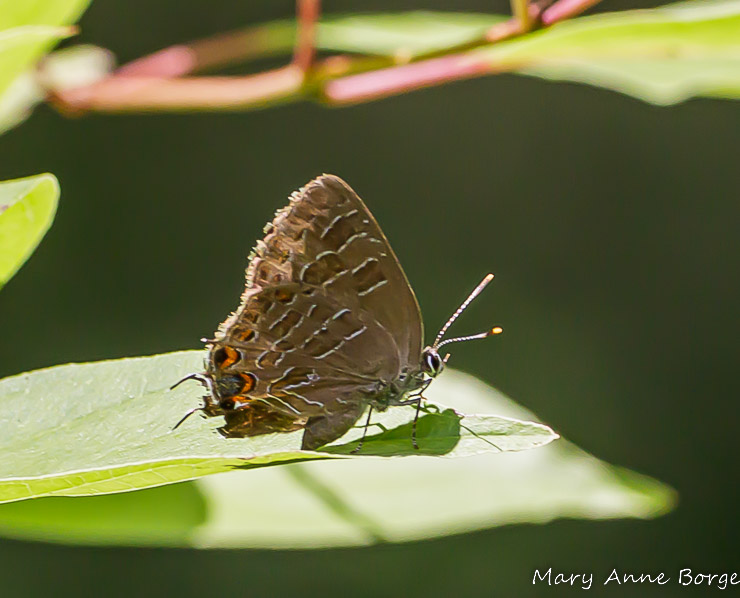
In late July I found a Striped Hairstreak in our habitat, my first time seeing this species. This butterfly was not only new for me, but it’s rare where I live in New Jersey. What was it doing in my garden? Striped Hairstreaks are typically found at forest edges where there are nectar sources, and with nearby access to its caterpillar foods – oaks, walnuts and hickories. We have nectar sources, and there are suitable caterpillar food trees nearby, so check and check.
My first ever sighting of a Striped Hairstreak, a butterfly that is rare where I live in New Jersey.
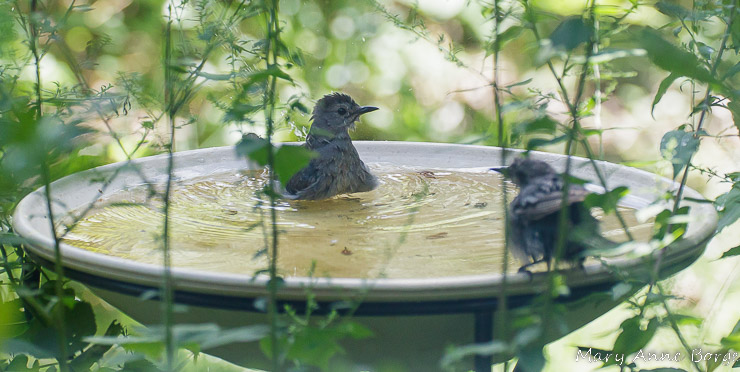
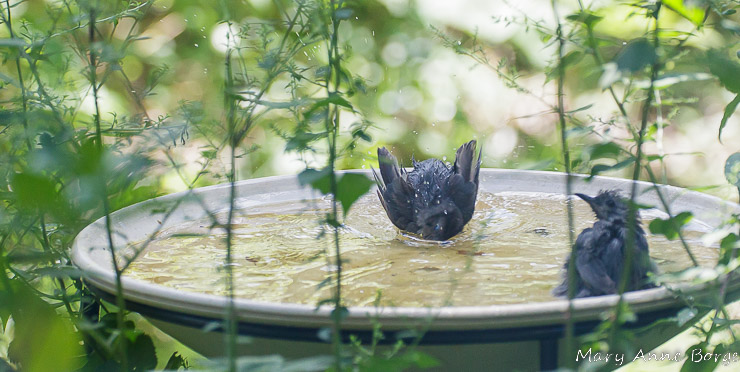
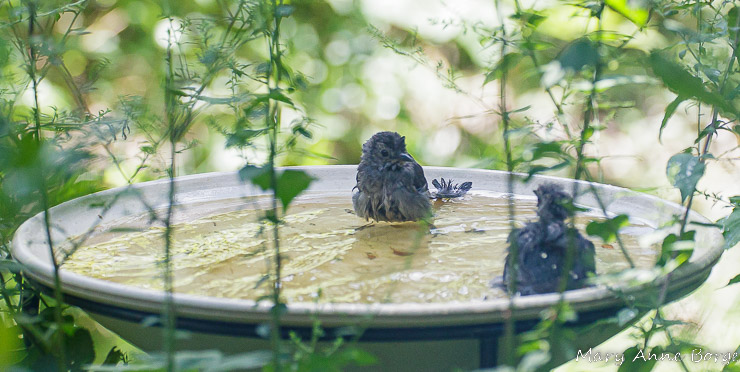
Catbirds arrived in spring and stayed through mid-fall. I saw them just about every day, usually in pairs, but sometimes in groups of four or more. Early one afternoon in August I witnessed a young Catbird being tutored on the proper way to take a bath.
Young Catbird delicately swirling the water in our birdbath, with adult supervision. The adult Catbird coach provides guidance, saying, ‘Really get your whole body into it. Flap your wings! Don’t be afraid.’The young Catbird gives it another shot. “That was refreshing!”The young Catbird, “How was that?” The adult supervisor, “Now you’ve got it!”
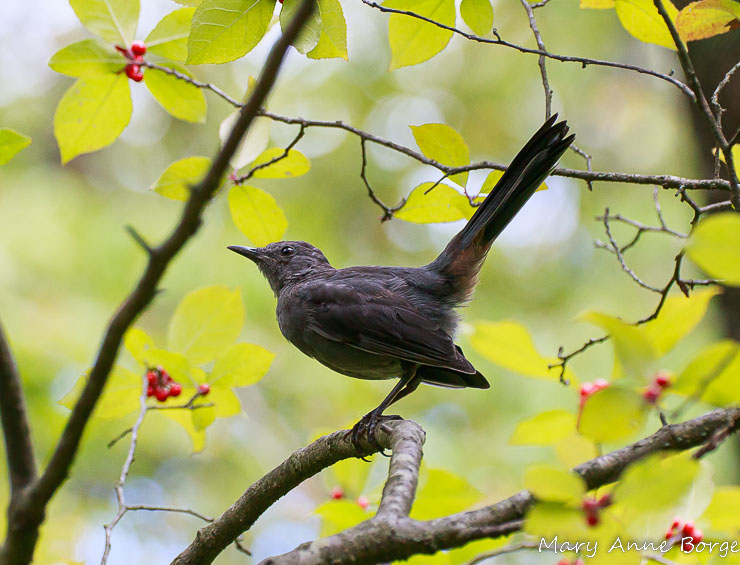
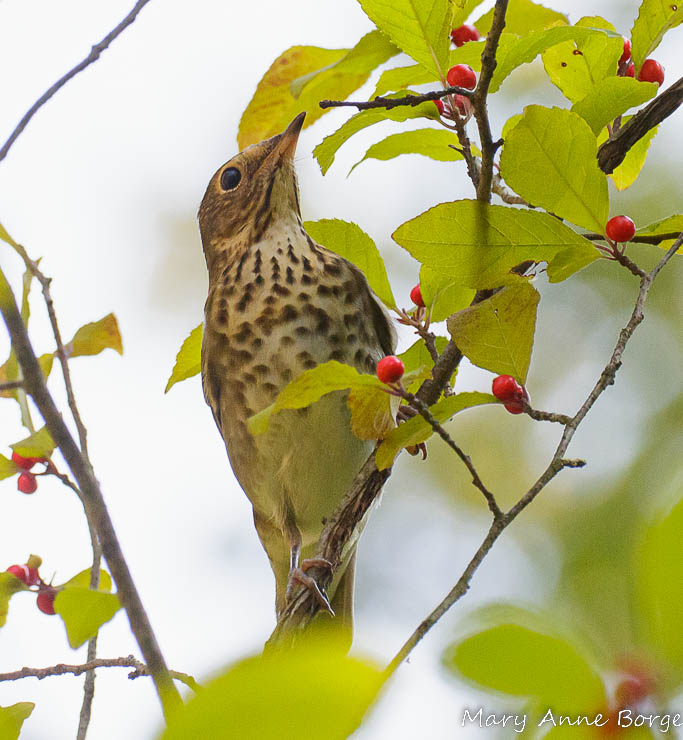
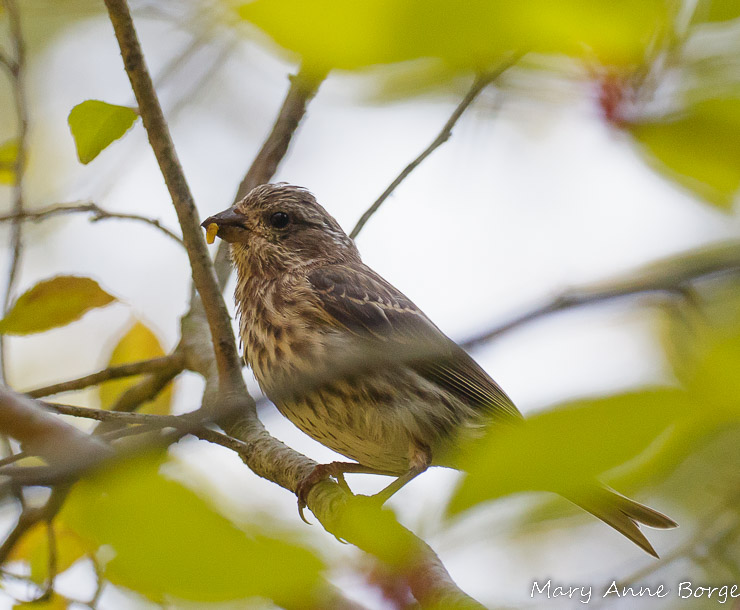
As Flowering Dogwood (Cornus florida), Winterberry Holly (Ilex verticillata) and Blackhaw Viburnum (Viburnum prunifolium) fruit ripened, the Catbirds were joined by migrating birds who passed through, using our habitat as a rest stop.
Catbird in fall, surrounded by ripening Flowering Dogwood (Cornus florida) fruit.A migrating Swainson’s Thrush happily ate Winterberry Holly (Ilex verticillata) fruit.Although surrounded by fruit, this female Purple Finch preferred to eat a caterpillar when visiting our habitat.
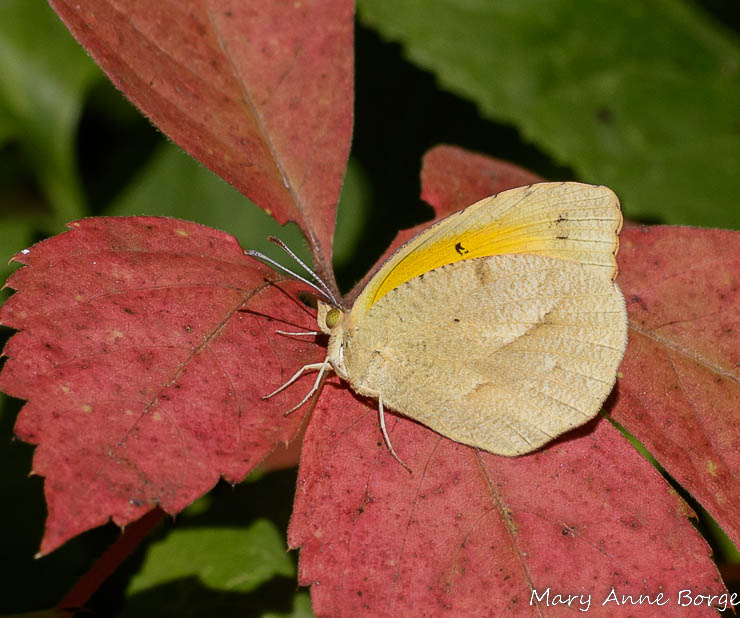
My favorite event was a visit from a Sleepy Orange in late September.
Sleepy Orange (winter color form) on Virginia Creeper (Parthenocissus quinquefolia) in my New Jersey garden in late September
I love this butterfly for its pioneering ways. It’s mainly a tropical butterfly, but works to extend its range northward, positioning itself for continued survival in these days of climate change. Instead of the southward migration strategy for winter survival employed by many insect and bird species, some Sleepy Oranges fly north in late summer and fall. I imagine them getting together, looking for volunteers to fly north, saying, “See if you can survive the winter in a place where you can find nectar for yourself and a partner, and food for the kids (caterpillars). If you succeed, great! We’ve extended our range. If not, no big deal, we adults will all be dead by late spring anyway.” I’m not sure that’s what really goes on, but I like to pretend it is.
Sleepy Orange (winter color form) on Blue Wood Aster (Symphyotrichum cordifolium) in my New Jersey garden in late September
At one time the Sleepy Orange was thought to be unable to survive the winter any farther north than North Carolina. But they are now seen fairly often in central New Jersey and eastern Pennsylvania, and may have established year-round colonies. I first encountered a Sleepy Orange in 2006 at nearby Bowman’s Hill Wildflower Preserve, but this was my first sighting of the species in my own habitat. Very exciting! This year I had nectar to offer this thirsty butterfly, but to extend its range it needs the food its caterpillars require, Wild Senna (Senna Hebecarpa, S. marylandica) or Partridge Pea (Chamaecrista fasciculata). I didn’t have the necessary caterpillar food to offer this year, but we’ll have some Wild Senna by next summer.
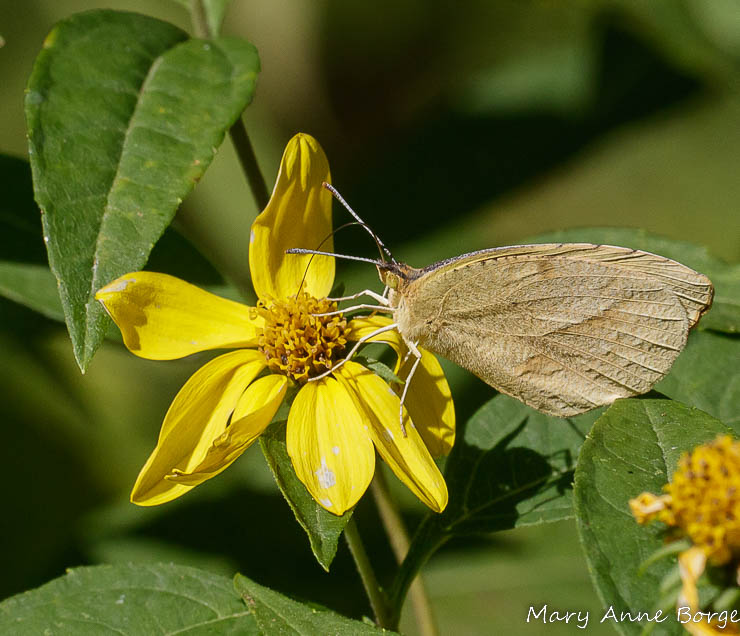
Sleepy Orange drinking nectar from Blue Wood Aster (Symphyotrichum cordifolium) Sleepy Orange drinking nectar from Thin-leaved Sunflower (Helianthus decapetalus)
No matter what time of year, there is always something interesting to see right outside our doors. I have my desk facing the windows so I can be easily distracted by wildlife. Even on a winter day I may see Box Elder Bugs, Chickadees, Titmice, Carolina Wrens, White-breasted Nuthatches, Juncos, White-throated Sparrows, Red-bellied Woodpeckers, Downy Woodpeckers, Robins, Bluejays, Pileated Woodpeckers, Yellow-bellied Sapsuckers, Cedar Waxwings, or Brown Creepers. Some visit for fruit, but many are gleaning insects from the branches, bark and leaves of trees and shrubs, and from the fallen leaves on the ground.
Red-tailed, Sharp-shinned and Coopers Hawks sometimes stop by. On rare occasions, a Bald Eagle does a fly-over.
Want to see more wildlife? Make your own backyard an inviting habitat. Just provide the food birds, butterflies, bees and other animals need in the form of plants native to your region, and do less: leave fallen leaves in your planting beds, leave spent perennials standing, don’t use pesticides, herbicides or fertilizers, reduce your lawn if you can.
You don’t need to have a large property to host and see wildlife. We live in an end unit in a townhouse development with a homeowners’ association (HOA), adjacent to commonly owned natural areas that were preserved when the development was built more than 30 years ago. (Note that we leave the leaves, standing spent perennials, and don’t use pesticides.) Even a planter or a window box can bring wildlife within view.
Why travel thousands of miles away from home to see wildlife, when you can make exciting discoveries in your own backyard?
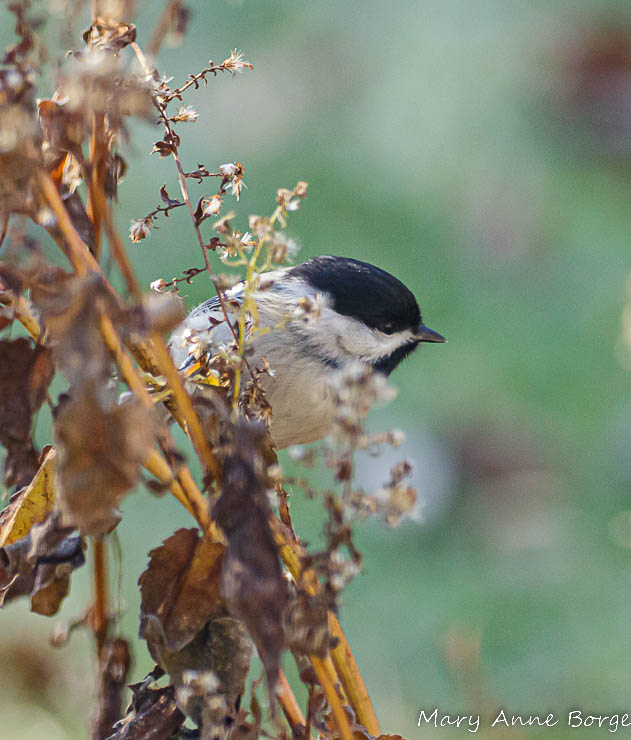
Chickadee foraging on Blue Wood Aster (Symphyotrichum cordifolium), looking for seeds or insects
Thinking about doing a fall clean-up in your garden? Maybe you are planning to remove the layer of naturally fallen leaves that are beginning to blanket your planting beds?
I hope my encounter with a Red-banded Hairstreak will prompt you to change your plans.
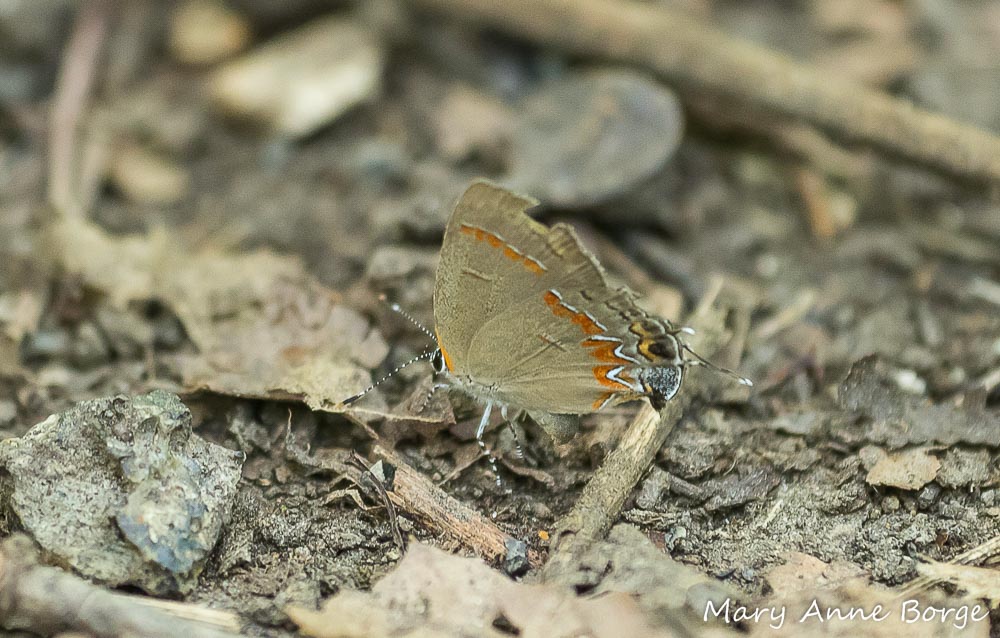
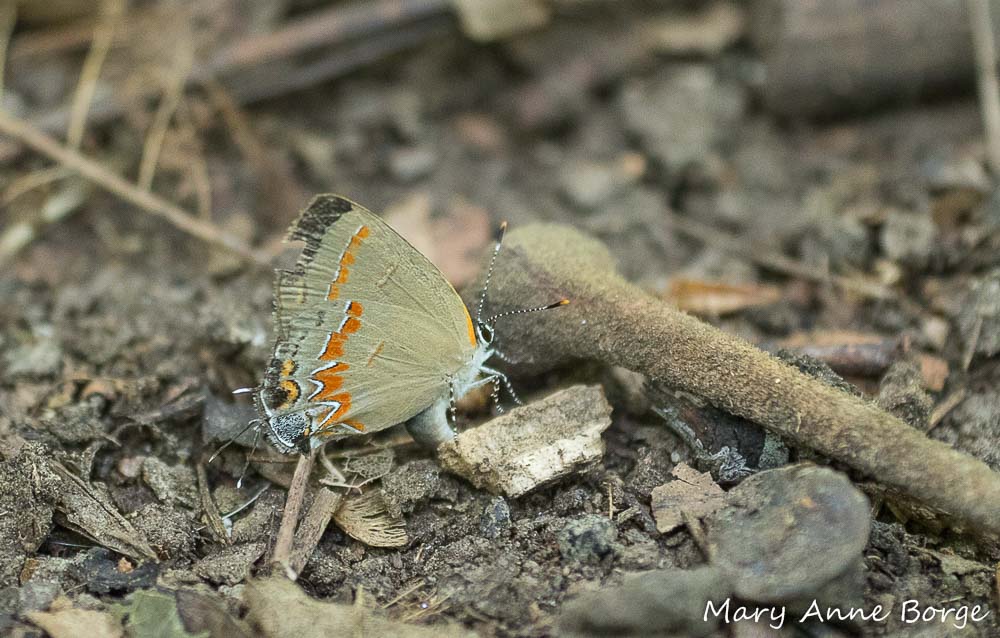
On a recent walk on a woodland trail near my home in central New Jersey, I had just turned around to head back to my car when I noticed a flutter of brownish wings at ground level at the edge of the trail. My first thought was that it was probably a moth, but when I saw the insect in profile, I could tell it was a butterfly. As I looked more closely, I saw the tell-tale markings of a Red-banded Hairstreak. I decided to watch for a while.
A Red-banded Hairstreak walking on the forest floor
She stayed on the ground, walking over obstacles that seemed like they would be a challenge for someone her size, especially when she could choose to fly. While I observed her, she climbed over leaves, rocks, leaf stems and small branches, never once taking to the air. Several times she paused in place for a few seconds. Was she just resting, or maybe getting her bearings? No! She had a purpose in mind.
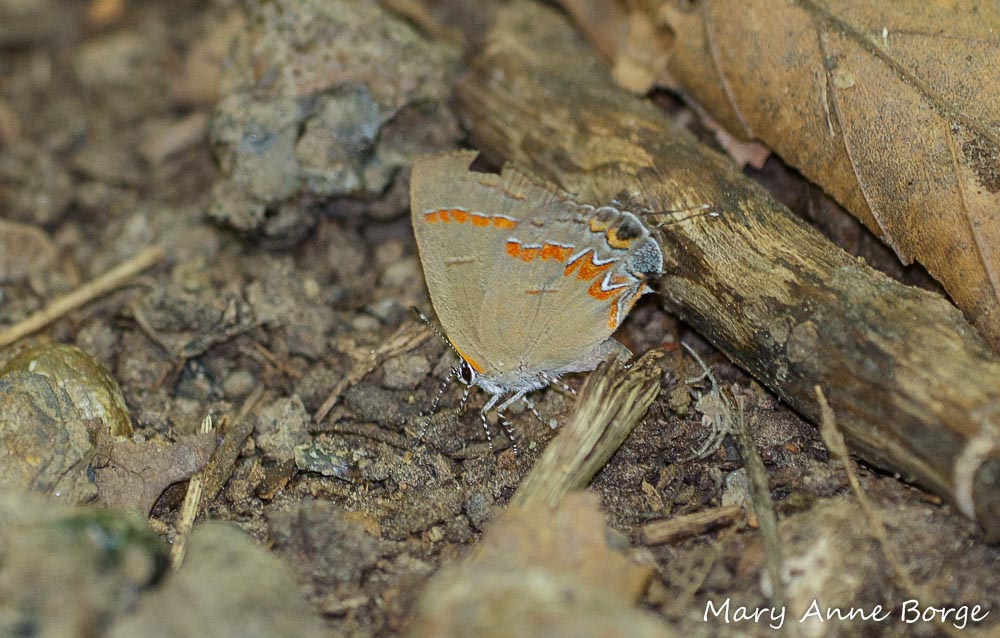
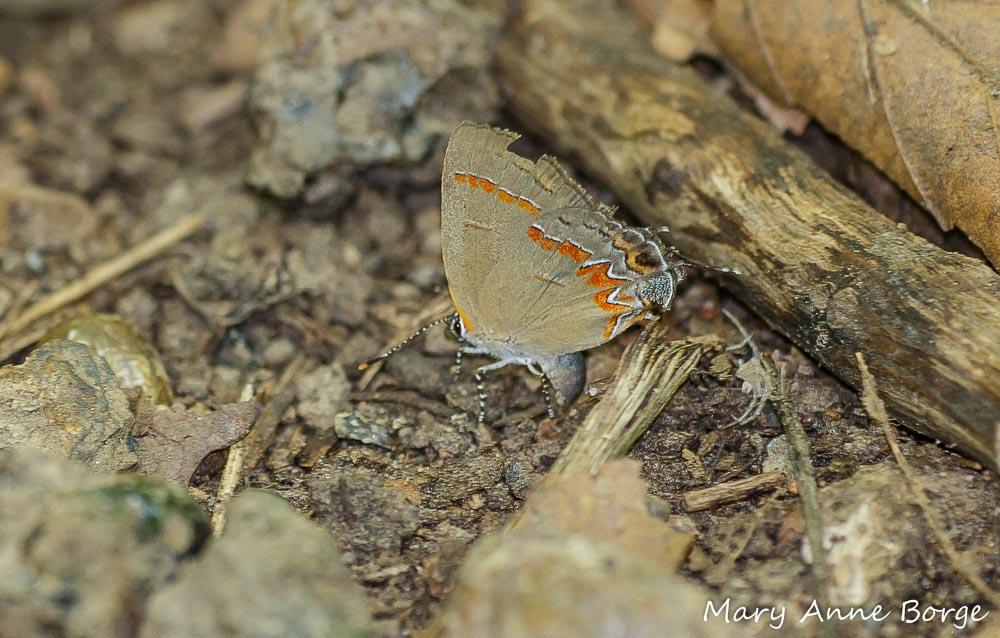
The Red-banded Hairstreak pauses. Wait! Is she laying an egg?No question this time! This Red-banded Hairstreak is ovipositing (laying an egg). Her curved abdomen is the tell-tale sign.
Red-banded Hairstreak caterpillars eat fallen leaves and other decaying plant matter. This little female was laying eggs on or near the kinds of material that her caterpillars would need to eat when they hatched. She alternated walking for a bit with brief pauses to lay an egg.
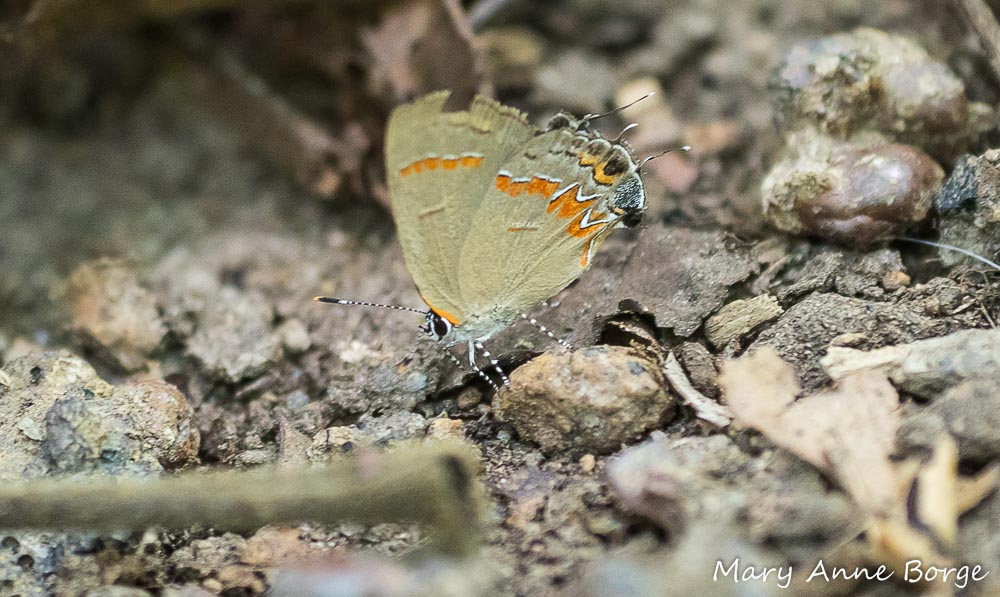
She continues walking, over leaves and twigs.Our Red-banded Hairstreak pauses at another promising spot to lay an egg.She walks on over rocks . . .She walks over twigs until she pauses one more time to lay an egg on detritus
After nearly five minutes, she flew off, presumably scouting for another promising location to lay more eggs.
The caterpillars that hatched from her eggs will spend the winter snug in the fallen leaves, waiting for warm spring days to arrive before completing their metamorphosis to become the next generation of Red-banded Hairstreaks.
Since my encounter with the Red-banded Hairstreak in the woods, I’ve seen other individuals in my own shade garden several times. Fortunately for them and for me, I leave the fallen leaves undisturbed in the garden. I recommend you do the same!
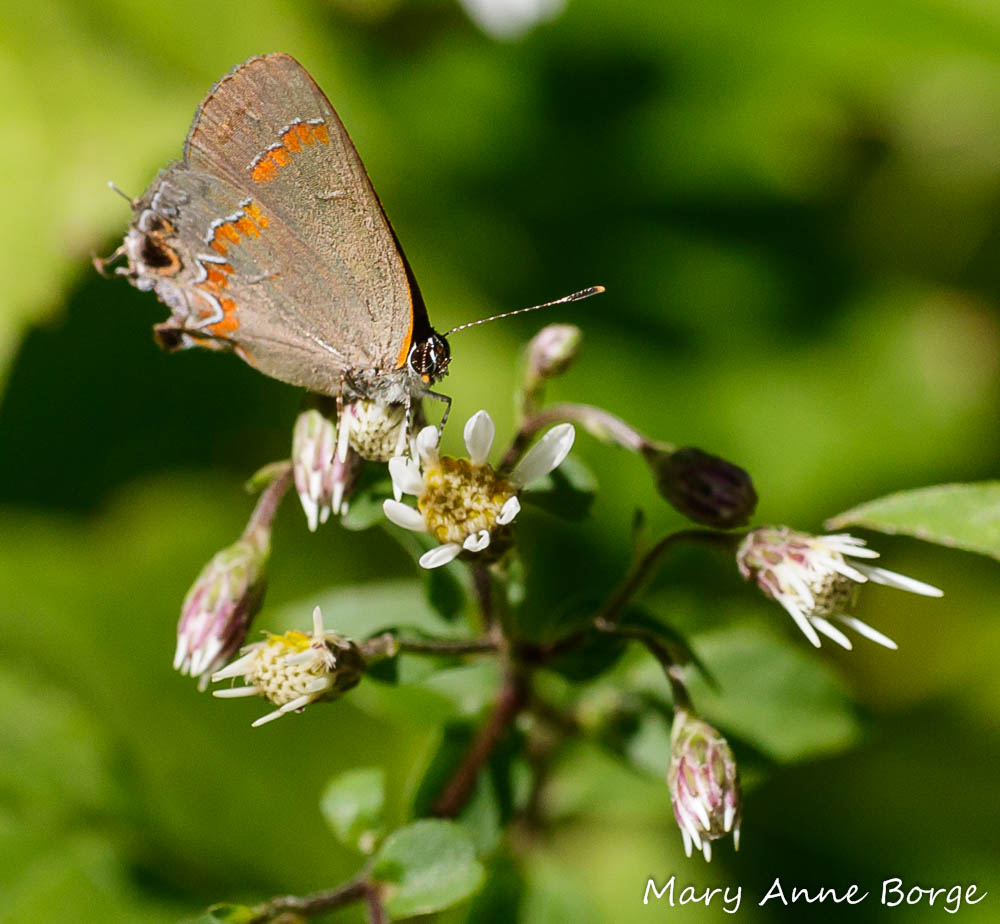
Red-banded Hairstreak on White Wood Aster (Eurybia divaricata) in our shade garden
American Cranberrybush (Viburnum opulus var. americanum synonym V. trilobum), also called Highbush Cranberry, Cranberrybush Viburnum, and several other common names, is not the source of the cranberries often served for Thanksgiving dinner. Those cranberries come from an unrelated species, Cranberry (Vaccinium macrocarpon), a member of the heath family, and a plant that is more closely related to blueberries than it is to American Cranberrybush.
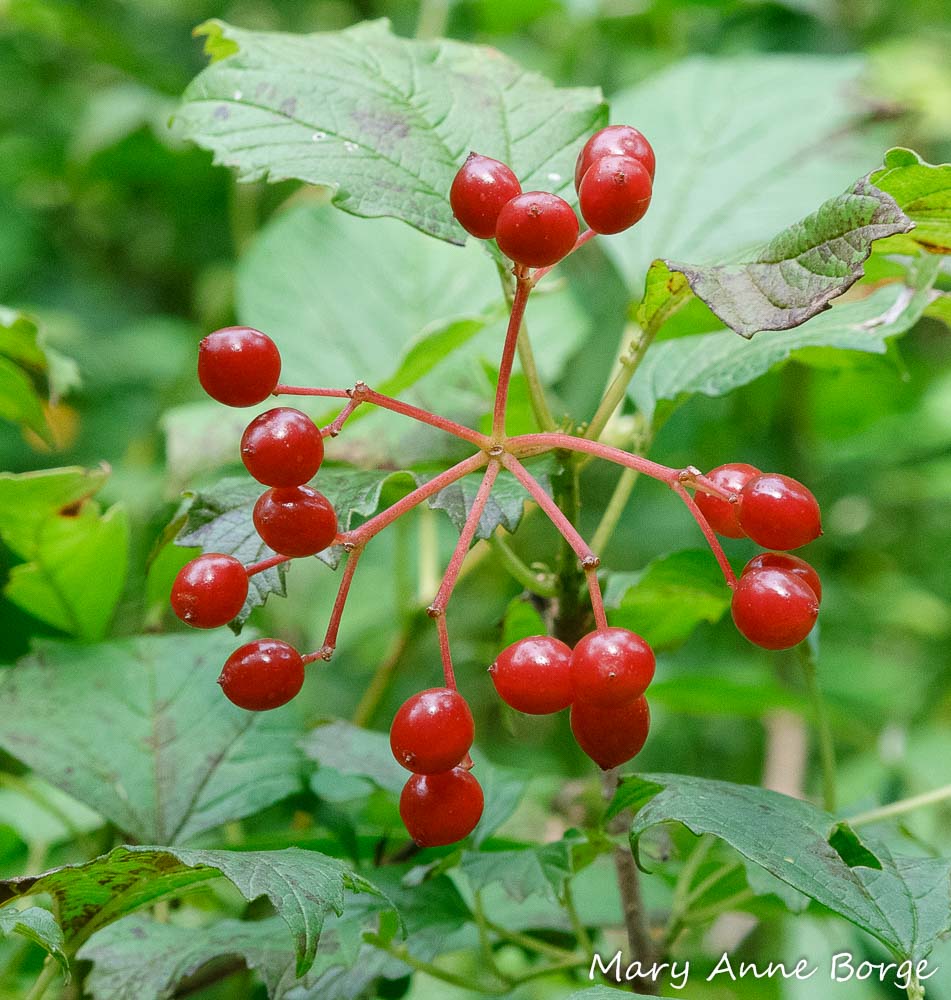
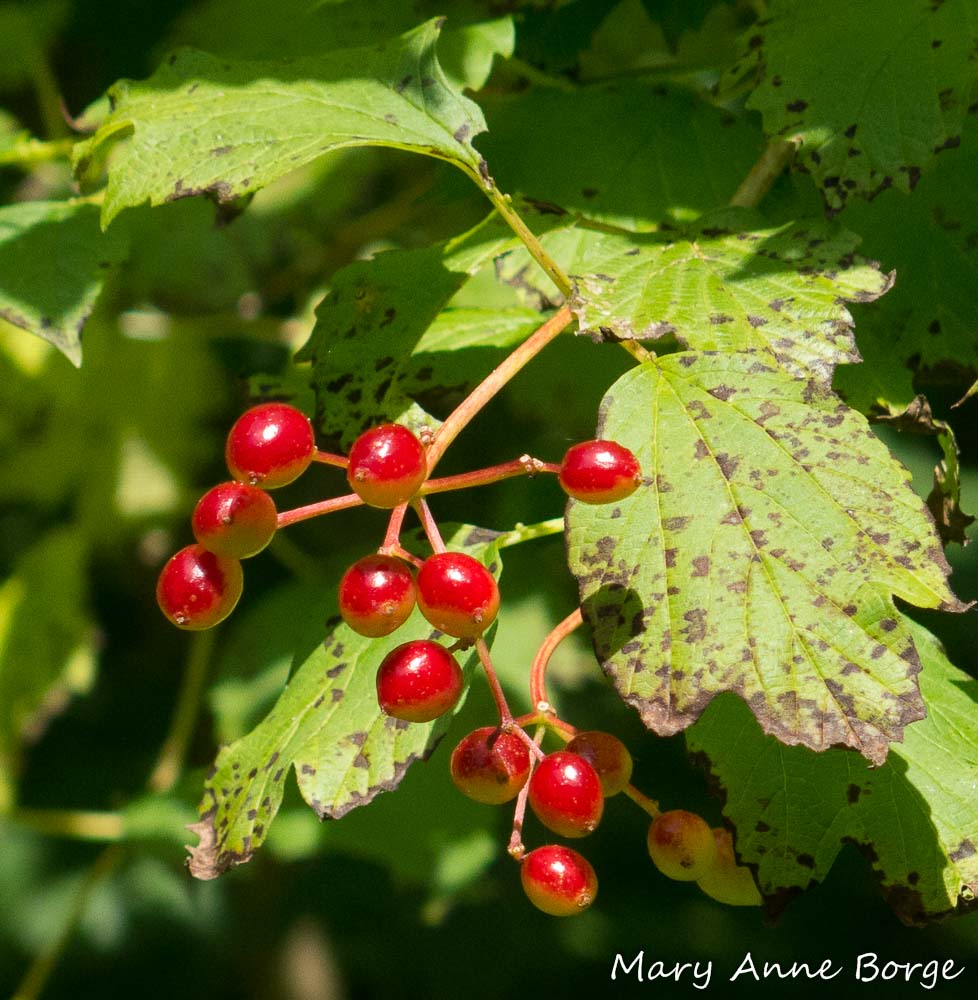
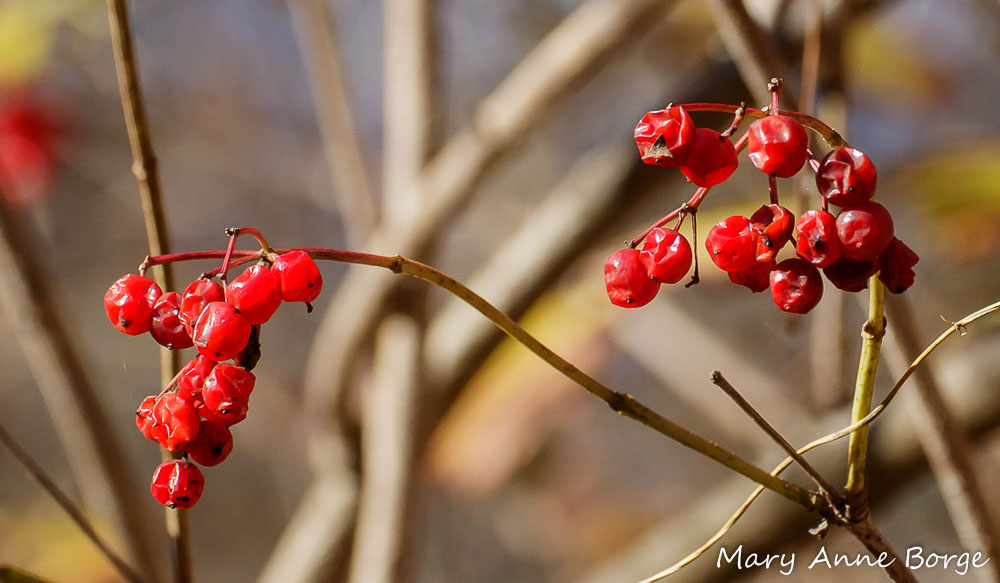
American Cranberrybush (Viburnum opulus var. americanum) fruit
American Cranberrybush gets its common name from the color of its bright red fruit, which does resemble the cranberries so often used to make holiday side dishes or to garnish a salad. The common name Highbush Cranberry refers to this shrub’s height, which can be in the range of 8 to 12 feet (2.5 – 3.6 meters), much taller than the species that yield fruit for those traditional dishes.
This lovely shrub blooms in spring, usually some time in May. Its floral display consists of two types of flowers arranged in a large rounded cluster, creating a lace-cap effect. Large white sterile flowers form the perimeter of the flower cluster, surrounding a dense group of much smaller fertile flowers that make up most of the inflorescence. The job of the sterile flowers is to be showy enough to attract potential pollinators to the fertile flowers, where the work of reproduction is carried out. This floral strategy is shared by Hobblebush Viburnum (Viburnum lantanoides, synonym V. alnifolia) and some of the hydrangeas.
The sterile perimeter flowers bloom first.
American Cranberrybush (Viburnum opulus var. americanum) flower cluster. The large sterile flowers around the perimeter are in bloom, while the fertile flowers are still in bud.
Then gradually, the fertile flowers open for business, enticing pollinators to visit, including many flies, bees and beetles, all important pollinators.
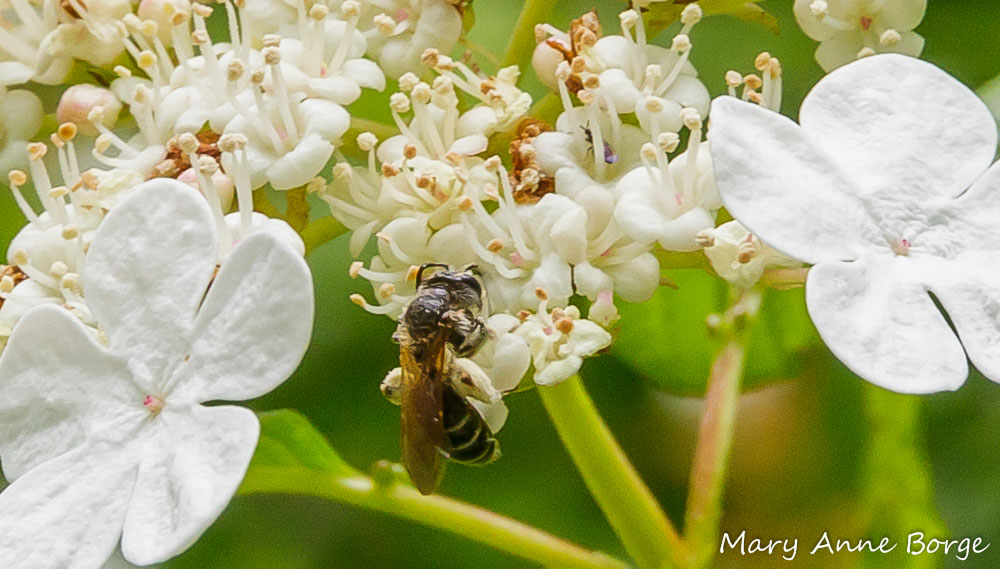
American Cranberrybush (Viburnum opulus var. americanum) flower clusters. Many of the small fertile flowers in the center of the inflorescences are in bloom, in addition to the sterile flowers around the perimeter. If you look closely at the top cluster, you can see a fly (a potential pollinator) foraging for nectar and pollen. Foraging Mining Bee (Andrena sp.) on blooming American Cranberrybush (Viburnum opulus var. americanum) flowers.Mining Bee (Andrena sp.) and another tiny pollinator a bit above and to her right, on blooming American Cranberrybush (Viburnum opulus var. americanum) flowers.
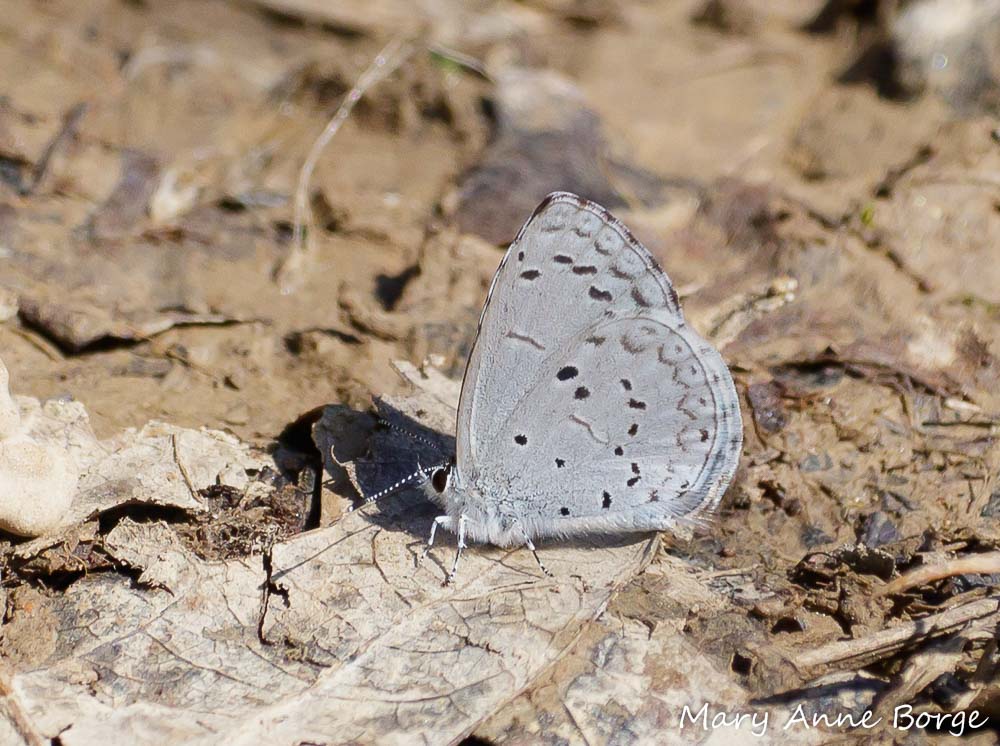
Spring Azure butterflies use the flowers and buds of this and other spring-blooming viburnums, and a few other woody species as food for their caterpillars.
Spring Azure butterfly
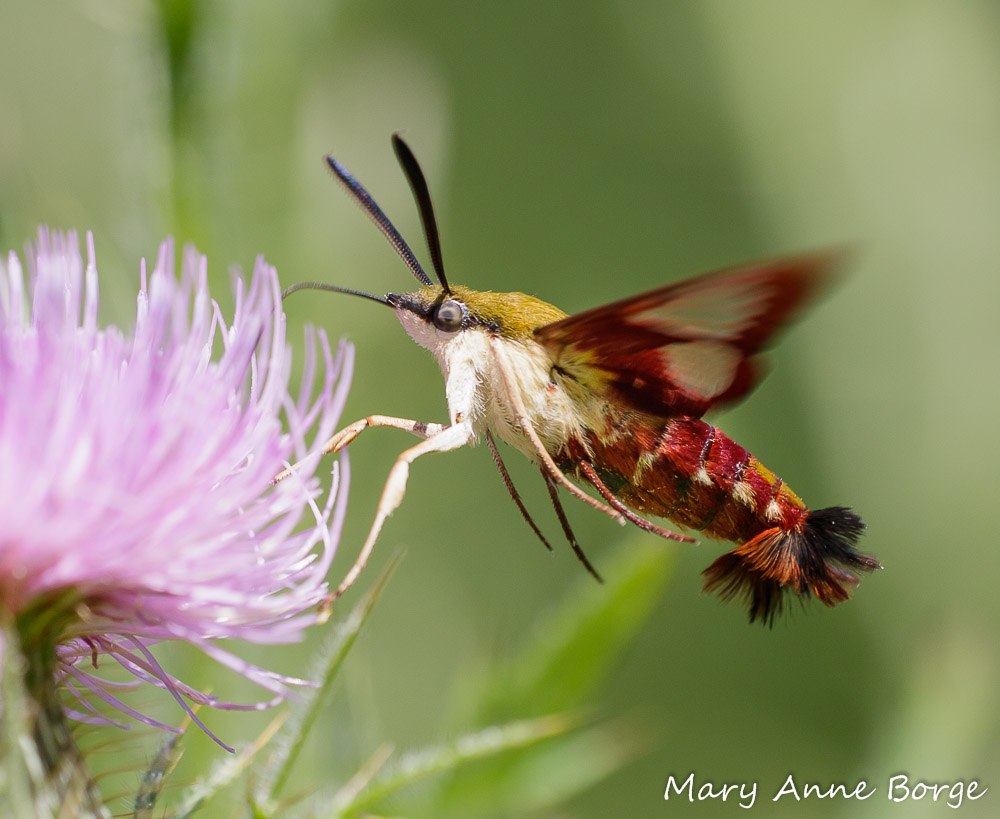
Hummingbird Clearwing and several other moth species also use this and other viburnums as food for their caterpillars.
Hummingbird Clearwing (Hemaris thysbe) moth
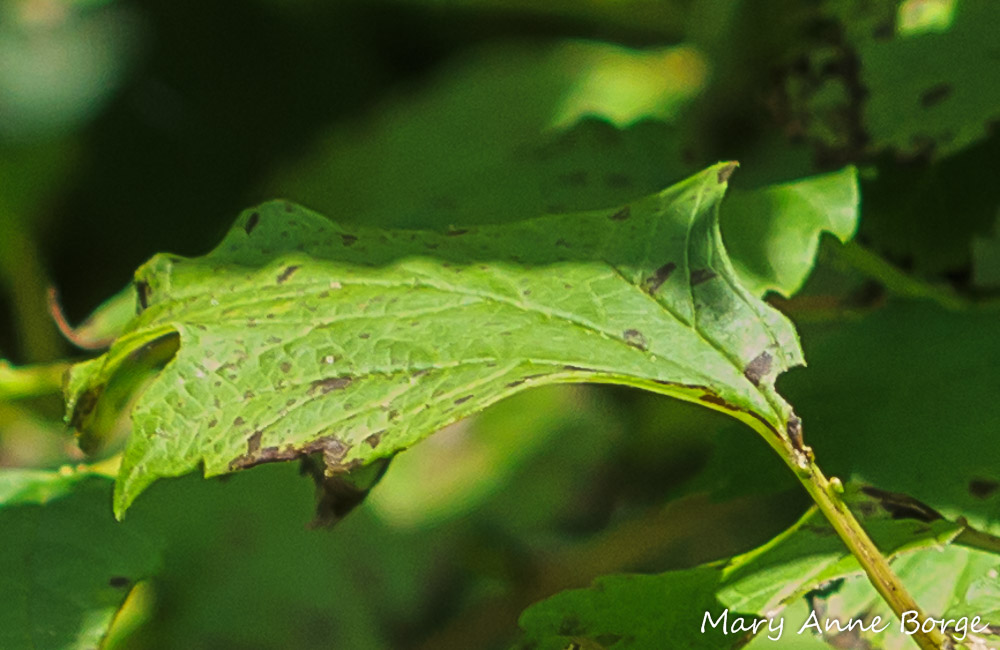
American Cranberrybush leaves have three lobes, resembling the leaves of Red Maple (Acer rubrum). To protect itself from hungry marauding caterpillars, American Cranberrybush has glands on its leaf stems just below where the stem meets the leaf blade. These glands are extra-floral nectaries, designed to lure insects that can be enticed by both a sweet nectar treat and the protein available from a caterpillar. Ants, wasps, even some flies are potential security guards that are paid for their presence with nectar from these glands, with the potential for a bonus: as many caterpillars as they can find. Ants drink nectar and eat caterpillars and other insects. Wasps and flies drink nectar, and some also hunt caterpillars or other insects to feed their young. The presence of these predatory insects helps protect American Cranberrybush from foraging caterpillars.
Note the bumps on the leaf stem, just below the 3-lobed leaf blade. They are the extra-floral nectaries.
American Cranberrybush is a variety of a look-alike shrub, European Cranberrybush (Viburnum opulus) which is of European origin and can become invasive in North America. The two can interbreed, which has the undesirable potential to lead to the loss or alteration of the native variety. The best way to tell the two apart is by their extra-floral nectaries. On American Cranberrybush, these nectaries are somewhat convex or slightly rounded at the top, while those on European Cranberrybush leaf petioles (stems) are concave.
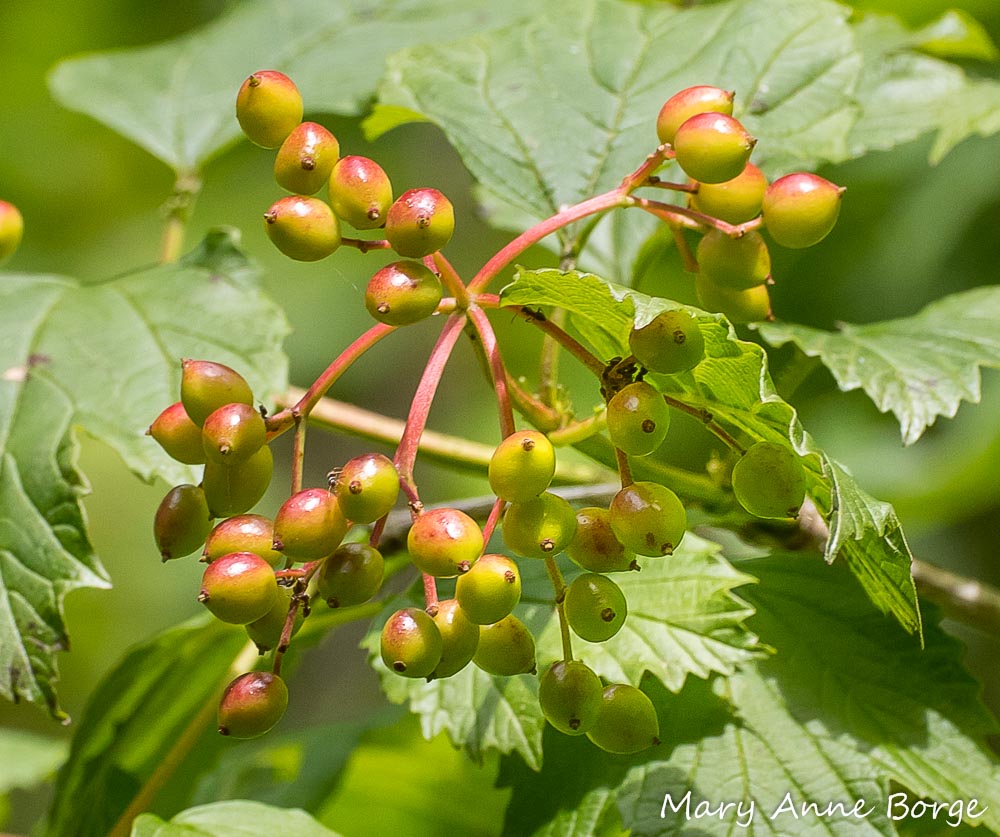
By late June, developing fruit replaces successfully pollinated flowers, ripening as the summer goes on. The fruit is a drupe, a fleshy fruit with a single seed encased in a stony pit. Peaches and cherries are examples of fruits that are drupes.
American Cranberrybush (Viburnum opulus var. americanum) developing fruit, late June in Pennsylvania.American Cranberrybush (Viburnum opulus var. americanum) ripening fruit, mid-July in Pennsylvania.
American Cranberrybush fruit has a relatively low fat content, so it is less desirable for migrating birds than some other options like Spicebush (Lindera benzoin). It often lasts well into the winter, but this year, where I live and play in central New Jersey and eastern Pennsylvania, the fruit was already gone by mid-November. Of course, we have already had a few hard freezes, followed by warm-ups.
American Cranberrybush (Viburnum opulus var. americanum) fruit, November, in Pennsylvania.
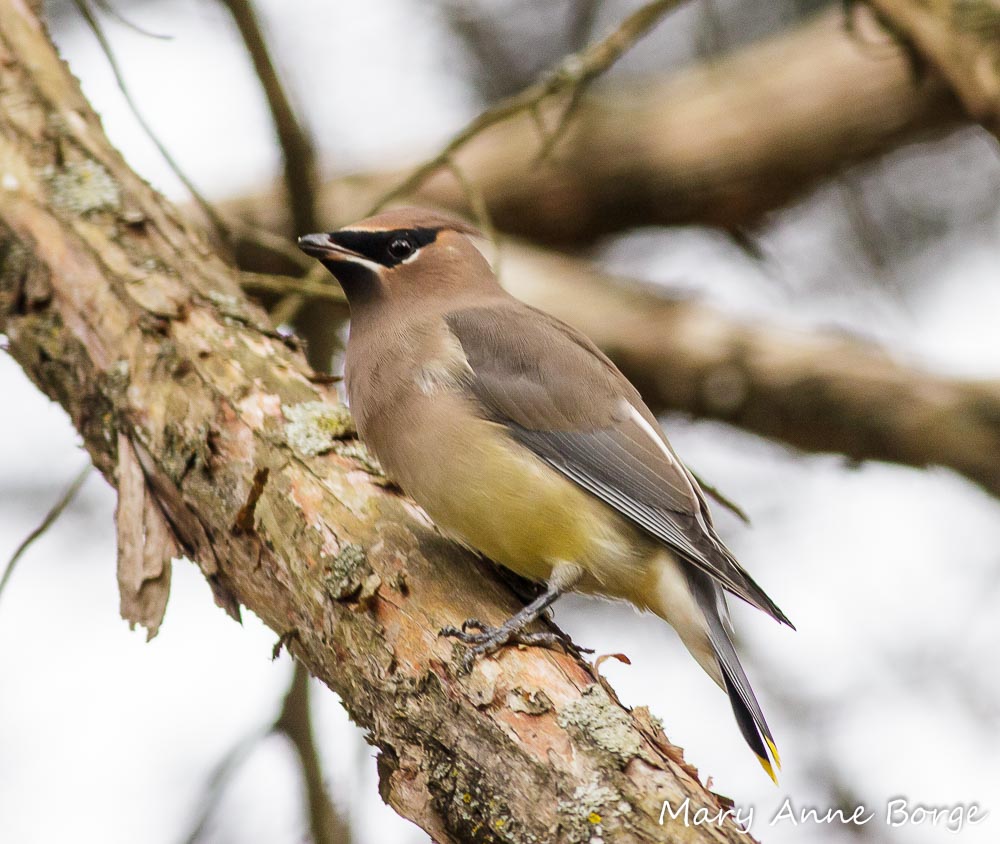
Robins, Bluebirds, Hermit Thrush, Cedar Waxwings, grouse and many more birds eat American Cranberrybush fruit.
Cedar Waxing – they are among the birds who eat American Cranberrybush fruit.
All kinds of animals, from moose to fox to squirrels and mice also eat the fruit.
Gray squirrels and many other animals eat American Cranberrybush fruit.
What about humans? If we get to it before our animal neighbors do, can we use this fruit as an actual cranberry substitute? If it is cooked with sugar or other sweetener added, people find the fruit of American Cranberrybush edible, too. Some sources say that fruit from European Cranberrybush tends to be more bitter.
Look for American Cranberrybush in wet woods or along streams in its native range, from Nova Scotia to British Columbia in Canada, and in the United States from Maine to Washington state, south to New Jersey, West Virginia and Illinois, although it is more common in the eastern US. The USDA also shows it in one county in New Mexico.
Happy Thanksgiving! Enjoy those cranberries!
American Cranberrybush (Viburnum opulus var. americanum) fruit
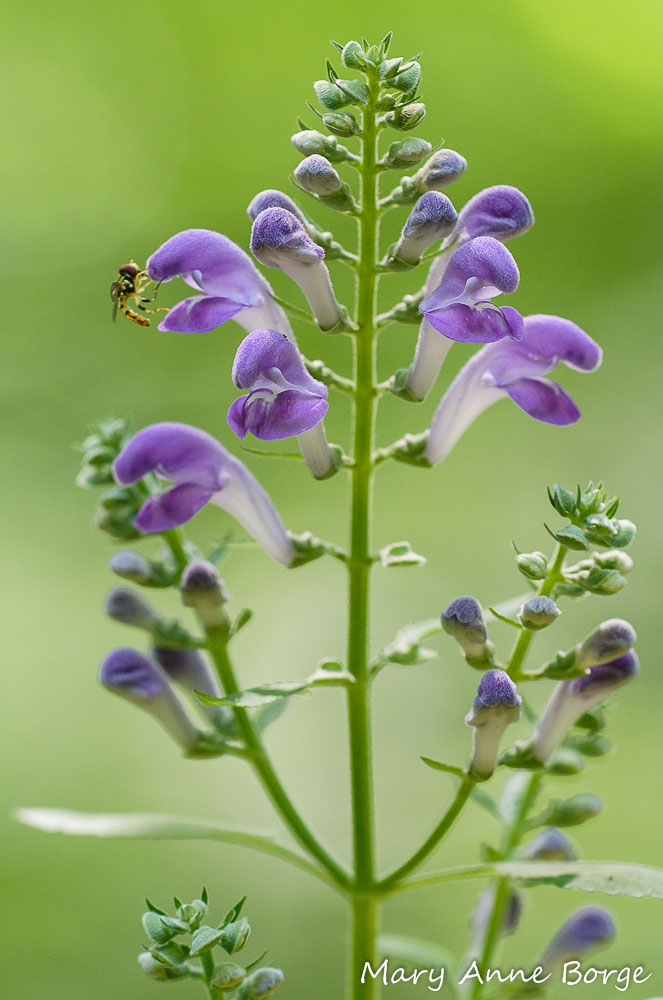
Apparently I planted some Downy Skullcap (Scutellaria incana) in our garden last year and then promptly forgot, so it was a delightful surprise when the vivid blue flowers began to bloom in long stalks above gray-green foliage.
Downy Skullcap (Scutellaria incana) with Flower (Syrphid) Fly
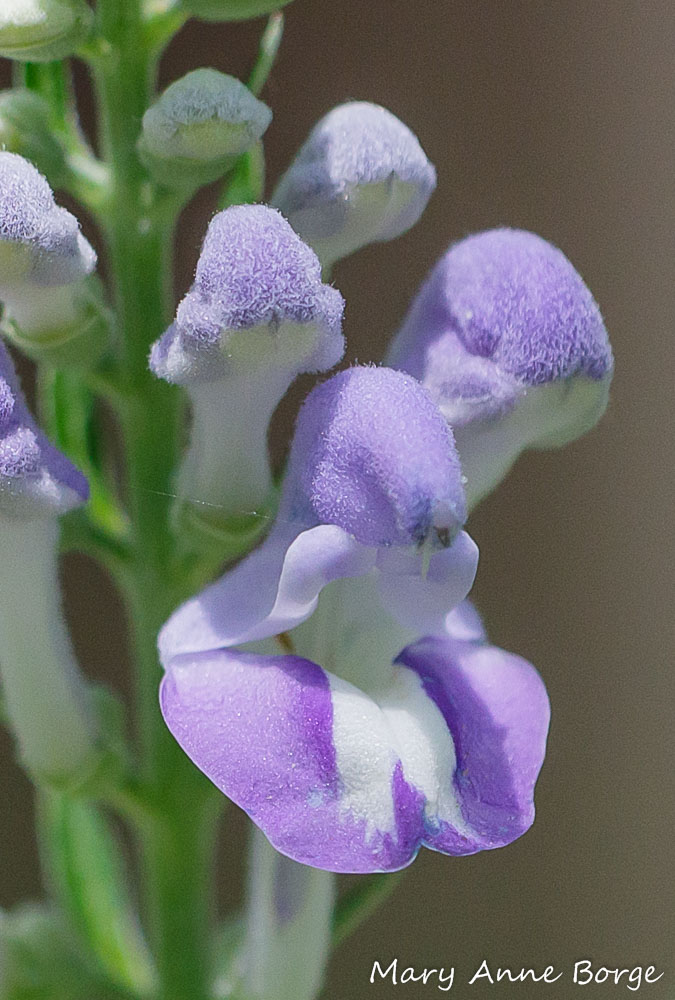
Each long tubular flower has an entrance with a hood- or cap-like overhang at the top, and a floor with a white pathway beckoning to visitors who might help pollinate the flowers.
Downy Skullcap (Scutellaria incana) Flower
The almost sapphire blue flowers are especially attractive to bees, and are thought to be most often pollinated by Bumble Bees (Bombus species) but they entice other pollinators as well, including flower flies, bee flies, and small butterflies.
I watched for visitors to the flowers in our garden and at another near-by site, Bowman’s Hill Wildflower Preserve. At both locations, bees were the most frequent visitors on days when I checked, and of the bees, Small Carpenter Bees (Ceratina species) were the most common.
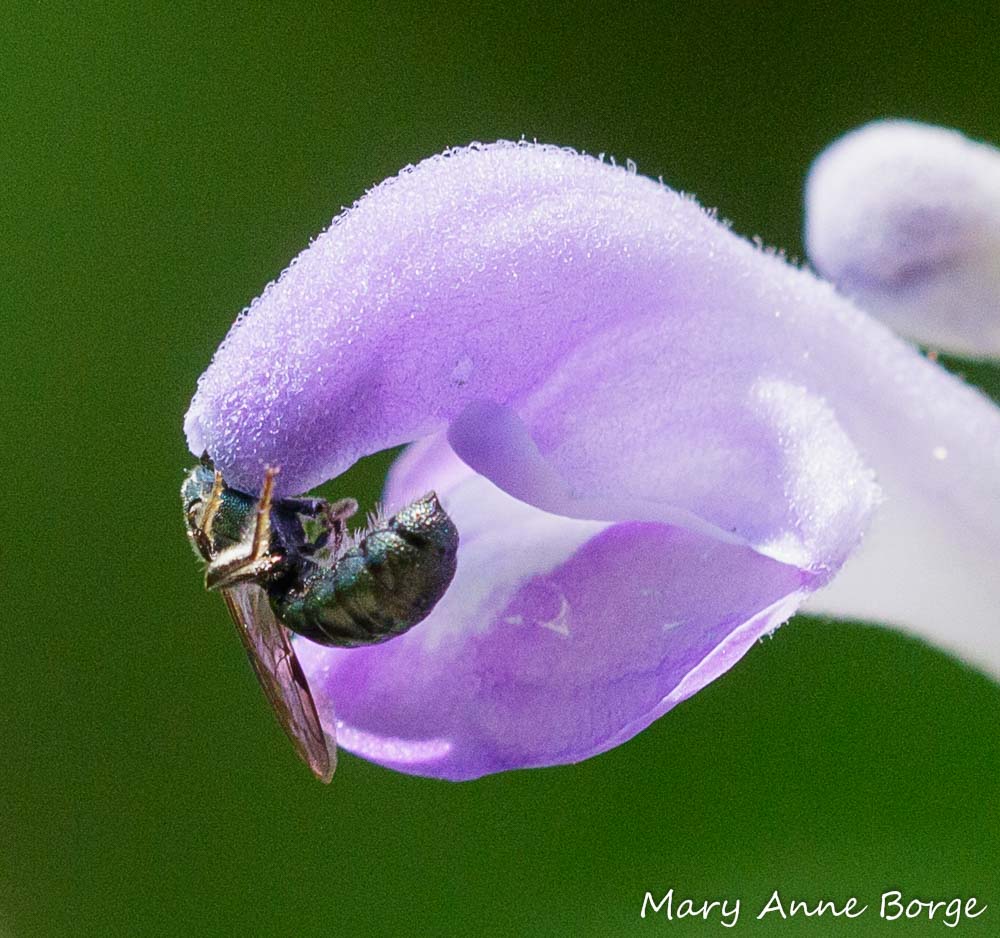
Downy Skullcap (Scutellaria incana) with Small Carpenter Bee (Ceratina species)
Don’t be put off by the fact that they are called carpenter bees. These tiny bees won’t be drilling holes in the deck, siding or wood trim of your home. They nest in the stems of dead or broken twigs, excavating nesting cells by chewing through the pith, the softer tissue inside the stem. Small Carpenter Bees are pollinators of many plants, especially those with small flowers.
Each bee crawled inside the flower, disappearing down the throat until they reached the nectar reward at the bottom.
Downy Skullcap (Scutellaria incana) with Small Carpenter Bee (Ceratina species) crawling down the throat of the flower to reach the nectar reward
But it wasn’t just nectar they were after. Bees need a balanced diet. They wanted pollen, too, for the protein and lipids it provides. The flowers’ reproductive parts, the stamens and pistils, are hidden under the hood at their entrance. After emerging from drinking nectar at the depths of a flower, each bee then checked under the hood for pollen, which is dispersed from the anthers at the stamens’ tips. Some bees even went straight for the pollen without bothering with the nectar. Hopefully some of that pollen was later deposited on the stigma of another flower, the female flower part where pollen must be placed in order for pollination to occur.
Downy Skullcap (Scutellaria incana) with Small Carpenter Bee (Ceratina species) emerging from the flower
Downy Skullcap (Scutellaria incana) with Small Carpenter Bee (Ceratina species) harvesting pollen
Much larger relatives of these tiny bees, Eastern Carpenter Bees (Xylocopa virginica), also visited the flowers. Although these bees can be excellent pollinators, it pains me to tell you that in the case of Downy Skullcap, Eastern Carpenter Bees are thieves. They can’t access the flowers’ nectar by going through the inviting entrance, thus interacting with the flowers’ reproductive parts and helping with pollination. So instead, they bite through the floral tube near its base, directly accessing the nectar, doing nothing in return to assist the plant in its reproductive goals. Interestingly, a Honey Bee tried to discourage the Eastern Carpenter Bees from this dishonest activity by trying to chase them away, with some success. And yes, regrettably, Eastern Carpenter Bees might choose to nest in the wood of your home.
Downy Skullcap (Scutellaria incana) with Eastern Carpenter Bees (Xylocopa virginica) robbing the flower of nectar by biting through the floral tube to drink it.
While looking for Downy Skullcap flower visitors in our garden, I spotted a male Zabulon Skipper drinking nectar.
Male Zabulon Skipper drinking nectar from a Downy Skullcap (Scutellaria incana) flower
A moment later, I noticed a female Zabulon Skipper, doing the same.
Female Zabulon Skipper drinking nectar from a Downy Skullcap (Scutellaria incana) flower. Notice the bee disappearing into the flower above hers.
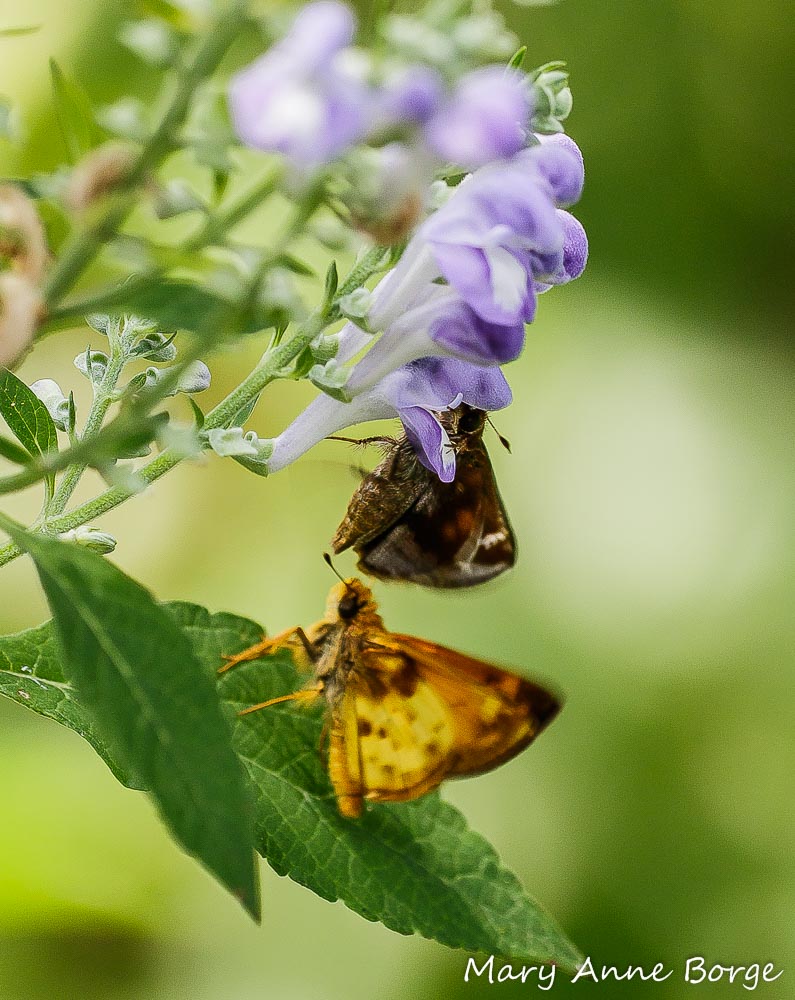
Then the male flew over to the female and suggested a ‘hook up’.
Female (top) and male (bottom) Zabulon Skippers, negotiating a hook up. Their wings are a little out of focus because both were vibrating them energetically as a lead-up to an agreement.
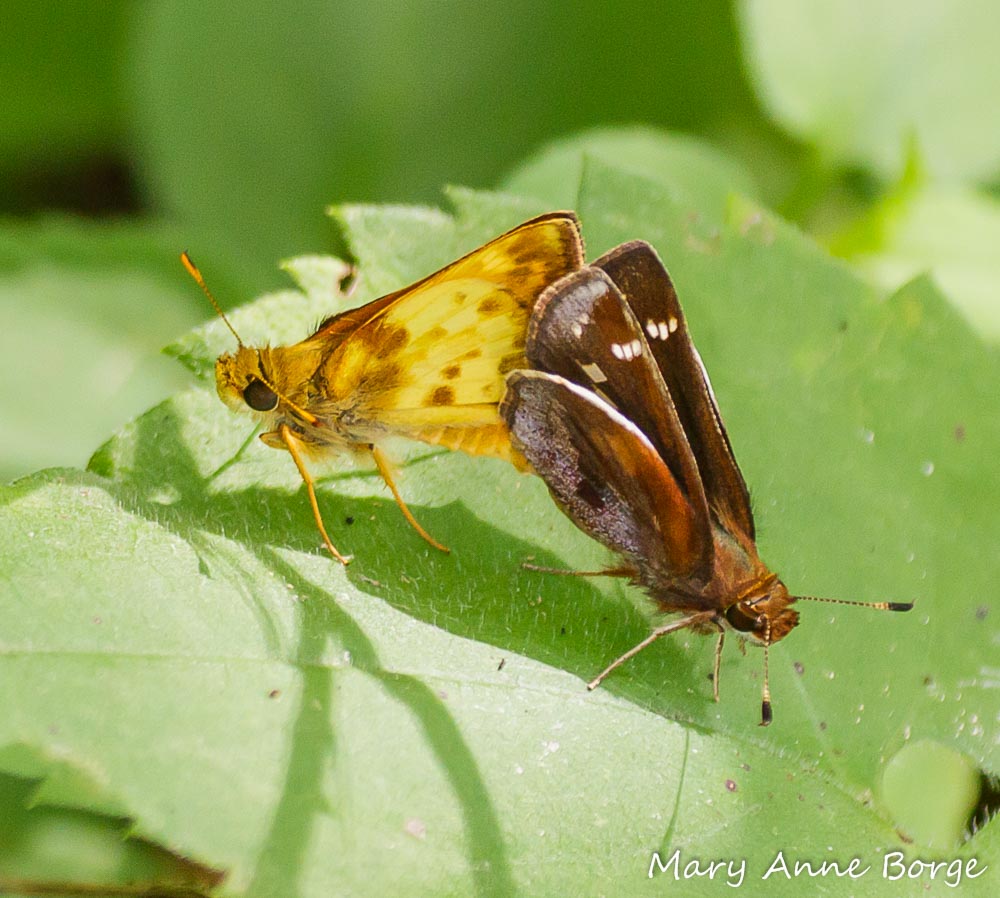
She was apparently persuaded by his pitch. They went off to a more secluded spot, and stayed there beyond the limits of my attention span.
Zabulon Skippers, mating
Zabulon Skippers, mating
These small butterflies are common in gardens and natural areas, specializing on many grass species as food for their caterpillars, including Purpletop (Tridens flavus), Purple Love Grass (Eragrostis spectabilis), and other related species.
Purpletop (Tridens flavus), a caterpillar food for Zabulon Skippers
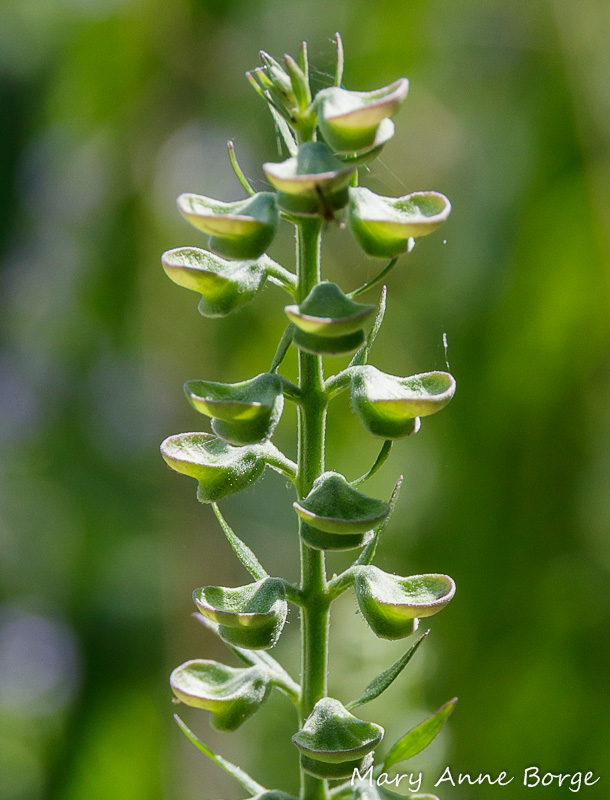
When the flowers have finished blooming and drop away, a cap-shaped calyx, the set of sepals that act as bud scales remains, providing the inspiration for the common name ‘skullcap’.
Cap- or dish-like calyxes of Downy Skullcap (Scutellaria incana)
‘Downy’ in the common name and ‘incana’ in the scientific name, which means hoary or quite gray, refer to the short soft hairs present on the flowers and stems of this plant. Hoary Skullcap is another common name for the species.
Downy Skullcap is native in the United States from New York west to Wisconsin, south as far as Texas and the Florida panhandle. It can tolerate full sun to full shade, dry to moist soil. Blooming in mid-summer, it makes a dramatic addition to a garden. Add it to yours and wait for the real drama (food foraging, bee face-offs, theft, flirtation, sex!) to begin.
Downy Skullcap (Scutellaria incana) with Small Carpenter Bee (Ceratina species)
Resources
Cech, Rick; Tudor, Guy. Butterflies of the East Coast. 2005.
Eaton, Eric R.; Kauffman, Ken. Kaufman Field Guide to Insects of North America. 2007.
Rhoads, Ann Fowler; Block, Timothy A. The Plants of Pennsylvania. 2007
Stearn, William T. Stearn’s Dictionary of Plant Names. 1996
Willmer, Pat. Pollination and Floral Ecology. 2011
Wilson, Joseph S.; Carril, Olivia Messinger. The Bees in Your Backyard. 2016.


























 The Natural Web