Sleepy Orange Butterflies Overwintering in Pennsylvania

As I write this, it’s 30°F and snowing lightly, with snow, ice and rain predicted for the next few days.  It’s December in New Jersey.  Oddly, I like winter.  So what am I doing thinking about butterflies?
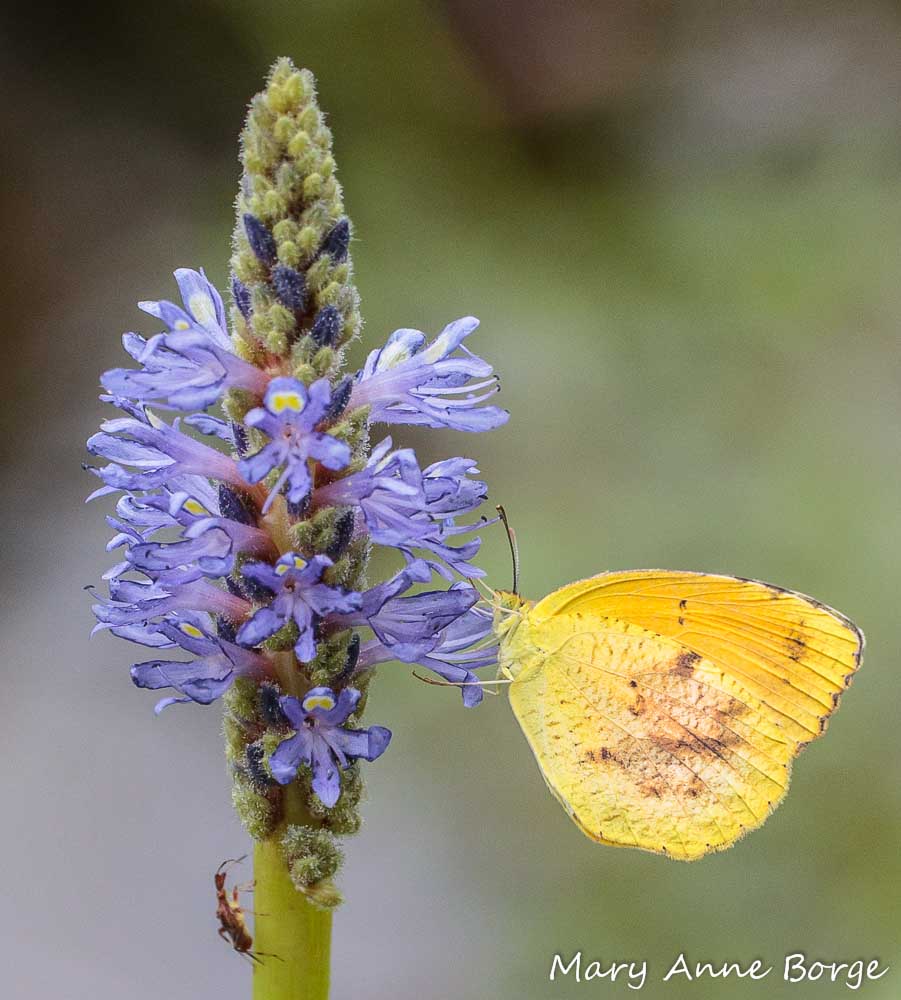
Sleepy Orange Nectaring on Pickerelweed (Pontederia cordata)

Sleepy Orange Nectaring on Pickerelweed (Pontederia cordata)

Since summer I’ve been puzzling over the fact that a butterfly species that is primarily tropical, the Sleepy Orange (Eurema nicippe or Abaeis Nicippe), has been seen regularly in summer across the Delaware River at Bowman’s Hill Wildflower Preserve, just south of New Hope, Pennsylvania.  (See Sleepy Orange Butterflies are Back)  This species is not thought to overwinter farther north than North Carolina.  How is it that Sleepy Oranges have consistently been at the Preserve for the past four summers, and before that in 2006 and 2008?

Is it random chance?  Are they successfully overwintering here?  Or have they evolved to be able to migrate south in the fall and back north in the summer, returning to the same location?  Inquiring minds want to know (ok, I want to know), so I gave myself the assignment of observing them throughout the fall to see if I could learn anything that could help answer this question.

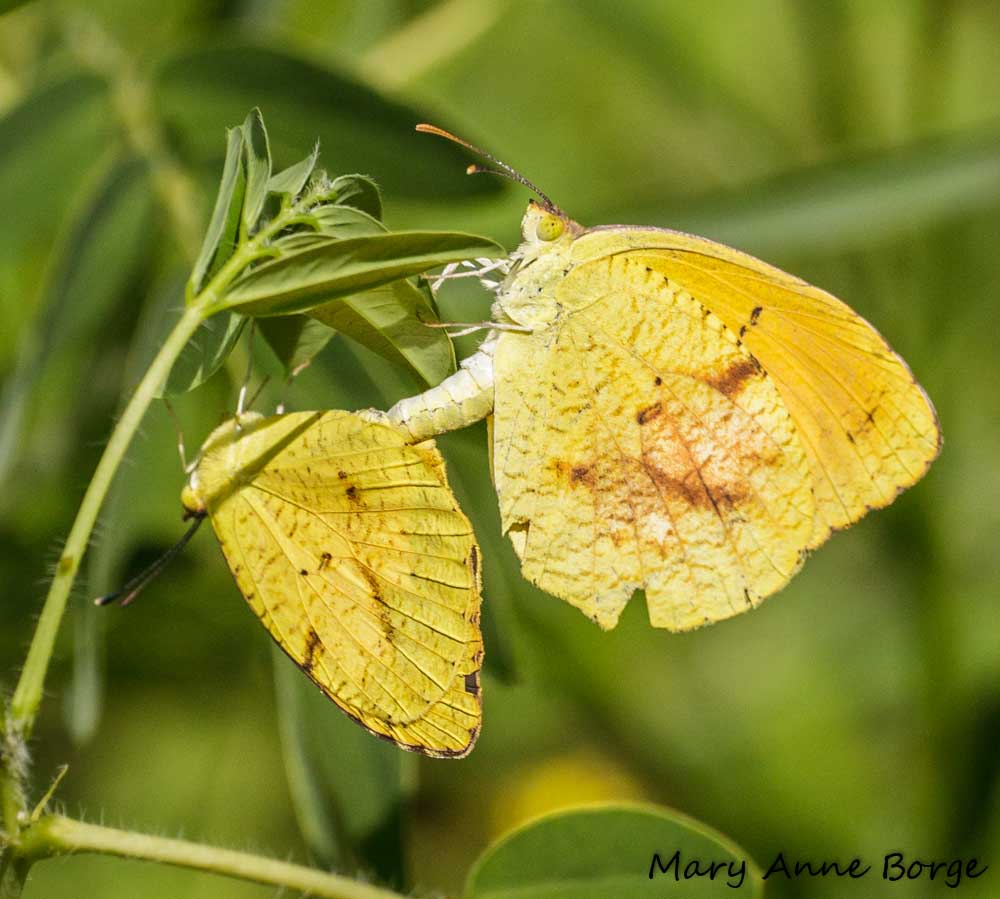
Throughout August the Sleepy Oranges could be seen mating, with the females taking the lead in selecting the location, usually on or near their favorite caterpillar food plant, Wild Senna (Senna hebecarpa).

Sleepy Oranges mating on Wild Senna

Sleepy Oranges mating on Wild Senna

Naturally, this activity was followed by the females laying eggs.
Sleepy Orange laying an egg (ovipositing)

Sleepy Orange laying an egg (ovipositing)

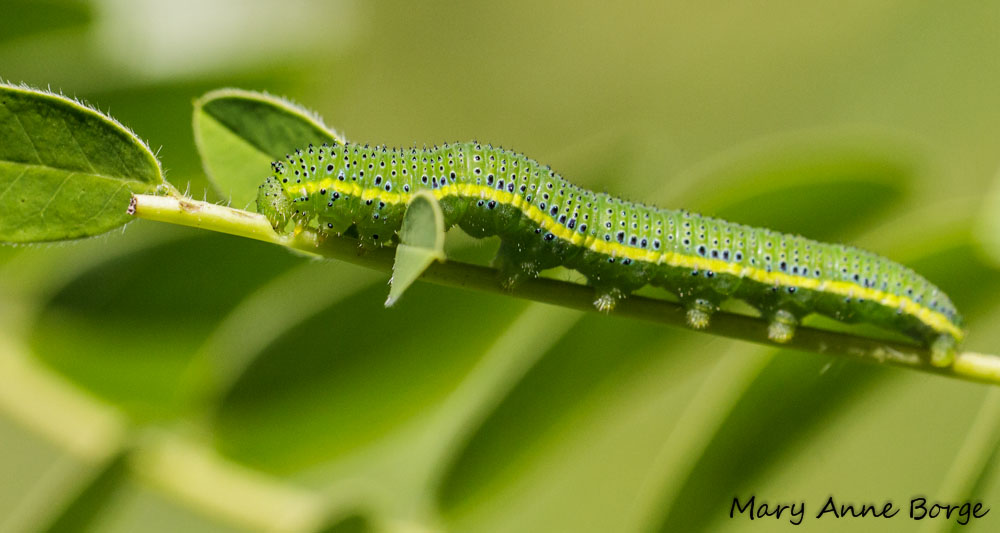
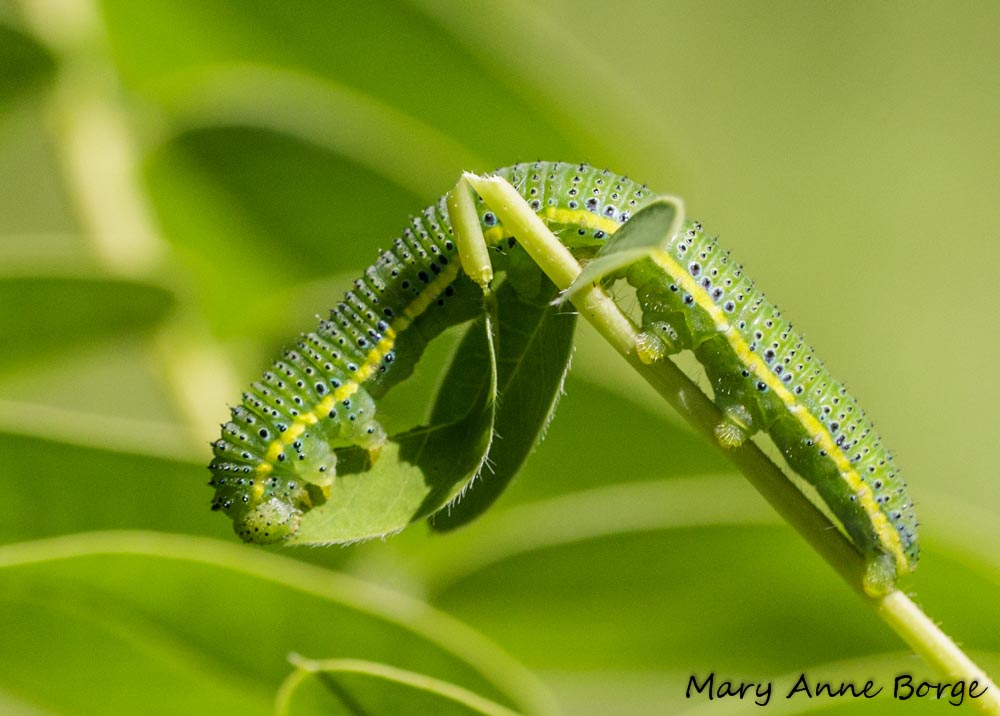
Their efforts were pretty successful, treating me to many caterpillar

Sleepy Orange Caterpillar

Sleepy Orange Caterpillar

and chrysalis sightings throughout September.
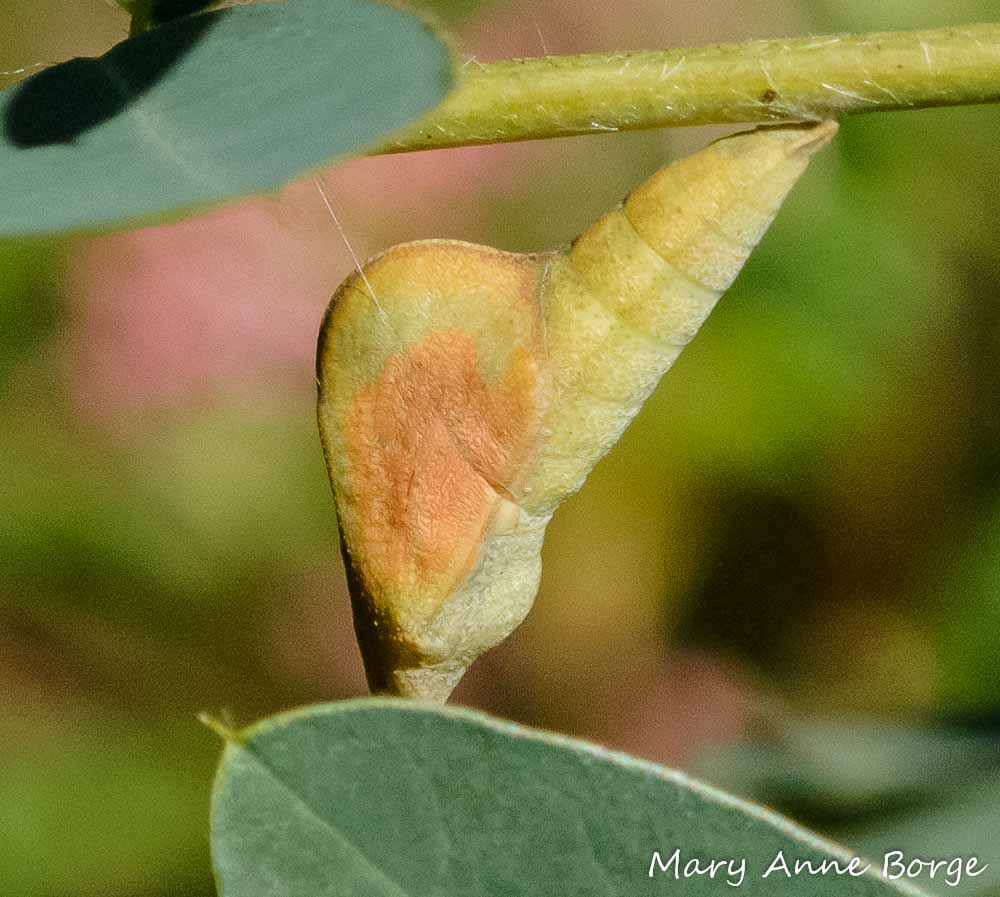
Sleepy Orange Chrysalis

Sleepy Orange Chrysalis

Empty Sleepy Orange Chrysalis - the butterfly has already emerged

Empty Sleepy Orange Chrysalis – the butterfly has already emerged

The chrysalises masqueraded perfectly as leaflets loosing their chlorophyll and changing to shades of tan, yellow and orange.

By late September, I still saw fresh-looking adult butterflies in their summer coloration form.

Sleepy Orange, summer color form

Sleepy Orange, summer color form

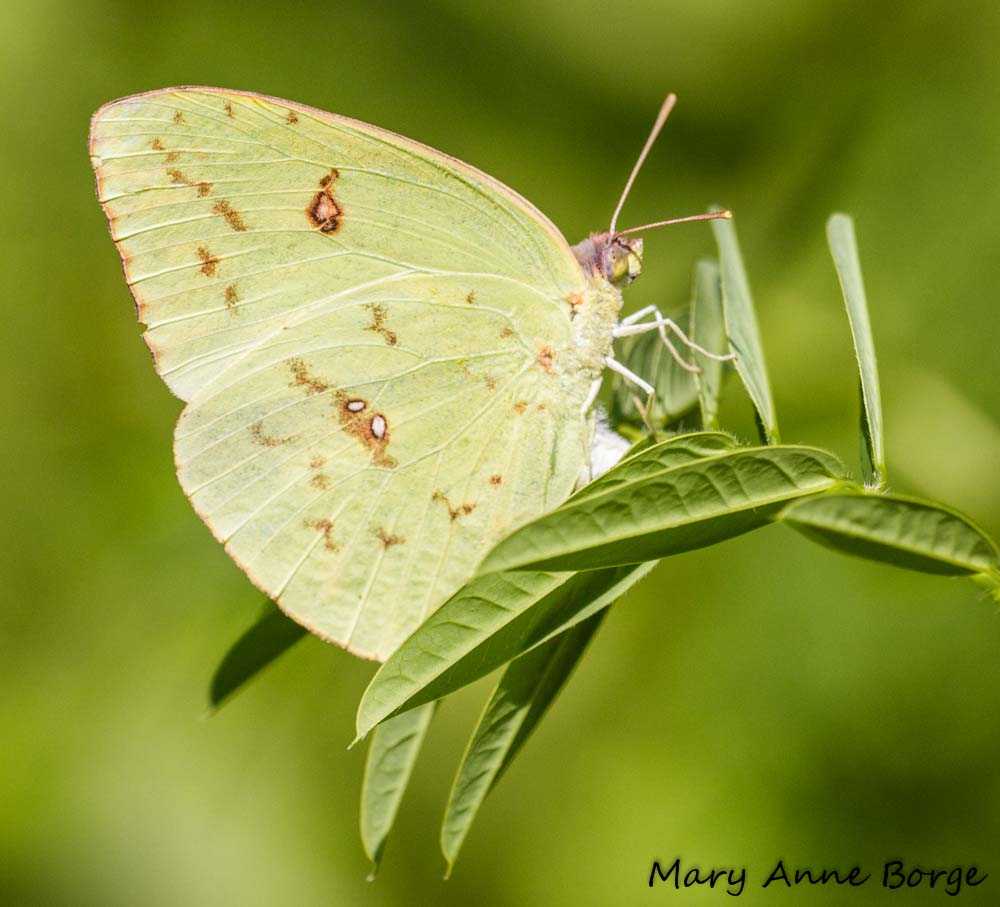
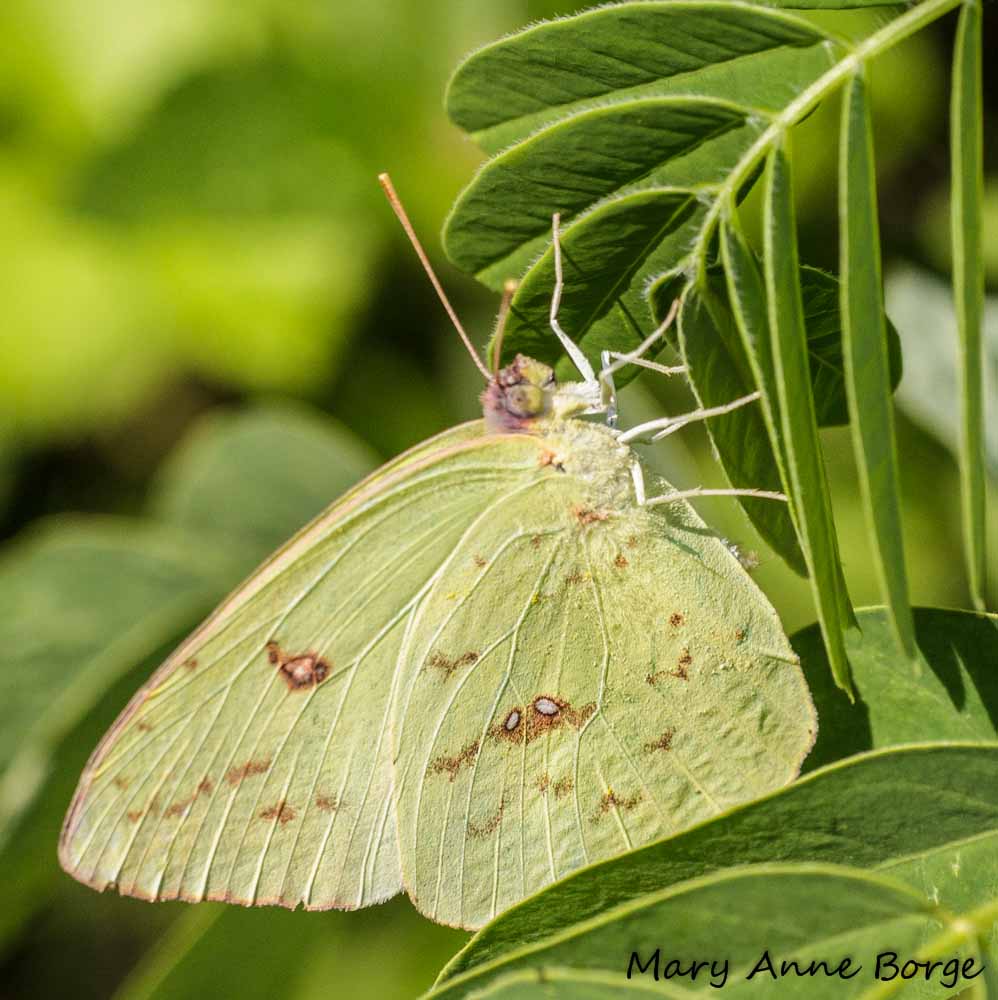
In the south, where Sleepy Oranges are known to overwinter as adults in reproductive diapause, they have a different, darker coloration for this overwintering generation. I observed my first individual with this coloration at the Preserve on September 24.

Sleepy Orange, winter color form

Sleepy Orange, winter color form

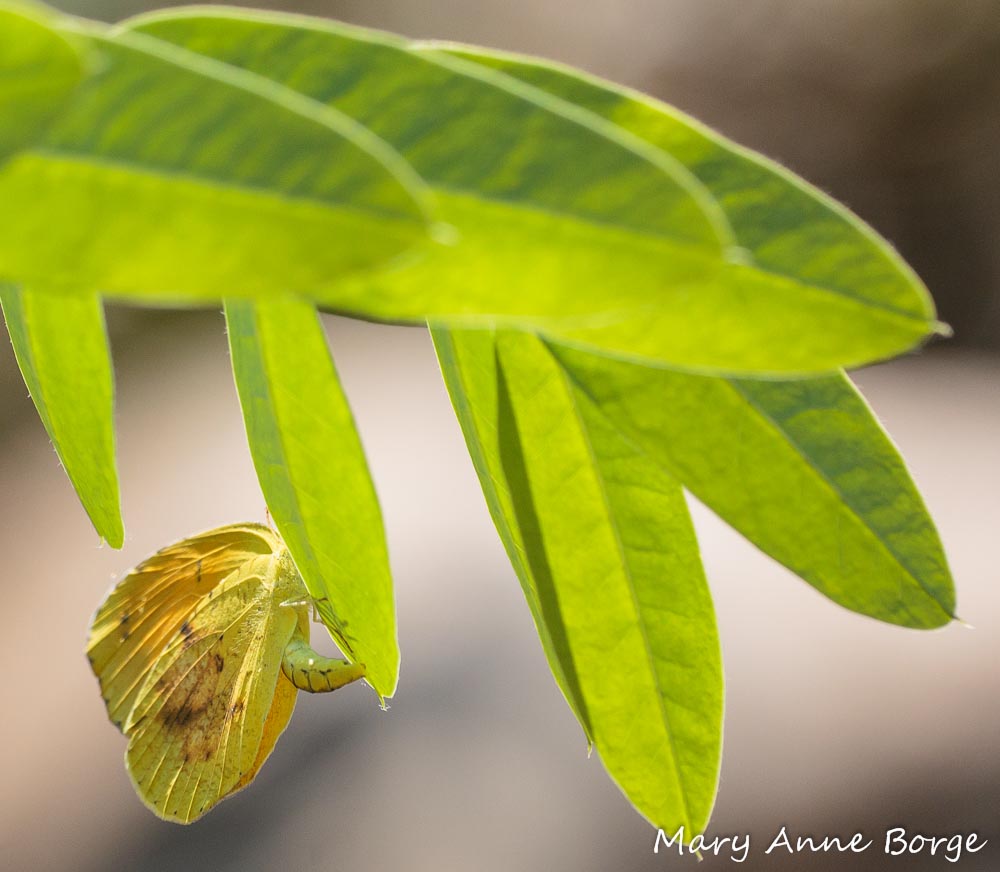
This butterfly had just emerged from its chrysalis.  The tan leaf-like thing hanging behind and between the two leaves to the right of this butterfly is the recently vacated chrysalis, positioned perfectly as if it were a leaflet.
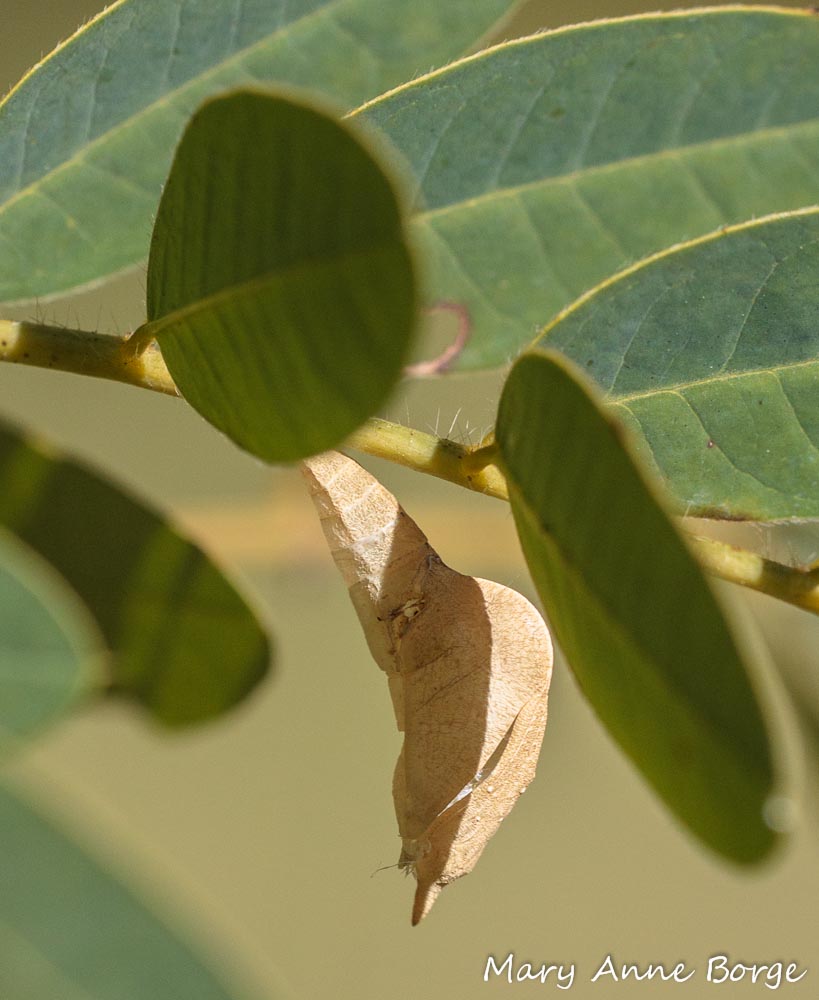
Empty Sleepy Orange Chrysalis

Empty Sleepy Orange Chrysalis

Throughout October, every time I looked on a warm enough day I eventually saw adult Sleepy Oranges.  They usually made their appearance by flying up from the ground, first one butterfly, then two, maybe three or four, flying constantly, circling around each other, flitting back and forth, until they disappeared back down to the grasses and fallen leaves on the ground.  I no longer saw mating, caterpillars or chrysalises.

Occasionally a Sleepy Orange basked from a tree branch, safe in the camouflage of the changing fall leaves.
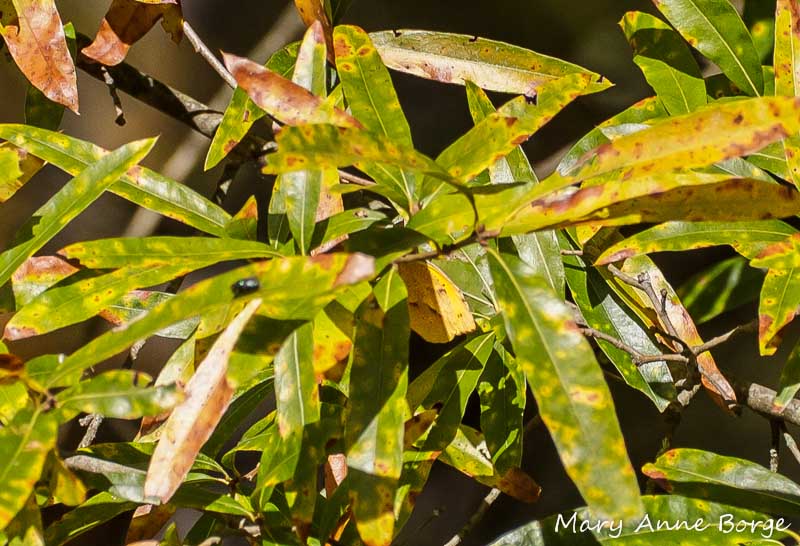
Sleepy Orange basking on Willow Oak - Can you see the butterfly?

Sleepy Orange basking on Willow Oak – Can you see the butterfly?

Only very rarely did I see them nectaring, although they may have been feeding more than I was able to observe, possibly on blossoms of young plants at nearly ground level, like this aster.
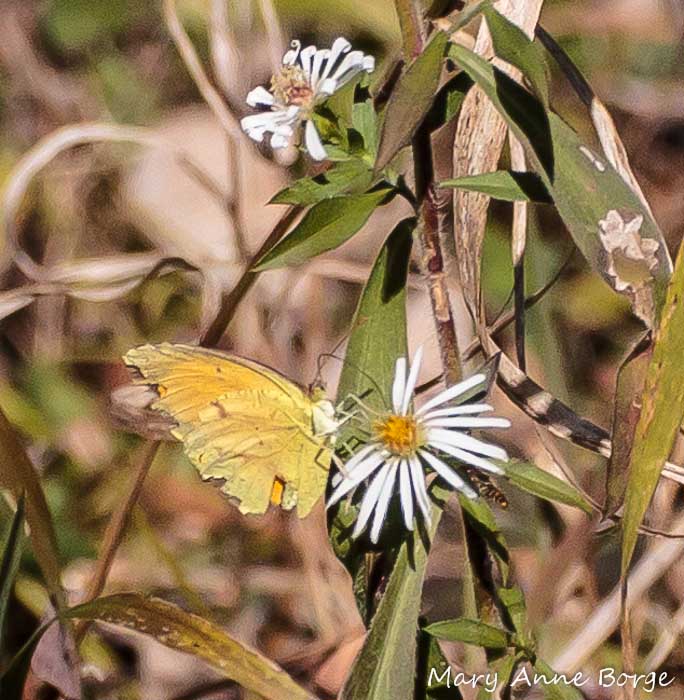
Sleepy Orange nectaring on aster

Sleepy Orange nectaring on aster

The spot where I saw the butterflies most frequently is a small meadow area with lots of young plants (including Wild Senna, their caterpillar food plant) and exposure to afternoon sun.

My last sighting of an adult was on November 2, a mild sunny day with a high in the mid-60s.  Given the current temperatures, I’m pretty sure that will be my last sighting until next year.

So it appears that the Sleepy Oranges are at least attempting to overwinter here, probably as adults, and probably in the shelter of the plants and fallen leaves on the ground.  Lets see if they’re successful.  This fall and winter is starting out a bit colder than normal, so even if they have survived the winter here in the past, it doesn’t necessarily mean they’ll make it this year.  I hope they do!

Even if they do overwinter here, it doesn’t exclude the possibility that they might also have a second strategy that involves migration.

I’ll keep you posted.

Sleepy Orange, winter form

Sleepy Orange, winter form

Resources:

Cech, Rick; Tudor, Guy.  Butterflies of the East Coast.  2005.

In Praise of Black Walnut Trees

If you go for a walk in the woods any time soon, you may still encounter black walnuts or the remains of their hulls on the ground.

Fallen Black Walnuts

Fallen Black Walnuts

The nuts usually remain on the tree until after the leaves fall, reminding me of a Charlie Brown Christmas tree.  Then all the nuts fall within a short time of each other.  These nuts are sweet tasting and highly nutritious.  Studies show that eating them helps prevent cardiovascular disease, diabetes and cancer.  Walnuts have as much protein as an equal weight of beef, but they also contain essential fatty acids that are necessary for healthy brain development and function.  Any aging brains out there?  Eat walnuts!

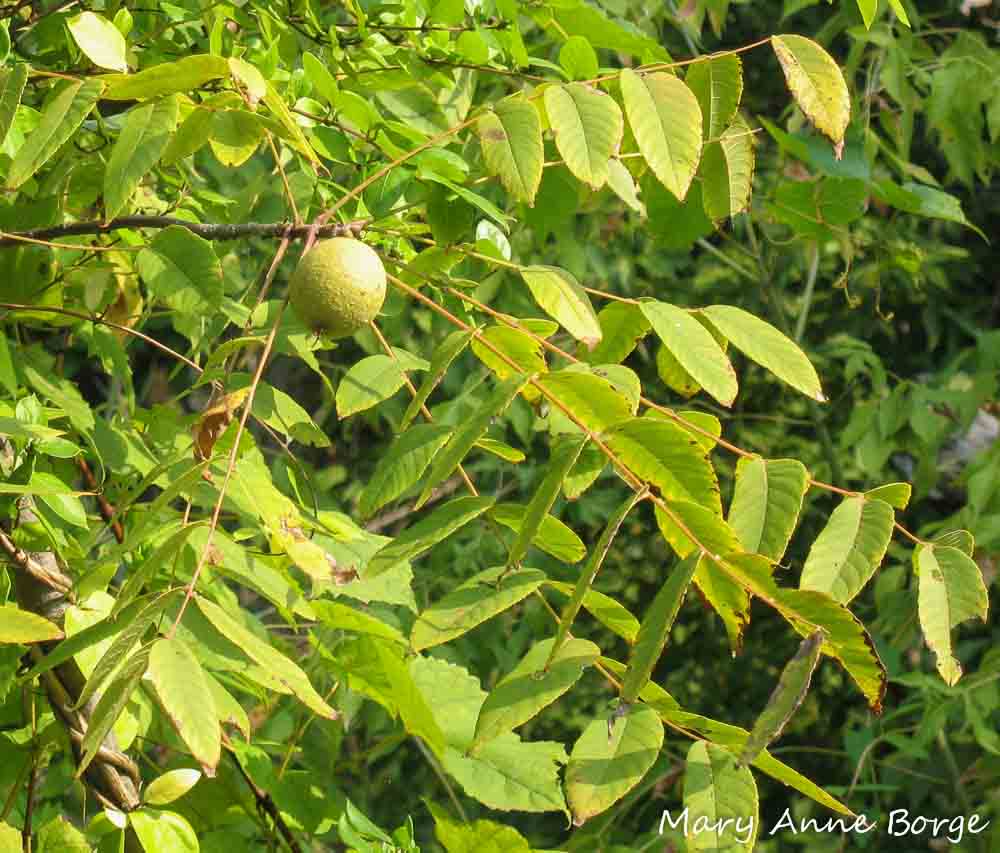
Black Walnut (Junglans nigra)

Black Walnut (Junglans nigra)

Mammals other than humans like them, too: squirrels, mice and voles, for example.

Eastern Gray Squirrels eat and help disperse Walnuts

Eastern Gray Squirrels eat and help disperse Walnuts

Red Squirrels also enjoy many tree nuts, including Walnuts

Red Squirrels also enjoy many tree nuts, including Walnuts

These animals aid in the spread of Walnut trees when they overlook some of the nuts they have hidden away for later use, effectively planting them.

In turn, these animals are food for larger animals, like fox

Red Fox

Red Fox

and raptors.

Red-shouldered Hawks, as well as most other raptors, hunt and eat small mammals

Red-shouldered Hawks, as well as most other raptors, hunt and eat small mammals

According to Douglas Tallamy in Bringing Nature Home, the leaves of Black Walnut (Juglans nigra) trees and the closely related Butternut (Juglans cinerea) provide food for the caterpillars of over 100 species of moths and butterflies, including Luna Moths and Banded Hairstreaks.

Banded Hairstreak on Butterflyweed. Their caterpillars feed on the leaves of Black Walnut and other woody species

Banded Hairstreak on Butterflyweed. Their caterpillars feed on the leaves of Black Walnut and other woody species

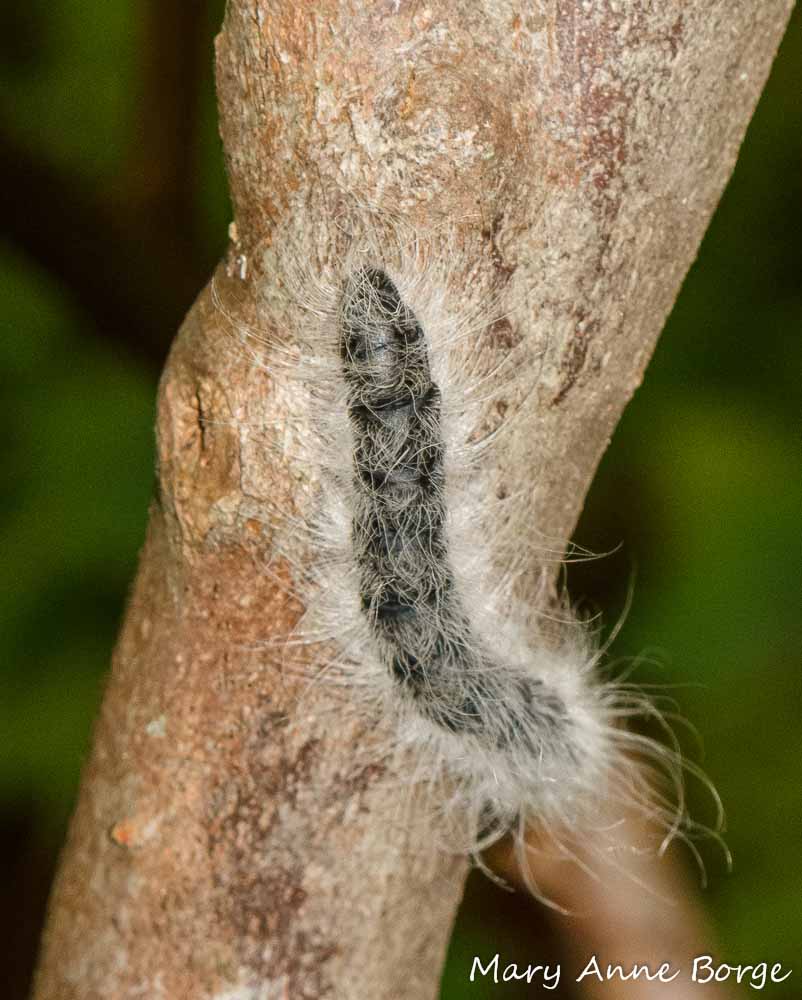
The Walnut Caterpillar specializes on Black Walnut and relatives such as Butternut.  This means the leaves of these trees are the only food these caterpillars can eat.

Walnut Caterpillar (Datana integerrima)

Walnut Caterpillar (Datana integerrima)

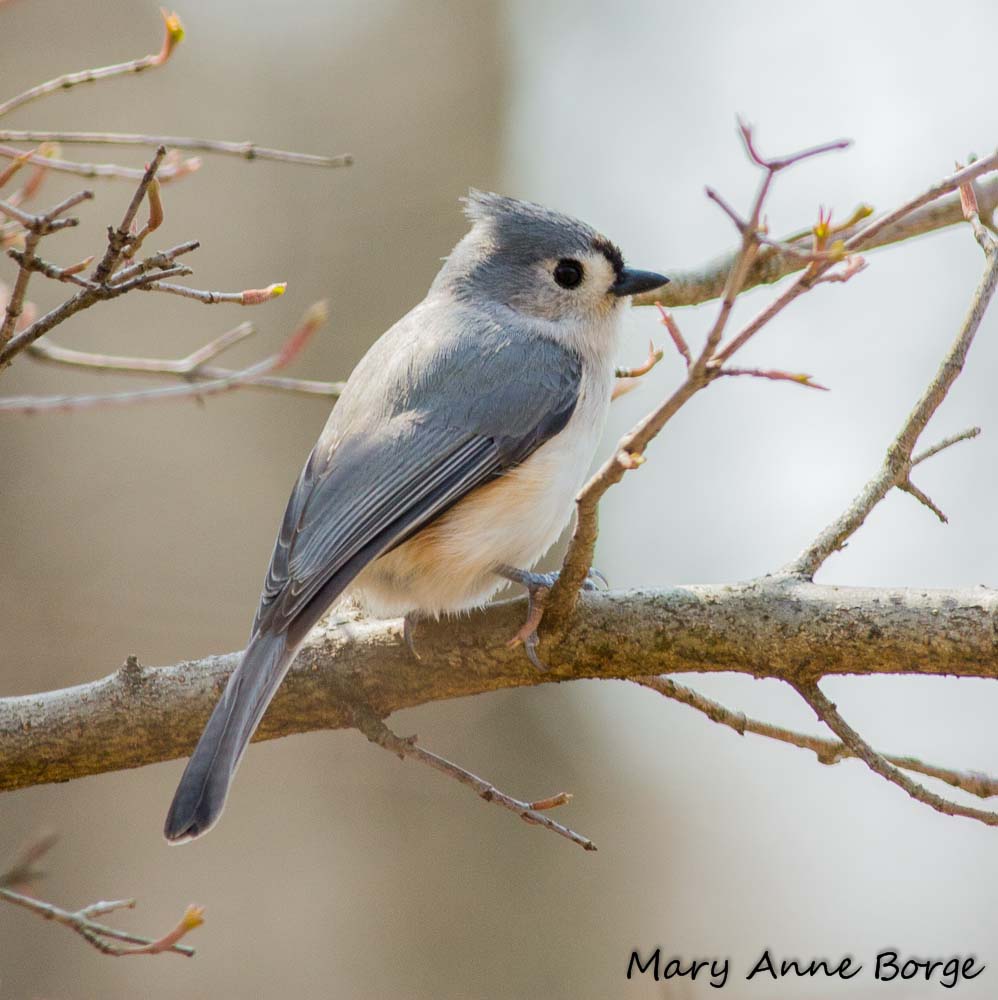
Since they are an important source of food for birds, not all caterpillars will see life as an adult butterfly or moth.

Tufted Titmouse

Tufted Titmouse

Black Walnut trees have a reputation for not playing well with other plants. That is, many plants won’t grow successfully in close proximity (within the drip-line or reach of the roots) of a Black Walnut. The reason is more complex than shade and competition for water.  Black Walnuts contain juglone, which is an anti-fungal chemical.  In order to derive nutrients from the soil, the vast majority of plants partner with underground mycorrhizal fungi (think mushroom, not the mold in your shower).  Unless the fungi on which the plant depends is resistant to juglone, or the plant doesn’t require this partnership to obtain its nutrition, that plant won’t do well.  Of course, some plants and their fungi partners have evolved in exactly this way.  Click here for some suggestions from The Mortem Arboretum for plants that can co-habit successfully with Black Walnut trees.

It’s of benefit to Black Walnut trees to produce juglone, since it does reduce competition for resources, and protects the trees from fungal invaders that might do them harm. Juglone also has sedative properties that may aid animals in dormancy. It can even have a calming effect on people.

Black walnut trees contain another compound called ellagic acid in both their nuts and leaves. This compound is thought to help prevent cancer in people who consume the nuts. The ellagic acid in the leaves is effective in removing carcinogenic hydrocarbons from the air, helping to reduce the effects of air pollution.

As if that weren’t enough, Black Walnut’s wood is valuable for furniture and cabinet making, and the nut hulls can be used to make a dye.

Black Walnut with hull partially removed

Black Walnut with hull partially removed

These are just some of the known benefits of Black Walnut trees.  Just imagine what we don’t know yet!  No wonder ‘juglans’ is sometimes translated as ‘nut of Jupiter’, or ‘nut of the gods’.

Black Walnut Tree (Juglans nigra)

Black Walnut Tree (Juglans nigra)

Resources

Beresford-Kroeger, Diana.  Arboretum America: A Philosophy of the Forest.  2003

Eastman, John. The Book of Forest and Thicket. 1992.

Tallamy, Douglas W.  Bringing Nature Home.  2007

Wagner, David L.  Caterpillars of Eastern North America.  2005.

Butterflies and Moths of North America

Natural History Museum Database of Leipidoptera Hostplants

Nutritious Fall Foliage: What makes leaves so colorful?

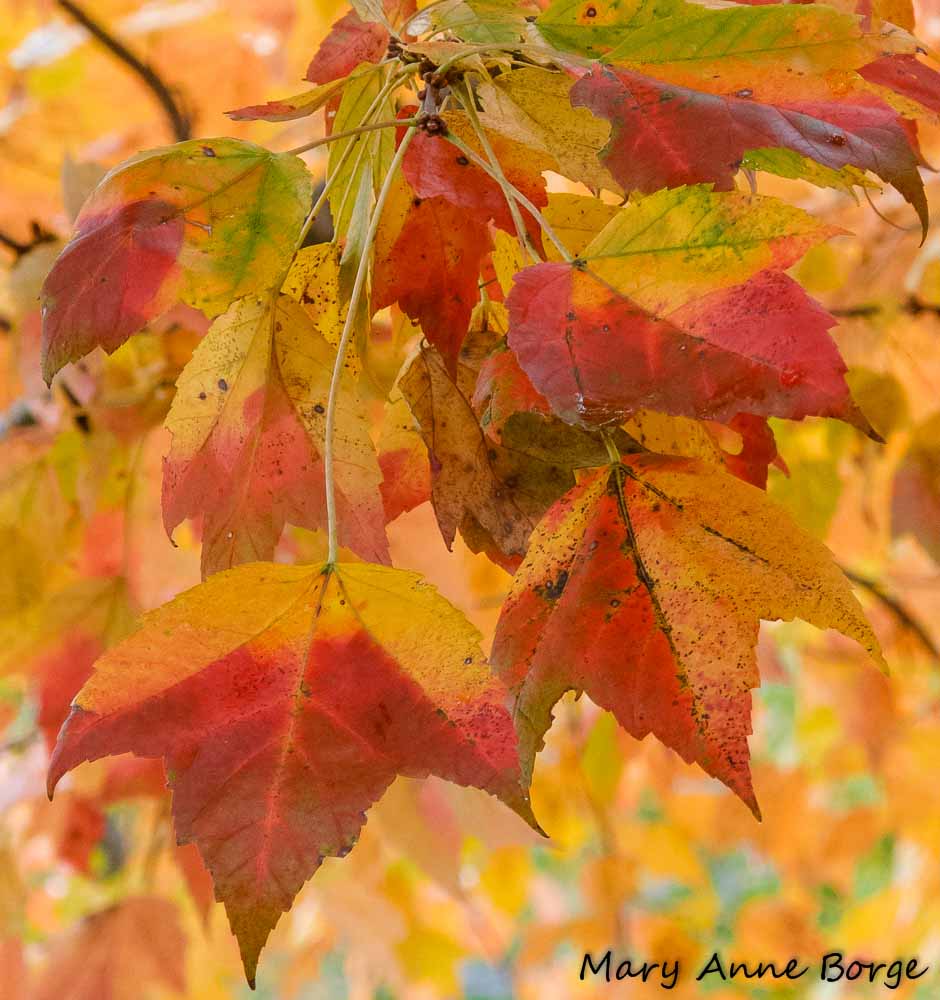
Red Maple (Acer rubrum)

Red Maple (Acer rubrum)

On Halloween, the Red Maple (Acer rubrum) outside our kitchen window gave up the ghost, so to speak. The leaves on the north side of the tree had been changing colors for weeks, but the rest of the tree remained stubbornly green.  Overnight, the entire tree was awash in reds and oranges.

It’s the change in day length (or really night length) and temperature that signals deciduous trees and shrubs that it’s time to get ready for winter. They have to drop their leaves to protect themselves from damage that would be caused due to the heavy weight of winter ice and snow storms. As nights get longer and temperatures drop, these woody plants gradually slow and eventually stop replenishing chlorophyll, the substance that is responsible for the green pigment in their leaves.

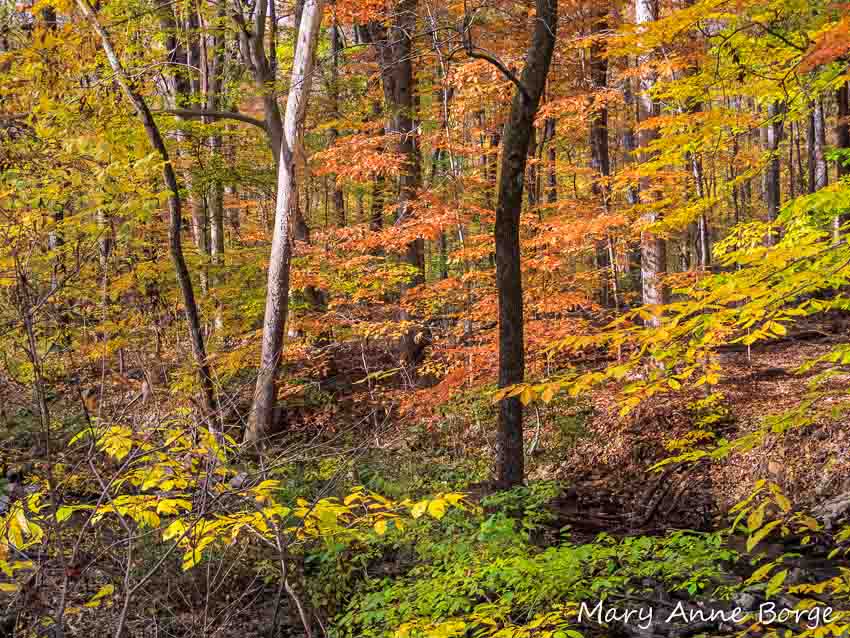
Alexauken Wildlife Management Area, West Amwell, New Jersey

Alexauken Wildlife Management Area, West Amwell, New Jersey

But what accounts for the array of colors that are revealed as the chlorophyll gradually disappears? The yellow, orange, red, purple, bronze and browns?

These colors reflect some of the same nutrients that are present in the plant-based foods we eat. Many of these chemicals were present throughout the growing season, but were masked by or blended with the green of the chlorophyll.

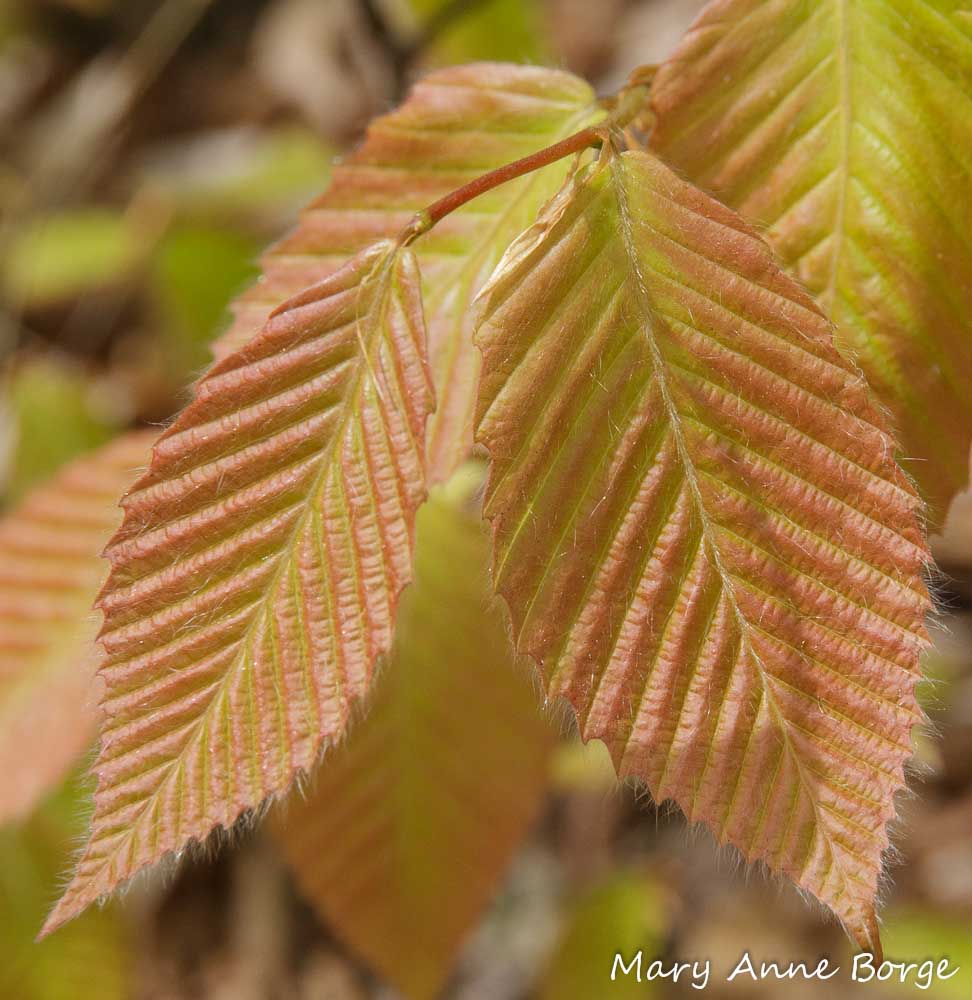
American Beech (Fagus grandifolia) Leaves in Spring

American Beech (Fagus grandifolia) Leaves in Spring

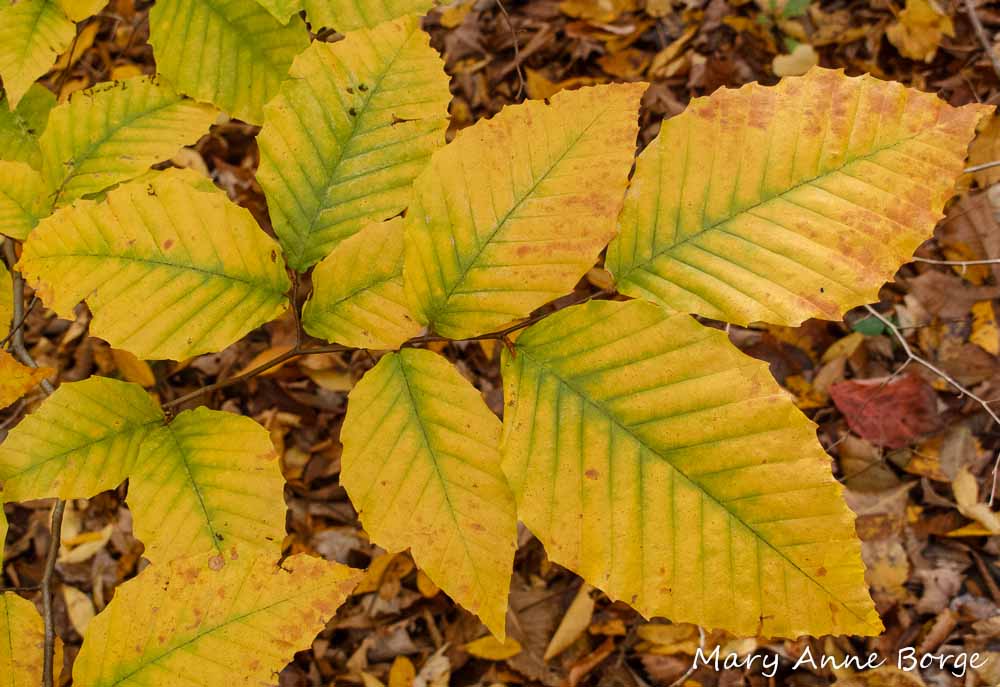
American Beech (Fagus grandifolia ) Leaves in Fall

American Beech (Fagus grandifolia ) Leaves in Fall

The yellows are carotenoids, mainly xanthophylls, nutrients that help to reduce inflammation, boost the immune system and reduce tumor growth. They are present in yellow summer squash, beets, carrots, corn, peppers, green leafy vegetables, and many others. Xanthophylls help plants to absorb energy from the sun while protecting tissues against the sun’s intense radiation.

Alexauken Wildlife Management Area, West Amwell, New Jersey

Alexauken Wildlife Management Area, West Amwell, New Jersey

Carotenes (another group of carotenoids) are responsible for the orange shades revealed in fall leaves. Beta-carotene is an anti-oxidant, visible in the orange color of foods like winter squash, carrots and sweet potatoes. They assist in photosynthesis, and help protect plant tissues from too much exposure to the sun’s rays.

American Hornbeam (Carpinus caroliniana) or Ironwood

American Hornbeam (Carpinus caroliniana) or Ironwood

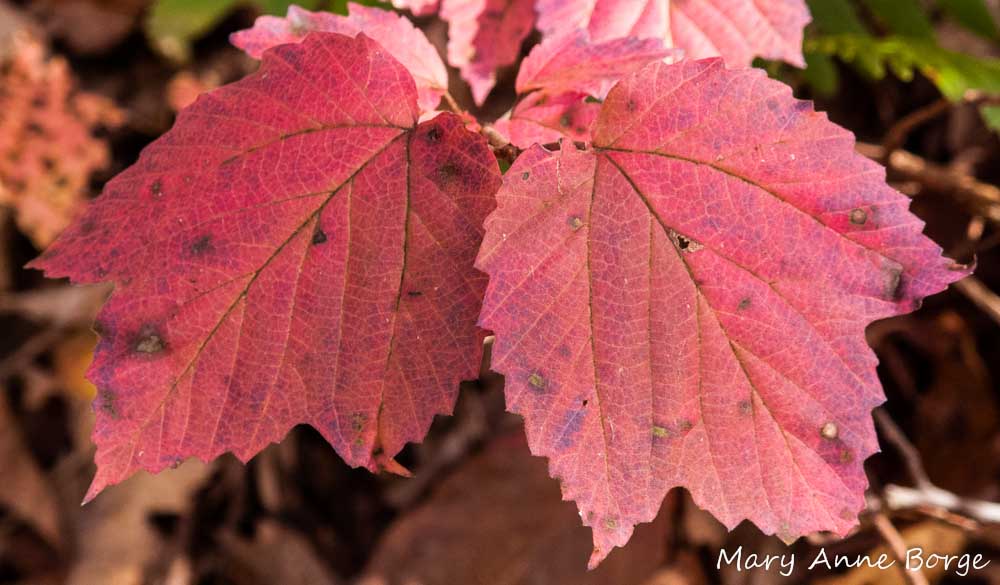
Reds and purples are anthocyanins, nutrients found in foods like blueberries, blackberries, cherries, grapes (and red wine; yay!), purple cabbage, other purple-tinged greens like red leaf lettuce, some kale and swiss chard, as well as many others that show red or purple colors.  Anthocyanins are antioxidants, with anti-inflammatory, anti-viral, and anti-cancer properties.  Plants may also benefit from anthocyanin’s antioxident effect, and the dark colored pigments help protect from sun damage. They continue to manufacture these chemicals until the leaves fall.

Maple-leaf Viburnum (Viburnum acerifolium)

Maple-leaf Viburnum (Viburnum acerifolium)

Brown and tan colors show the presence of tannins. They tend to be bitter or astringent tasting, and as a result discourage browsing by herbivores (plant-eaters) so they may provide some protection to plants. Tannins are found in foods like grapes, wine, tea, and chocolate, though, so you can see that this protection isn’t foolproof.

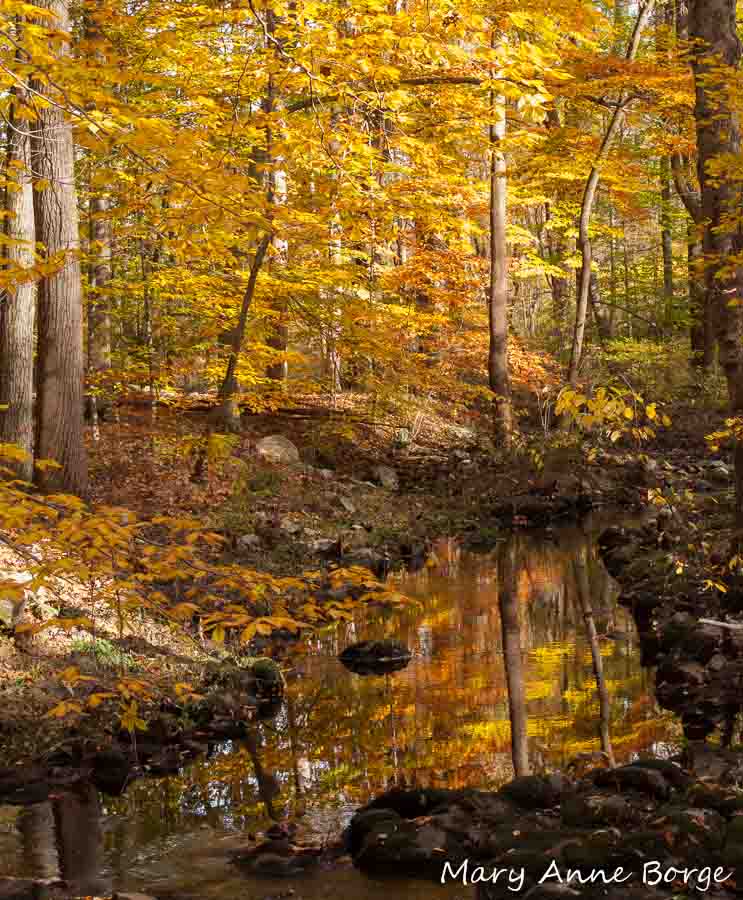
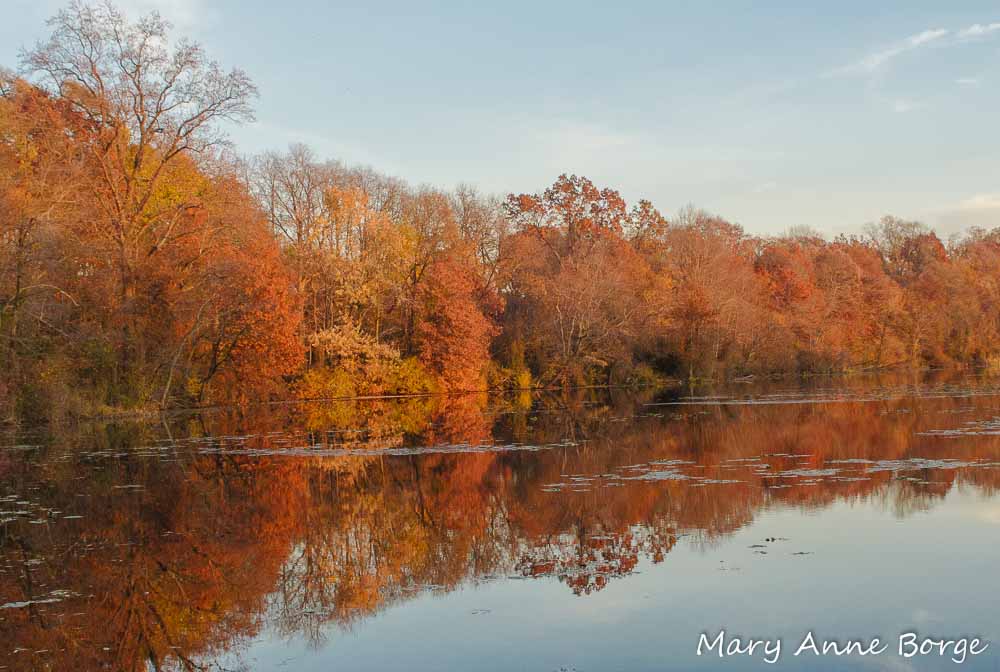
Spring Lake at Roebling Park, Abbott Marshlands, Hamilton Township, New Jersey

Spring Lake at Roebling Park, Abbott Marshlands, Hamilton Township, New Jersey

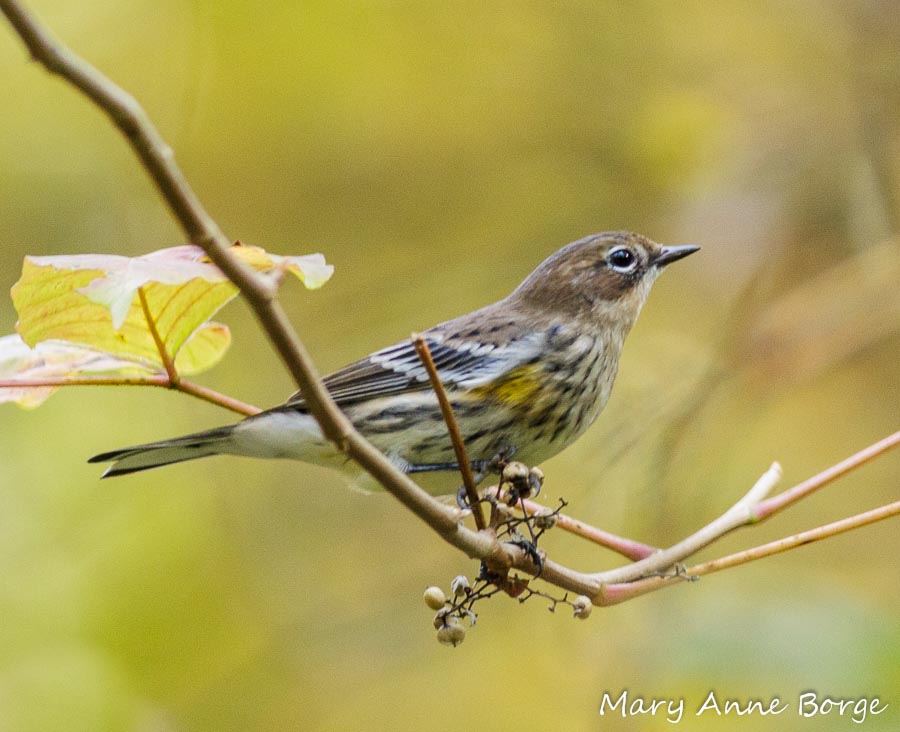
There is overlap and blending of colors based on the mix of chemicals in the leaves. These bright colors may also signal to birds that there is fruit available for consumption.

Yellow-rumped Warbler with Poison Ivy Fruit

Yellow-rumped Warbler with Poison Ivy Fruit

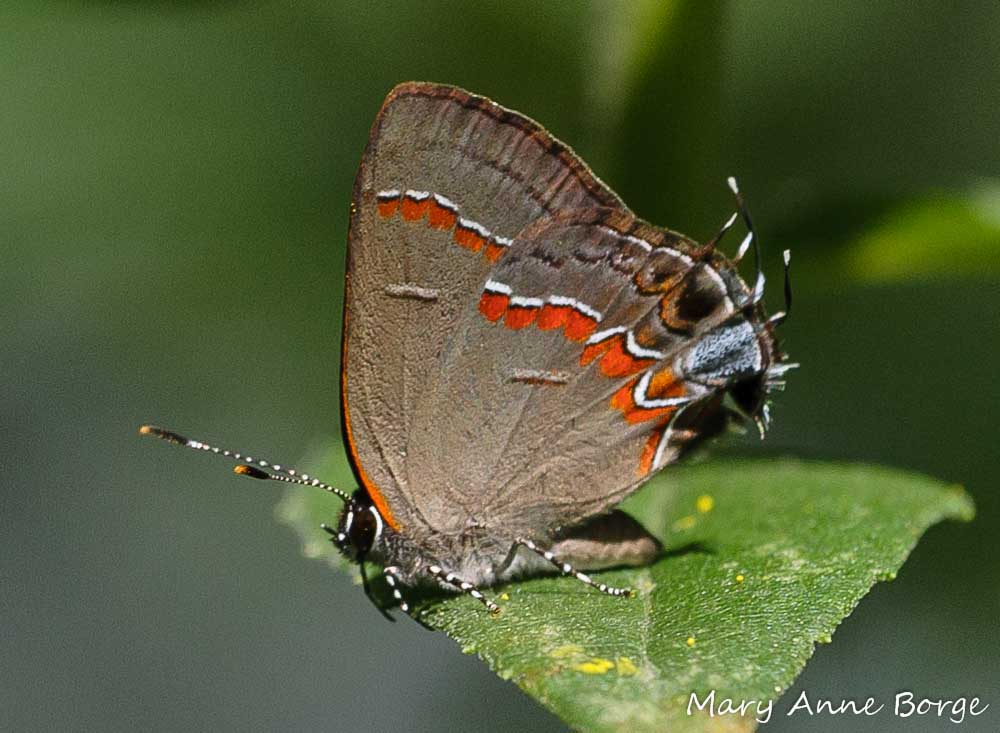
These nutrients, along with others that are obtained from the soil, like calcium and potassium, break down and return to the soil as the fallen leaves gradually decompose. During this process, animals may still take advantage of the nutrients. Red-banded Hairstreak caterpillars, for example, feed on fallen leaves, especially those of sumacs, contributing to the process of decomposition, and the cycle of life for the next generation.

Red-Banded Hairstreak

Red-Banded Hairstreak

A few days later, and the leaves on our Red Maple have almost all fallen. We’ll watch them gradually break down, nourishing the soil, and the plants and animals that rely on them.

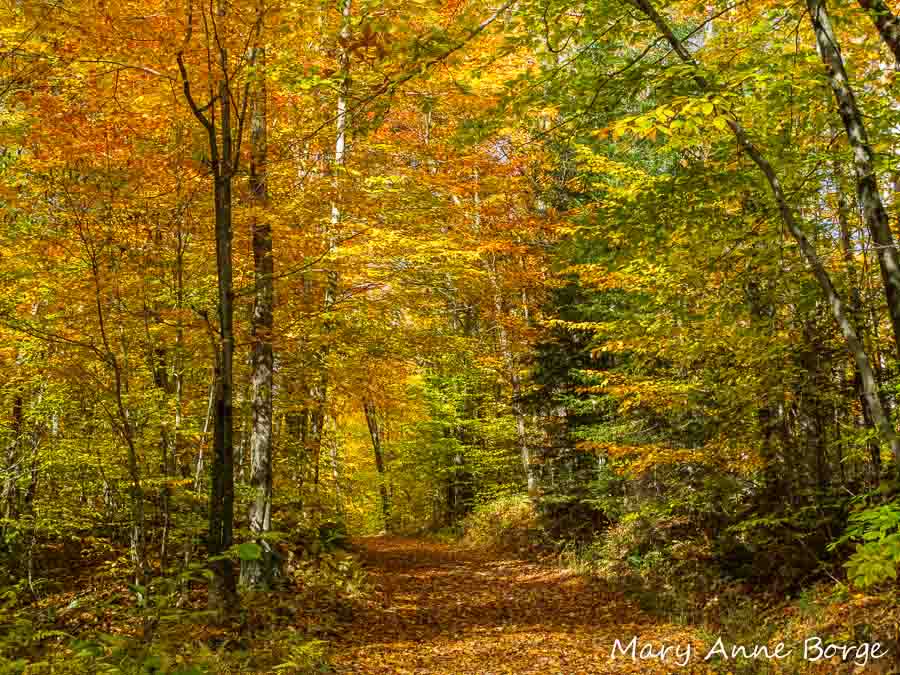
Haul Road at the Trapp Family Lodge, Stowe, Vermont

Haul Road at the Trapp Family Lodge, Stowe, Vermont

Resources

http://science.jrank.org/pages/5303/Plant-Pigment-Carotenoids.html

http://www.usna.usda.gov/PhotoGallery/FallFoliage/ScienceFallColor.html

Embracing the Shade: Summer and Fall

Is it possible to have a perennial shade garden with continuous bloom throughout the summer and fall?  By June, the trees are fully leafed out, sheltering our home from the summer sun’s strong rays. That means that the garden is in the shade, too. Will anything be blooming? You bet.

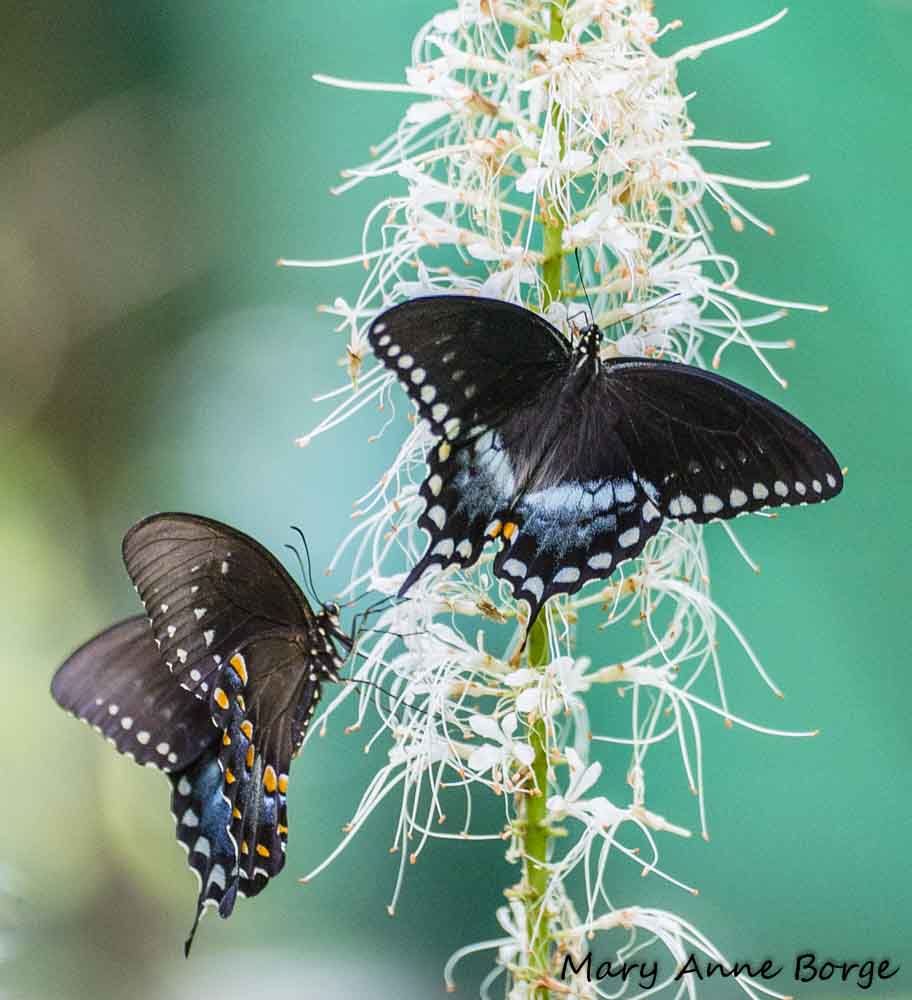
Spicebush Swallowtails nectaring on Bottlebrush Buckeye

Spicebush Swallowtails nectaring on Bottlebrush Buckeye

Some spring bloomers, like Heartleaf Foamflower (Tiarella cordifolia) and Virginia Goldenstar (Chrysogonum virginianum), also called Green and Gold, may continue their display into the summer months. While not yet blooming, the leaves of White Wood Aster (Eurybia divaricata) join the violets, ferns, and Spreading Sedge (Carex laxiculmis) to form a ground cover blanketing much of the garden. Arching four to five feet above them are long sprays of Goat’s-beard (Aruncus dioicus) a.k.a. Bride’s Feathers’ tiny white flowers, lighting up the deep shade. June brings Rosebay Rhododendron (Rhododendron maximum) and Wild Hydrangea (Hydrangea arborescens) blossoms, too.

Bottlebrush Buckeye (Aesculus parviflora) is part of the shrub layer in the woods behind our house. In July, this reliable bloomer with its large palmately compound leaves and tall spikes of white tubular flowers attracts Ruby-throated Hummingbirds in addition to Spicebush and Eastern Tiger Swallowtails.

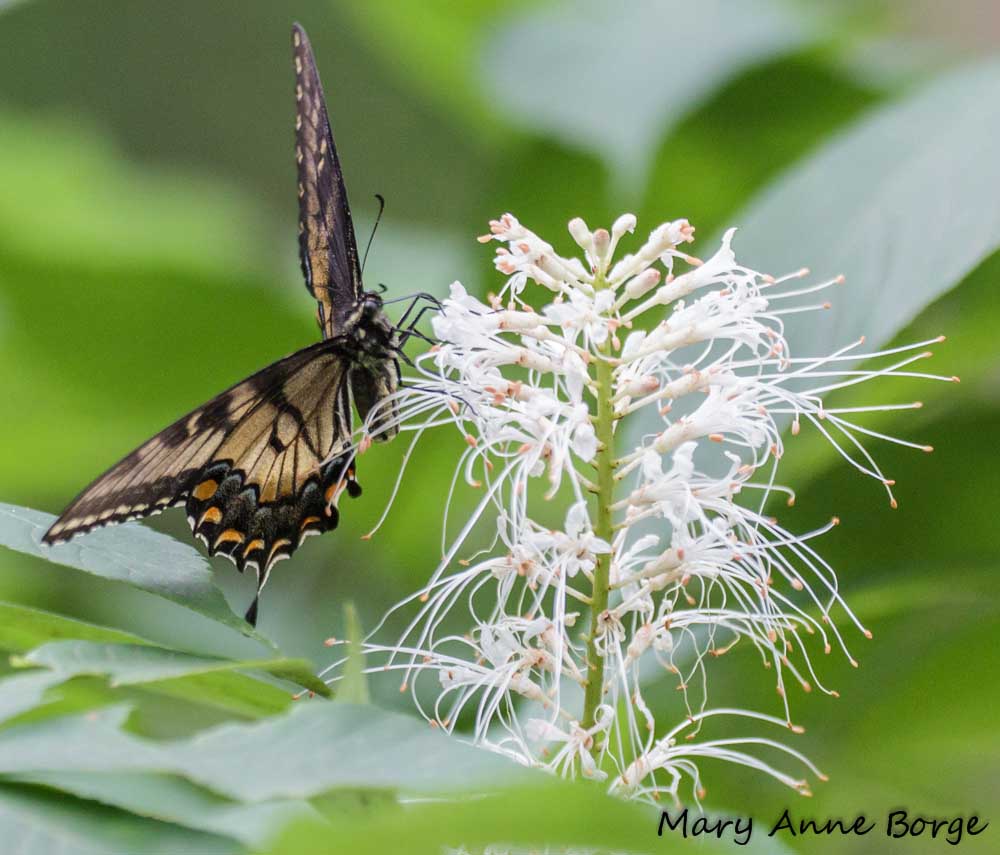
Dark form Eastern Tiger Swallowtail nectaring on Bottlebrush Buckeye

Dark form Eastern Tiger Swallowtail nectaring on Bottlebrush Buckeye

Last summer we were surprised to see dark morph Tiger Swallowtails nectaring on the Bottlebrush Buckeye. By adopting this Pipevine Swallowtail-like coloration disguise, the Tiger Swallowtails gain some protection from being eaten by birds and other predators who have learned of the Pipevine Swallowtail’s toxicity. The dark morph occurs most frequently in areas where Pipevine Swallowtails are present. Maybe Dutchman’s Pipevine (Aristolochia macrophylla) and its namesake swallowtail are increasing in our area!

Courting Zabulon Skippers on Purple Giant Hyssop

Courting Zabulon Skippers on Purple Giant Hyssop

July is also the beginning of Purple Giant Hyssop’s (Agastache scrophulariifolia) long bloom, lasting well into September. We have it in both deep shade and a spot that gets a few hours of afternoon sun, blooming dependably in both locations. This herbaceous plant is a great choice for a woodland garden, with a growth form that is similar to Butterfly Bush. In our garden, butterflies from the smallest skippers to the largest swallowtails love Purple Giant Hyssop. Bees love it, too, and even hummingbirds may drink from the nectar-packed purple flowers.

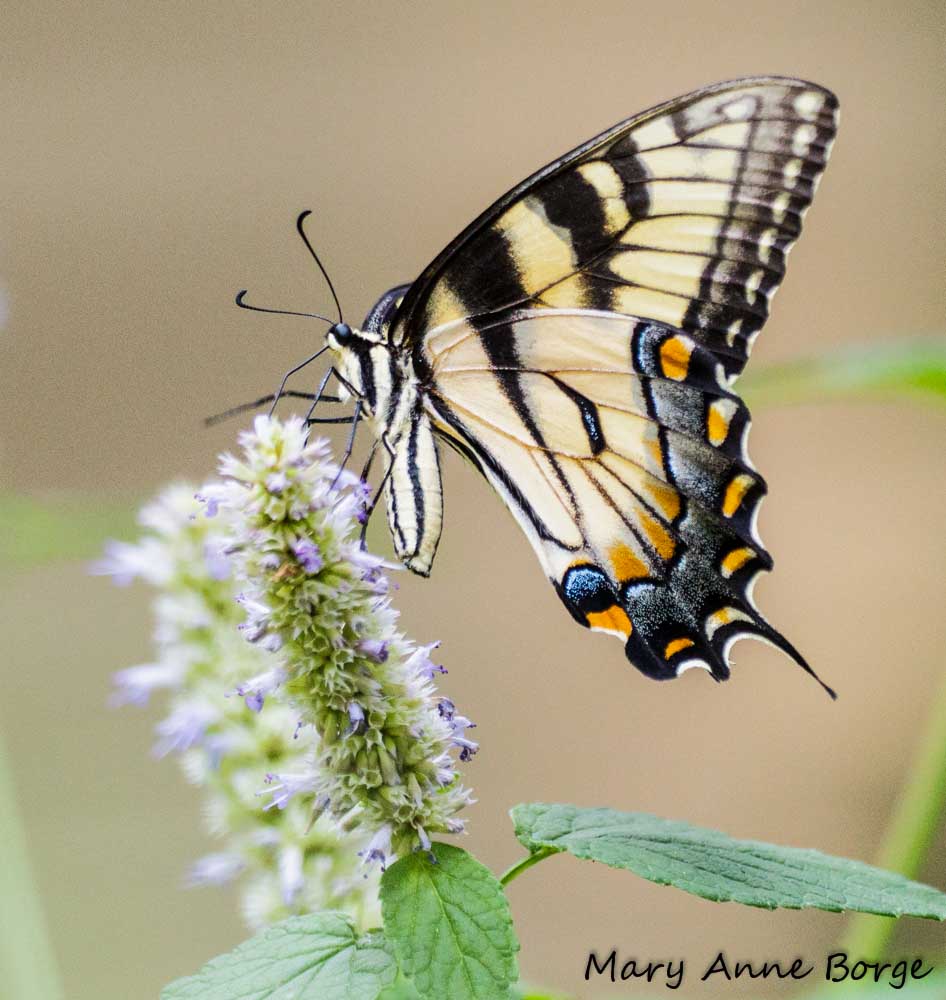
Eastern Tiger Swallowtail nectaring on Purple Giant Hyssop

Eastern Tiger Swallowtail nectaring on Purple Giant Hyssop

Pollinators can’t resist Mountain Mints.

Sweat Bee (Lasioglossum species) on Short-toothed Mountain Mint

Sweat Bee (Lasioglossum species) on Short-toothed Mountain Mint

I decided to try Short-toothed Mountain Mint (Pycnanthemum muticum), also called Clustered Mountain Mint, the only one of the Mountain Mint (Pycnanthemum) species I thought could tolerate some shade. I put it in the one location that gets about four hours of afternoon sun, and I got lucky. While not as robust as it would be in a sunnier spot, it’s doing well, its tiny magenta and white blossoms enticing the smaller butterflies like azures and skippers throughout July and August.

Summer Azure nectaring on Short-toothed Mountain Mint

Summer Azure nectaring on Short-toothed Mountain Mint

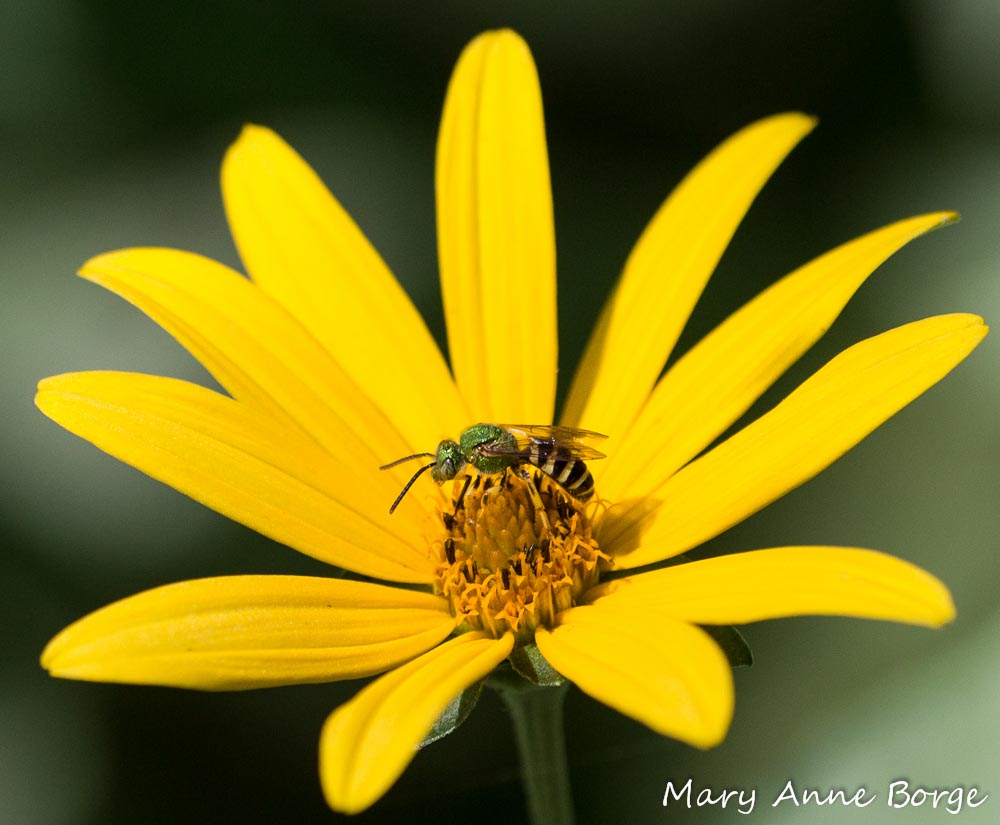
As summer progresses, False Sunflower (Heliopsis helianthoides) radiates bright yellow sunbursts at the wood’s edge from July well into September.

Sweat Bee (Agapostemom species) on False Sunflower (Heliopsis helianthoides)

Sweat Bee (Agapostemom species) on False Sunflower (Heliopsis helianthoides)

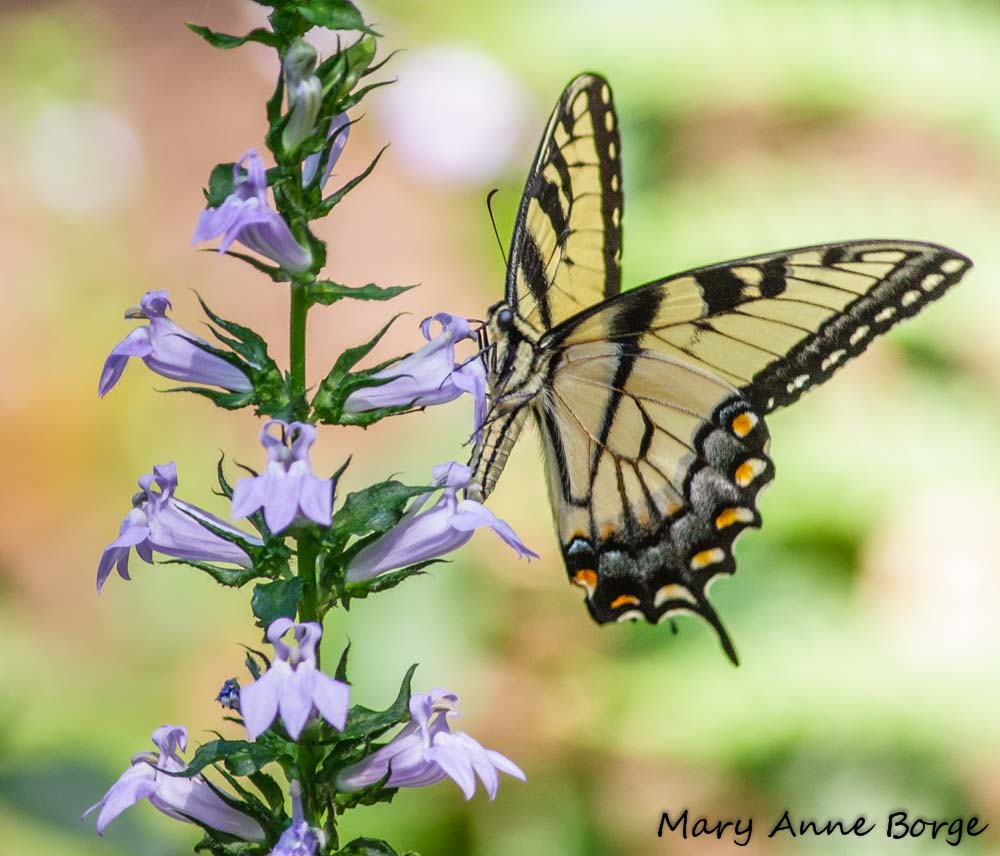
Eastern Tiger Swallowtails and Bumble Bees are frequent diners at Great Blue Lobelia (Lobelia siphilitica), open for business during August and September.  Even Ruby-throated Hummingbirds will stop here for a drink.

Eastern Tiger Swallowtail nectaring on Great Blue Lobelia

Eastern Tiger Swallowtail nectaring on Great Blue Lobelia

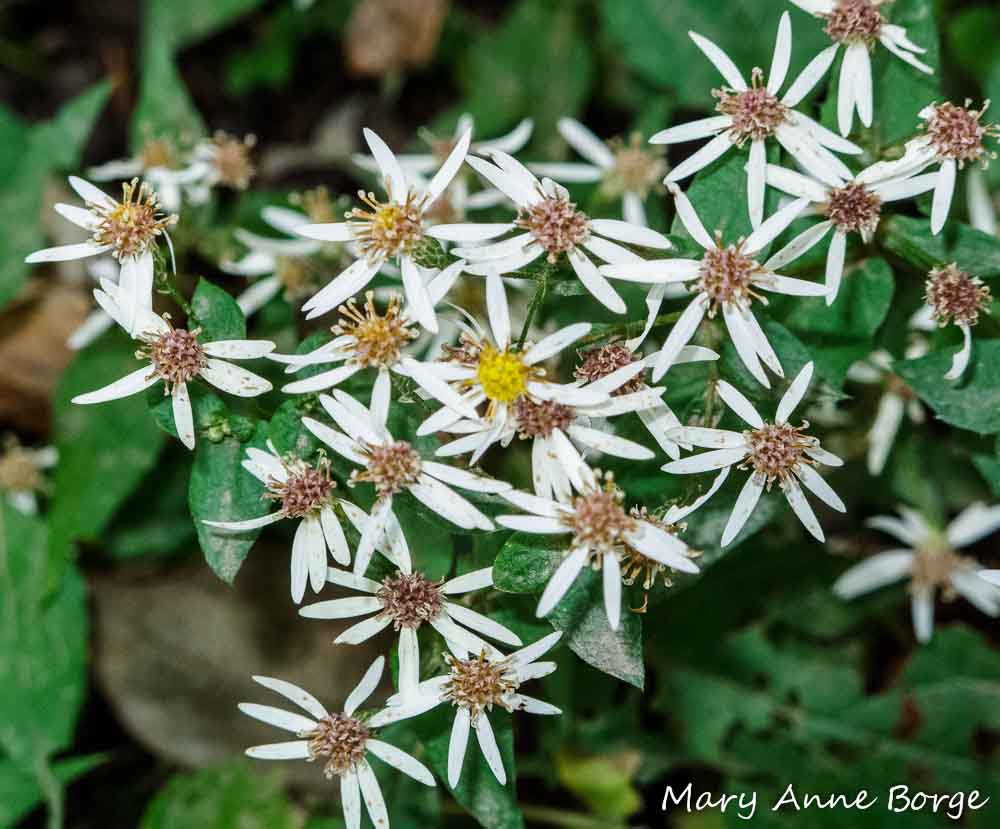
Also in August, after gathering energy from the sun from the earliest spring days when its leaves begin to emerge, White Wood Aster blinks on its light show of white blossoms, illuminating the dense shade through October. The delicate blue disk flowers of Carolina Elephantsfoot (Elephantopus carolinianus) provide a complementary offset in August and September.

White Wood Aster

White Wood Aster

Butterfly traffic slows by September, but Black Swallowtails may still lay eggs this late, sometimes on my cooking herbs (parsley and dill).

Black Swallowtail caterpillar eating parsley

Black Swallowtail caterpillar eating parsley

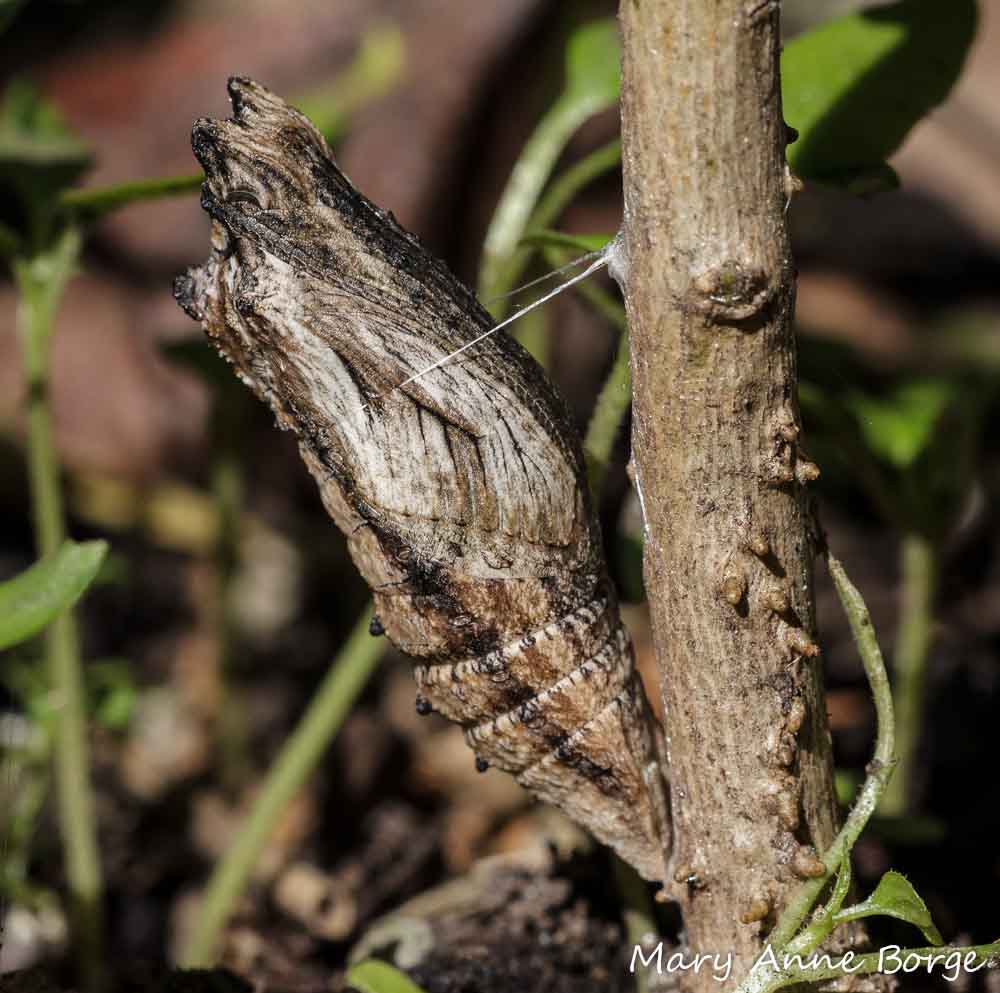
Last fall we hosted a chrysalis on a hot pepper plant.

Black Swallowtail chrysalis on pepper plant

Black Swallowtail chrysalis on pepper plant

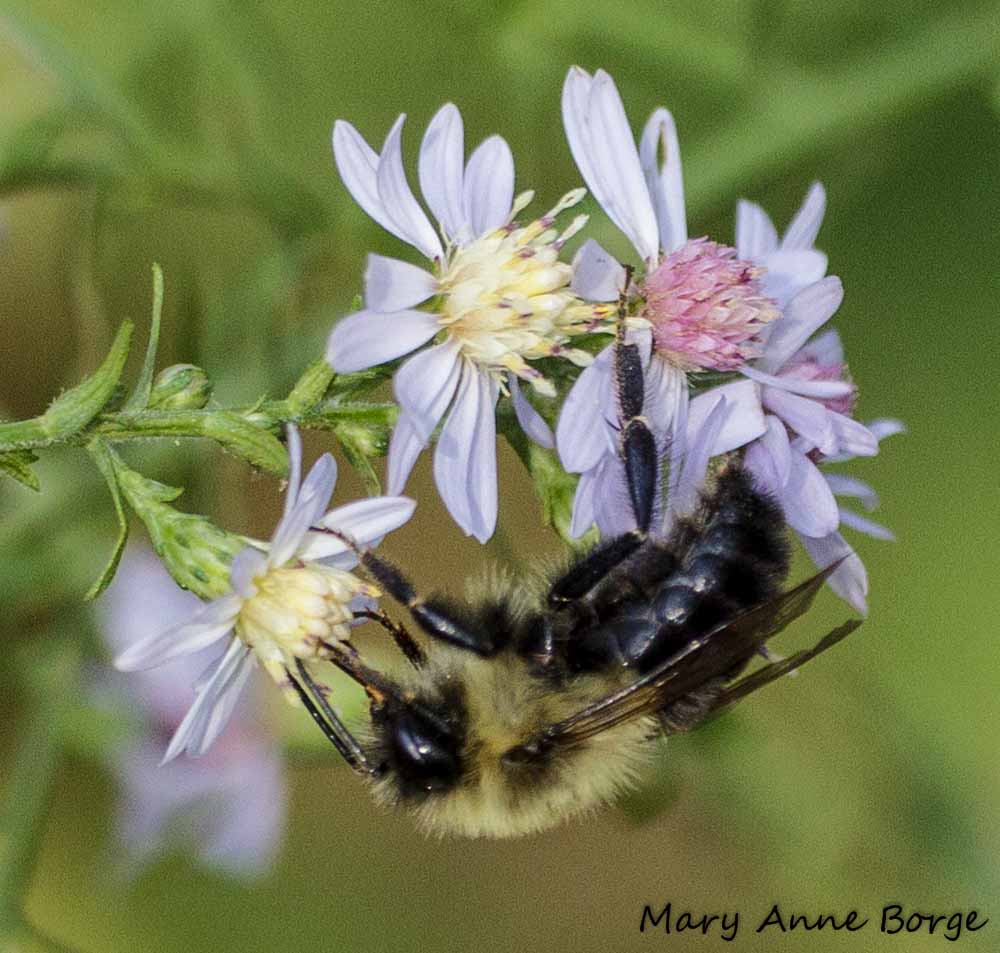
More aster family members begin their fall performance now, including Blue Wood Aster (Symphyotrichum cordifolium),

Blue Wood Aster with Bumble Bee

Blue Wood Aster with Bumble Bee

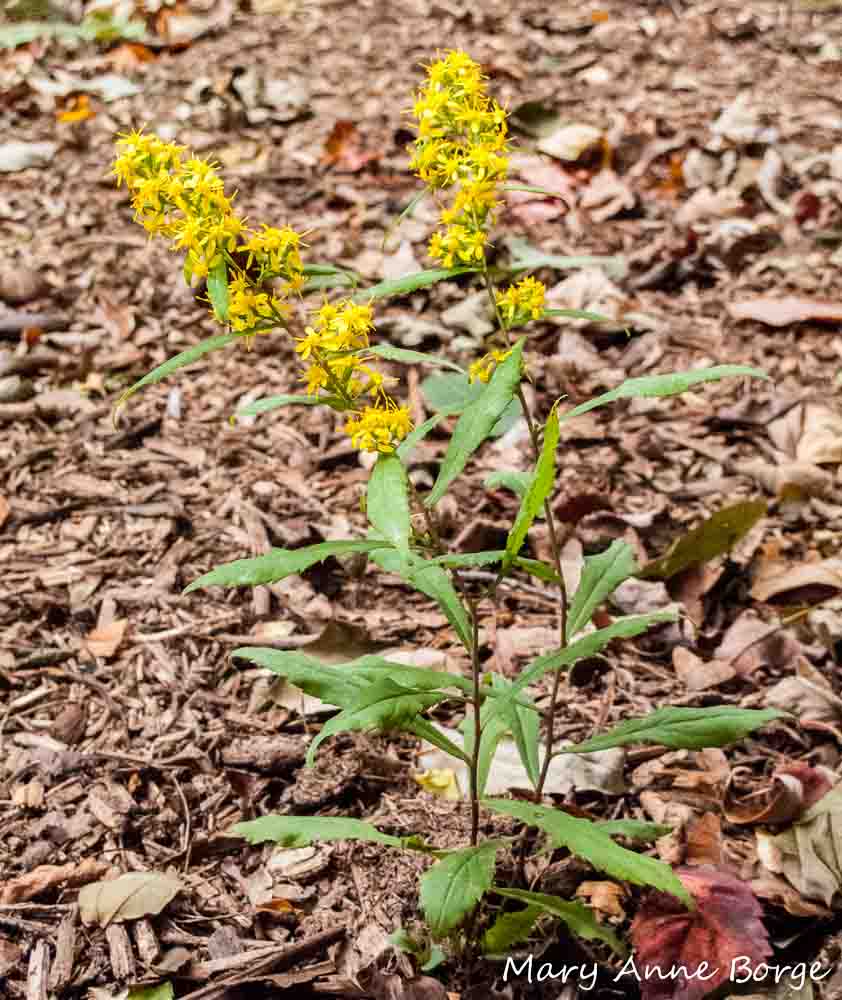
Wreath Goldenrod (Solidago caesia),

Wreath Goldenrod

Wreath Goldenrod

and Zigzag Goldenrod (Solidago flexicaulis), in bloom and offering nectar through October or early November. Like White Wood Aster, all of the foliage of these species emerged in early spring from the winter’s leaf cover.

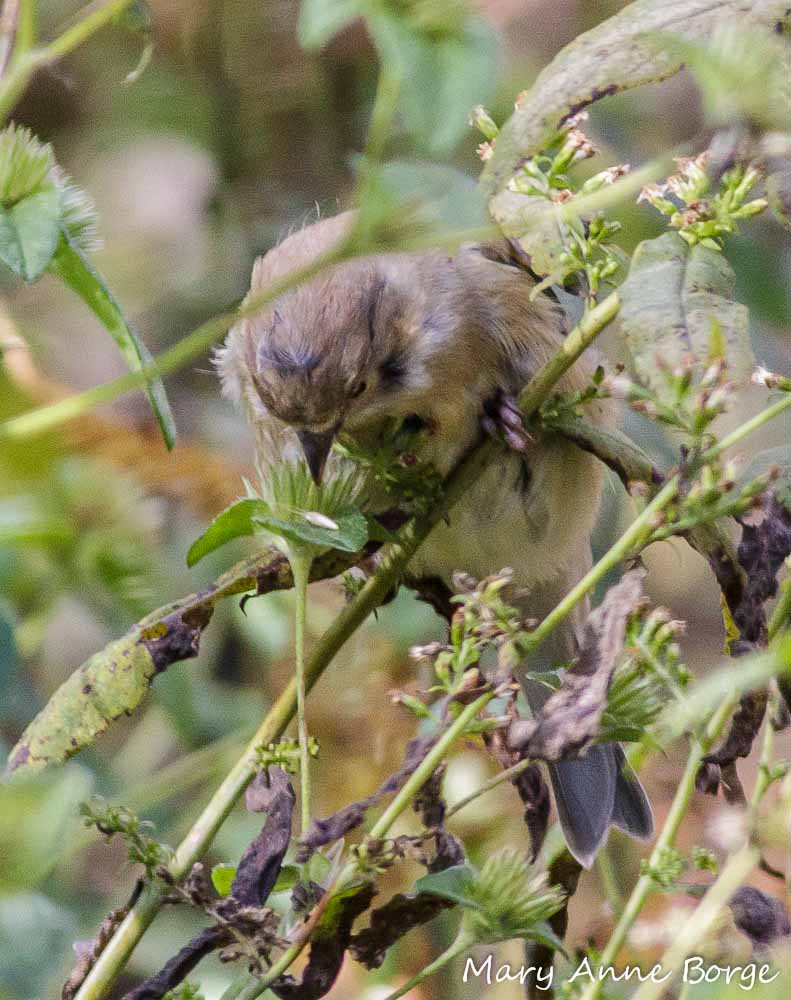
All of these summer and fall blooming species have a reproductive strategy that includes clusters or spikes of flowers that bloom gradually over a period of many weeks, increasing each plant’s chances of pollination by bees, butterflies, and others, and resulting in a long colorful garden display.When successfully pollinated, Purple Giant Hyssop, Carolina Elephantsfoot and Woodland Sunflower offer Chickadees, Goldfinches and other birds a fall bounty of food.

Goldfinch eating Elephant's Foot seeds

Goldfinch eating Elephant’s Foot seeds

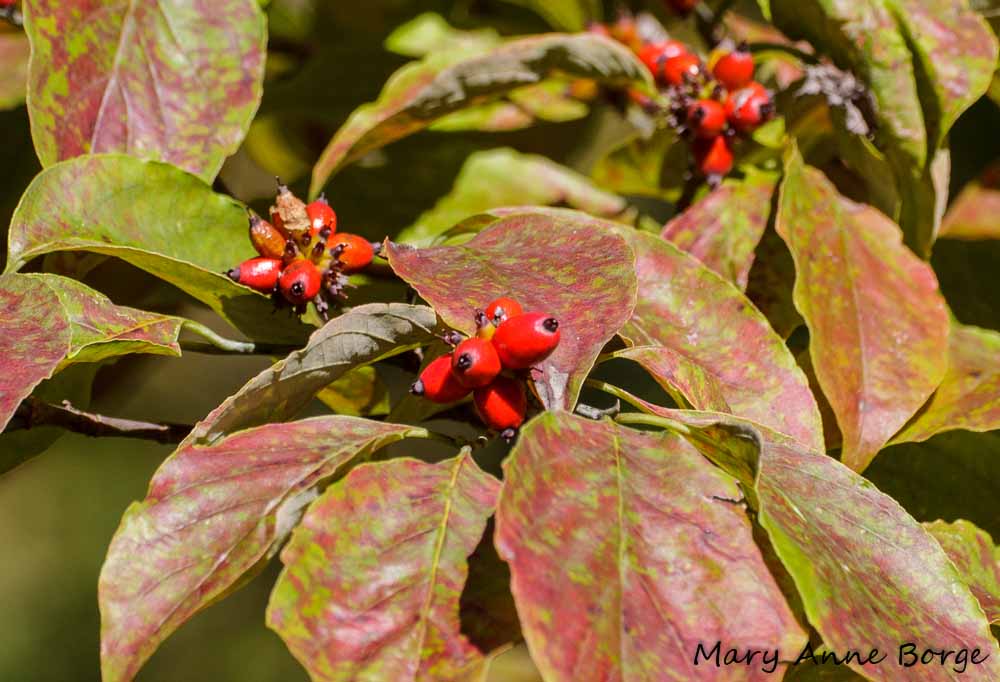
Resident and migrant birds dine on the bright red fruit of Spicebush (Lindera benzoin) and Flowering Dogwood (Cornus florida) and the dark blue fruit of Sassafras (Sassafras albidum) and Blackhaw Viburnum (Viburnum prunifolium). This is after a busy season of acting as caterpillar food plants – Spicebush and Sassafras for Spicebush Swallowtails, Flowering Dogwood and Blackhaw for Spring Azures.

Flowering Dogwood fruit

Flowering Dogwood fruit

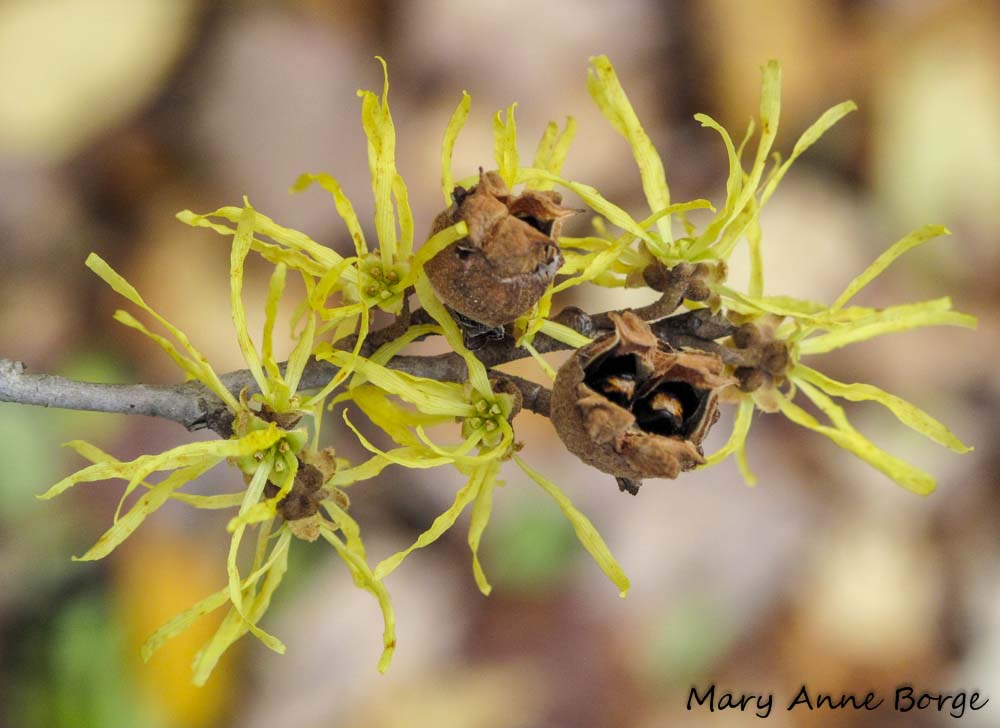
In October and November, Witch-hazel’s (Hamamelis virginiana) spidery yellow blossoms complement the fall foliage.

Witch-hazel flowers and fruits

Witch-hazel flowers and fruits

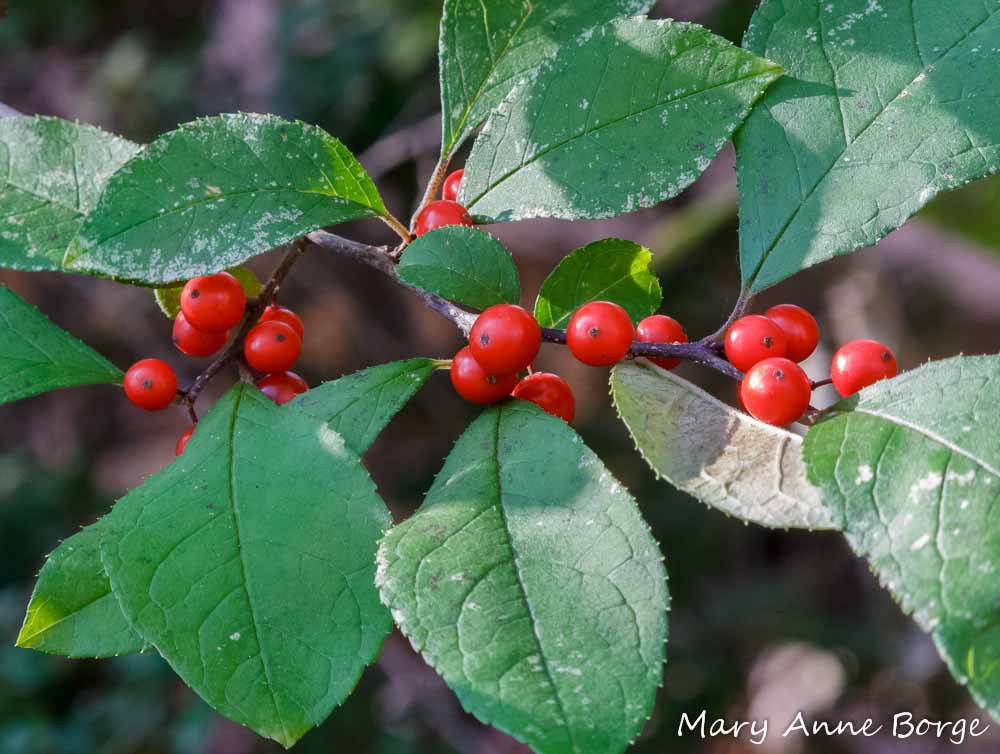
The bright red fruits of Winterberry Holly (Ilex verticillata) may last until late winter, when hungry birds finally eat them.

Winterberry Holly berries

Winterberry Holly berries

Little maintenance is required in this woodland garden. Because the plants have filled in to form a ground cover in most places, there is little weeding to do. We primarily use naturally fallen leaves as mulch, although we may supplement with a bit of prepared leaf compost around the front edges, in deference to our homeowners’ association’s sensibilities.

When we were trying to grow lawn in the shade, it was sparse, and we had problems with standing water after a heavy rainfall. Not anymore. The trees, shrubs and other plants in the garden, as well as the leaf litter, help the soil to absorb rainfall. The shade keeps the soil from drying out too quickly. So once these plants are established, watering is only required when drought conditions become extreme.

Not a bad performance for a woodland garden. And it brings so much pleasure!

Notes:

This is part 3 of a 3 part series.  To see parts 1 & 2, see A Butterfly Garden That Embraces the Shade and  A Butterfly Garden That Embraces the Shade – Spring.

This post was adapted from an article that was originally published in the Summer 2013 issue of Butterfly Gardener, a publication of the North American Butterfly Association.

Cloudless Sulphurs Are on the Move

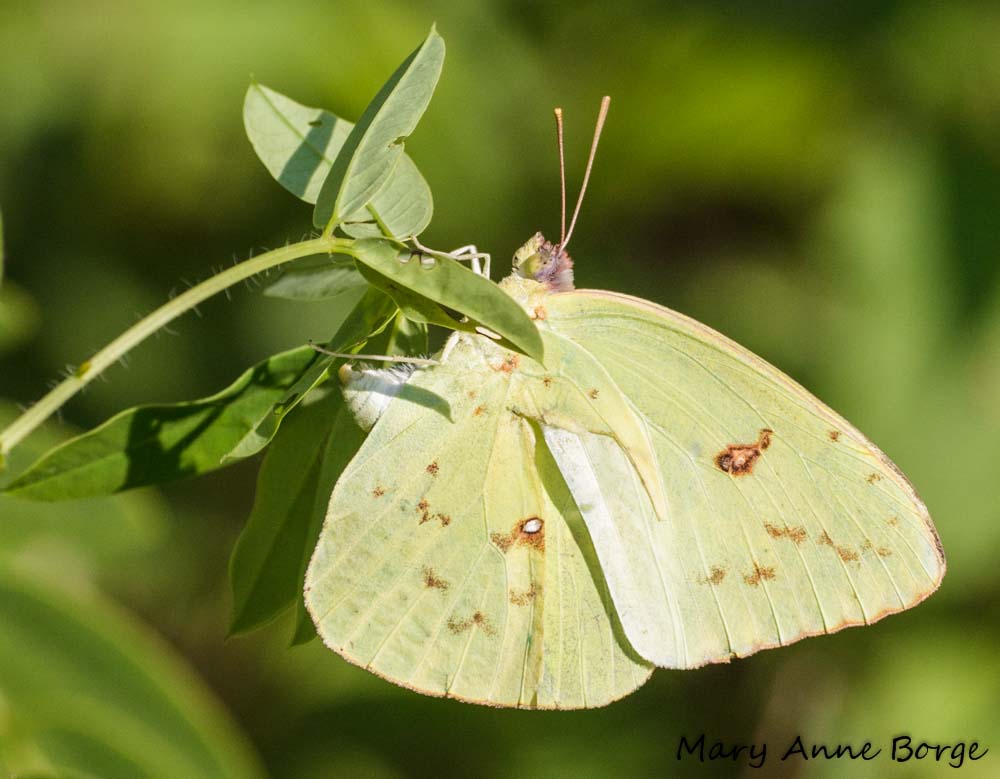
Very common in the southern United States and Mexico, Cloudless Sulphur butterflies (Phoebis sennae) are much more rare in the northern states and Canada, at least until late in the summer when some individuals pursue their annual dispersal … north?  For the past few weeks I’ve been seeing them at Bowman’s Hill Wildflower Preserve, near New Hope, in the central part of eastern Pennsylvania.

Cloudless Sulphur on Wild Senna (Senna hebecarpa)

Cloudless Sulphur on Wild Senna (Senna hebecarpa)

Look for them flying rapidly while cruising for mates, hunting for caterpillar food plants and laying eggs, or nectaring.  The butterflies I’ve seen have been so busy with the first two activities that I haven’t seen much nectaring.

Cloudless Sulphur laying egg, or ovipositing, on Wild Senna (Senna hebecarpa)

Cloudless Sulphur laying egg, or ovipositing, on Wild Senna (Senna hebecarpa)

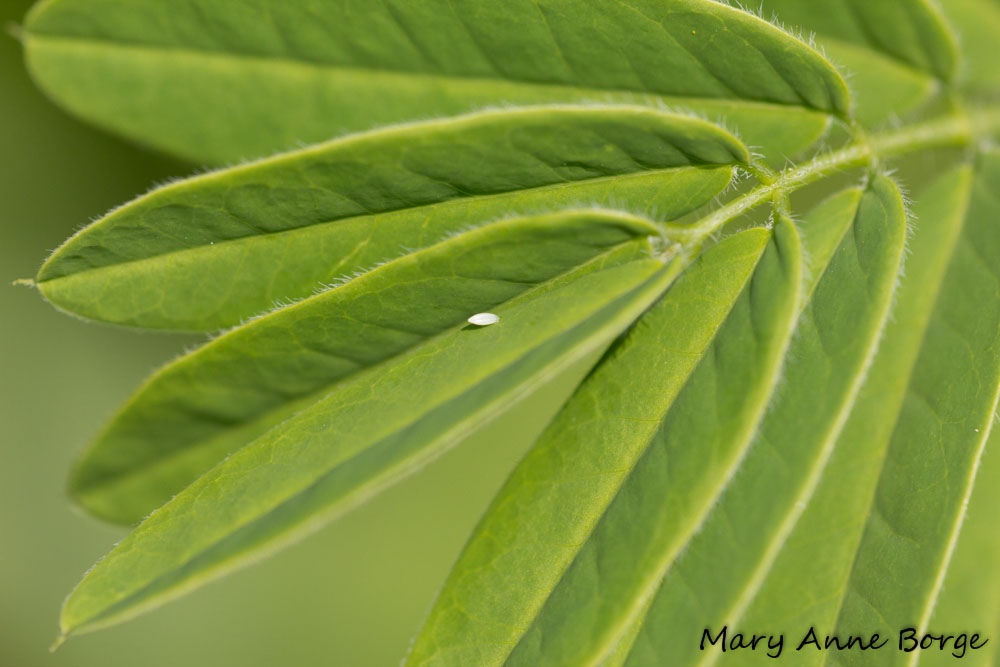
Cloudless Sulphur egg on Wild Senna (Senna hebecarpa)

Cloudless Sulphur egg on Wild Senna (Senna hebecarpa)

Cloudless Sulphurs specialize on pea family members, primarily Sennas and closely related plants like Partridge Pea (Chamaecrista fasciculata) and Wild Sensitive-plant (C. nictitans) as food plants for their caterpillars.  At Bowman’s Hill Wildflower Preserve the Cloudless Sulphurs seem to prefer Wild Senna (Senna hebecarpa, S. marilandica). Partridge Pea is also available here, although not as plentiful, but I haven’t yet seen them use it as a caterpillar food plant.

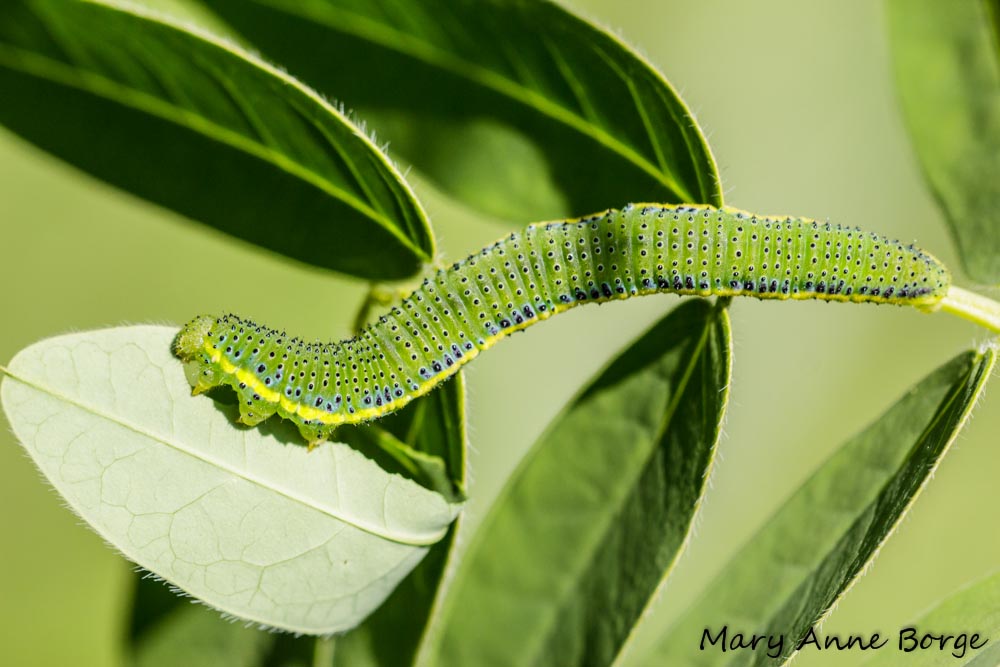
Cloudless Sulphur caterpillar on Wild Senna (Senna hebecarpa)

Cloudless Sulphur caterpillar on Wild Senna (Senna hebecarpa)

The caterpillars’ coloration blends perfectly with their food plants, varying from yellow to green.  At this location, their overall green background is an exact match for the color of the Wild Senna leaves on which they’re feeding.  The yellow stripe along the length of the caterpillar’s body resembles the leaf mid-rib, where they can be seen resting or feeding.  This camouflage makes it much harder for a hungry bird to spot them!

Wild Senna (Senna hebecarpa)

Wild Senna (Senna hebecarpa)

The caterpillars may eat the entire compound leaf, including mid-rib

Cloudless Sulphur caterpillar eating leaf midrib of Wild Senna (Senna hebecarpa)

Cloudless Sulphur caterpillar eating leaf midrib of Wild Senna (Senna hebecarpa)

and leaflets.

Cloudless Sulphur caterpillar eating leaflet of Wild Senna (Senna hebecarpa)

Cloudless Sulphur caterpillar eating leaflet of Wild Senna (Senna hebecarpa)

At Bowman’s Hill Wildflower Preserve they are sharing a habitat with Sleepy Orange butterflies, who are usually resident here from July through September, nectaring on a broad variety of flowers, mating, and laying eggs.

Sleepy Orange butterflies, mating

Sleepy Orange butterflies, mating

In the photo below, a Cloudless Sulphur is laying an egg directly opposite a leaf where a Sleepy Orange caterpillar is hiding.

Cloudless Sulphur on Wild Senna (Senna hebecarpa) laying egg opposite leaf where a Sleepy Orange caterpillar is hiding

Cloudless Sulphur on Wild Senna (Senna hebecarpa) laying egg opposite leaf where a Sleepy Orange caterpillar is hiding

These two butterfly species have a lot in common.  Sleepy Oranges use the same food plants for their caterpillars, and I have so far seen the same preference for Wild Senna rather than Partridge Pea at this location.  Both Cloudless Sulphurs and Sleepy Oranges seem to prefer using younger plants as caterpillar host plants.

Like Sleepy Oranges, Cloudless Sulphurs are primarily a tropical species.  Their range goes as far south as Argentina. In the moderate temperatures of a southern winter, they survive as adults, mostly inactive, but feeding occasionally.  They are somewhat cold tolerant, flying in fairly cool temperatures for butterflies.

But these bright, sprightly butterflies have an adventurer’s genes.  Most years, some individuals move northward, sometimes reaching as far as Ontario province in Canada, in spite of the fact that they can’t currently survive sustained cold winter temperatures. At least, as far as we know, they can’t.

So why do Cloudless Sulphurs keep pushing north every year if they can’t survive sustained periods of cold winter weather?  How is this beneficial to the species’ continued existence?

A species that can subsist over a broad geographic range in diverse habitats is in a better position to survive over time than one that is more narrowly focused.  If something happens to make one part of the range or habitat inhospitable, the species has many other options for locations that will accommodate their continued existance. The larger a species’ population becomes, and the more diverse the environments to which segments of the population are exposed, the more genetic mutations will result in individuals.  If the same genetic mutation occurs frequently enough, it may lead to an evolutionary change in the species.

Cloudless Sulphur laying egg on Wild Senna (Senna hebecarpa)

Cloudless Sulphur laying egg on Wild Senna (Senna hebecarpa)

Cloudless Sulphurs have evolved so that many of those that head north (or their offspring) make a return southward fall migration, spending the winter in a warm southern climate.

But some Cloudless Sulphurs continue to move north in late summer and fall, and probably die when the cold winter sets in.  But two things could happen to make this exploration of new territory a worthwhile effort for the species.  Warming temperatures could eventually make some of this northern territory moderate enough for the Cloudless Sulphurs to survive the winters as they do in the south.  Or a genetic mutation could occur in the Cloudless Sulphurs that leads to an evolutionary change, enabling them to survive a cold northern winter.  Their caterpillar food plants, Wild Sennas, are available to support them as far north as Ontario and all of the northeastern United States.

Cloudless Sulphur laying egg on Wild Senna (Senna hebecarpa)

Cloudless Sulphur laying egg on Wild Senna (Senna hebecarpa)

Resources:

Cech, Rick; Tudor, Guy. Butterflies of the East Coast. 2005.

Glassberg, Jeffrey. Butterflies through Binoculars A Field Guide to Butterflies in the Boston-New York-Washington Region. 1993.
Scott, James A. The Butterflies of North America. 1986.

Wilson, Edward O.  The Social Conquest of Earth.  2013

Butterflies and Moths of North America

Canadian Biodiversity Information Facility

Georgia Department of Natural Resources Wildlife Resources Division

USDA Plants Database