Feasting on Green-headed Coneflower

How many flowers do you see in the photo below?
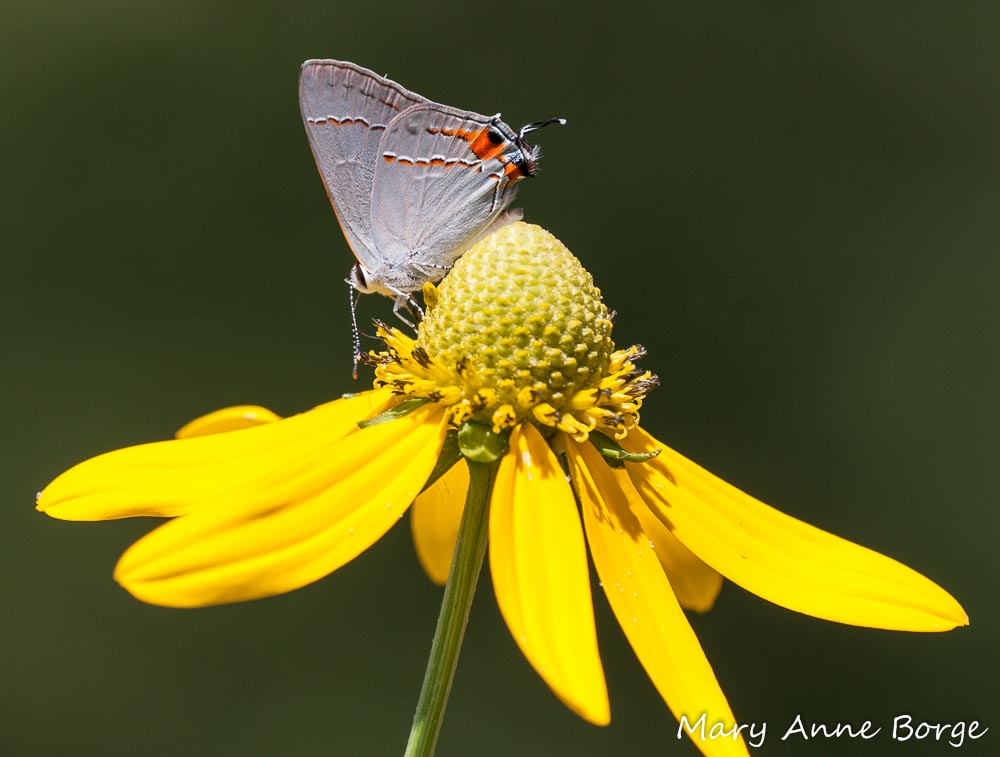
Gray Hairstreak on Green-headed Coneflower (Rudbeckia laciniata)

Gray Hairstreak on Green-headed Coneflower (Rudbeckia laciniata)

If you said one, that’s the answer I was looking for. However, it’s not correct!

The plant pictured here is Green-headed Coneflower (Rudbeckia laciniata), also sometimes called Cut-leaf Coneflower in deference to its deeply lobed leaves.  Green-headed Coneflower is a member of the Aster, or ‘Composite’ family, a name that’s pretty descriptive of their typical flower clusters (inflorescences). What our brains think is a single flower is actually a cluster (or composite) of tiny flowers, often of two different types, ray flowers and disk flowers. The petal-like parts of the flower cluster are each an individual ray flower with a single petal. In the center there are dozens of tiny tubular flowers called disk flowers, in reference to the disk-like shape of the flower cluster.  In the picture above, just a few of the disk flowers are blooming.

Some Aster family members just have ray flowers, like Dandelions.
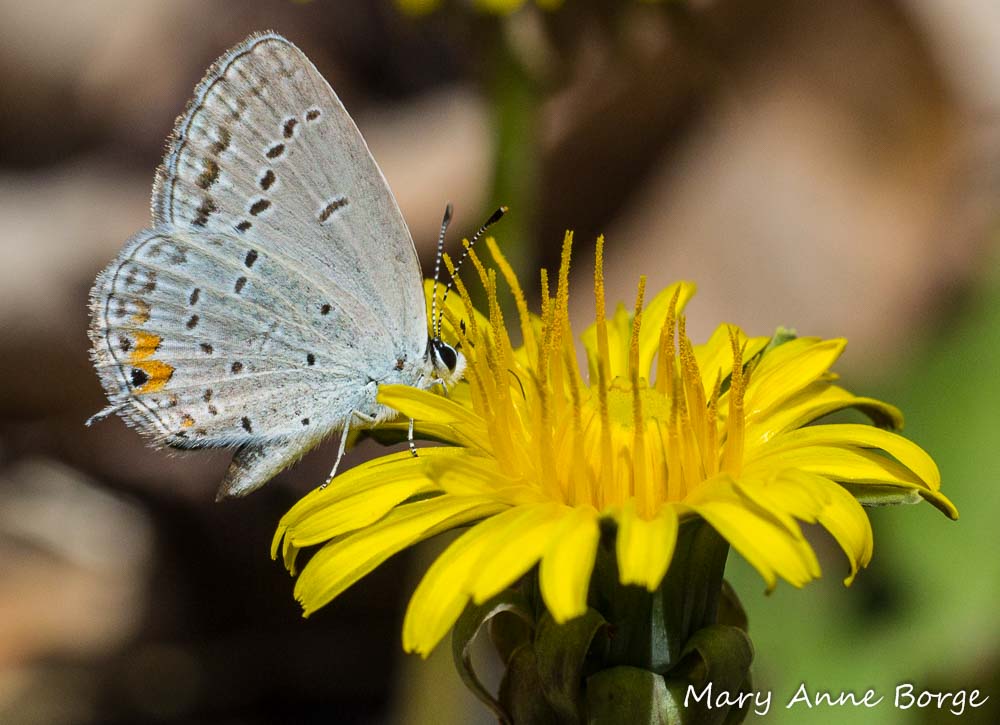
Eastern-Tailed Blue nectaring on a Dandelion

Eastern-Tailed Blue nectaring on a Dandelion

Some have just disk flowers, like New York Ironweed.
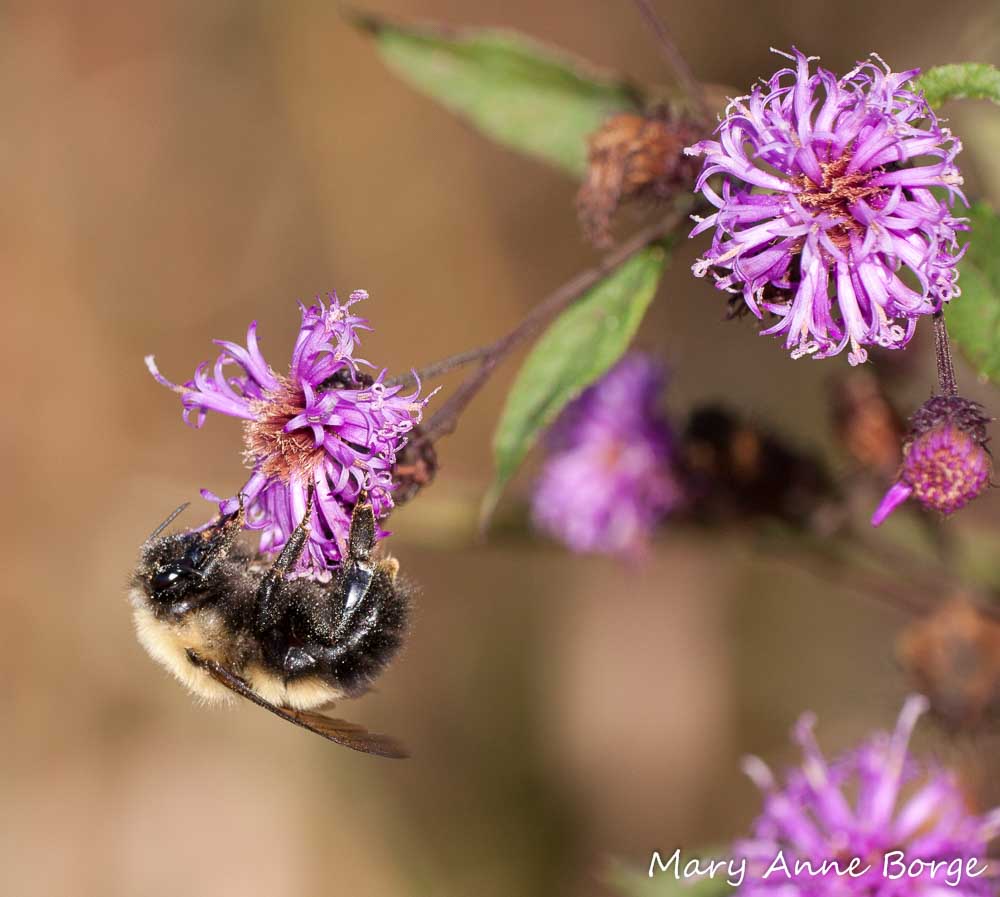
Bumble Bee on New York Ironweed

Bumble Bee on New York Ironweed

Many, like Green-headed Coneflower, have both types of flowers. When both ray flowers and disk flowers are present, the ray flowers are often sterile, in which case their primary purpose is to act as nectar guides, alerting pollinators to the availability of nectar and pollen in the many disk flowers at the center of the flower cluster.
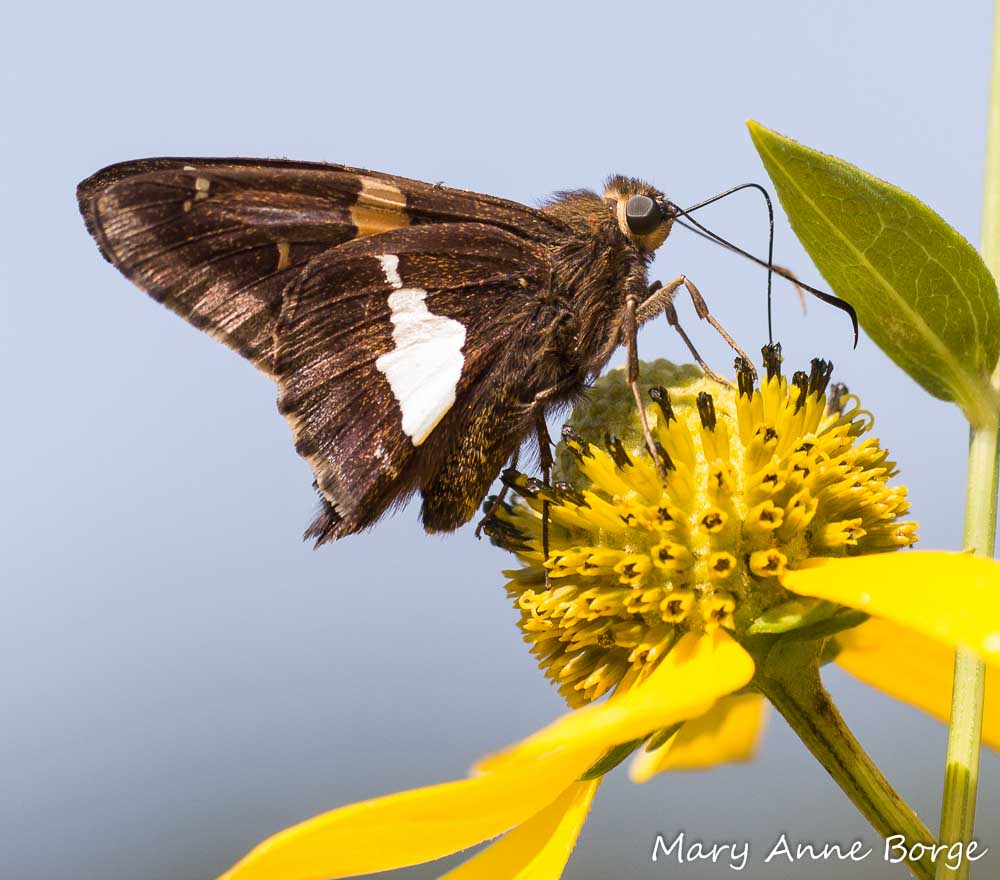
A Silver-spotted Skipper is nectaring on the disk flowers that are in bloom on this Green-headed Coneflower. The lowest disk flowers have finished blooming, while those at the top of the flower cluster are still in bud.

A Silver-spotted Skipper is nectaring on the disk flowers that are in bloom on this Green-headed Coneflower. The lowest disk flowers have finished blooming, while those at the top of the flower cluster are still in bud.

The disk flowers bloom gradually over a period of a few weeks, maximizing the plant’s chances for pollination with the assistance of insect partners. In the case of Green-headed Coneflower, the disk flowers bloom gradually from the bottom, or outside ring, to the top, or center, of the flower cluster.
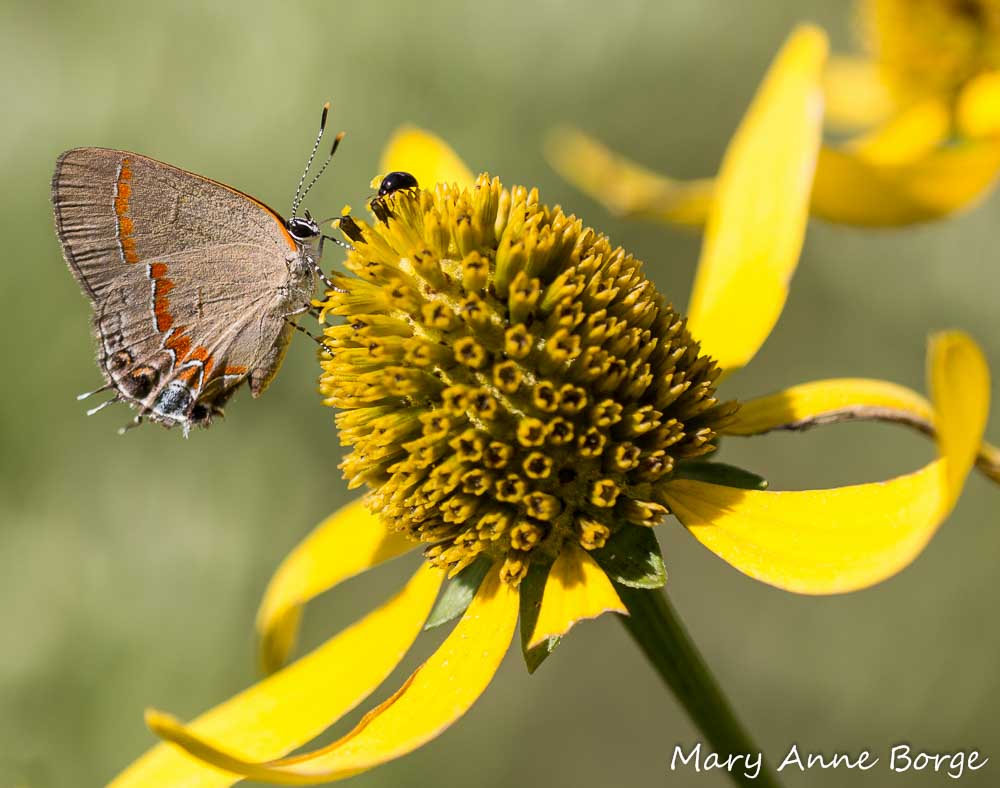
A Red-banded Hairstreak is drinking nectar from the last few blooming flowers of this Green-headed Coneflower inflorescence.

A Red-banded Hairstreak is drinking nectar from the last few blooming flowers of this Green-headed Coneflower inflorescence.

Because of the number and size of its disk flowers, Green-headed Coneflower is able to attract many insects as potential pollinators. Often multiple insects can be found feeding simultaneously on different flowers in the same flower cluster.
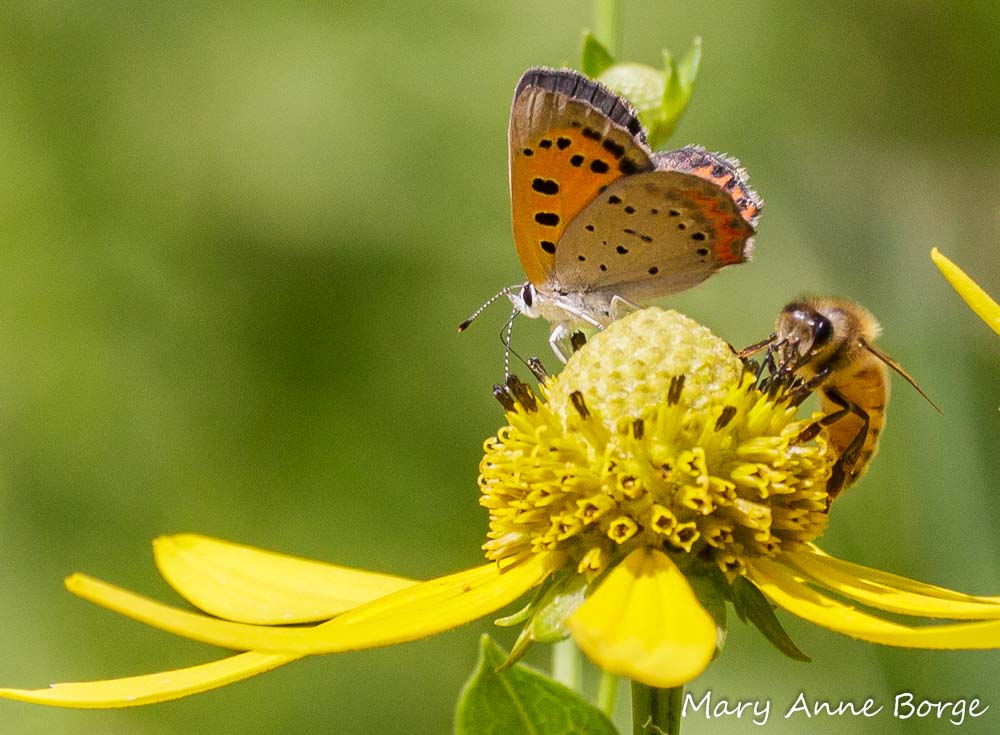
This Green-headed Coneflower offers enough flowers with nectar to feed both an American Copper and a Honey Bee.

This Green-headed Coneflower offers enough flowers with nectar to feed both an American Copper and a Honey Bee.

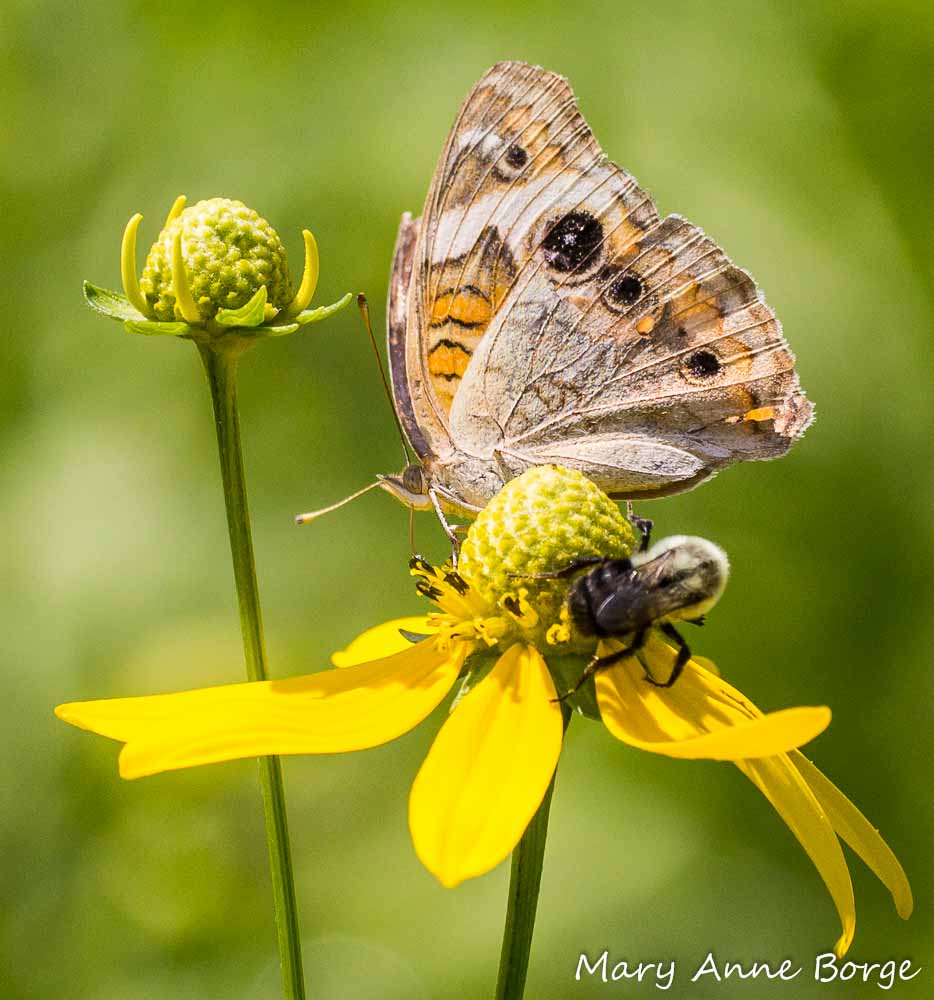
Green-headed Coneflower’s disk flowers are large enough to accommodate small to medium sized butterflies like those pictured here.  They may rub against some pollen and transfer it to another plant, assisting with pollination.
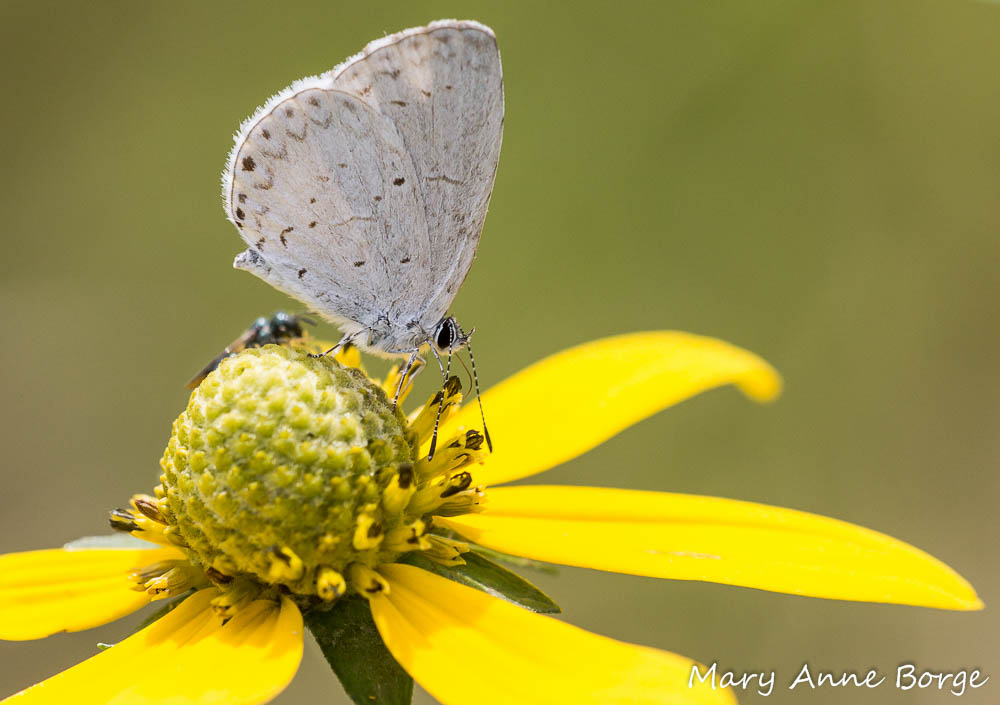
Summer Azure with Green-headed Coneflower (Rudbeckia laciniata)
Summer Azure with Green-headed Coneflower (Rudbeckia laciniata)

Common Buckeye and Bumble Bee feeding on Green-headed Coneflower (Rudbeckia laciniata)

Common Buckeye and Bumble Bee feeding on Green-headed Coneflower (Rudbeckia laciniata)

Beneficial predators like the thread-waisted wasps (a species of Sphecid wasp) pictured below also benefit from the abundant nectar, giving them the energy they need to reproduce.  (I often see this species mating and nectaring at the same time, as they are doing here. A level of skill and coordination to which humans can only aspire!)  Their anatomy makes it more likely that they will help with pollination than butterflies, since more of their bodies are likely to come in contact with pollen.  The female wasps of this species (Eremnophila aureonotata) hunt caterpillars to feed their larvae.
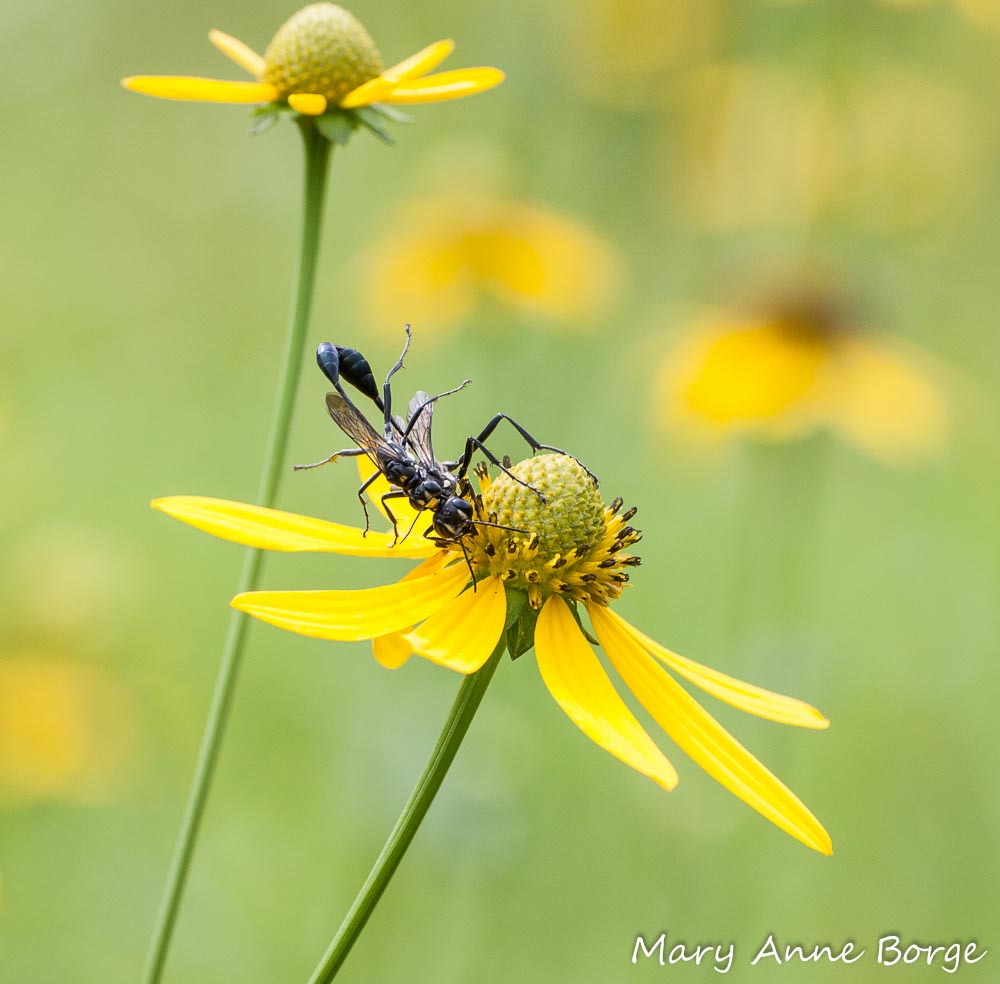
Green-headed Coneflower with mating Wasps (Eremnophila aureonotata)

Green-headed Coneflower with mating Wasps (Eremnophila aureonotata)

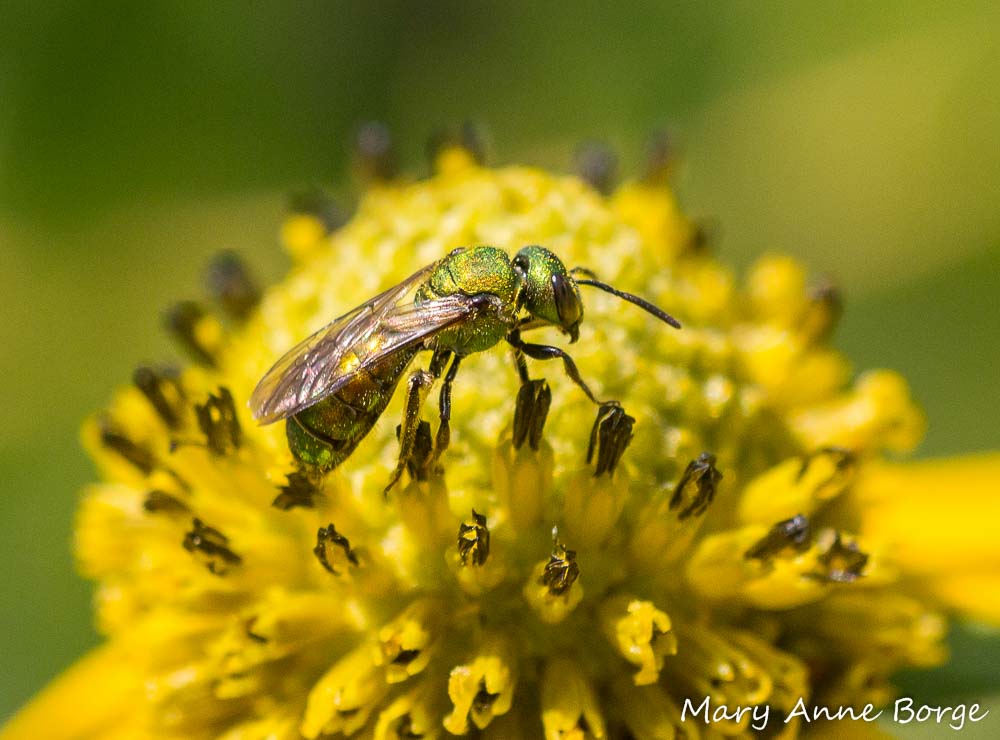
But bees are the most likely to be successful pollinators, because they are the best anatomical match for gathering pollen, and it’s more likely to stick to the branched hair on their bodies and be carried away to be deposited on another flower.
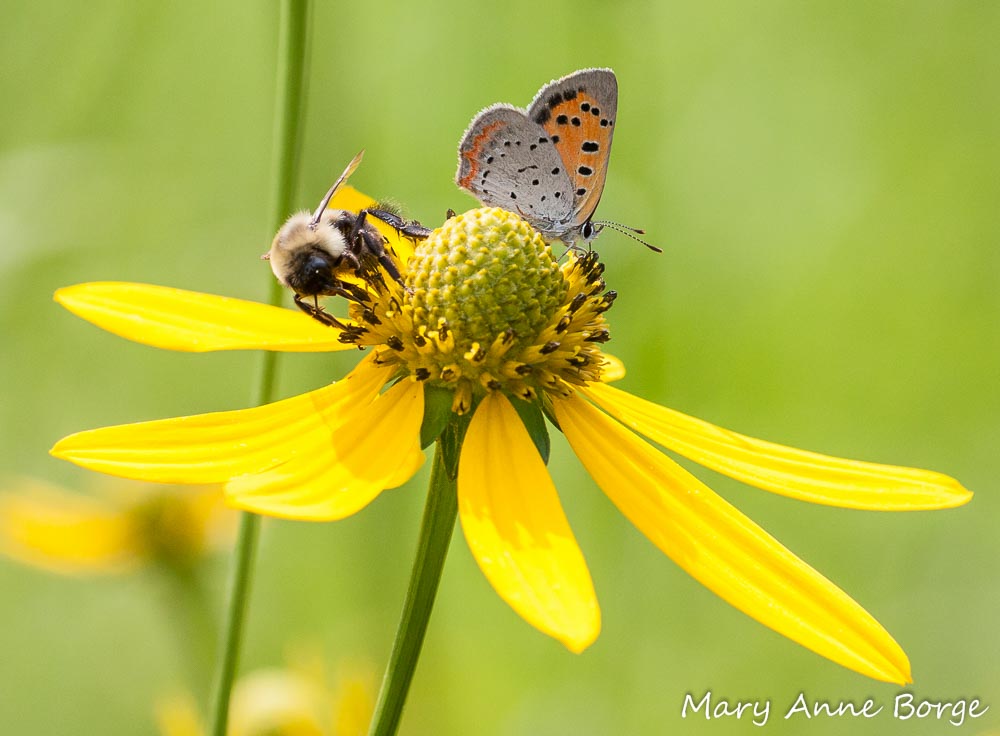
Bumble Bee and American Copper nectaring on Green-headed Coneflower (Rudbeckia laciniata)
Bumble Bee and American Copper nectaring on Green-headed Coneflower (Rudbeckia laciniata)

Sweat Bee on Green-headed Coneflower (Rudbeckia laciniata)

Sweat Bee on Green-headed Coneflower (Rudbeckia laciniata)

The Sweat Bee below is gathering pollen on her hind legs to take back to feed her larvae.  Only female bees gather pollen this way.
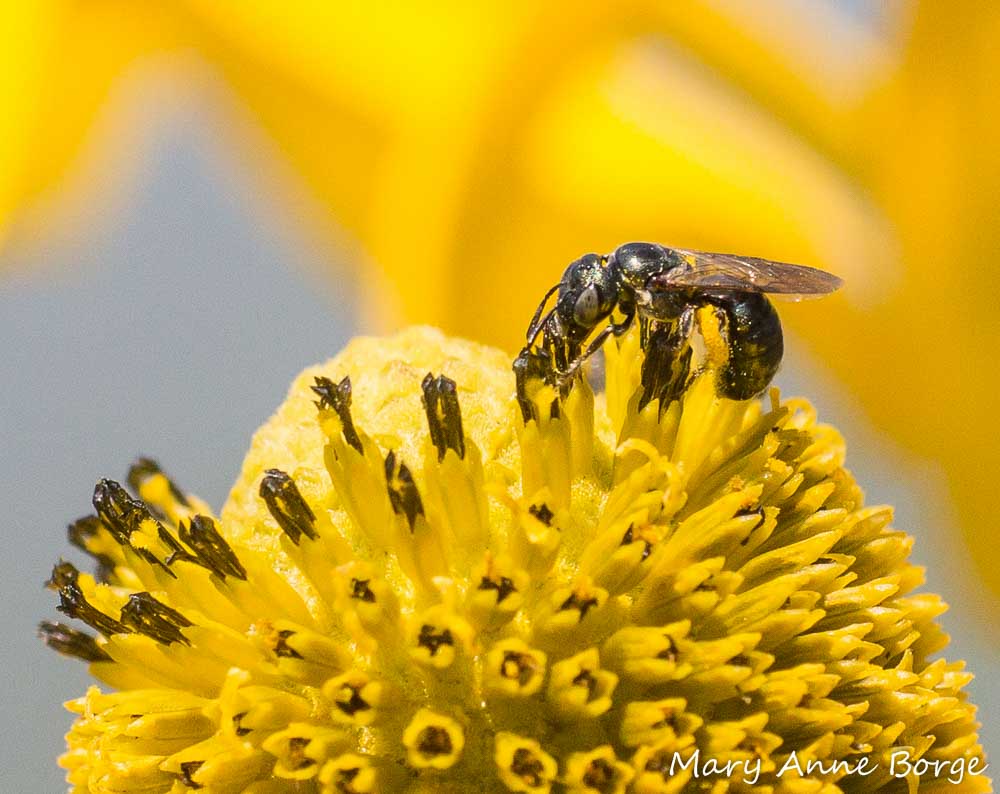
Sweat Bee (Lasioglossum species) on Green-headed Coneflower (Rudbeckia laciniata)

Sweat Bee (Lasioglossum species) on Green-headed Coneflower (Rudbeckia laciniata)

Dining on Green-headed Coneflower is not without danger, as this Bumble Bee found out when it fell victim to a Wheel Bug, a type of assassin bug.  Sometimes the diner becomes the dinner.
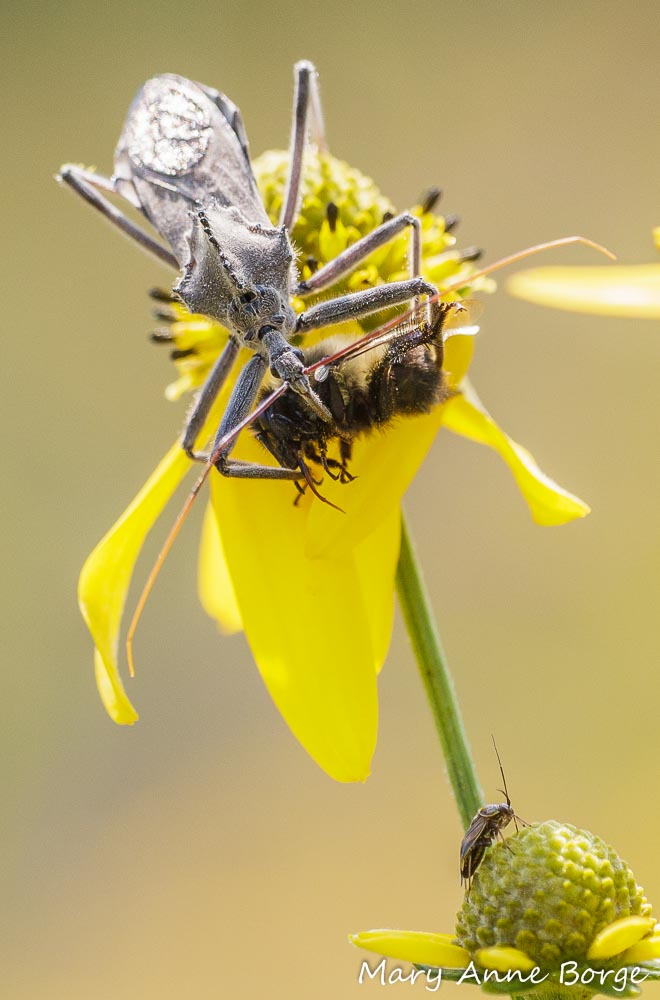
Wheel Bug (Arilus cristatus) consuming a Bumble Bee smoothie

Wheel Bug (Arilus cristatus) consuming a Bumble Bee smoothie

If the flowers are successfully pollinated, you’re likely to see Goldfinches and other birds feeding on the seeds later in the season and throughout fall.
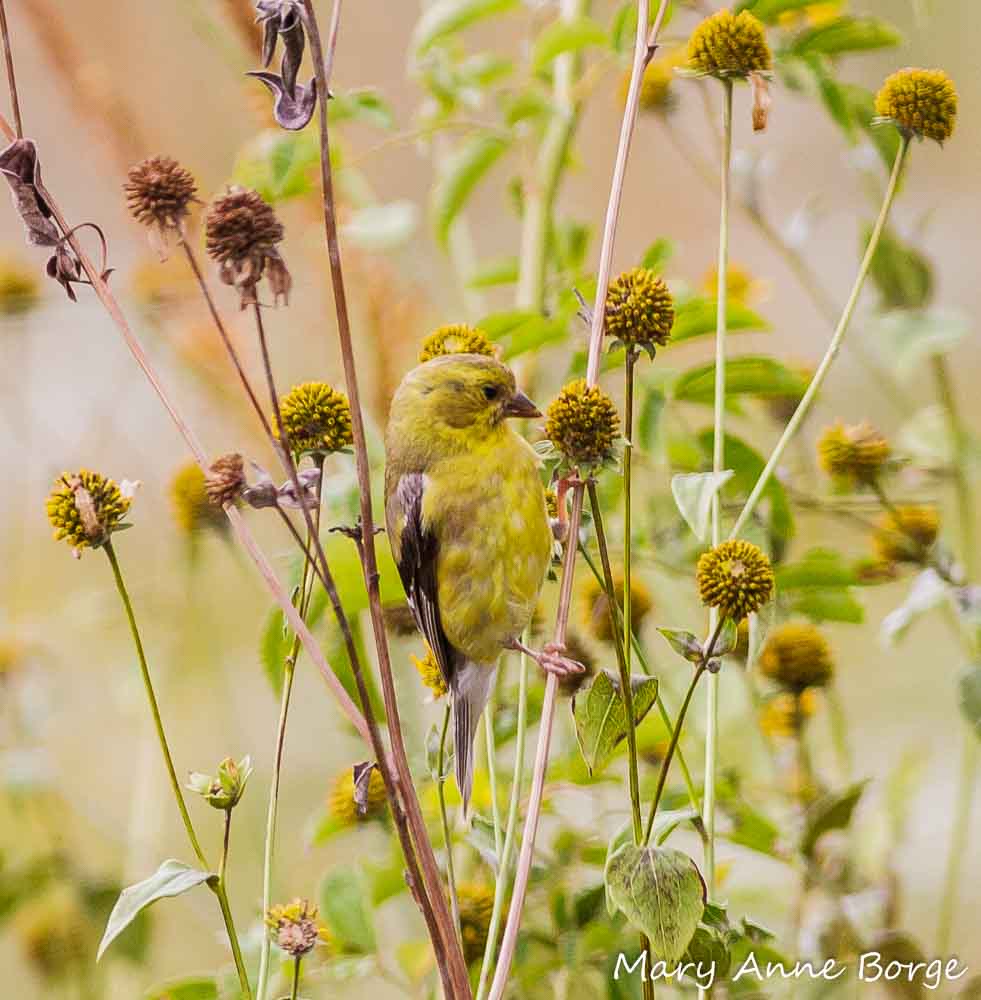
Goldfinch eating Green-Headed Coneflower seeds

Goldfinch eating Green-Headed Coneflower seeds

The Aster family is the second largest family of flowering plants in terms of its number of species, second only to the Orchid family.  In late summer and fall the Aster family represents a high percentage of what’s in bloom.  For information on a few other Aster family members, see Asters Yield a Treasure Trove! and Fall Allergies?  Don’t Blame Goldenrod!

Resources

Eaton, Eric R.; Kauffman, Ken.  Kaufman Field Guide to Insects of North America.  2007.

Elpel, Thomas J.  Botany in a Day.  2006.


Indigo Buntings – Living on the Edge!

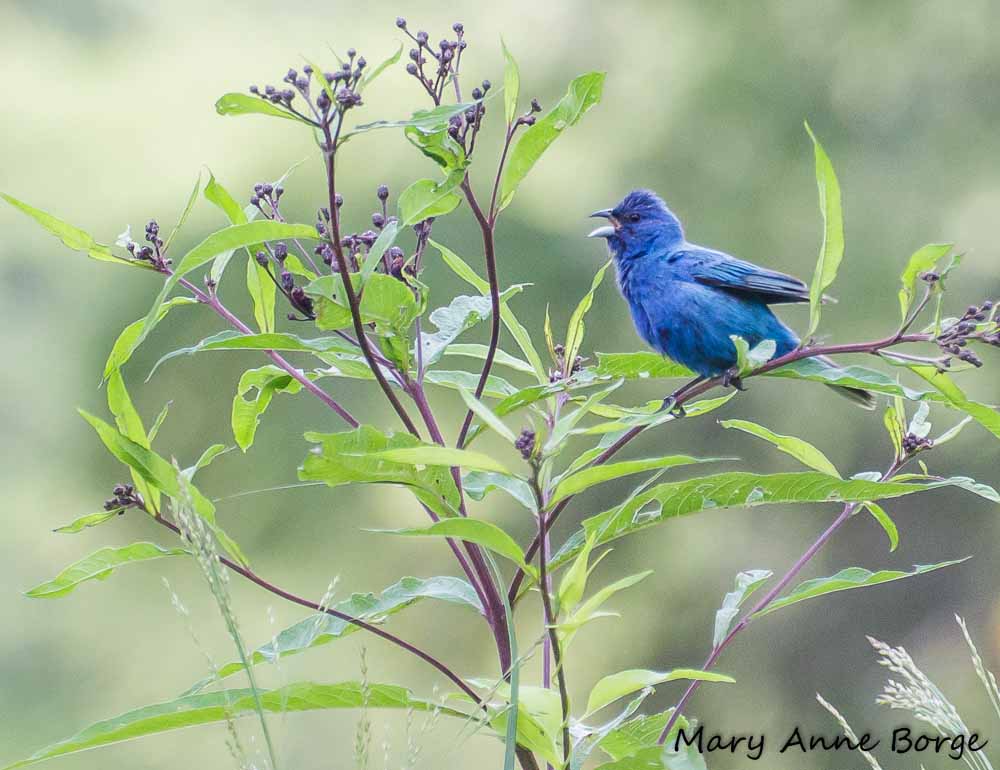
As I started down the path through the meadow, I heard a ‘Chip!’ call to my left, then a ‘Chip!’ call to the right. Then another ‘Chip!’ to the left, followed by a ‘Chip!’ to the right. This call and response was repeated several times until I finally spotted the source of half of the duet, a male Indigo Bunting perched on New York Ironweed (Vernonia noveboracensis). Indigo Buntings often use this vocalization if you are near their nest, even if you are still as far away as 30-40 feet (9-12 meters).

Male Indigo Bunting perched in New York Ironweed (Vernonia noveboracensis)

Male Indigo Bunting perched in New York Ironweed (Vernonia noveboracensis)

Indigo Buntings need edge habitat, like an open field or meadow near a woodland, or a woods opening. They nest fairly low to the ground, usually at a height of at least 2-3 feet (.6 – .9 meters), but not more than 10 feet (3 meters) above ground. They require a dense cover of shrubs or brambles for their nesting site. The female Indigo Bunting makes the nest, weaving the structure from plant materials, including leaves, twigs, bark, and stems, possibly wrapping it with spider web, and lining it with softer grasses, mosses, rootlets, hair, down, or the fluff often attached to seeds.

Male Indigo Buntings need a high perch from which they can survey their territory and ward off encroaching competitors, which explains the need for the nearby trees. They sing to advertise their presence and ownership of their turf. The song often consists of several paired notes, sung repeatedly in rapid succession.

Male Indigo Bunting, singing

Male Indigo Bunting, singing

The male I saw on this visit started to sing, then flew off about 40 feet (12 meters) from his original position, continuing his song from his new grass perch. He was closer to me, and sang to draw my attention to him, presumably to distract me from seeing his partner so she could return to the nest undetected. His ploy almost worked, but I did catch a glimpse of her peeking out of a patch of blackberry brambles, about 30 feet (9 meters) away and almost out of my range of vision when I looked directly at the male.

Male Indigo Bunting

Male Indigo Bunting

On several visits to the meadow, I caught glimpses of the female, but she was always on the move. Each time I saw her she had food in her mouth to take back to her offspring. Like most birds, Indigo Buntings require a lot of protein in their diet, especially when they are young. The meadow offers plenty of grasshoppers, caterpillars, beetles, aphids and other insects and spiders to fill that dietary need. To round out the menu, berries and seeds are made available by blackberries, goldenrods, asters and other meadow plants. There is no shortage of fresh, local, organic food available for foraging nearby!

On one visit, a female and I finally had a close encounter. She was hiding in a blackberry bramble near the trail, with an insect in her beak, as usual.

Female Indigo Bunting in Blackberry (Rubus allegheniensis) bramble

Female Indigo Bunting in Blackberry (Rubus allegheniensis) bramble

As I watched, she gradually moved to a more open spot,

Female Indigo Bunting in Blackberry (Rubus allegheniensis) bramble

Female Indigo Bunting in Blackberry (Rubus allegheniensis) bramble

stayed for a few minutes,

Female Indigo Bunting in Blackberry (Rubus allegheniensis) bramble

Female Indigo Bunting in Blackberry (Rubus allegheniensis) bramble

then disappeared into the brambles to feed the kids.

To hear an Indigo Bunting’s song, click here.

Male Indigo Bunting

Male Indigo Bunting

Resources

Eastman, John. Birds of Forest, Yard, and Thicket. 1997.

Harrison, Hal H. Eastern Birds’ Nests. 1975

Eaton, Eric R.; Kauffman, Ken.  Kaufman Field Guide to Insects of North America.  2007.

Stokes, Donald W.; Stokes, Lillian. A Guide to Bird Behavior Volume II. 1983

Bugguide.net

The Cornell Lab of Ornithology All About Birds

Romance in the Meadow – Baltimore Checkerspots

Warning!  Before you read any further, I should warn you that some of the content of this post is for mature audiences only.

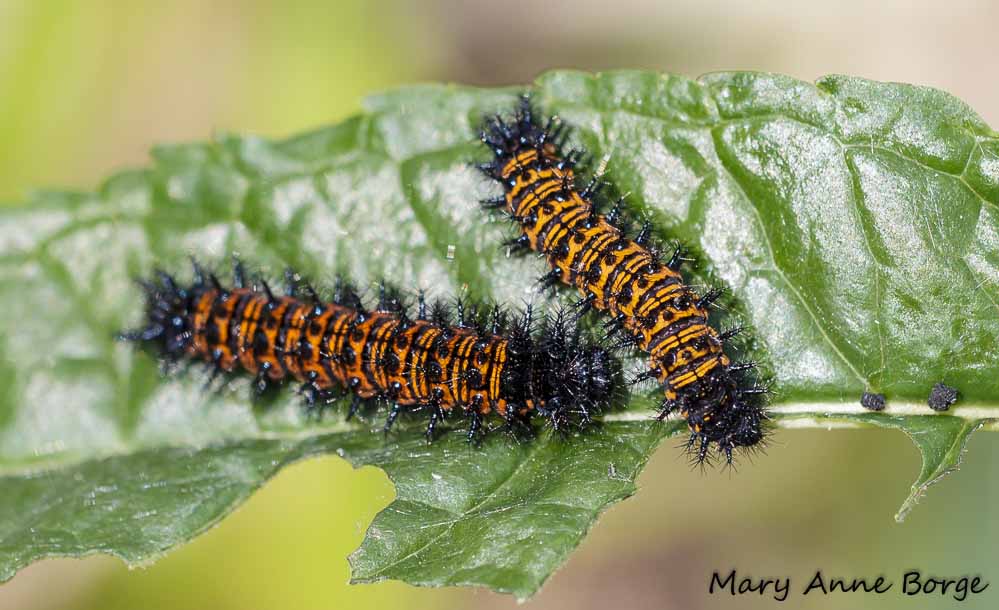
On May 18 I joined a group from the American Entomological Society to do an insect survey at Bowman’s Hill Wildflower Preserve. As we fanned out across the meadow, one of the participants found dozens of caterpillars feeding on plants in the wet part of the meadow.

Baltimore Checkerspot caterpillars on Turtlehead (Chelone glabra)

Baltimore Checkerspot caterpillars on Turtlehead (Chelone glabra)

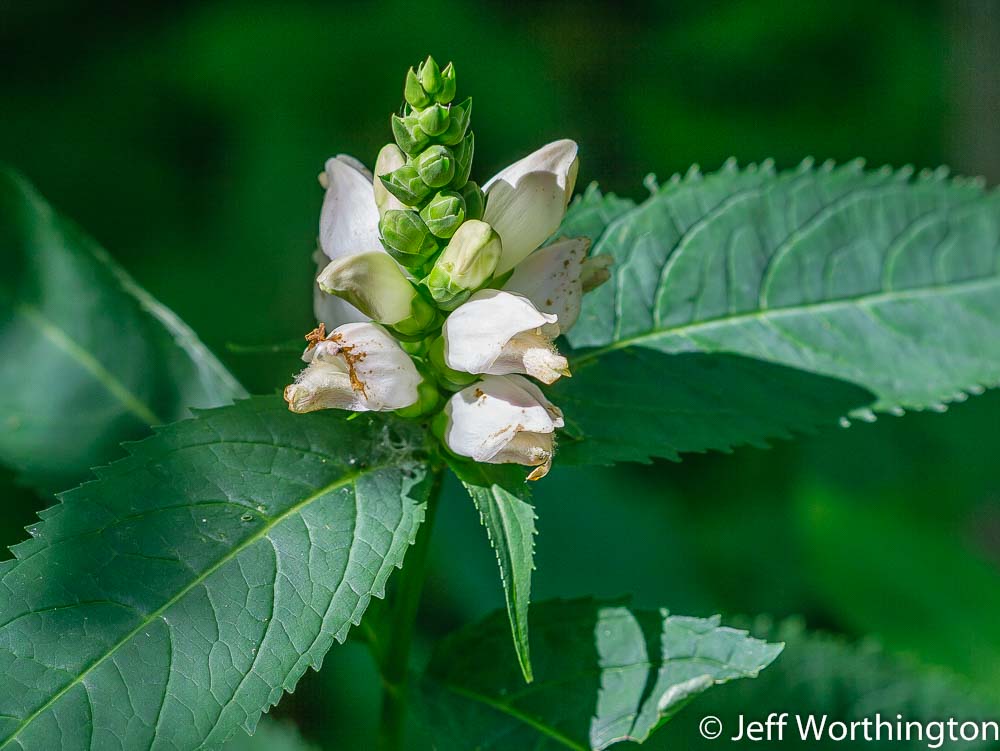
They turned out to be Baltimore Checkerspot (Euphydryas phaeton) caterpillars eating the leaves of Turtlehead (Chelone glabra).

Turtlehead (Chelone glabra)

Turtlehead (Chelone glabra)

Baltimore Checkerspots are reported to use a few different species of plants as food for their caterpillars, particularly in their later growth stages.  But their preferred food plant is Turtlehead. This plant contains iridoid glycoside chemicals which enhance the caterpillars’ growth and makes them distasteful to birds. Both the caterpillars and the resulting adult butterflies benefit from this protection, and their bright black, white, and orange coloration act as a warning to advertise their toxicity to potential predators. It helps to fend off attempts to eat them.

Baltimore Checkerspot caterpillars on Turtlehead (Chelone glabra)

Baltimore Checkerspot caterpillars on Turtlehead (Chelone glabra)

Given the early date, the caterpillars were almost certainly individuals that had spent the winter there in the meadow.

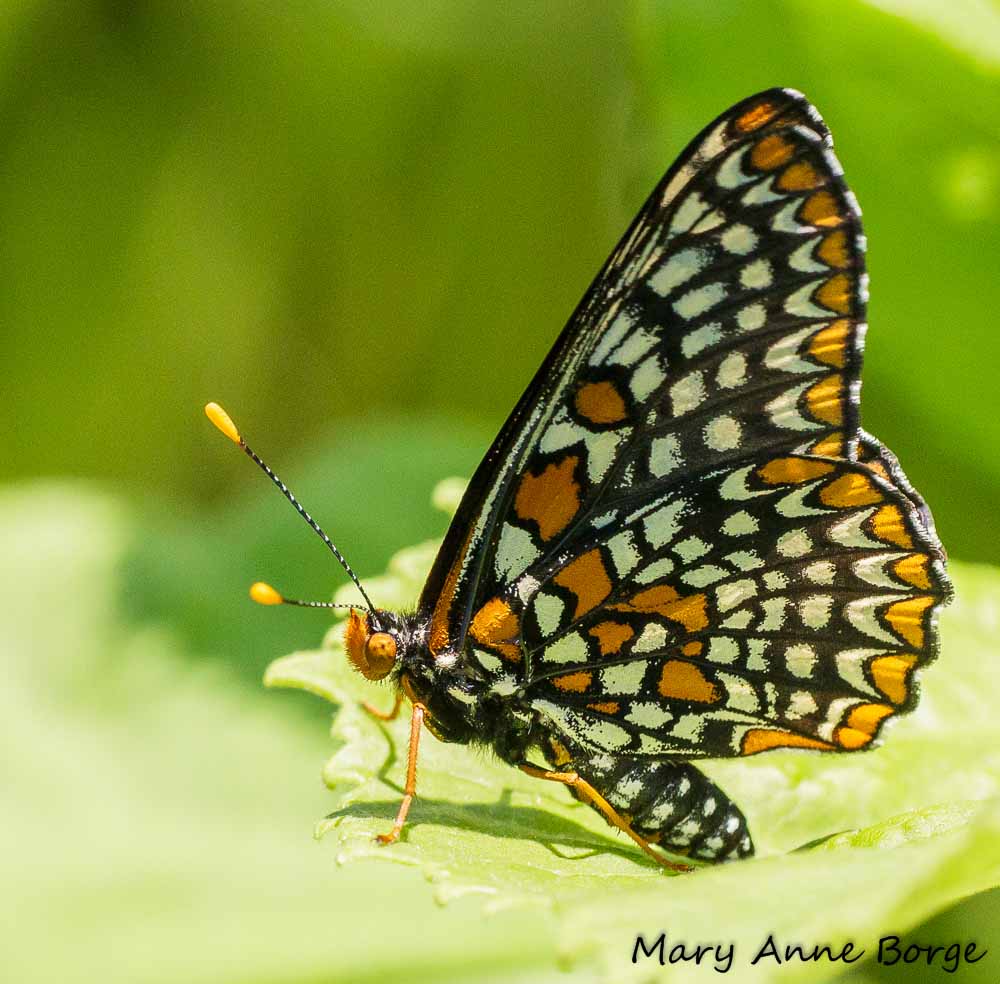
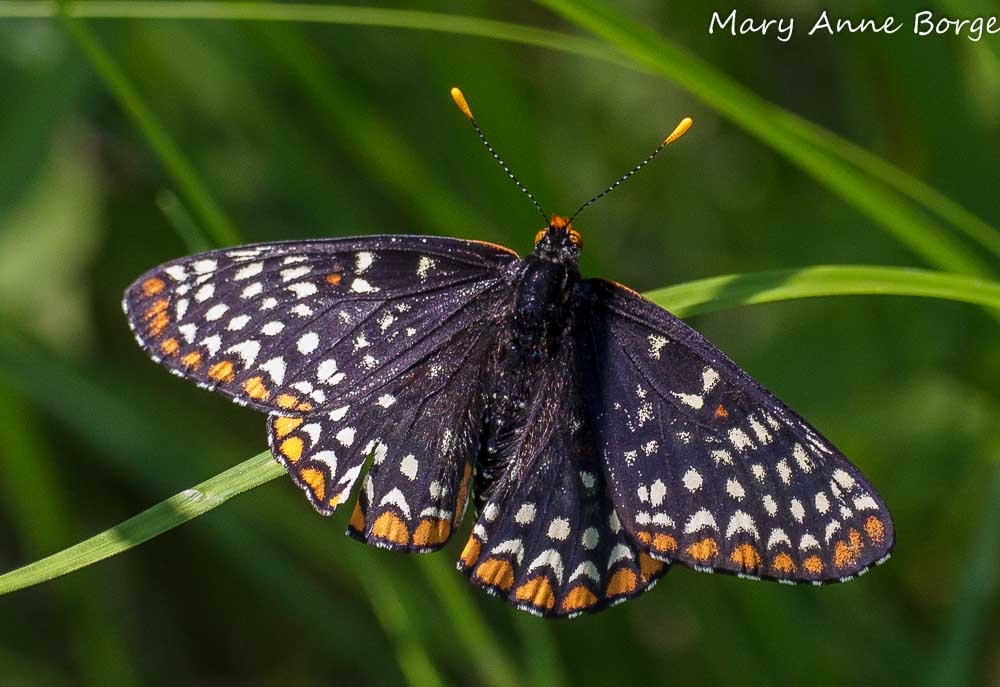
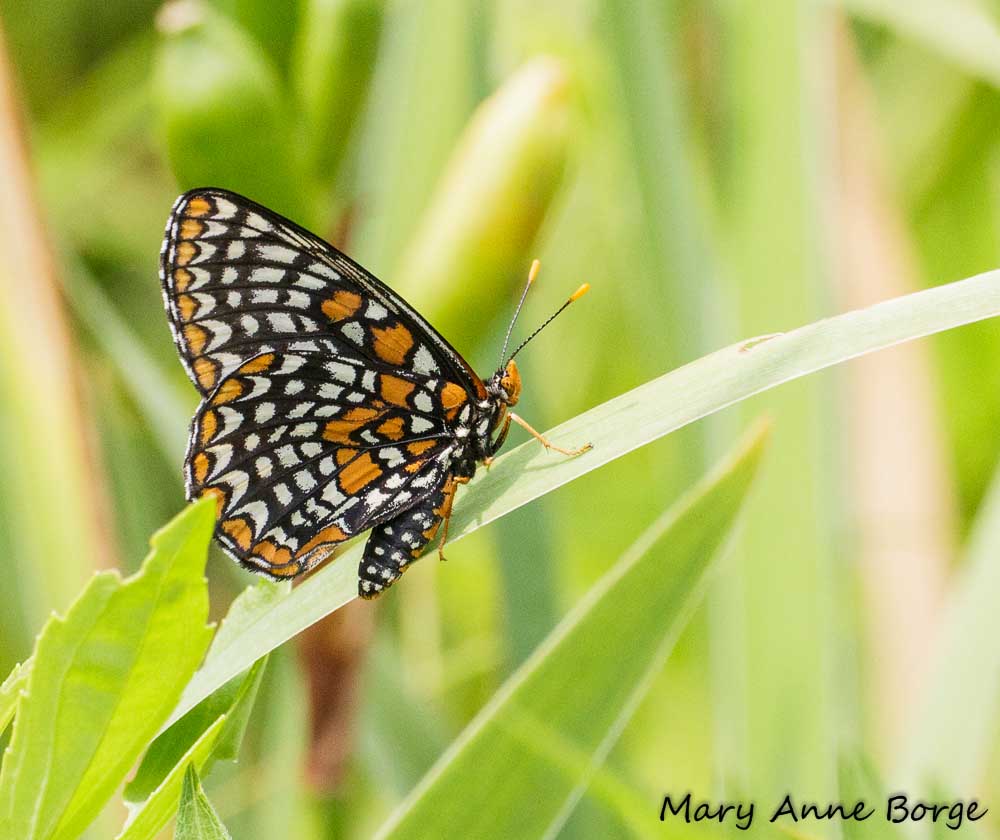
On June 16, almost a month after the initial caterpillar sighting, I saw two adult Baltimore Checkerspot butterflies for the first time, not far from where we saw the caterpillars.

Baltimore Checkerspot

Baltimore Checkerspot

Baltimore Checkerspot

Baltimore Checkerspot

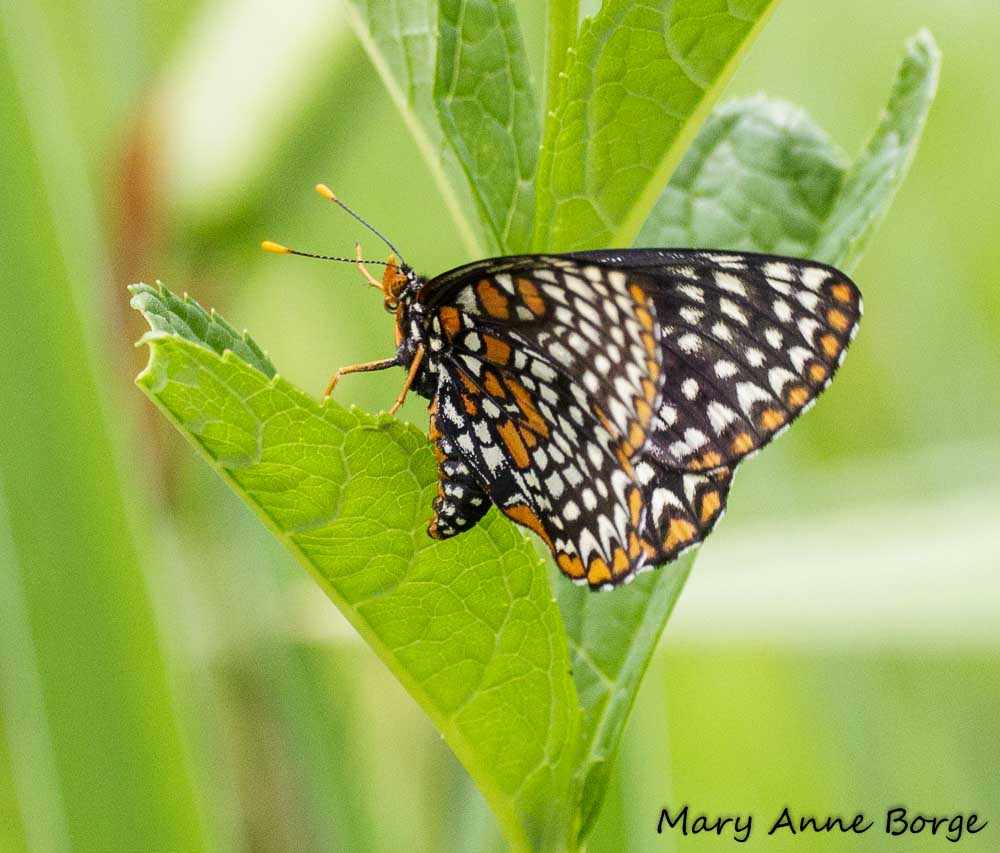
A week later, there were at least 10 individuals in the same general vicinity. They spent most of their time perching fairly low to the ground, either basking or advertising for a potential mate. Most flights were short and fairly low.

Baltimore Checkerspot

Baltimore Checkerspot

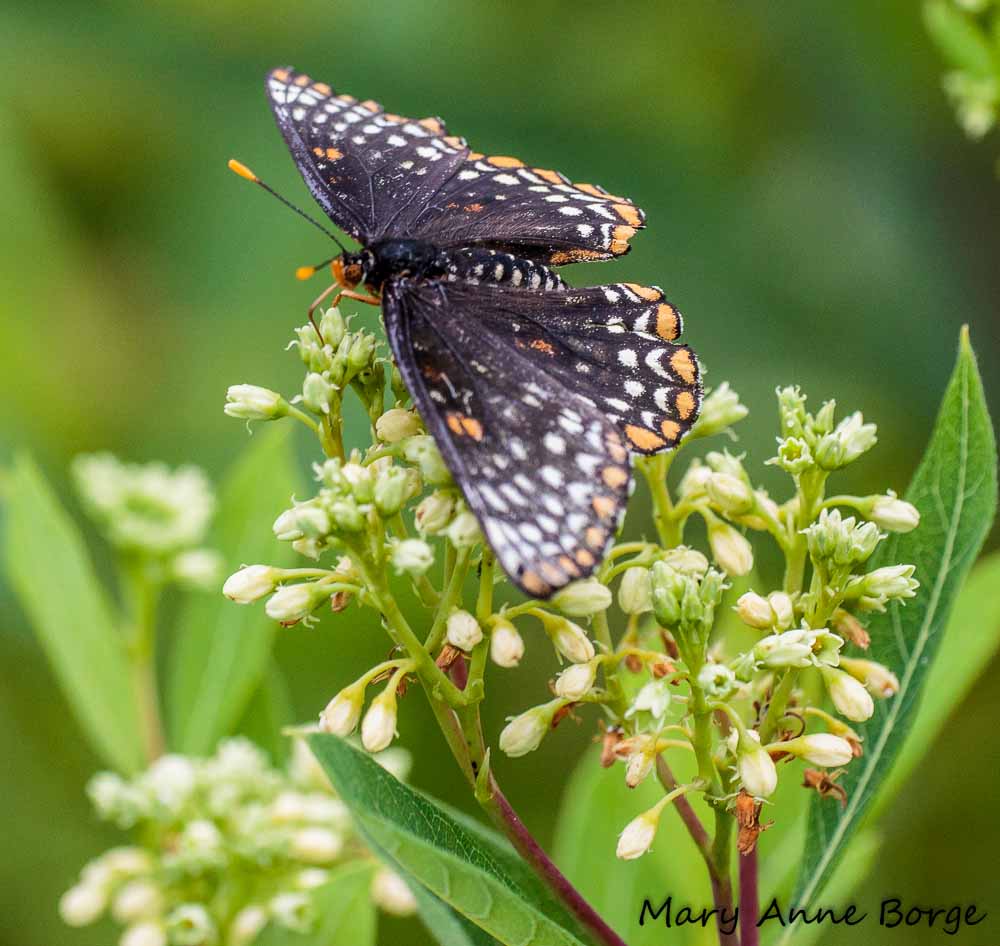
Occasionally I saw a butterfly drinking nectar from Indian Hemp (Apocynum cannabinum) or White Clover (Trifolium repens).

Baltimore Checkerspot drinking nectar from Indian Hemp (Apocynum cannabinum)

Baltimore Checkerspot drinking nectar from Indian Hemp (Apocynum cannabinum)

Baltimore Checkerspot drinking nectar from White Clover (Trifolium repens)

Baltimore Checkerspot drinking nectar from White Clover (Trifolium repens)

Ok, this is where things start to get a little racy.

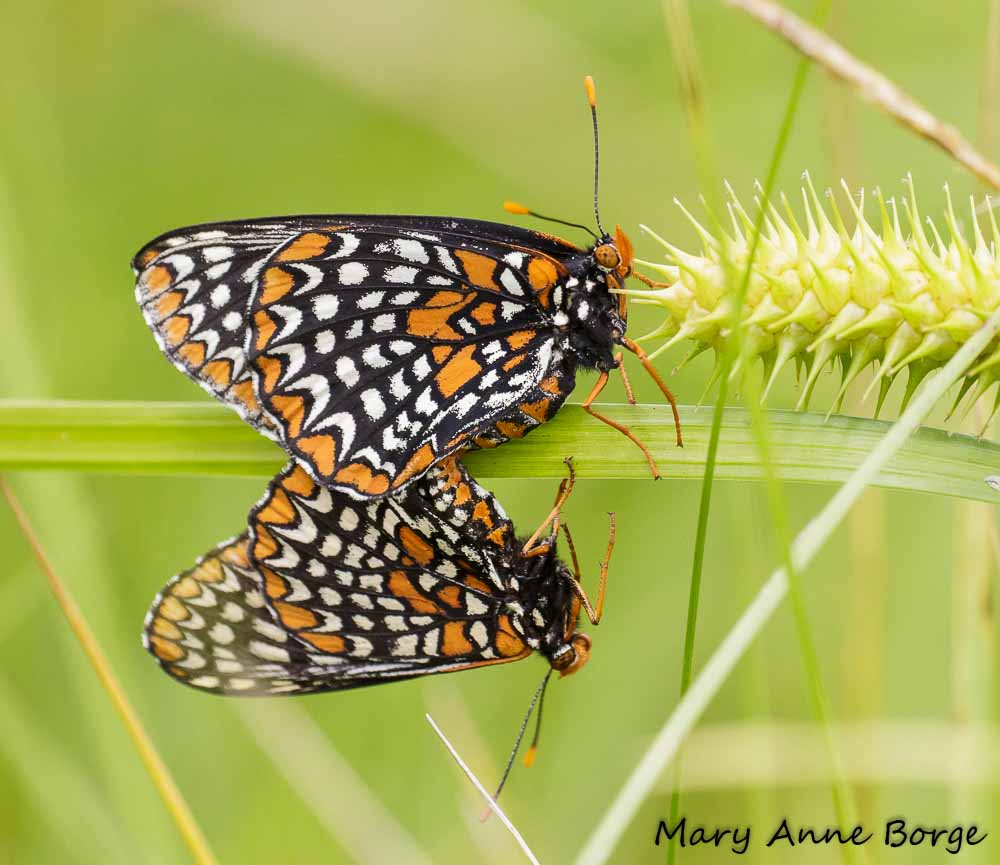
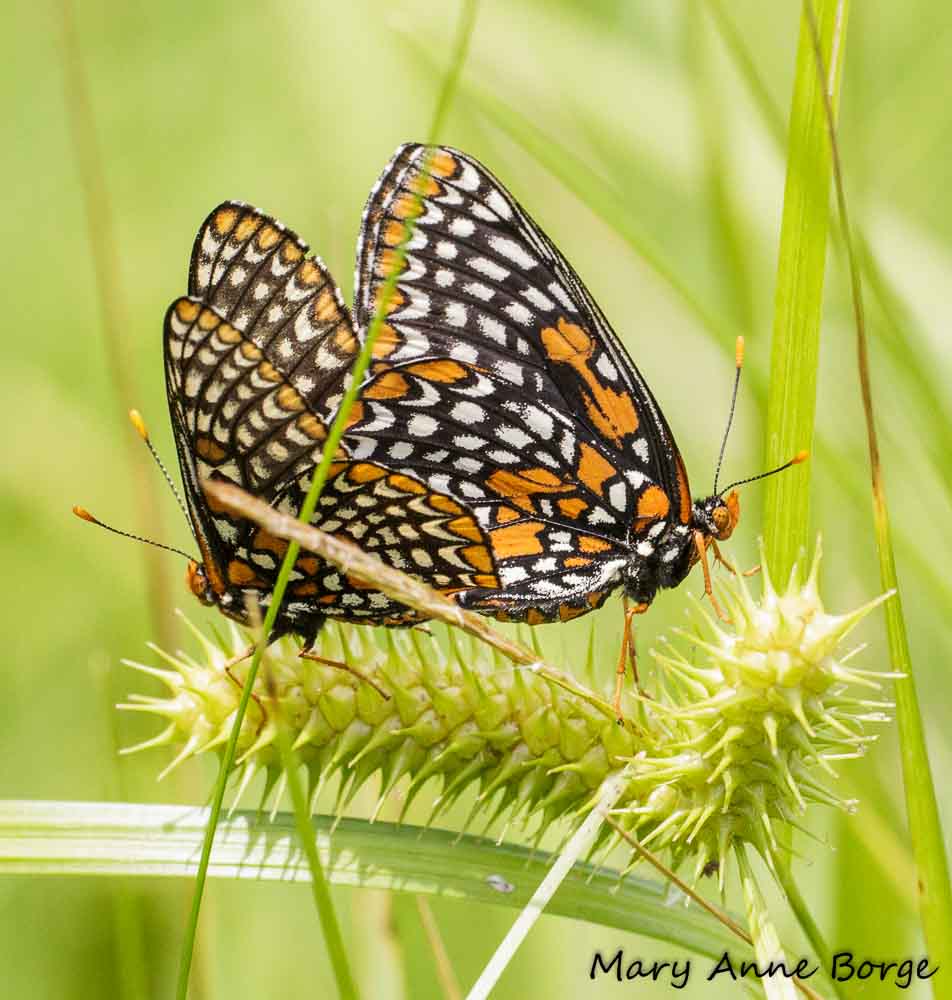
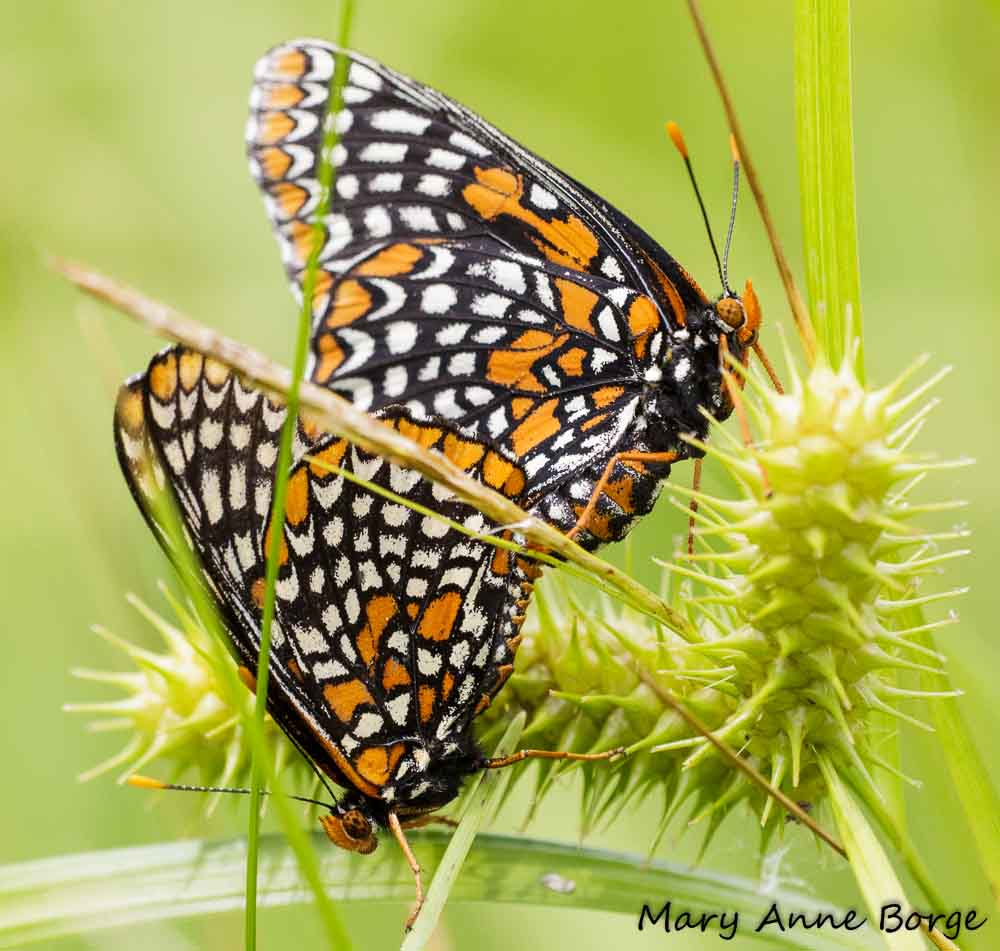
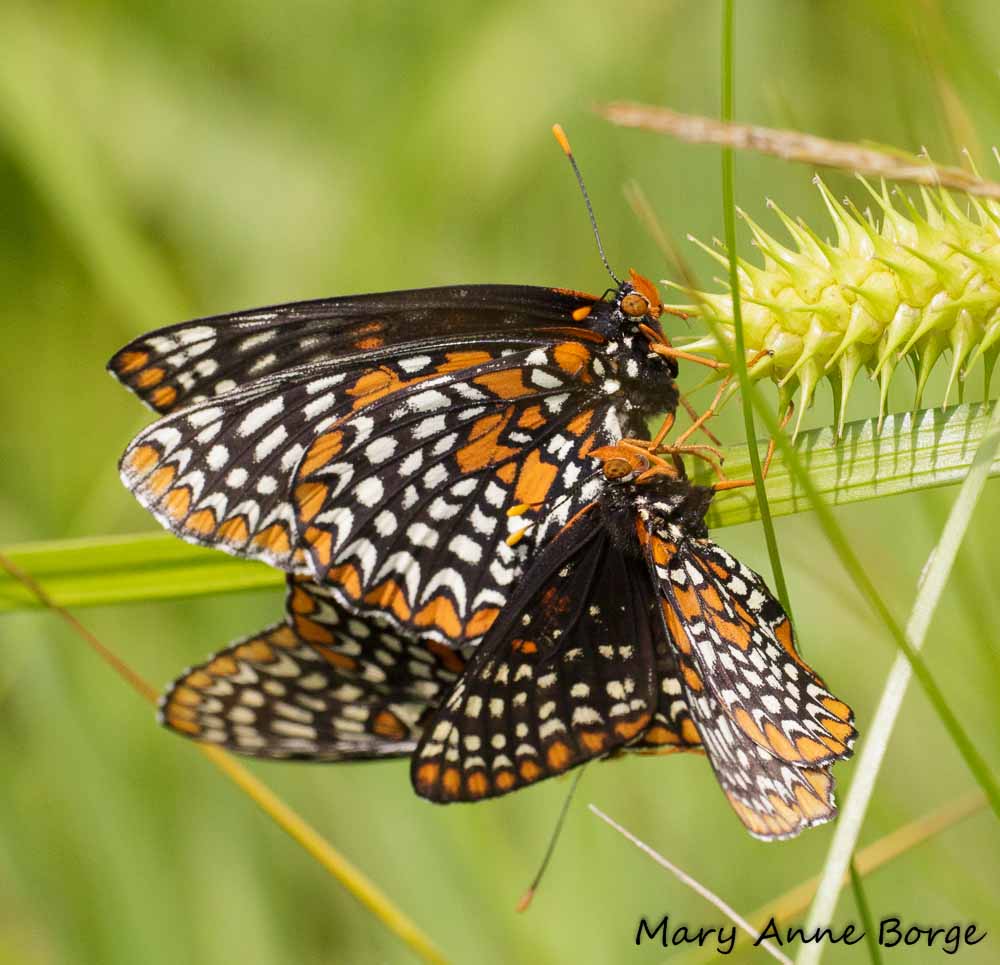
Eventually I spotted a pair of butterflies deep in the meadow foliage, mating.

Baltimore Checkerspots, mating

Baltimore Checkerspots, mating

They gradually moved higher on the sedge to which they were clinging, changing positions, taking turns being on top. They were intent on their goal.

Baltimore Checkerspots, mating

Baltimore Checkerspots, mating

Baltimore Checkerspots, mating

Baltimore Checkerspots, mating

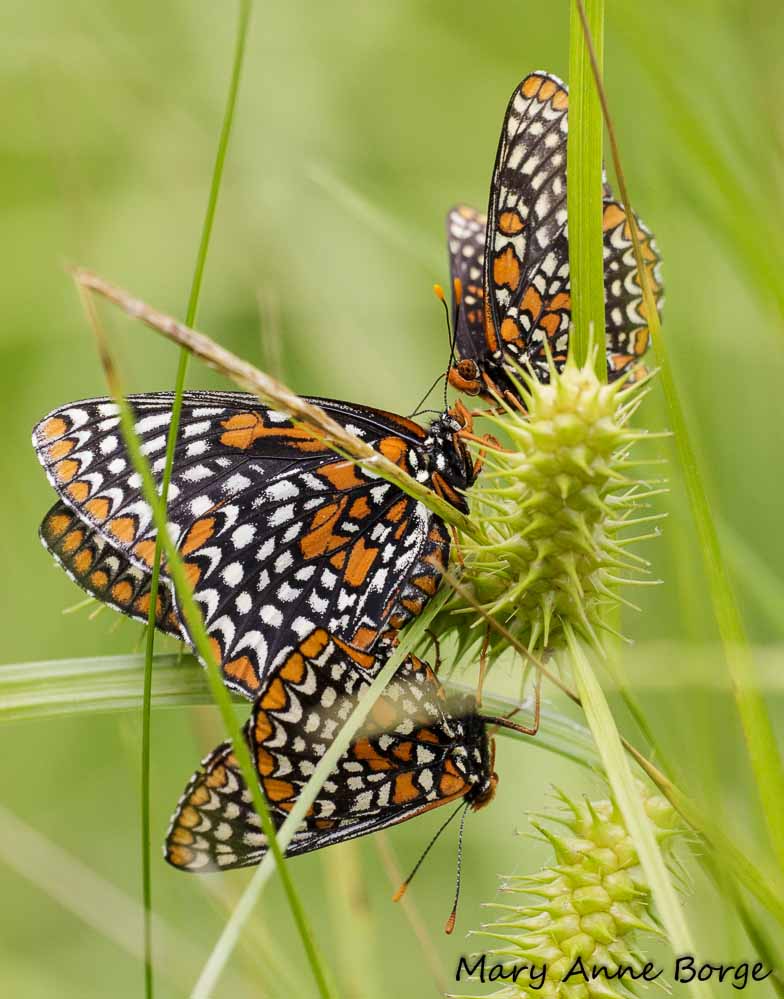
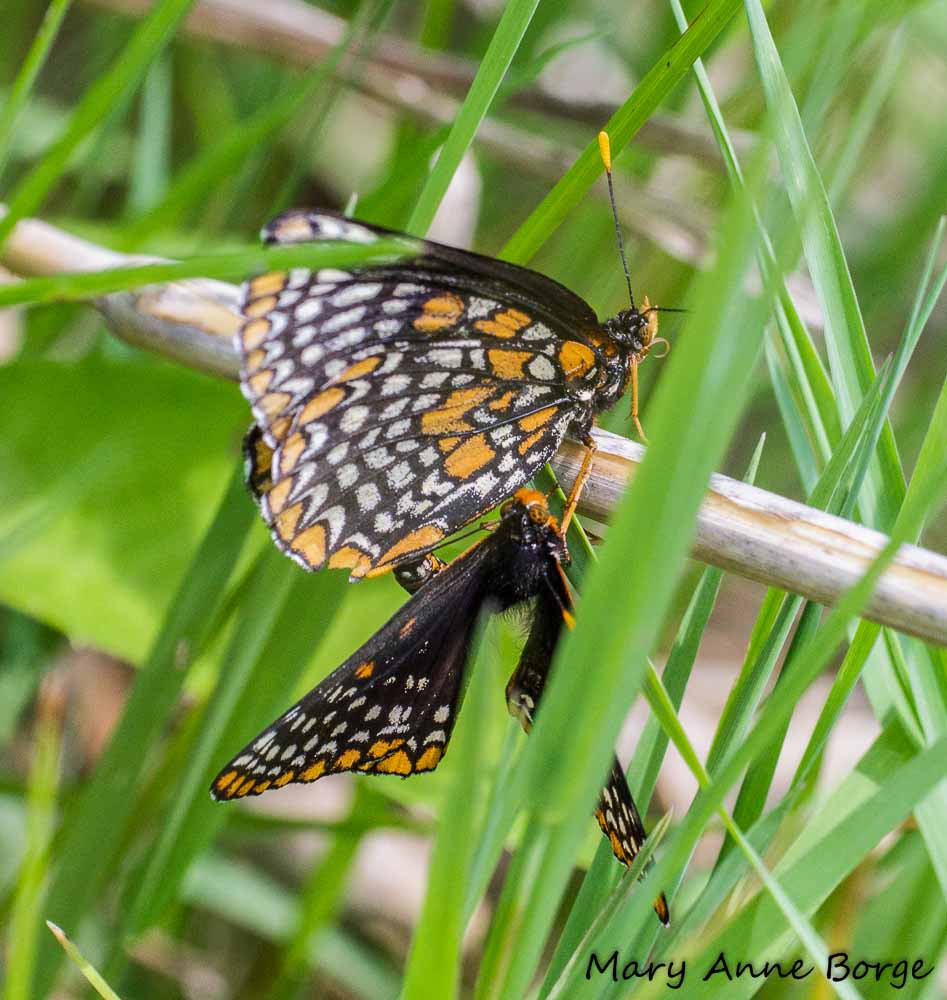
Several times another butterfly, I’m guessing a male, tried to break up the happy couple.

Baltimore Checkerspots, mating, with interloper

Baltimore Checkerspots, mating, with interloper

They indicated their disinterest to him by flapping their wings.

Baltimore Checkerspots, mating, with interloper

Baltimore Checkerspots, mating, with interloper

When he persisted, they steadfastly ignored the intruder.

Baltimore Checkerspots, mating, with interloper

Baltimore Checkerspots, mating, with interloper

It was an hour and fifteen minutes between the first and last photos I took of this mating pair. They were already engaged when I encountered them, and they were still at it when I finally had to leave. (!)

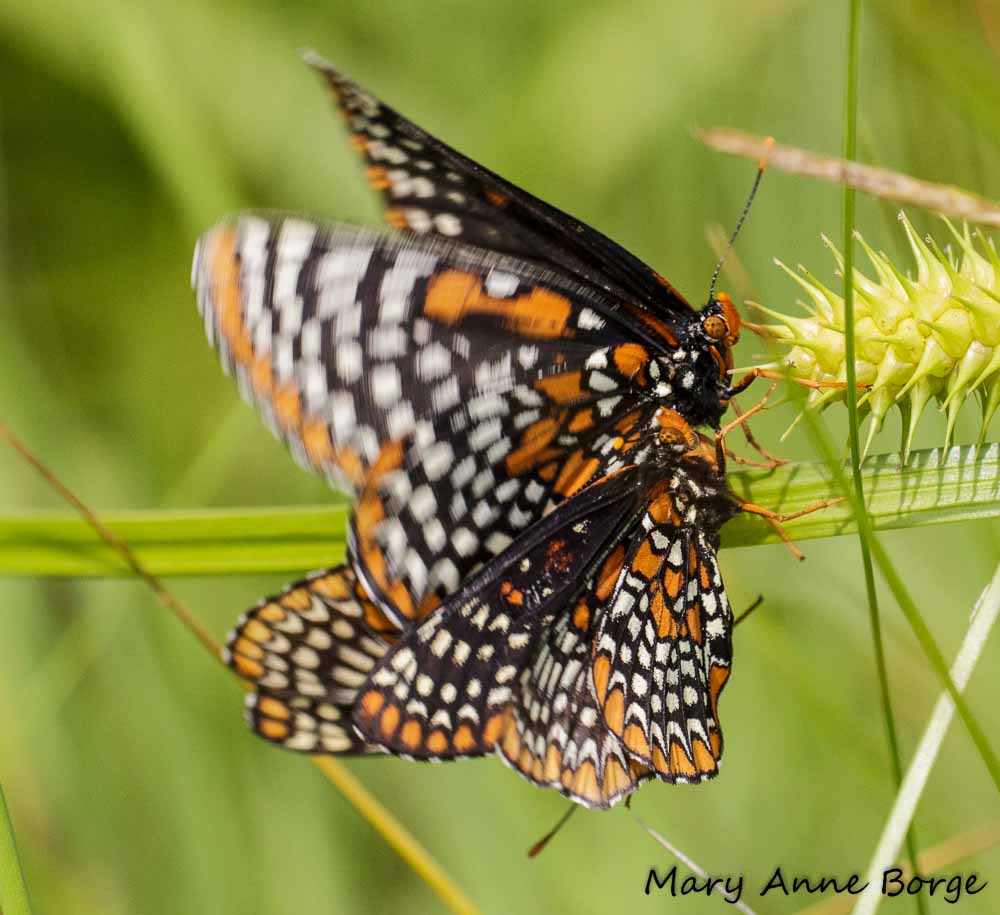
They were not the only couple that managed to meet up. I did spot another example of splendor in the grass a bit further along the trail.

Baltimore Checkerspots, mating

Baltimore Checkerspots, mating

When I went back to check the Turtlehead where the initial caterpillar sighting took place, there were several females laying eggs (ovipositing). Looks like the Preserve will see another generation of Baltimore Checkerspots.

Baltimore Checkerspots, laying eggs (ovipositing)

Baltimore Checkerspots, laying eggs (ovipositing)

Resources

Cech, Rick; Tudor, Guy. Butterflies of the East Coast. 2005.

Glassberg, Jeffrey. Butterflies through Binoculars A Field Guide to Butterflies in the Boston-New York-Washington Region. 1993.

Scott, James A. The Butterflies of North America. 1986.

Butterflies of Massachusetts

Gray Dogwood for Butterflies, Bees and Birds

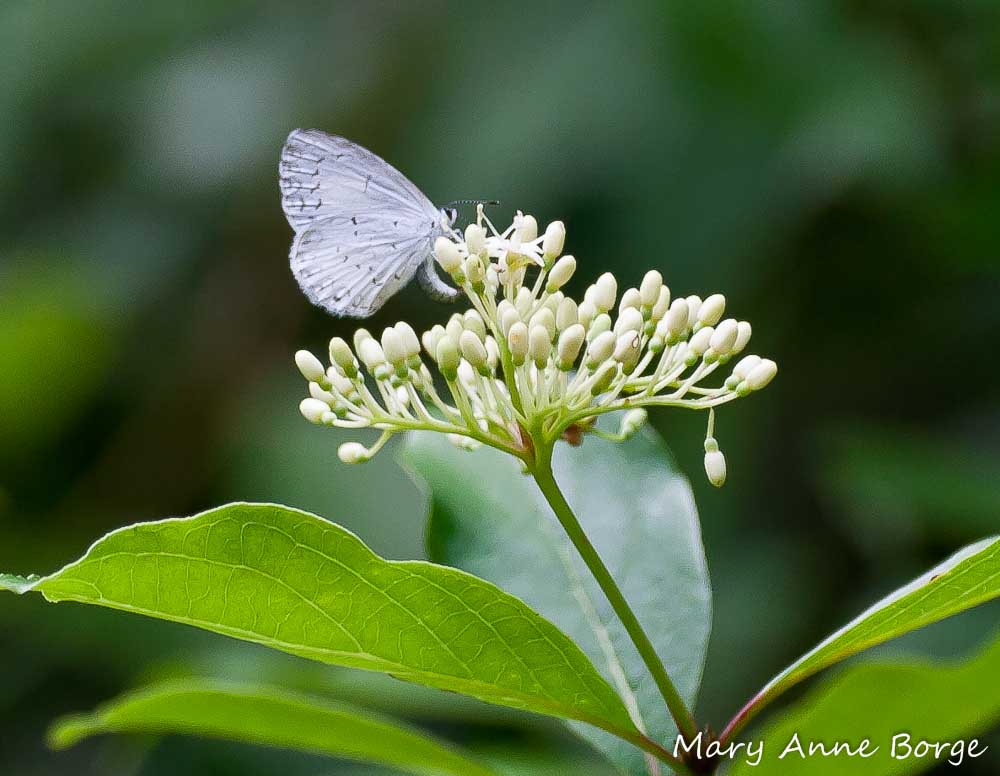
This Spring Azure butterfly is laying her eggs on the flower buds of a Gray Dogwood (Cornus racemosa), taking advantage of the nourishment this shrub provides her offspring. Dogwoods are among the favored plants of this butterfly’s caterpillars, helping to ensure that you’ll continue to see the sprightly Azure on a regular basis.

Azure butterfly laying an egg on Gray Dogwood (Cornus Racemosa) flowers

Azure butterfly laying an egg on Gray Dogwood (Cornus Racemosa) flowers

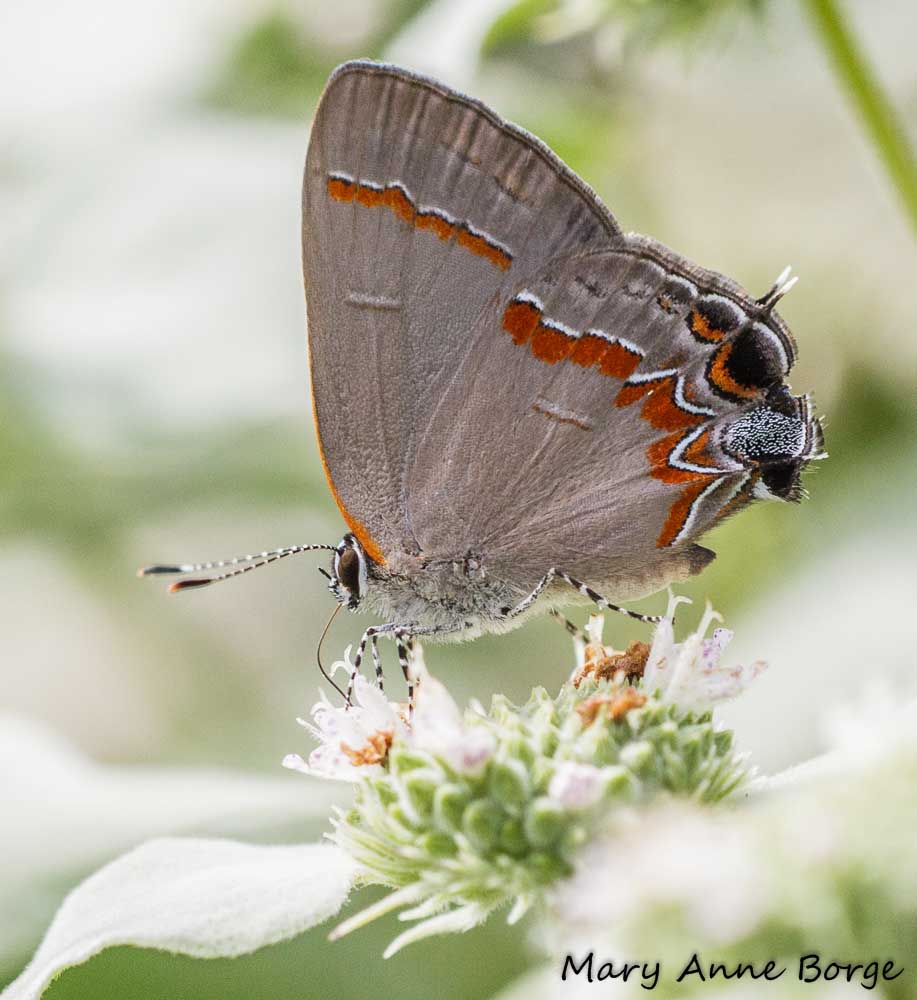
Nearby, a Red-banded Hairstreak drank the nectar offered by the profusion of lovely flowers.

Red-banded Hairstreak, different day, on Short-toothed Mountain Mint (Pycnanthemum muticum)

Red-banded Hairstreak, different day, on Short-toothed Mountain Mint (Pycnanthemum muticum)

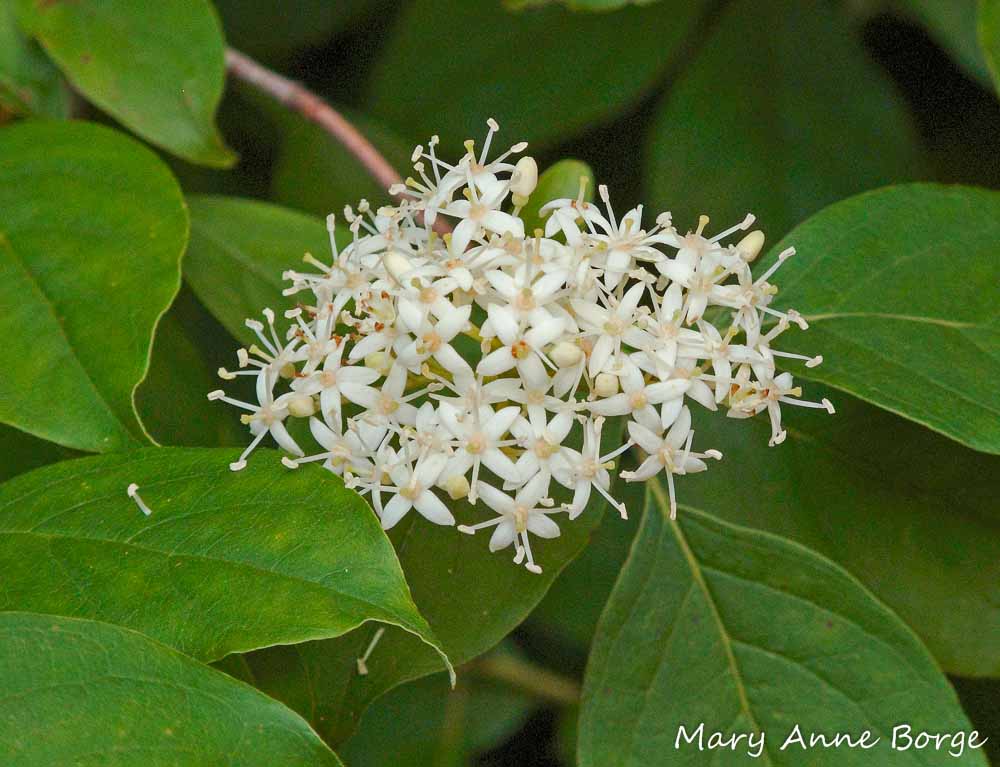
Blooming for a period of a few weeks in late May to mid June, Gray Dogwood is a relative of the more familiar Flowering Dogwood (Cornus florida), but Gray Dogwood is a shrub, growing to a maximum height of 12-15 feet (about 3.5-4.5 meters). The flowers and leaves of Gray Dogwood show typical characteristics of this family of plants.

Each delicate flower has four petals, arranged symmetrically in a cross shape. The leaves are opposite each other along the branches, with arched veins curving toward the tip of the leaf on both sides of the midrib. The common name, Gray Dogwood, refers to the color of the bark, which is usually a light gray. The species name, racemosa, describes the half-sphere arrangement of the creamy white flower clusters.

Gray Dogwood (Cornus racemosa)

Gray Dogwood (Cornus racemosa)

The flowers’ nectar attracts an array of busy pollinators, including bees, beetles and butterflies. Even better, Gray Dogwood provides the female Azure butterfly a place to lay her eggs. Several moth species use the dogwoods as food plants for their caterpillars, including the beautiful Polyphemus Moth.

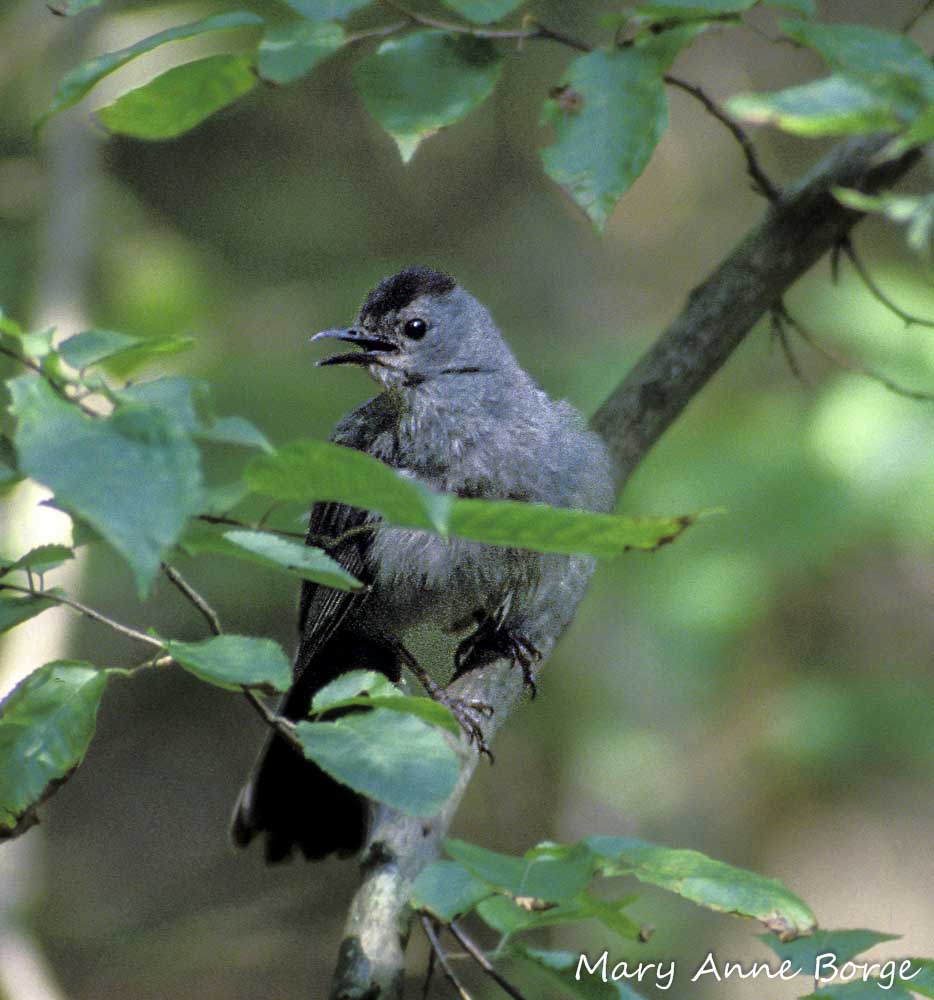
Birds that like to nest in the shrub layer look favorably on Gray Dogwood when they’re shopping for real estate. Northern Cardinals, Goldfinches, Catbirds and Yellow Warblers are some of the birds that covet the features offered by Gray Dogwood.

A young Gray Catbird

A young Gray Catbird

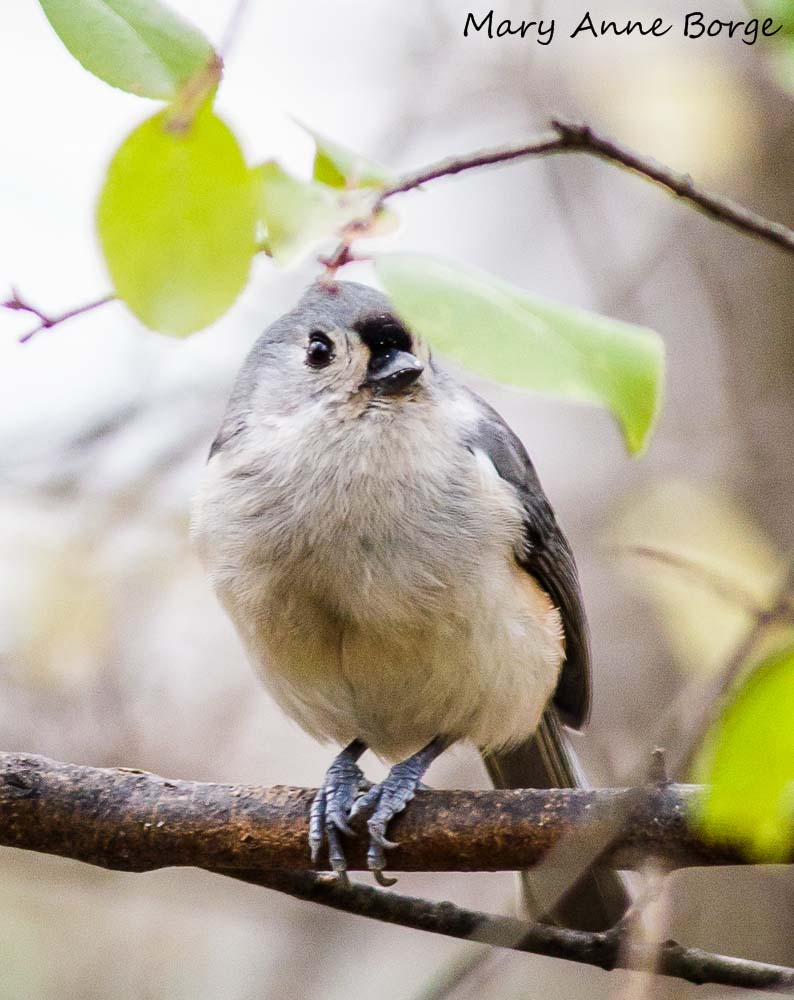
The multi-stemmed shrub with its sturdy branches offers a safe nesting place, with food right on the premises. During nesting season, the pollinators and any caterpillar progeny offer the protein necessary to raise healthy young birds. Newly fledged Chickadees and Titmice may also browse Gray Dogwood for a quick bite, or take refuge in its sturdy branches.

Tufted Titmouse

Tufted Titmouse

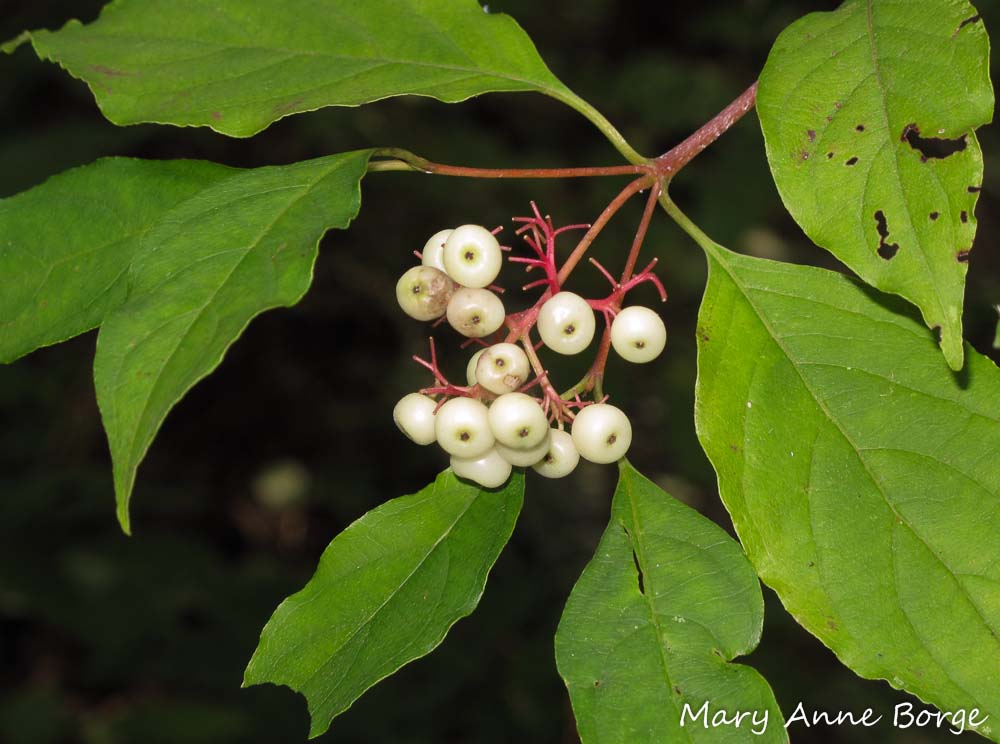
Flowers that are successfully pollinated by butterflies, bees or other insects will produce a round white berry-like fruit called a drupe. The fruit appears on a platform of bright red stems, called pedicels, beckoning the local bird population to stop for a meal. Birds find the fruit irresistibly delectable, eating it as soon as it ripens in late summer for a jolt of energy. Squirrels, chipmunks and other mammals also enjoy the tasty bounty.

Gray Dogwood fruit

Gray Dogwood fruit

For your viewing pleasure, the red fruit platforms remain for weeks even after the fruit is snapped up by resident and migrating birds. As fall approaches, Gray Dogwood’s leaves turn from deep green to a regal reddish-purple. In winter, its branches shelter the birds that live with us year-round.

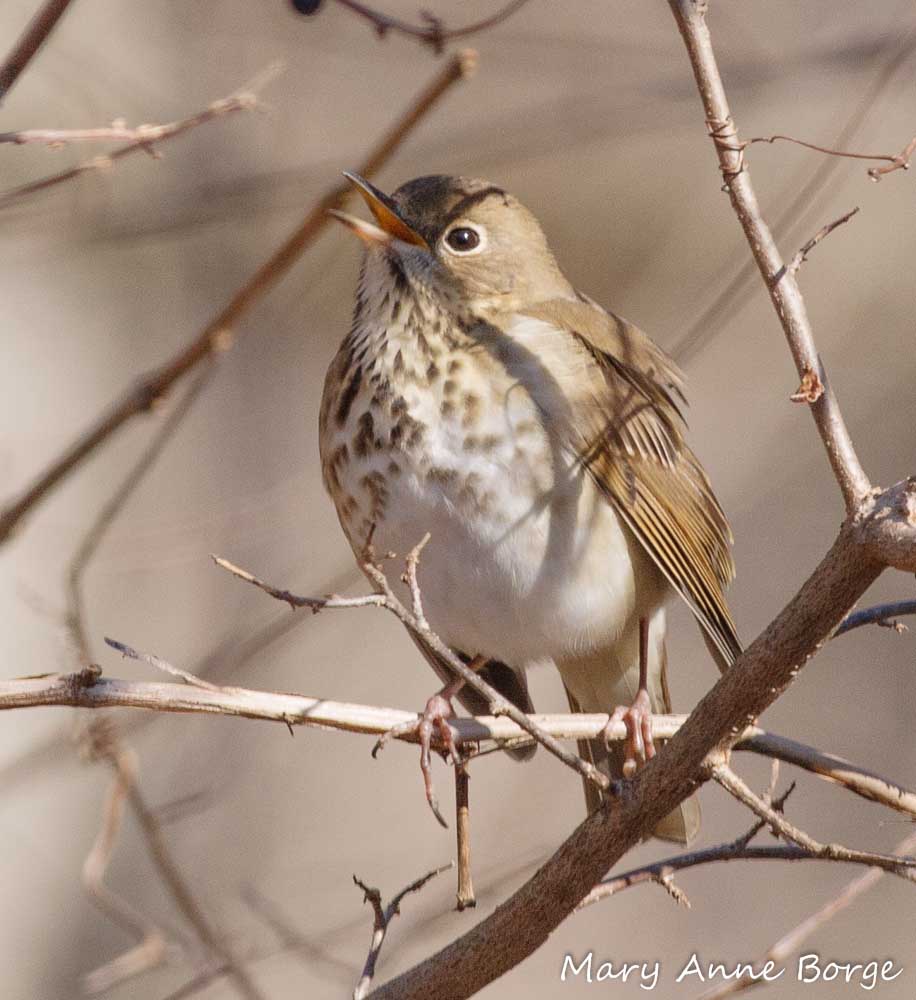
Hermit Thrush - one of the many bird species that eat Gray Dogwood fruits

Hermit Thrush – one of the many bird species that eat Gray Dogwood fruits

Gray Dogwood is native in the Canadian provinces of Manitoba, Ontario and Quebec, as far south in the United States as South Carolina, Kentucky, Arkansas, Nebraska, and Texas. It adapts well in many conditions. It prefers moist, well-drained soil, but can tolerate poor, compacted soils, and drought conditions. It likes sun, but it can also do well in part shade. It’s often found in woodland openings or open fields.

In landscaping, Gray Dogwood can be used alone in any location where a good-sized shrub is needed. Or even better, mixed with other species it brings visual and animal diversity to your property. Gray Dogwood combines well with Ninebark (Physocarpus opulifolius), American Hazelnut (Corylus americana), or Blackhaw Viburnum (Viburnum prunifolium), among others.

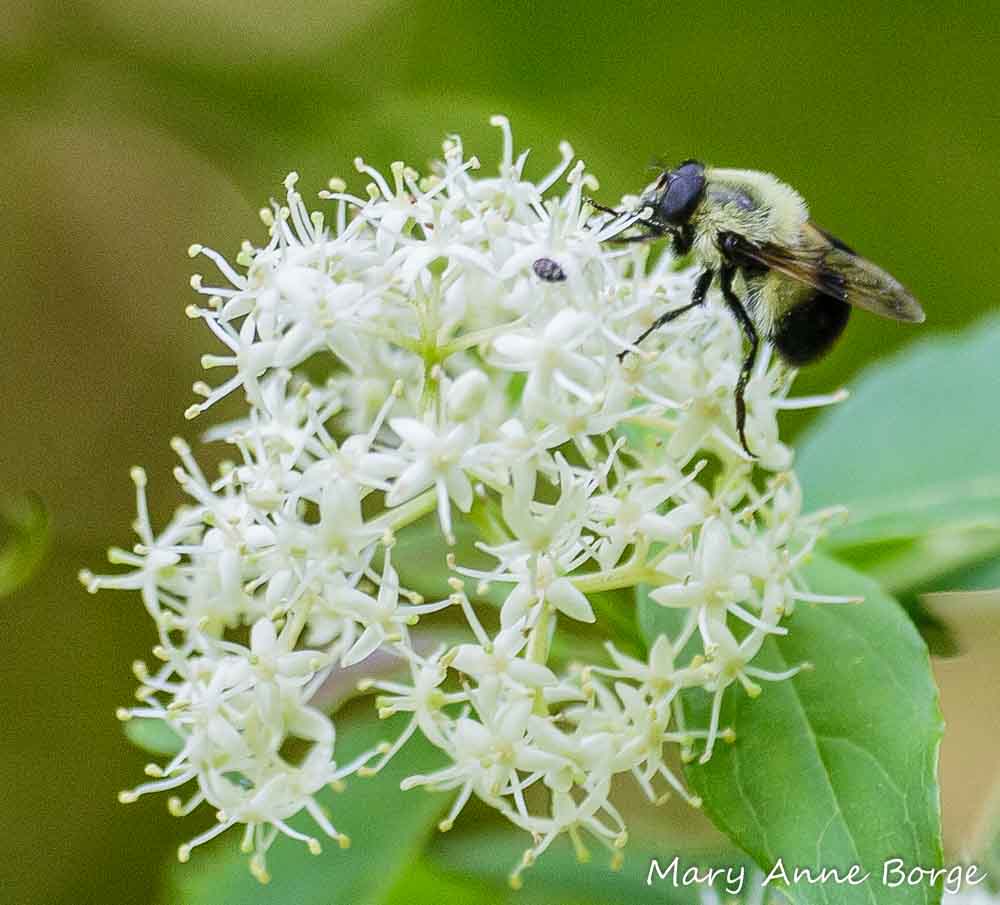
Gray Dogwood with Syrphid Fly, a Bumble Bee mimic.

Gray Dogwood with Syrphid Fly, a Bumble Bee mimic.

Gray Dogwood is great for birds, butterflies, bees, and many other critters – even people!

Resources

Wagner, David L.;  Caterpillars of Eastern North America, 2005.

Eastman, John.  The Book of Forest and Thicket.  1992.

Illinois Wildflowers


A Carpet of Spring Beauty, Woven by … Ants!

Trout Lily (Erythronium americanum )

Trout Lily (Erythronium americanum )

It’s breathtaking to watch the delicate spring wildflowers emerge from their blanket of leaves, bloom, develop and disperse fruit, all in a matter of a few short days or weeks.

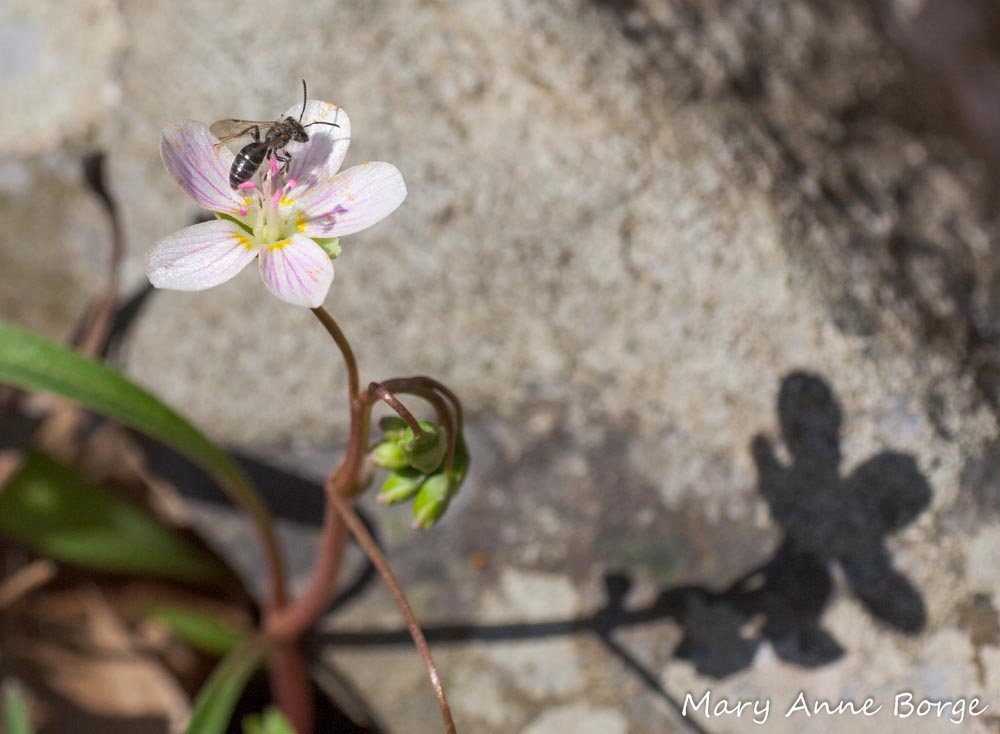
Spring Beauty (Claytonia virginica)

Spring Beauty (Claytonia virginica)

Although they look fragile, these are tenacious little plants, each focusing its efforts on perpetuating its species. They have evolved to have a wide range of flower structures and colors, some with scents, enticing many different insect species to assist them in pollination.

Dutchman's Breeches with Bumble Bee

Dutchman’s Breeches with Bumble Bee

There is one strategy that a surprising number of spring blooming native plants have evolved in common: seed dispersal by ants. Many ant species are omnivorous, that is, they’ll eat both plant and animal matter. But given a choice, many ant species tend to prefer animals, often other insects. Early in the spring there are not as many animal food sources (insects) available as there will be as the growing season progresses, so the ants are more likely to make do with plant-based food at this time.

Canada Violet (Viola canadensis)

Canada Violet (Viola Canadensis)

As many as thirty percent of the spring flowering herbaceous plant species in the forests of eastern North America have evolved to take advantage of this situation to benefit themselves. These species have evolved to provide food attached to their seeds to entice ants to disperse those seeds. This food, called an elaiosome, is a specialized fat body whose chemical composition more closely matches that of the insects that ants prefer than it does that of a seed.

Red Trillium (Trillium erectum)

Red Trillium (Trillium erectum)

Ants harvesting trillium seeds

Ants harvesting trillium seeds

When a fruit opens to disperse its seeds, the elaiosomes are an instant attraction for ants. They take the seed with its attached elaiosome back to their nests for consumption there, but they just eat the elaiosome, their preferred food, and dispose of the seed on their trash pile. This tends to be an environment that is rich in nutrients, and will benefit the growth of the new plant. Just to make sure the ants don’t eat the seeds in addition to the elaiosome, some plant species have hard seed coatings that ants can’t really bite through.

Squirrel Corn (Dicentra canadensis)

Squirrel Corn (Dicentra Canadensis)

So this dispersal by ants, called myrmecochory, effectively plants the seeds. The new location is generally close enough to the parent plant to be a hospitable environment for growth, but far enough away to minimize competition for resources. It generally occurs within a very short time of the seeds becoming available. As a result, the seeds are protected from animals that might otherwise consume the them, which would give the seeds no chance to germinate and grow into a new plant.

Rue Anemone (Thalictrum thalictroides)

Rue Anemone (Thalictrum thalictroides)

This evolutionary adaptation is somewhat analogous to the strategy of plants that have evolved to surround their seeds with fleshy fruits to attract birds to assist them with seed dispersal. Given the fact that there are fewer birds available in early spring to help with seed dispersal, it makes sense that the early blooming plants evolved to partner instead with the ants for this service.

Round-lobed Hepatica (Hepatica nobilis)

Round-lobed Hepatica (Hepatica nobilis)

The plants featured in this post are just some of the species that share the evolutionary characteristic of seed dispersal by ants. Did you ever wonder how your violets or Spring Beauty managed to pop up in new locations in your lawn or garden? Thank an ant!

Bloodroot (Sanguinaria canadensis)

Bloodroot (Sanguinaria Canadensis)

Resources

Special thanks to Amy Mawby for letting me use her photo of ants harvesting trillium seeds.

Eastman, John. The Book of Forest and Thicket. 1992.

Gracie, Carol. Spring Wildflowers of the Northeast. 2012.

Insect Visitors of Illinois Wildflowers

Rico-Gray, Victor; Oliveira. Paulo S. The Ecology and Evolution of Ant-Plant Interactions. 2007.

Waldbauer, Gilbert. What Good Are Bugs? Insects in the Web of Life. 2003.