Feasting on Green-headed Coneflower

How many flowers do you see in the photo below?
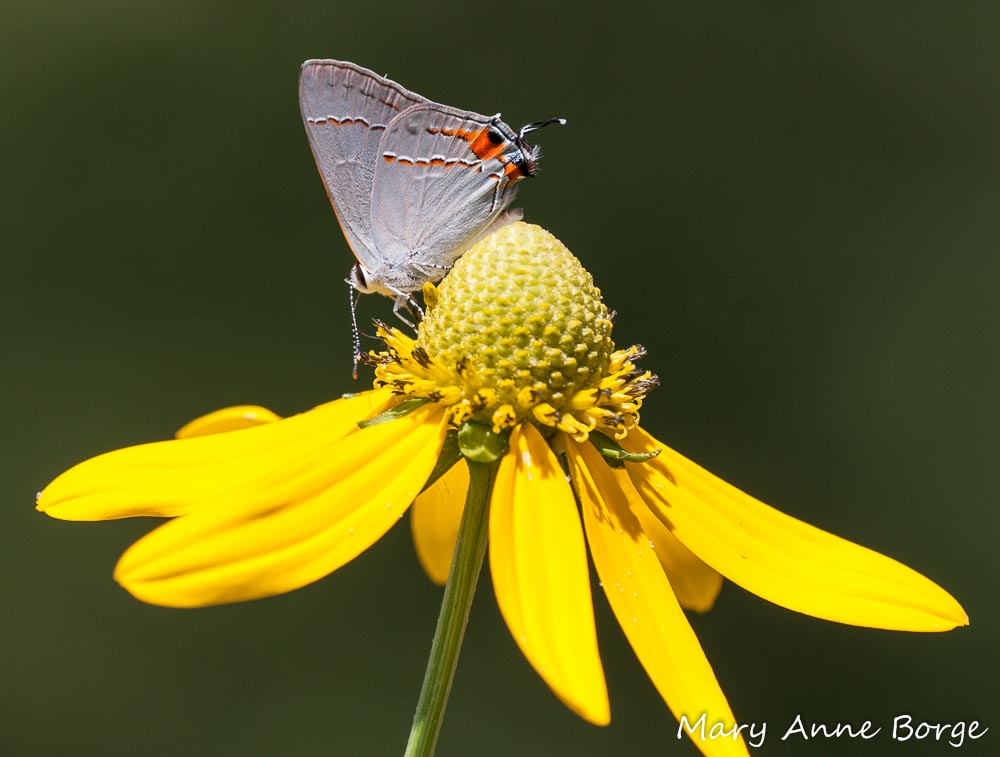
Gray Hairstreak on Green-headed Coneflower (Rudbeckia laciniata)

Gray Hairstreak on Green-headed Coneflower (Rudbeckia laciniata)

If you said one, that’s the answer I was looking for. However, it’s not correct!

The plant pictured here is Green-headed Coneflower (Rudbeckia laciniata), also sometimes called Cut-leaf Coneflower in deference to its deeply lobed leaves.  Green-headed Coneflower is a member of the Aster, or ‘Composite’ family, a name that’s pretty descriptive of their typical flower clusters (inflorescences). What our brains think is a single flower is actually a cluster (or composite) of tiny flowers, often of two different types, ray flowers and disk flowers. The petal-like parts of the flower cluster are each an individual ray flower with a single petal. In the center there are dozens of tiny tubular flowers called disk flowers, in reference to the disk-like shape of the flower cluster.  In the picture above, just a few of the disk flowers are blooming.

Some Aster family members just have ray flowers, like Dandelions.
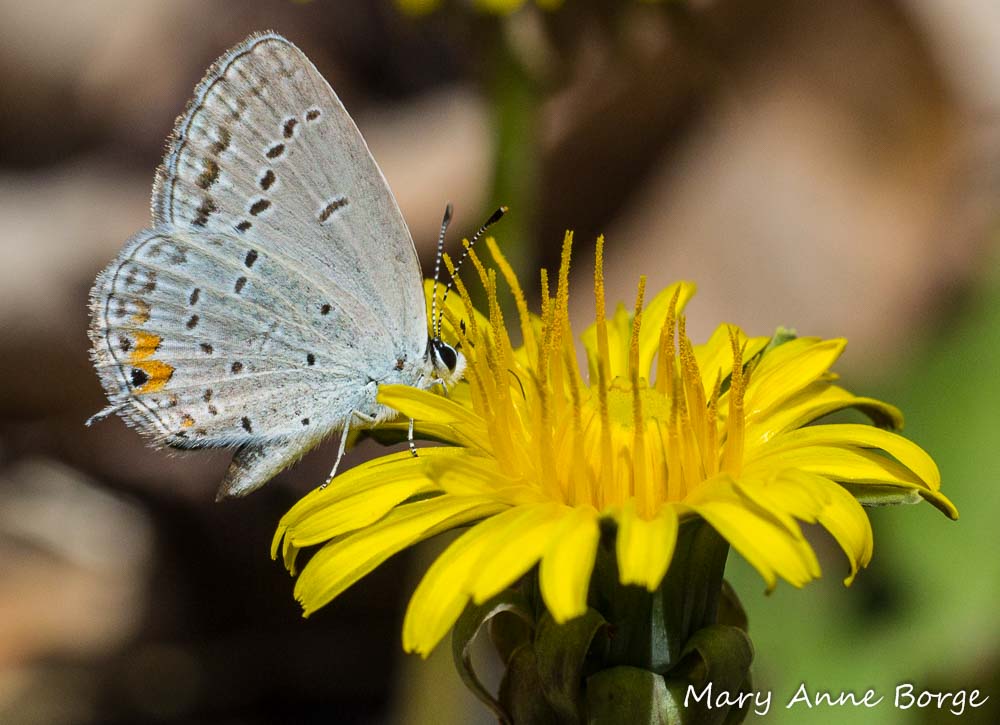
Eastern-Tailed Blue nectaring on a Dandelion

Eastern-Tailed Blue nectaring on a Dandelion

Some have just disk flowers, like New York Ironweed.
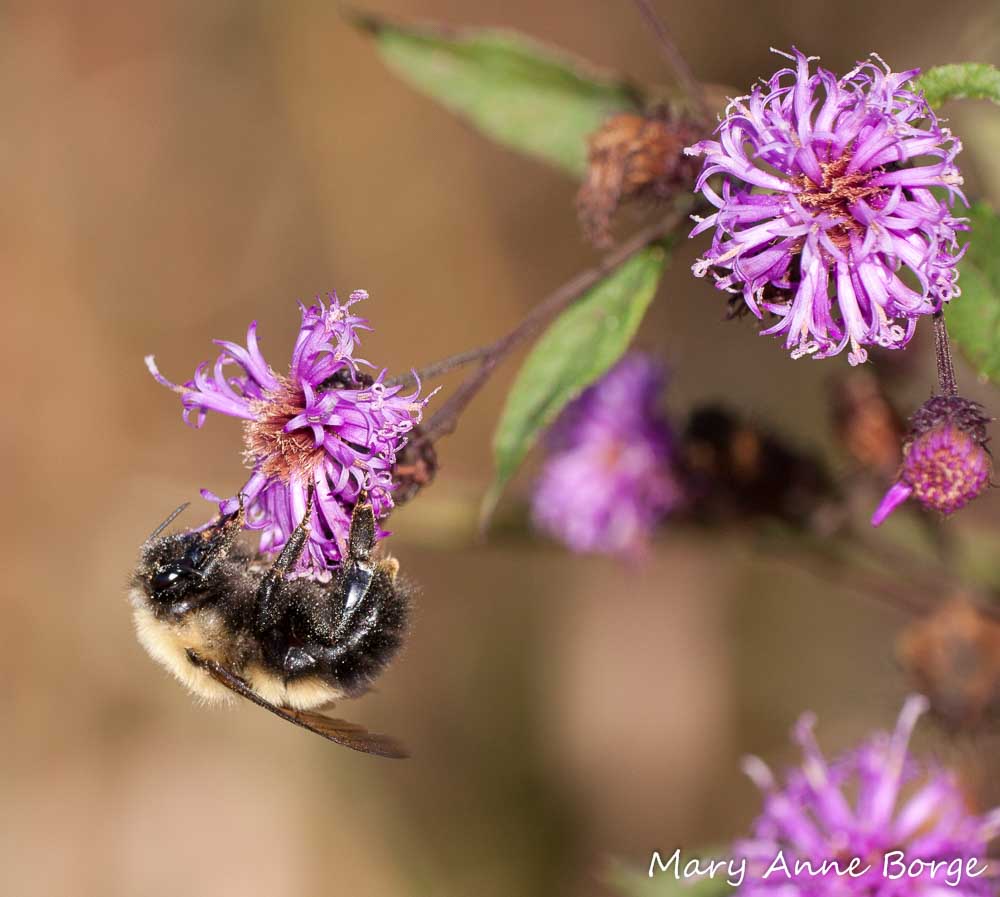
Bumble Bee on New York Ironweed

Bumble Bee on New York Ironweed

Many, like Green-headed Coneflower, have both types of flowers. When both ray flowers and disk flowers are present, the ray flowers are often sterile, in which case their primary purpose is to act as nectar guides, alerting pollinators to the availability of nectar and pollen in the many disk flowers at the center of the flower cluster.
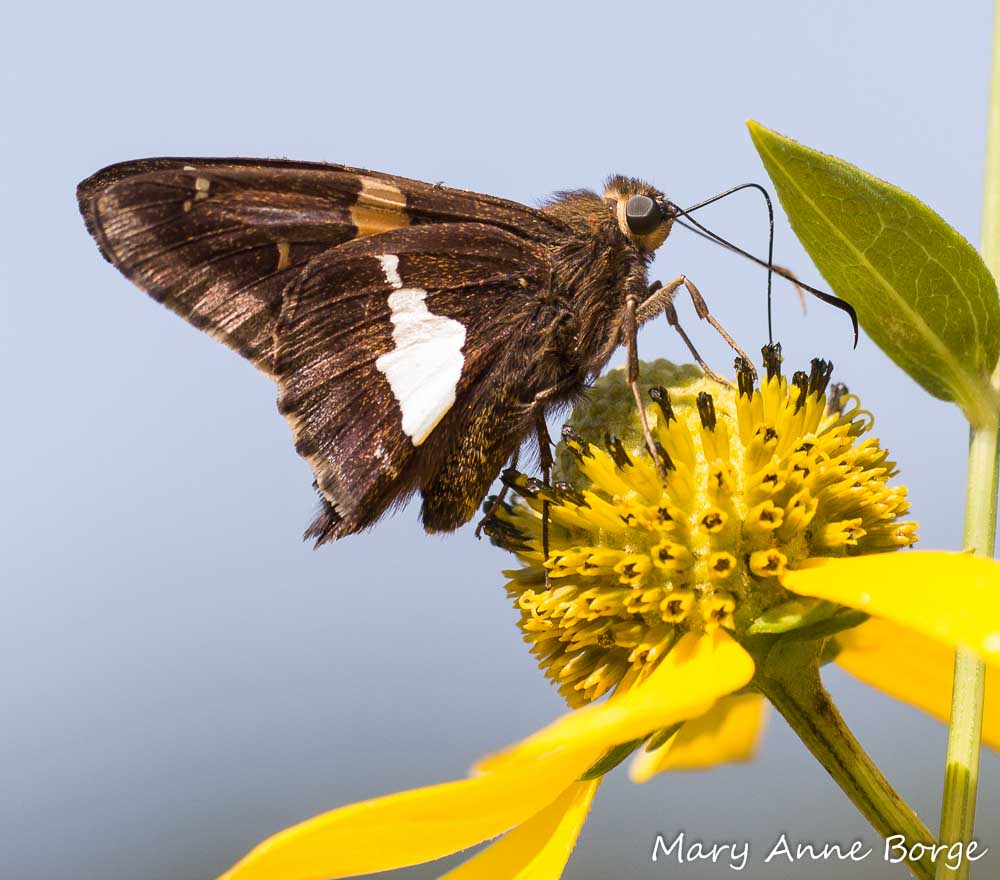
A Silver-spotted Skipper is nectaring on the disk flowers that are in bloom on this Green-headed Coneflower. The lowest disk flowers have finished blooming, while those at the top of the flower cluster are still in bud.

A Silver-spotted Skipper is nectaring on the disk flowers that are in bloom on this Green-headed Coneflower. The lowest disk flowers have finished blooming, while those at the top of the flower cluster are still in bud.

The disk flowers bloom gradually over a period of a few weeks, maximizing the plant’s chances for pollination with the assistance of insect partners. In the case of Green-headed Coneflower, the disk flowers bloom gradually from the bottom, or outside ring, to the top, or center, of the flower cluster.
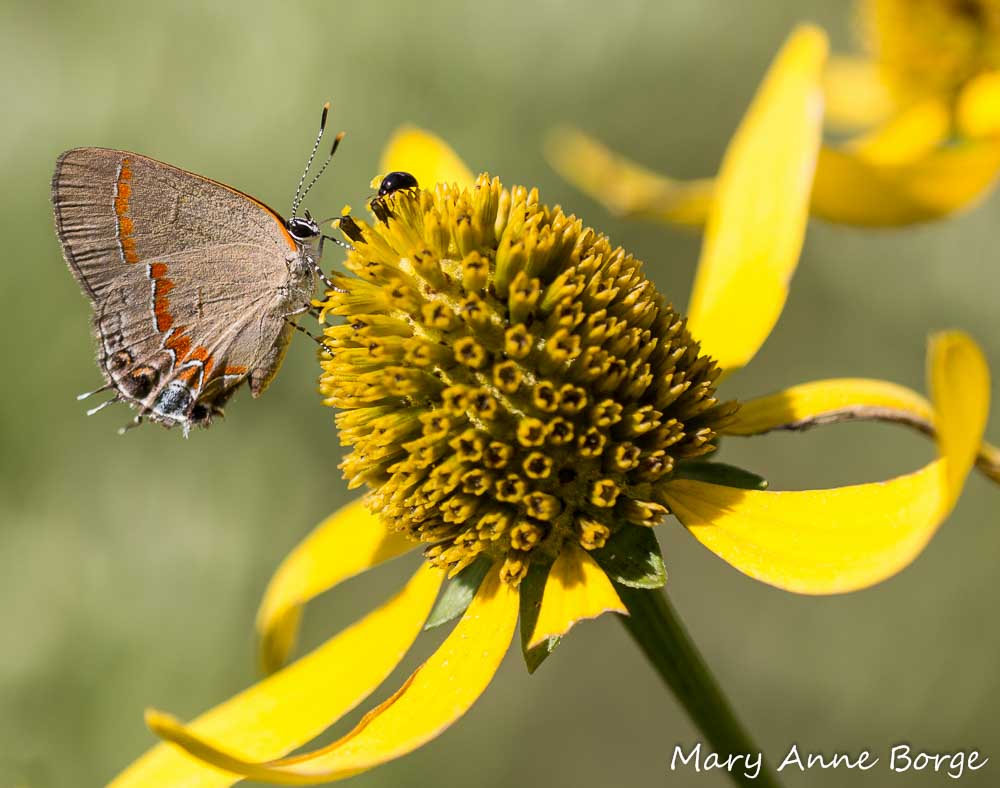
A Red-banded Hairstreak is drinking nectar from the last few blooming flowers of this Green-headed Coneflower inflorescence.

A Red-banded Hairstreak is drinking nectar from the last few blooming flowers of this Green-headed Coneflower inflorescence.

Because of the number and size of its disk flowers, Green-headed Coneflower is able to attract many insects as potential pollinators. Often multiple insects can be found feeding simultaneously on different flowers in the same flower cluster.
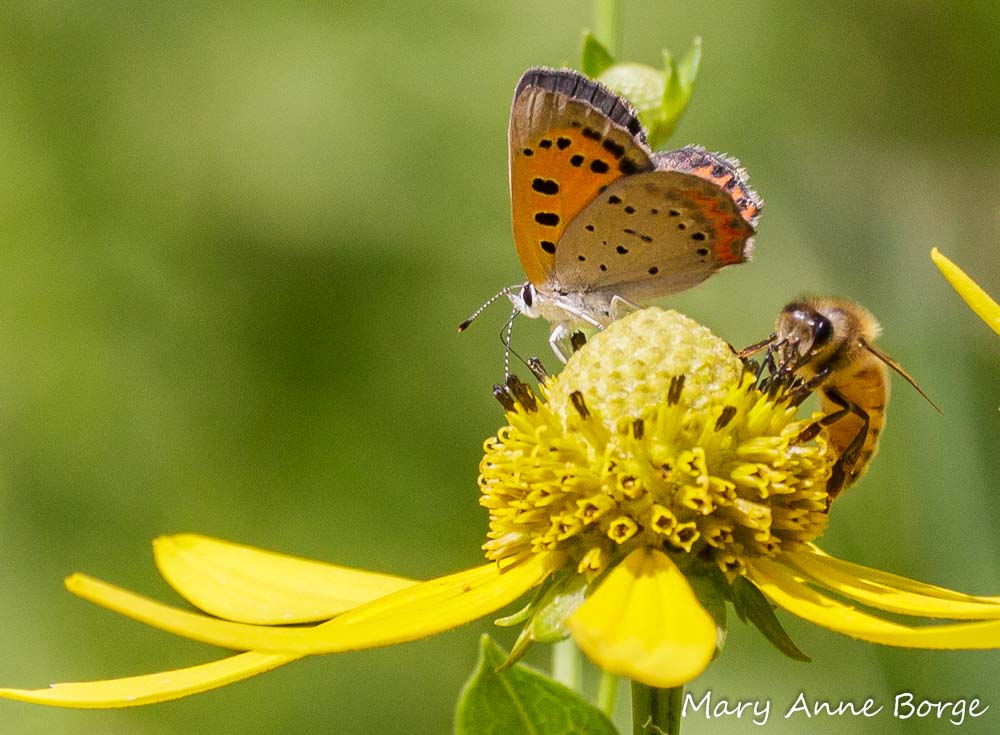
This Green-headed Coneflower offers enough flowers with nectar to feed both an American Copper and a Honey Bee.

This Green-headed Coneflower offers enough flowers with nectar to feed both an American Copper and a Honey Bee.

Green-headed Coneflower’s disk flowers are large enough to accommodate small to medium sized butterflies like those pictured here.  They may rub against some pollen and transfer it to another plant, assisting with pollination.
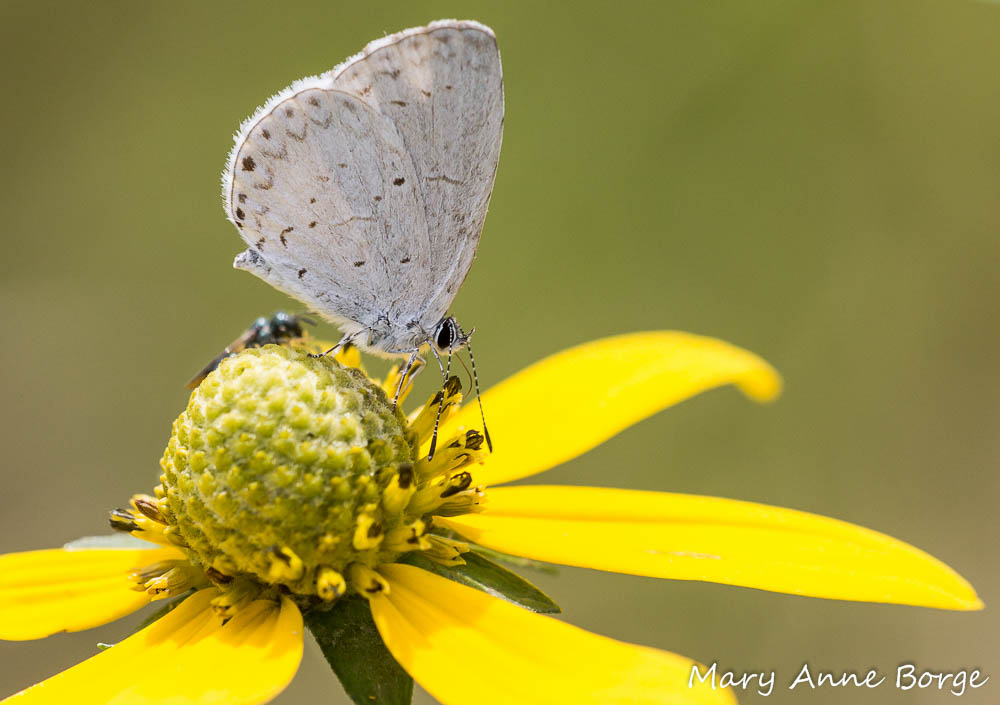
Summer Azure with Green-headed Coneflower (Rudbeckia laciniata)
Summer Azure with Green-headed Coneflower (Rudbeckia laciniata)

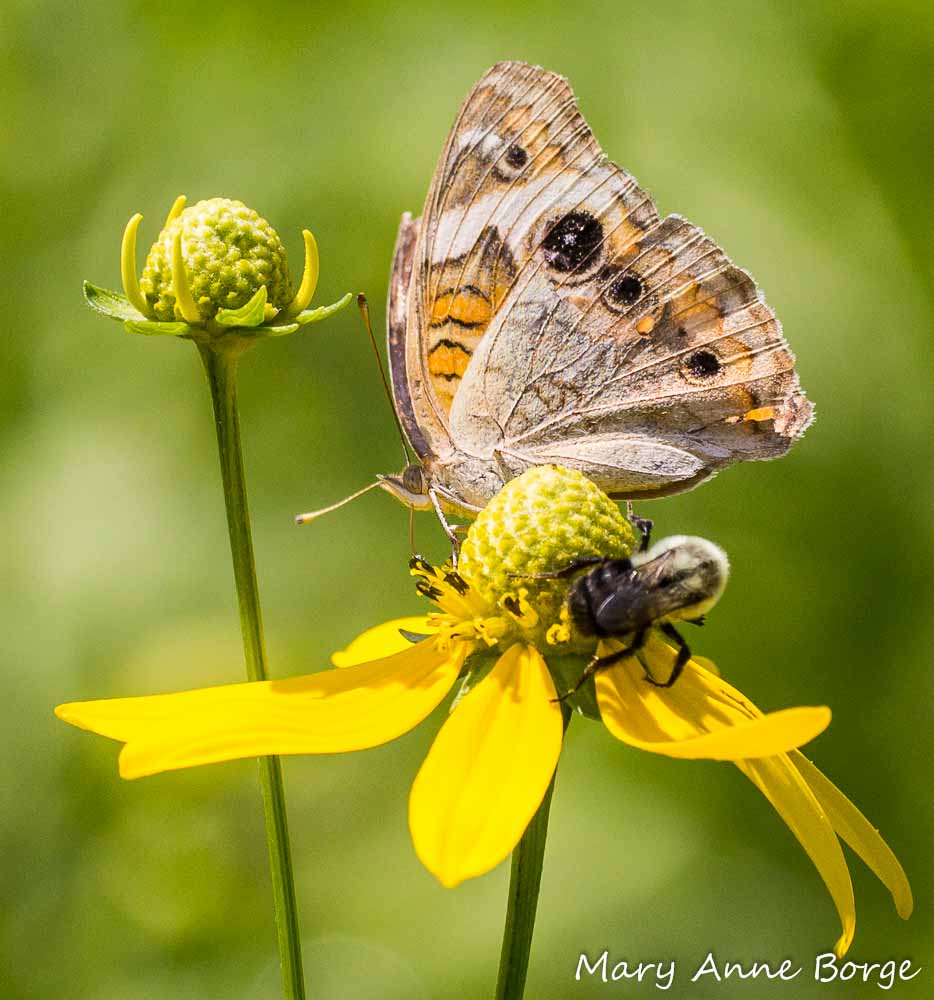
Common Buckeye and Bumble Bee feeding on Green-headed Coneflower (Rudbeckia laciniata)

Common Buckeye and Bumble Bee feeding on Green-headed Coneflower (Rudbeckia laciniata)

Beneficial predators like the thread-waisted wasps (a species of Sphecid wasp) pictured below also benefit from the abundant nectar, giving them the energy they need to reproduce.  (I often see this species mating and nectaring at the same time, as they are doing here. A level of skill and coordination to which humans can only aspire!)  Their anatomy makes it more likely that they will help with pollination than butterflies, since more of their bodies are likely to come in contact with pollen.  The female wasps of this species (Eremnophila aureonotata) hunt caterpillars to feed their larvae.
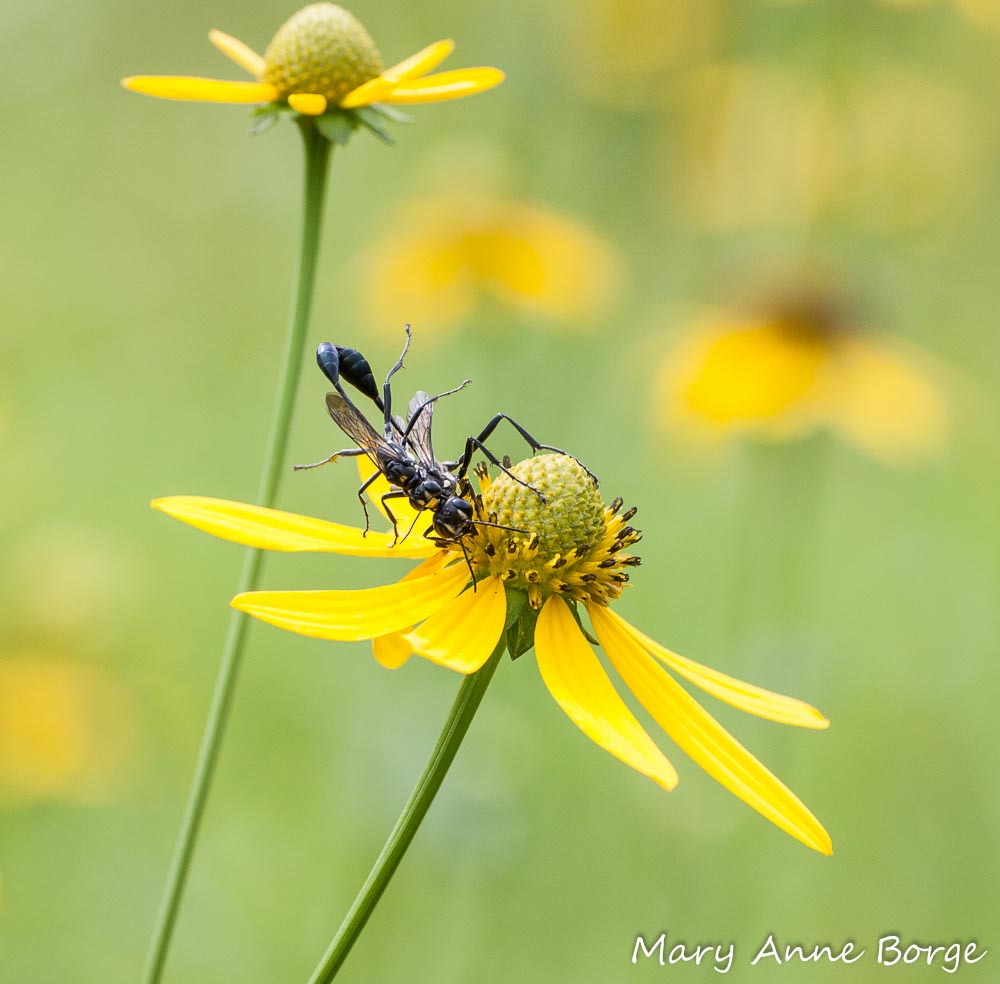
Green-headed Coneflower with mating Wasps (Eremnophila aureonotata)

Green-headed Coneflower with mating Wasps (Eremnophila aureonotata)

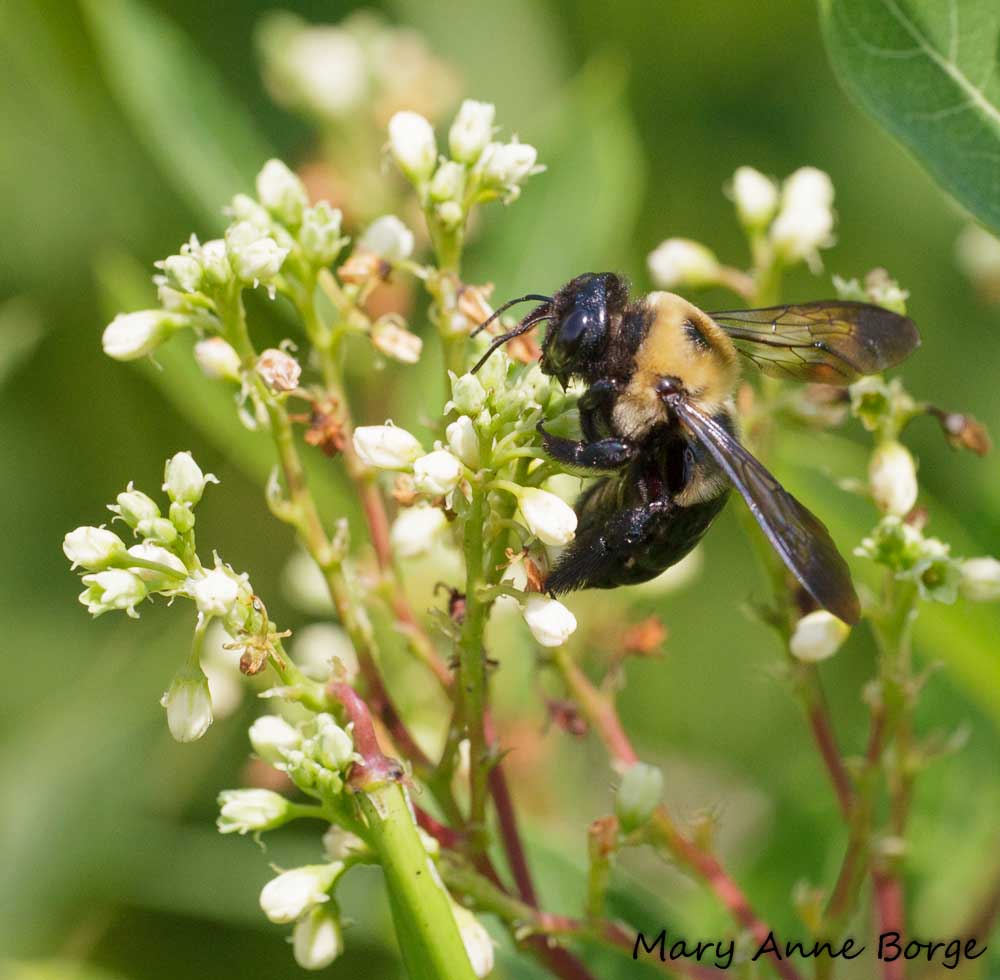
But bees are the most likely to be successful pollinators, because they are the best anatomical match for gathering pollen, and it’s more likely to stick to the branched hair on their bodies and be carried away to be deposited on another flower.
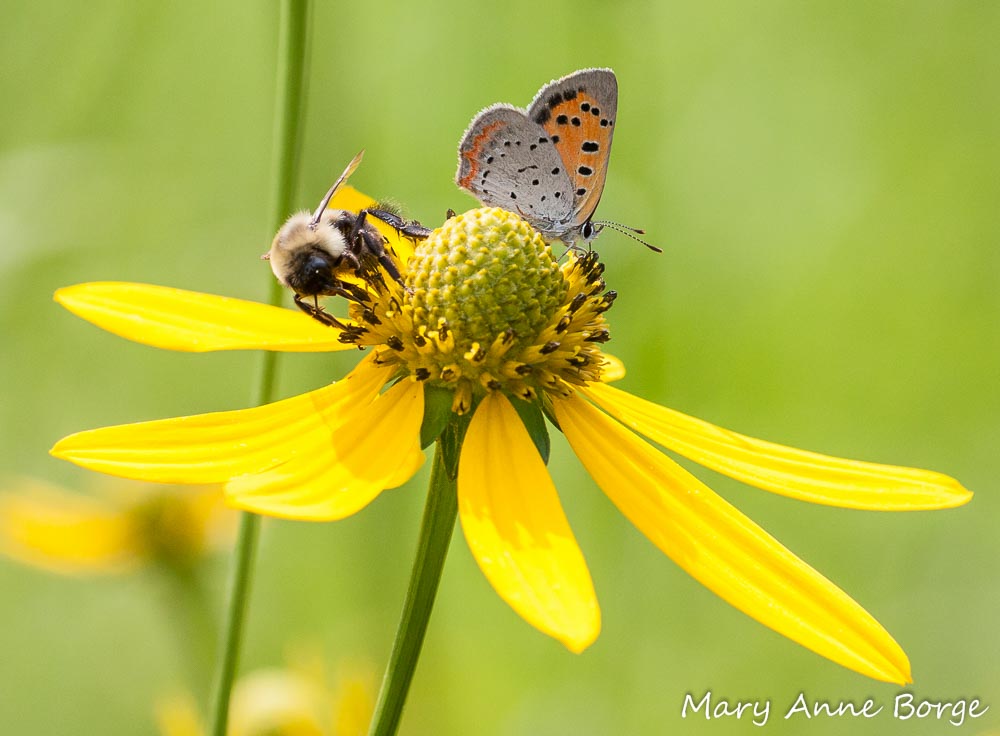
Bumble Bee and American Copper nectaring on Green-headed Coneflower (Rudbeckia laciniata)
Bumble Bee and American Copper nectaring on Green-headed Coneflower (Rudbeckia laciniata)

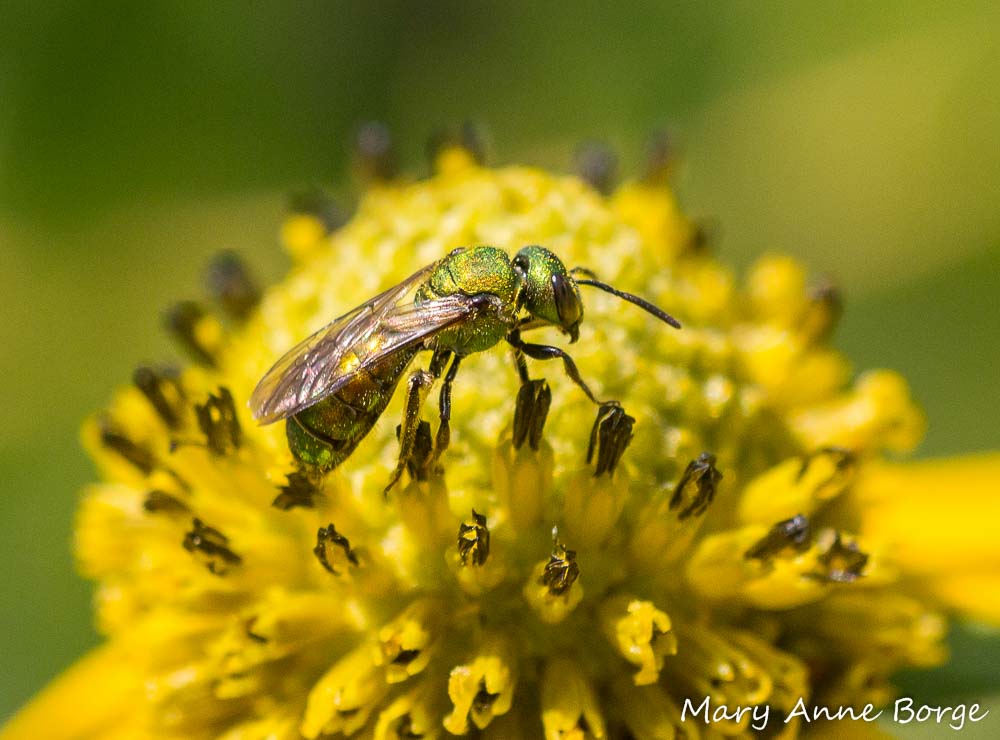
Sweat Bee on Green-headed Coneflower (Rudbeckia laciniata)

Sweat Bee on Green-headed Coneflower (Rudbeckia laciniata)

The Sweat Bee below is gathering pollen on her hind legs to take back to feed her larvae.  Only female bees gather pollen this way.
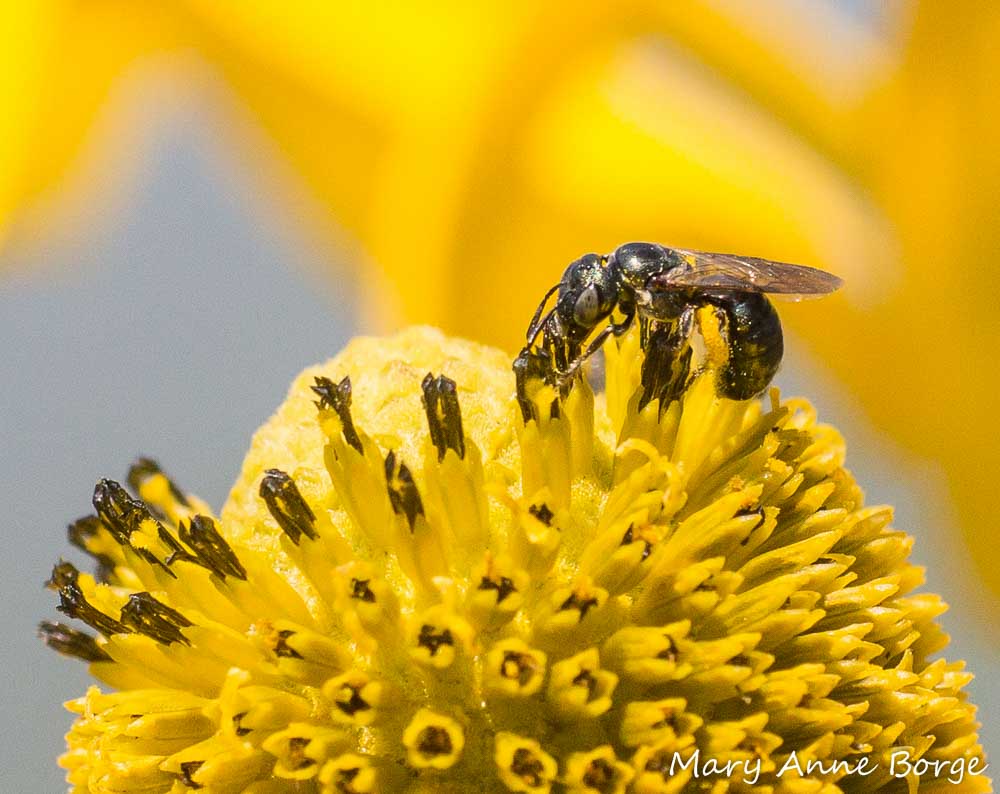
Sweat Bee (Lasioglossum species) on Green-headed Coneflower (Rudbeckia laciniata)

Sweat Bee (Lasioglossum species) on Green-headed Coneflower (Rudbeckia laciniata)

Dining on Green-headed Coneflower is not without danger, as this Bumble Bee found out when it fell victim to a Wheel Bug, a type of assassin bug.  Sometimes the diner becomes the dinner.
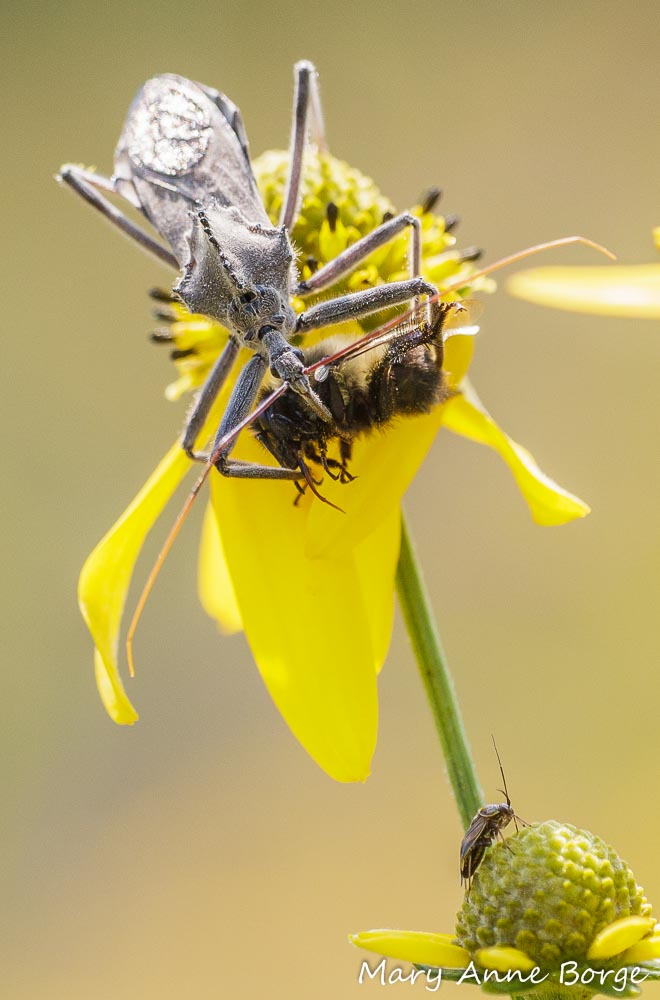
Wheel Bug (Arilus cristatus) consuming a Bumble Bee smoothie

Wheel Bug (Arilus cristatus) consuming a Bumble Bee smoothie

If the flowers are successfully pollinated, you’re likely to see Goldfinches and other birds feeding on the seeds later in the season and throughout fall.
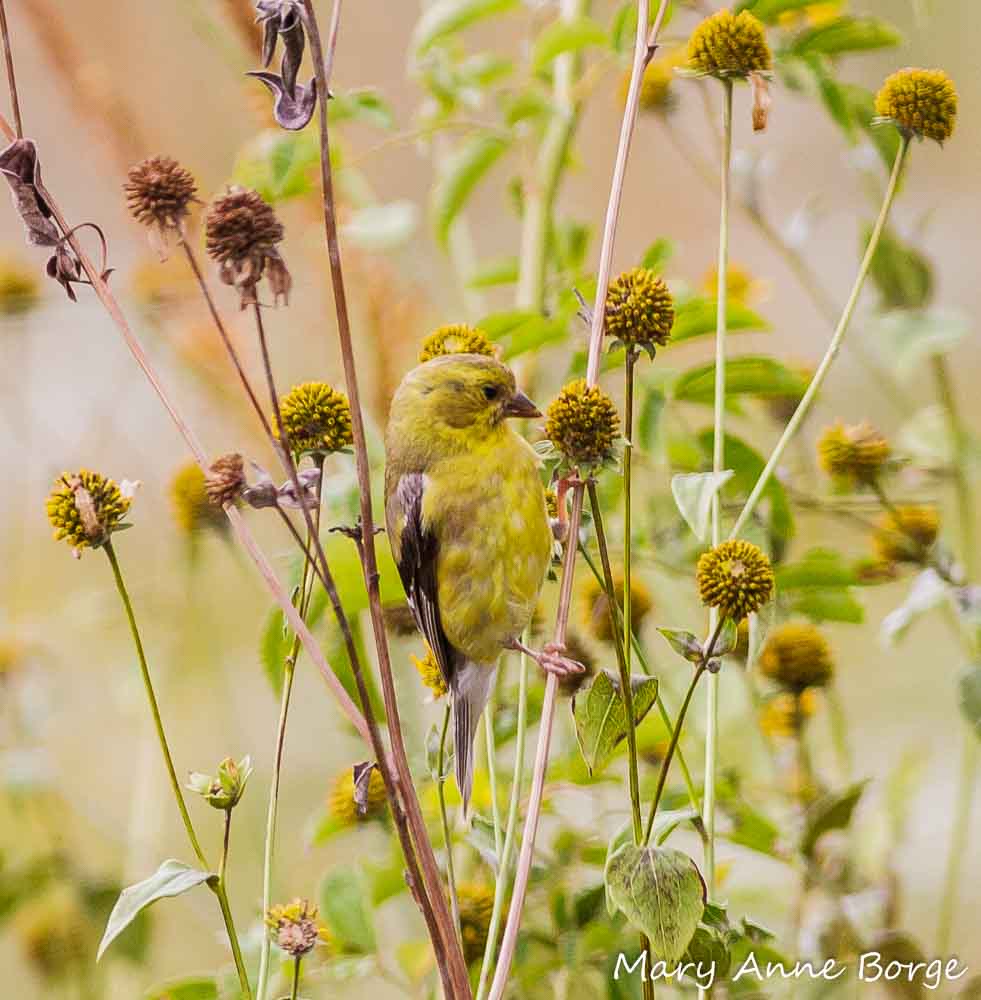
Goldfinch eating Green-Headed Coneflower seeds

Goldfinch eating Green-Headed Coneflower seeds

The Aster family is the second largest family of flowering plants in terms of its number of species, second only to the Orchid family.  In late summer and fall the Aster family represents a high percentage of what’s in bloom.  For information on a few other Aster family members, see Asters Yield a Treasure Trove! and Fall Allergies?  Don’t Blame Goldenrod!

Resources

Eaton, Eric R.; Kauffman, Ken.  Kaufman Field Guide to Insects of North America.  2007.

Elpel, Thomas J.  Botany in a Day.  2006.
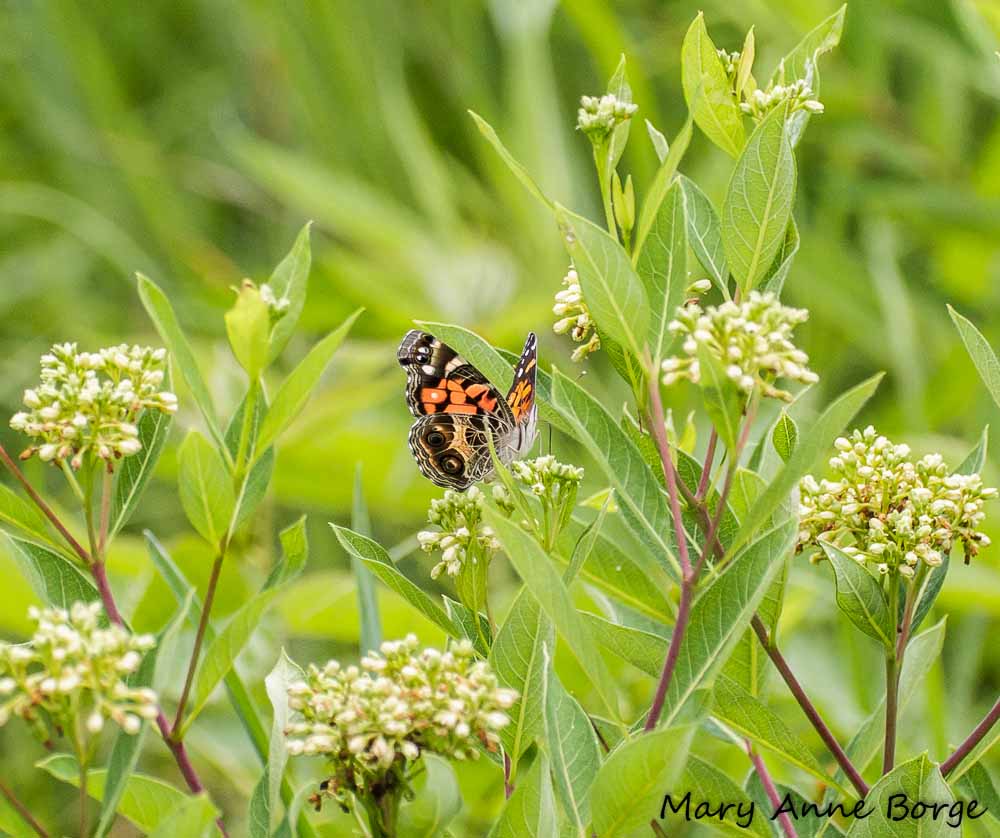
 

What Good is Dogbane?

American Lady on Indian Hemp (Apocynum cannabinum)

American Lady on Indian Hemp (Apocynum cannabinum)

A friend asked for help in identifying a plant growing on her property. She thought it was a milkweed, and she was excited at the prospect that it might attract Monarch butterflies. Milkweeds are the only food plants on which Monarch caterpillars can thrive. Monarch numbers have declined steeply in the past few years, largely due to loss of habitat and their caterpillar food plants, the milkweeds.

The plant in question turned out to be a dogbane, a species commonly called Indian Hemp (Apocynum cannabinum). There is a closely related species called Spreading Dogbane (Apocynum androsaemifolium), but Indian Hemp is the species I see most often. These two species also interbreed.

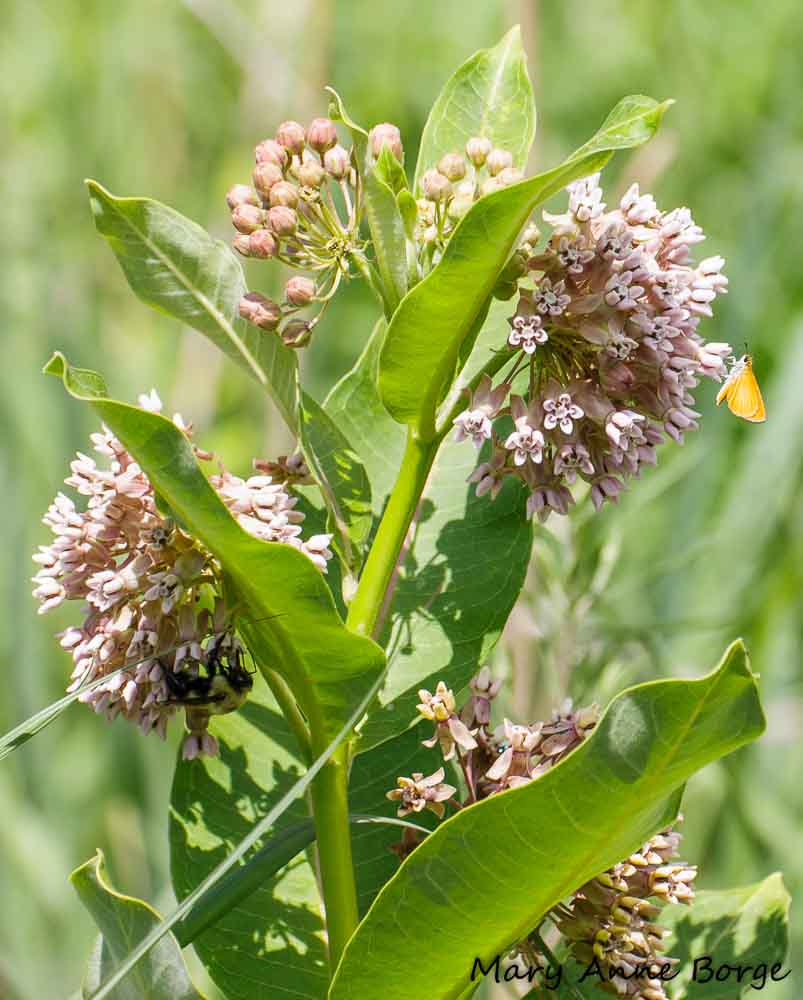
It’s easy to understand how my friend was fooled, since Indian Hemp and the other dogbane species resemble milkweeds. You might even say there is a family resemblance, since milkweeds are in the Dogbane (Apocynaceae) family. Both have simple, opposite, untoothed oval leaves with a strong midvein, and look similar at a glance.

Common Milkweed (Asclepias syriaca) with Least Skipper and Bumble Bee

Common Milkweed (Asclepias syriaca) with Least Skipper and Bumble Bee

My friend, disappointed that the plants weren’t a milkweed species, asked ‘What good is dogbane?’.

Plenty, as it turns out. It’s a great source of nectar in early summer, before many other species start blooming. The US Department of Agriculture – Natural Resources Conservation Service (USDA NRCS) ranks Indian Hemp’s value to pollinators as ‘very high’. Many bee species are frequent visitors to Indian Hemp, feeding on both nectar and pollen.

Bumble Bee on Indian Hemp (Apocynum cannabinum)

Bumble Bee on Indian Hemp (Apocynum cannabinum)

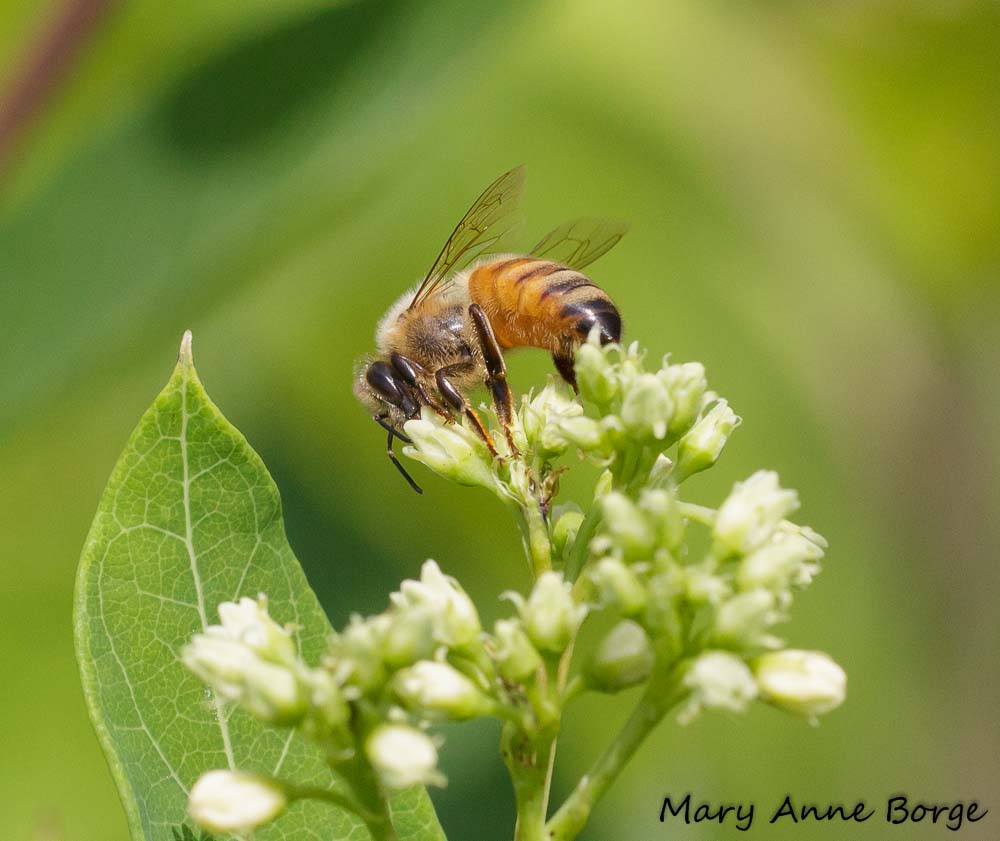
Honey Bee on Indian Hemp (Apocynum cannabinum)

Honey Bee on Indian Hemp (Apocynum cannabinum)

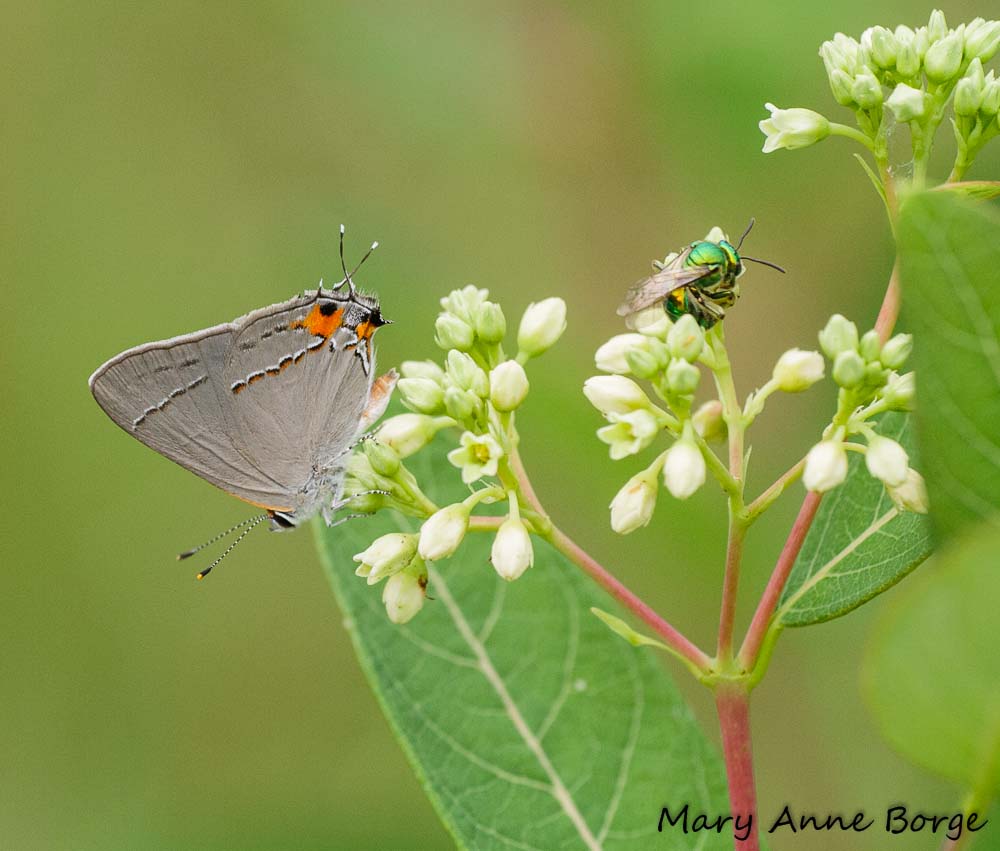
Sweat Bee and Gray Hairstreak on Indian Hemp (Apocynum cannabinum)

Sweat Bee and Gray Hairstreak on Indian Hemp (Apocynum cannabinum)

Butterflies also visit Indian Hemp for its nectar.

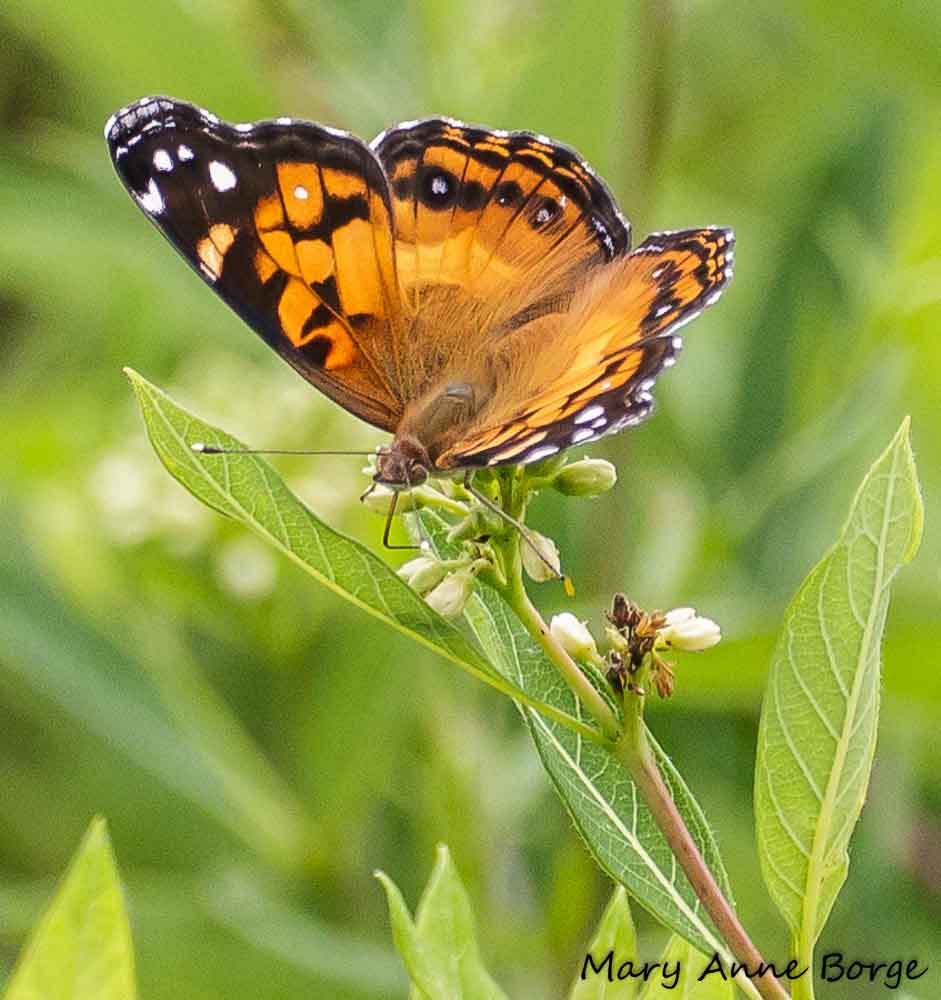
American Lady on Indian Hemp (Apocynum cannabinum)

American Lady on Indian Hemp (Apocynum cannabinum)

Silver-spotted Skipper on Indian Hemp (Apocynum cannabinum)

Silver-spotted Skipper on Indian Hemp (Apocynum cannabinum)

Northern Broken-dash on Indian Hemp (Apocynum cannabinum)

Northern Broken-dash on Indian Hemp (Apocynum cannabinum)

Least Skipper on Indian Hemp (Apocynum cannabinum)

Least Skipper on Indian Hemp (Apocynum cannabinum)

Many other beneficial insects can be found feeding on Indian Hemp. Adult Pennsylvania Leatherwings (Chauliognathus pensylvanicus), sometimes called Goldenrod Soldier Beetles, are known for foraging on goldenrods for pollen, but they visit a variety of other flowers, including Indian Hemp. Their larvae prey on the eggs and larvae of other insects, helping to keep those other insect populations in check.

Pennsylvania Leatherwings (Chauliognathus pensylvanicus) on Indian Hemp (Apocynum cannabinum)

Pennsylvania Leatherwings (Chauliognathus pensylvanicus) on Indian Hemp (Apocynum cannabinum)

Tachinid flies may visit Indian Hemp for nectar. These beneficial critters lay eggs on nymph or adult insects, some of which are harmful to crops or to plants in general, including stink bugs, squash bugs, and even Gypsy Moths and Japanese Beetles. Their larvae live inside these host insects, feeding on their insides. This prevents the victimized insects from reproducing, and ultimately kills them. (Science fiction writers, eat your hearts out!)

Tachinid Fly (Trichopoda pennipes) on Indian Hemp

Tachinid Fly (Trichopoda pennipes) on Indian Hemp

Small Milkweed Bugs (Lygaeus kalmii) are primarily seed eaters, but they have a broader palate than their name implies. The adults feed on a variety of food sources, including nectar from many flowers such as the dogbanes.

Small Milkweed Bug (Lygaeus kalmii) on Indian Hemp

Small Milkweed Bug (Lygaeus kalmii) on Indian Hemp

When Dogbane flowers are pollinated, they produce a pair of fruits, reflecting the structure of the flowers’ reproductive parts. Each flower has two ovaries, and each ovary produces one fruit called a follicle, a dry (not fleshy) fruit that splits open along one seam to release the many seeds inside. Small Milkweed Bug nymphs feed on dogbane seeds in addition to milkweeds, as well as the seeds of some other plants.

Small Milkweed Bug (Lygaeus kalmii) nymphs on Indian Hemp

Small Milkweed Bug (Lygaeus kalmii) nymphs on Indian Hemp

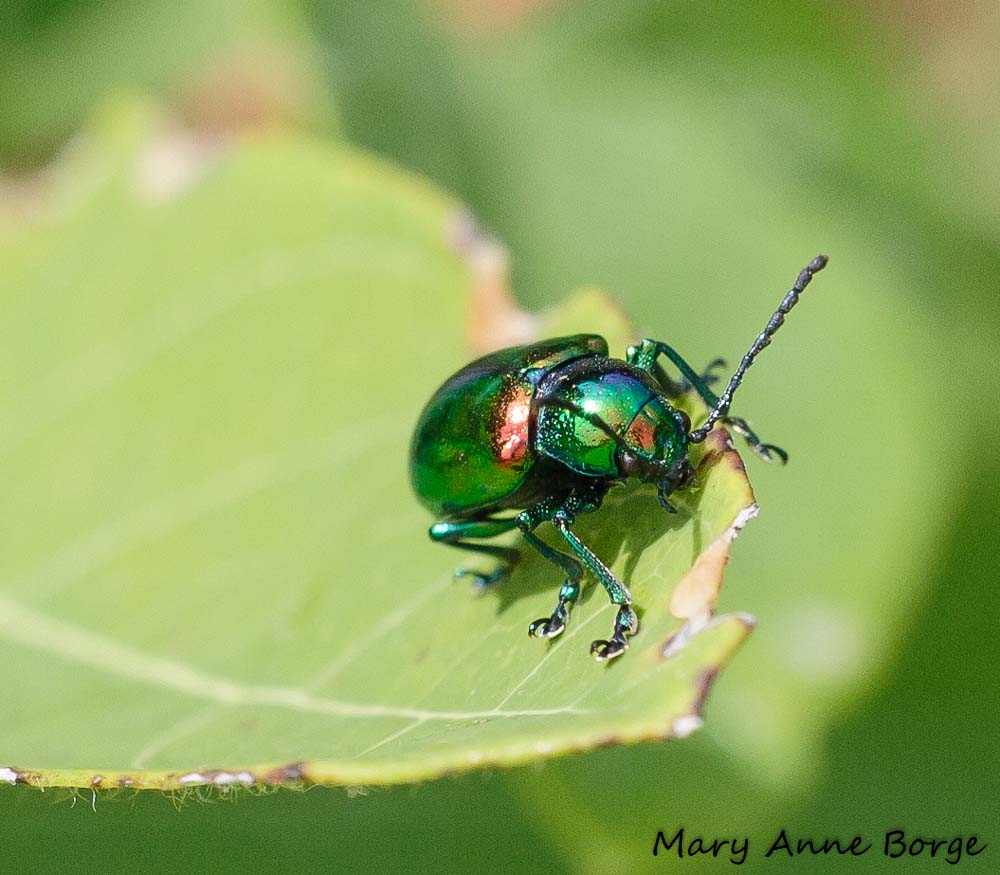
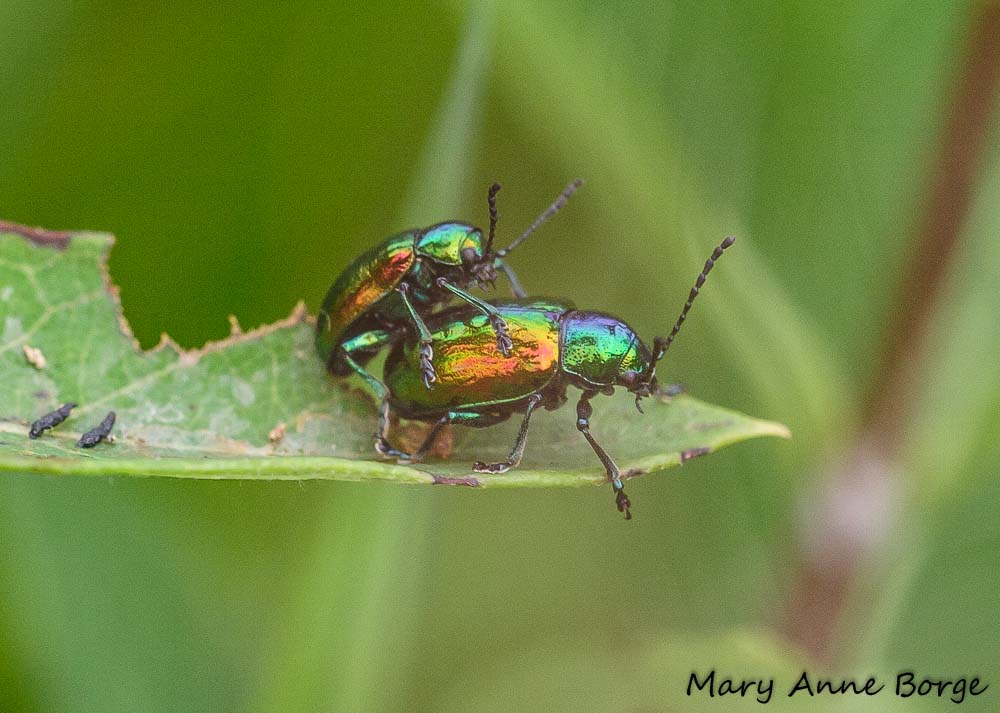
Dogbanes even have a beetle named after them, the Dogbane Beetle (Chrysochus auratus). This insect feeds primarily on various parts of plants in the Dogbane family throughout its life cycle. It’s appearance is often compared to that of the Japanese Beetle, but it’s much more beautiful, with distinctive iridescent red, blue-green and copper coloring.

Dogbane Beetle (Chrysochus auratus) on Indian Hemp (Apocynum cannabinum)

Dogbane Beetle (Chrysochus auratus) on Indian Hemp (Apocynum cannabinum)

Dogbane Beetle (Chrysochus auratus) on Indian Hemp (Apocynum cannabinum)

Dogbane Beetle (Chrysochus auratus) on Indian Hemp (Apocynum cannabinum)

Dogbane Beetles (Chrysochus auratus) mating on Indian Hemp (Apocynum cannabinum)

Dogbane Beetles (Chrysochus auratus) mating on Indian Hemp (Apocynum cannabinum)

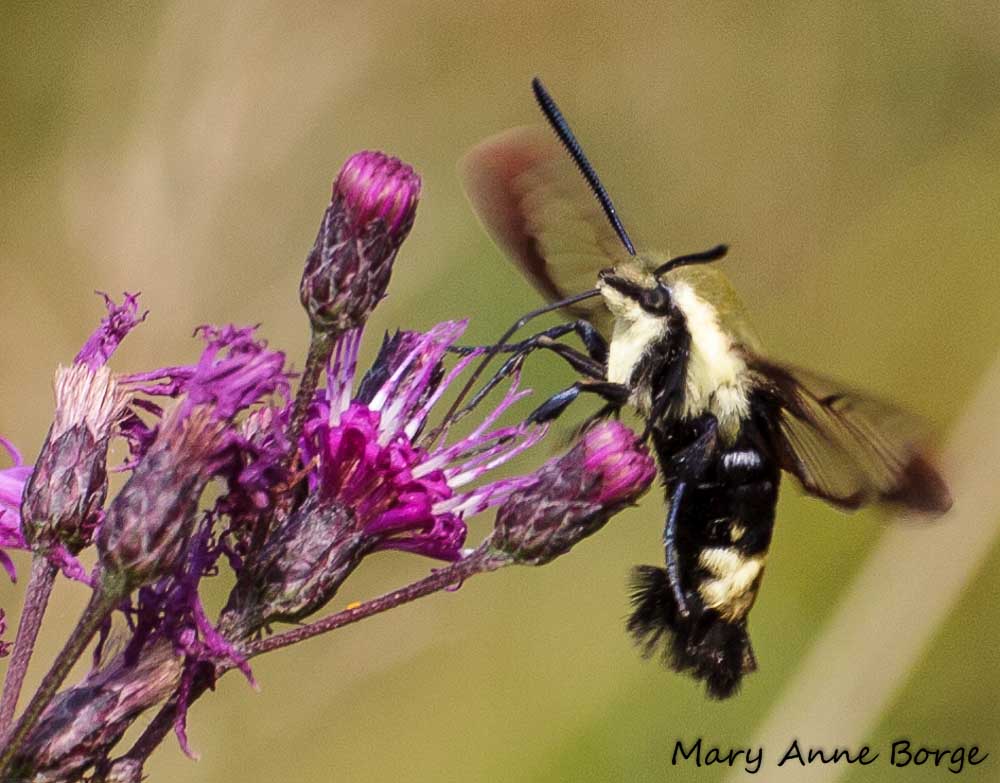
Dogbanes are among the food plants used by the caterpillars of the Snowberry Clearwing moth,

Snowberry Clearwing Moth on New York Ironweed (Vernonia noveboracensis)

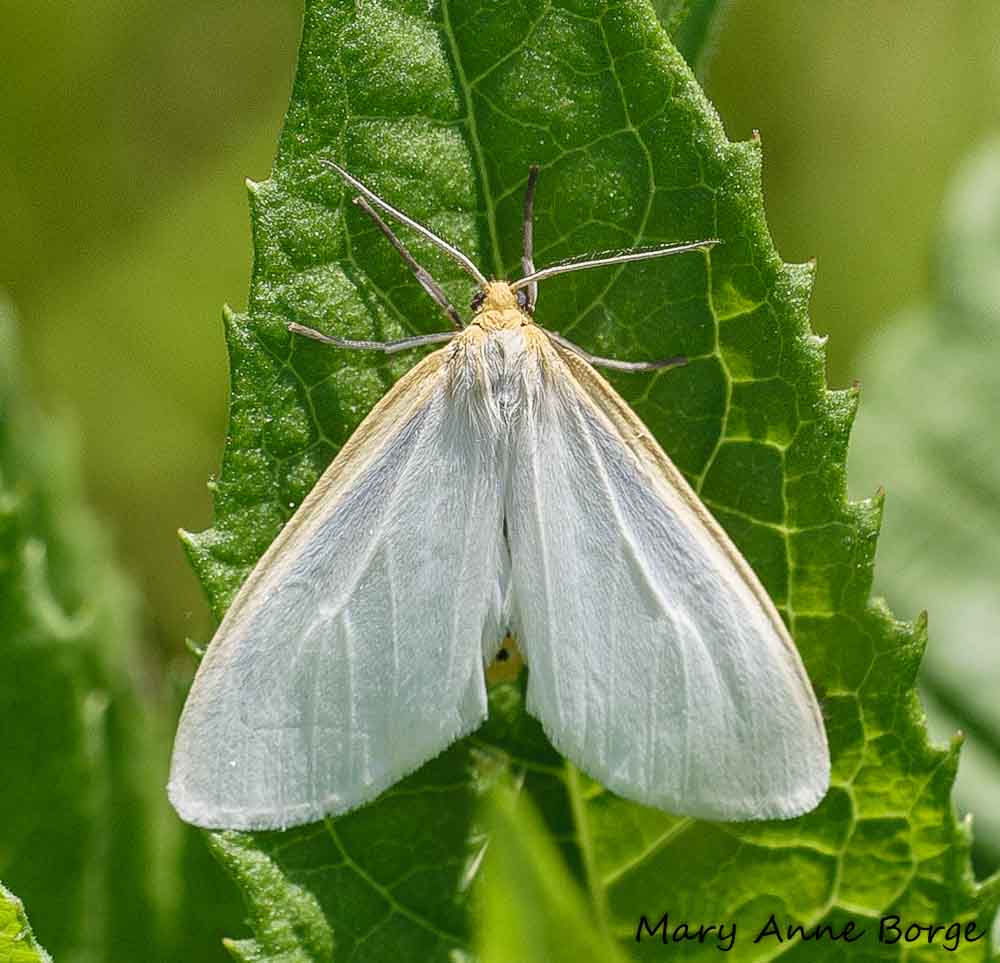
and of the Delicate Cycnia, also called the Dogbane Tiger Moth (Cycnia tenera).

Delicate Cycnia, or Dogbane Tiger Moth(Cycnia tenera)

Delicate Cycnia, or Dogbane Tiger Moth(Cycnia tenera)

Like the milkweeds, dogbane stems contain fibers that can be used to make rope. The common name Indian Hemp is based on the fact that this species is a particularly good source for these fibers, and were used by Native Americans for this purpose.

Birds take advantage of these fibers and the fluff from dogbane seeds for nest-building, just as they do with the fibers and seed fluff from milkweeds. (See Milkweed – It’s not just for Monarchs.)

 Indian Hemp seeds with Small Milkweed Bug (Lygaeus kalmii) nymph

Indian Hemp seeds with Small Milkweed Bug (Lygaeus kalmii) nymph

Dogbanes share some of the chemical compounds, including cardiac glycosides, that make milkweeds indigestible or toxic to many herbivores that would otherwise eat them.  These chemicals are especially potent in Indian Hemp.  A few sources (Natural History Museum; The Book of Swamp and Bog by John Eastman) say that Monarchs may use Spreading Dogbane as a caterpillar food plant.  Since the protection offered by sequestering these chemicals in parts of their bodies is the reason Monarchs have evolved to specialize on Milkweeds, maybe they can evolve to use dogbanes, too.  Have you ever seen a Monarch caterpillar on a dogbane? (I haven’t, but I’ll keep looking!)

Even without Monarchs, dogbanes are pretty productive plants!

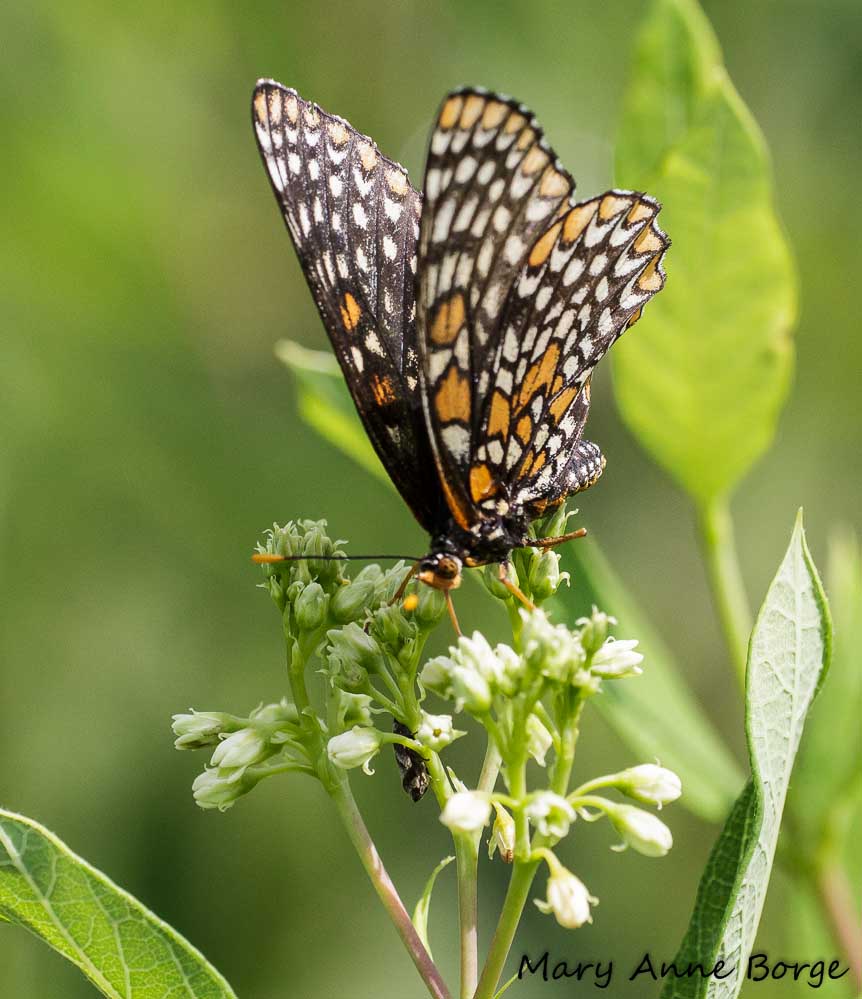
Baltimore Checkerspot on Indian Hemp (Apocynum cannabinum)

Baltimore Checkerspot on Indian Hemp (Apocynum cannabinum)

Resources

Eastman, John. The Book of Swamp and Bog. 1995.

Eaton, Eric R.; Kauffman, Ken. Kaufman Field Guide to Insects of North America. 2007.

Elpel, Thomas J. Botany in a Day. 2006.
Evans, Arthur V. Beetles of Eastern North America. 2014.

Rhoads, Ann Fowler; Block, Timothy A. The Plants of Pennsylvania of Pennsylvania. 2007.

Pollinator-friendly Plants for the Northeastern United States (USDA NRCS)

Illinois Wildflowers

USDA-NRCS Plant Guide

NRCS Wildflower Plant Characteristics for Pollinator and Conservation Plantings in the Northeast

Enhancing Farm Landscapes for Native Bees and Improved Crop Pollination

Primitive Ways

Native Plants and Ecosystem Services

Tachinid flies:
Attracting Beneficial Bugs

USDA National Agroforestry Center

Beneficial Insects and Spiders in Your Maine Backyard

Small Milkweed Bug:
Bug Eric

Dogbane Beetles:
Illinois State Museum 

University of Wisconsin-Milwaukee

Gray Dogwood for Butterflies, Bees and Birds

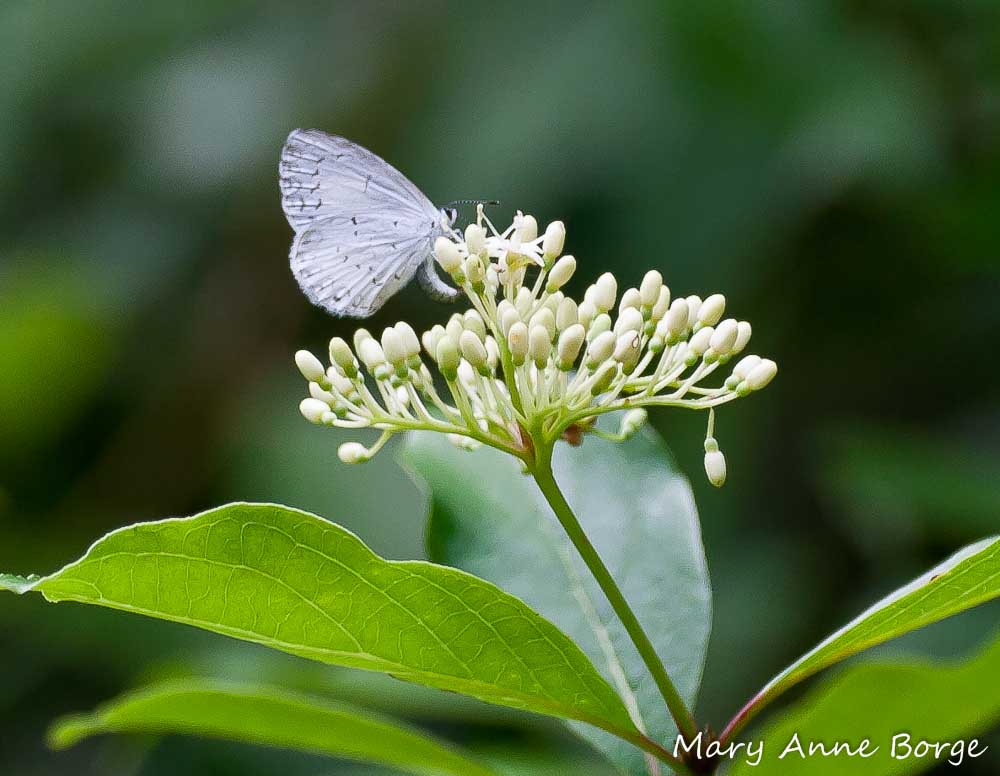
This Spring Azure butterfly is laying her eggs on the flower buds of a Gray Dogwood (Cornus racemosa), taking advantage of the nourishment this shrub provides her offspring. Dogwoods are among the favored plants of this butterfly’s caterpillars, helping to ensure that you’ll continue to see the sprightly Azure on a regular basis.

Azure butterfly laying an egg on Gray Dogwood (Cornus Racemosa) flowers

Azure butterfly laying an egg on Gray Dogwood (Cornus Racemosa) flowers

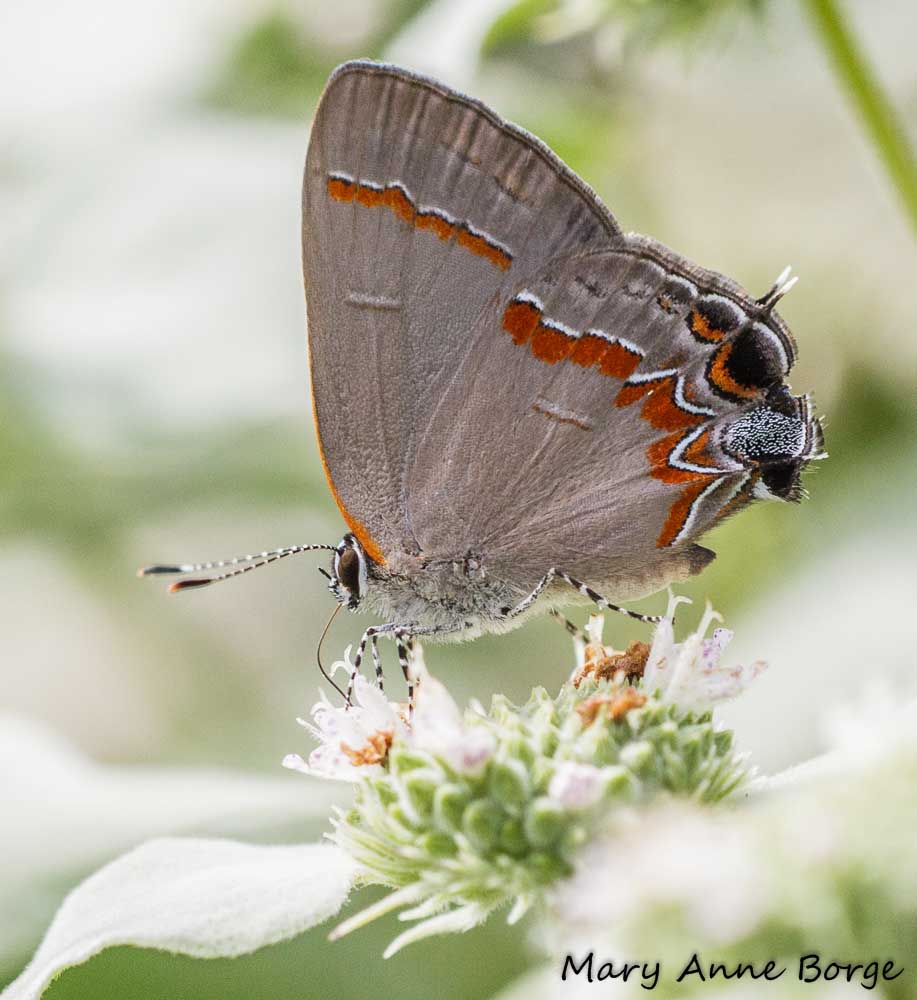
Nearby, a Red-banded Hairstreak drank the nectar offered by the profusion of lovely flowers.

Red-banded Hairstreak, different day, on Short-toothed Mountain Mint (Pycnanthemum muticum)

Red-banded Hairstreak, different day, on Short-toothed Mountain Mint (Pycnanthemum muticum)

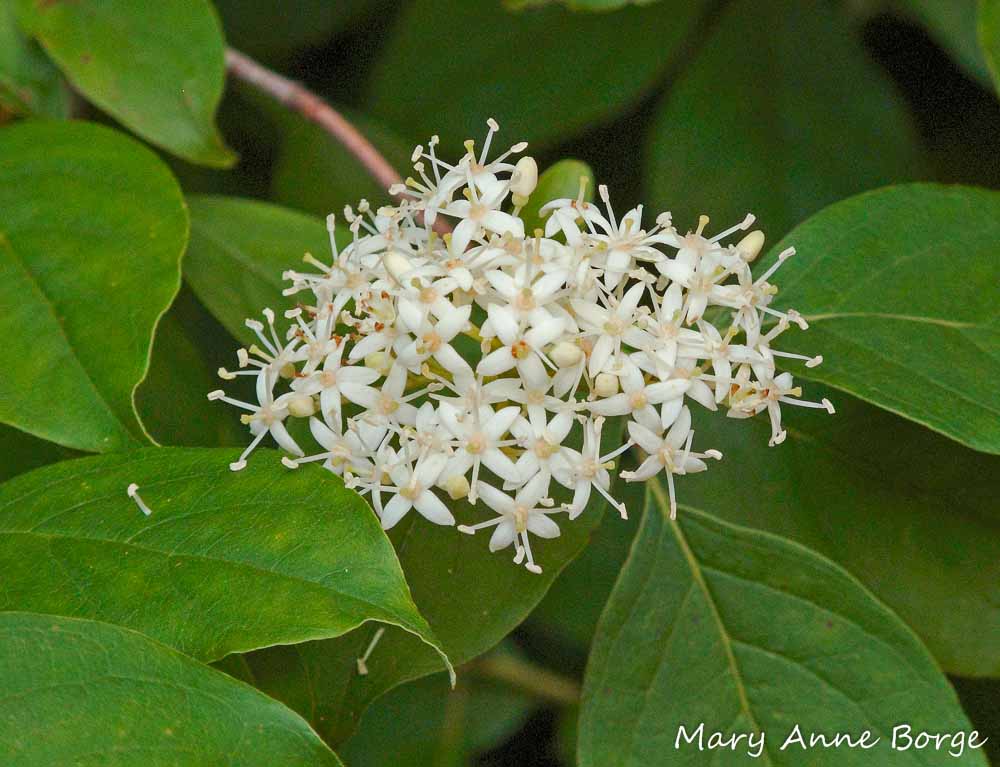
Blooming for a period of a few weeks in late May to mid June, Gray Dogwood is a relative of the more familiar Flowering Dogwood (Cornus florida), but Gray Dogwood is a shrub, growing to a maximum height of 12-15 feet (about 3.5-4.5 meters). The flowers and leaves of Gray Dogwood show typical characteristics of this family of plants.

Each delicate flower has four petals, arranged symmetrically in a cross shape. The leaves are opposite each other along the branches, with arched veins curving toward the tip of the leaf on both sides of the midrib. The common name, Gray Dogwood, refers to the color of the bark, which is usually a light gray. The species name, racemosa, describes the half-sphere arrangement of the creamy white flower clusters.

Gray Dogwood (Cornus racemosa)

Gray Dogwood (Cornus racemosa)

The flowers’ nectar attracts an array of busy pollinators, including bees, beetles and butterflies. Even better, Gray Dogwood provides the female Azure butterfly a place to lay her eggs. Several moth species use the dogwoods as food plants for their caterpillars, including the beautiful Polyphemus Moth.

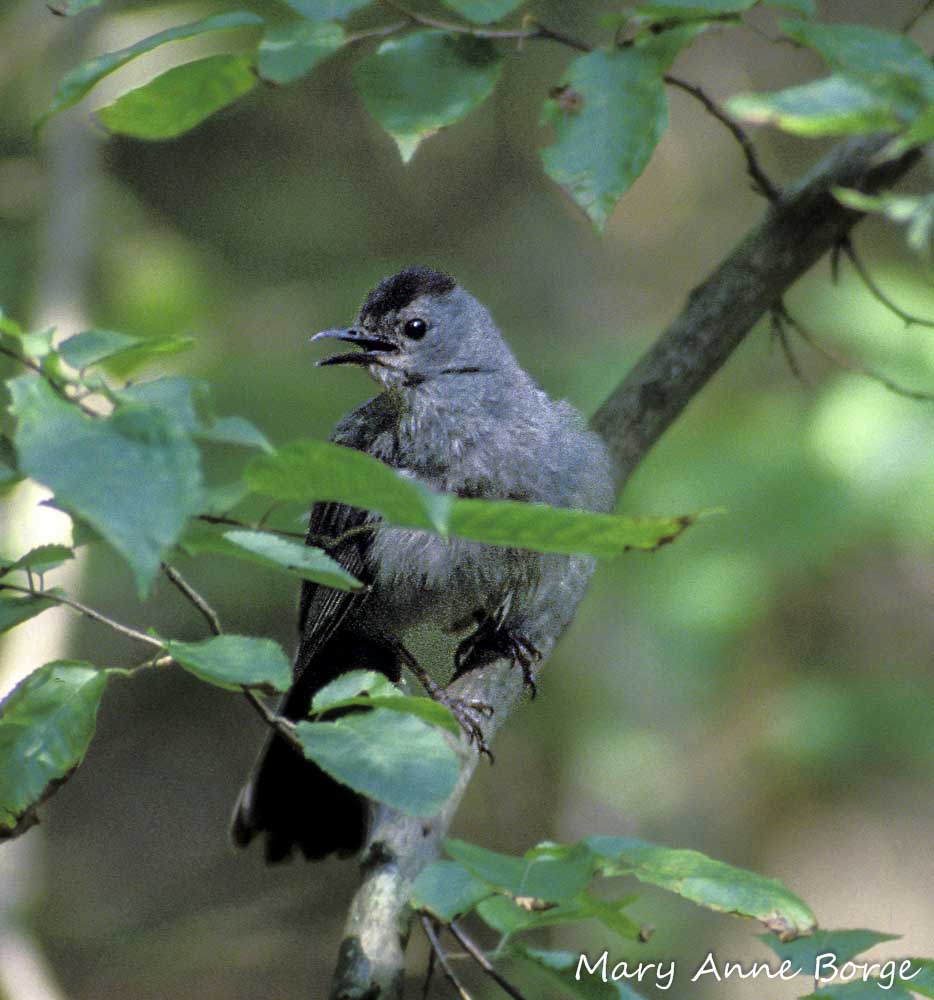
Birds that like to nest in the shrub layer look favorably on Gray Dogwood when they’re shopping for real estate. Northern Cardinals, Goldfinches, Catbirds and Yellow Warblers are some of the birds that covet the features offered by Gray Dogwood.

A young Gray Catbird

A young Gray Catbird

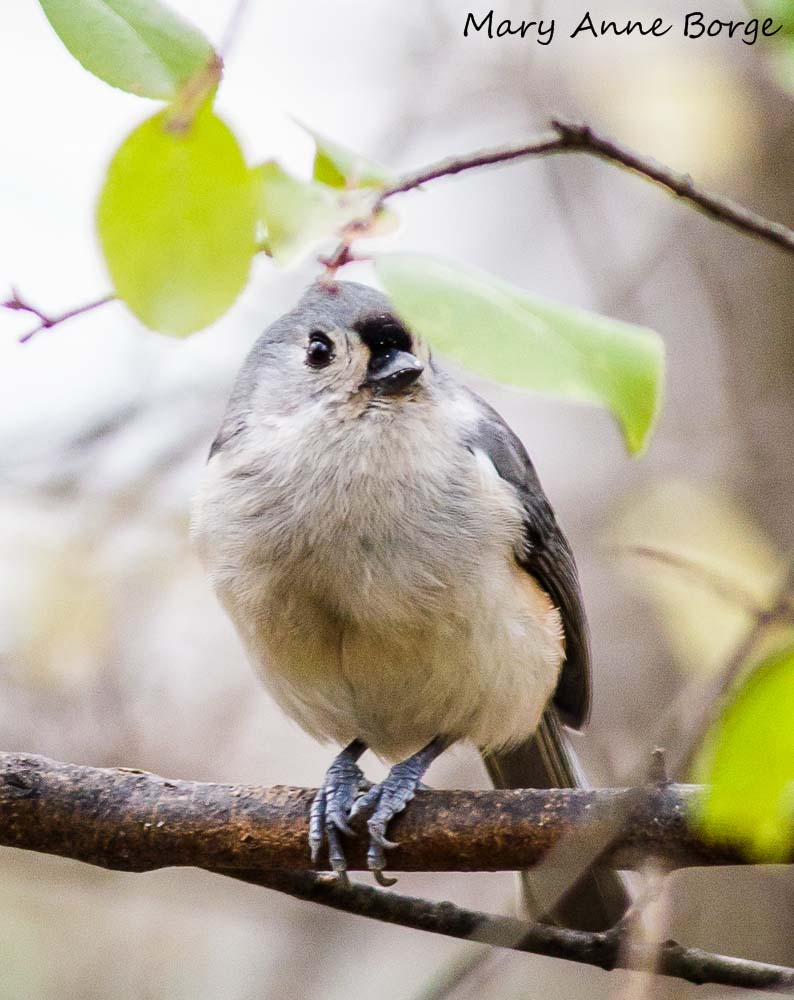
The multi-stemmed shrub with its sturdy branches offers a safe nesting place, with food right on the premises. During nesting season, the pollinators and any caterpillar progeny offer the protein necessary to raise healthy young birds. Newly fledged Chickadees and Titmice may also browse Gray Dogwood for a quick bite, or take refuge in its sturdy branches.

Tufted Titmouse

Tufted Titmouse

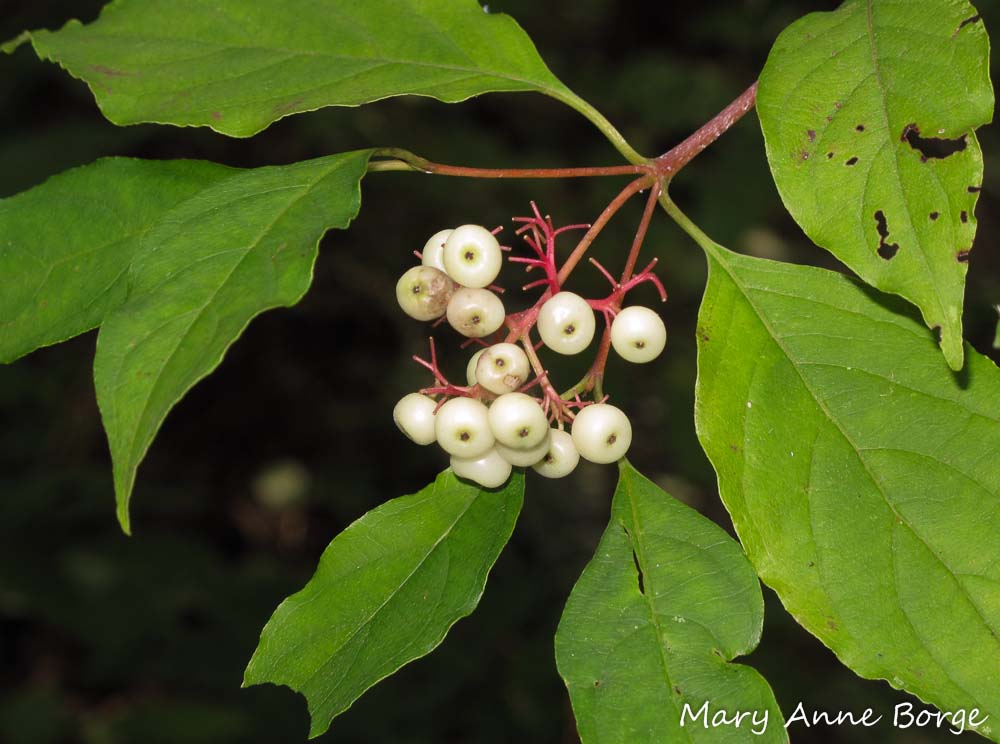
Flowers that are successfully pollinated by butterflies, bees or other insects will produce a round white berry-like fruit called a drupe. The fruit appears on a platform of bright red stems, called pedicels, beckoning the local bird population to stop for a meal. Birds find the fruit irresistibly delectable, eating it as soon as it ripens in late summer for a jolt of energy. Squirrels, chipmunks and other mammals also enjoy the tasty bounty.

Gray Dogwood fruit

Gray Dogwood fruit

For your viewing pleasure, the red fruit platforms remain for weeks even after the fruit is snapped up by resident and migrating birds. As fall approaches, Gray Dogwood’s leaves turn from deep green to a regal reddish-purple. In winter, its branches shelter the birds that live with us year-round.

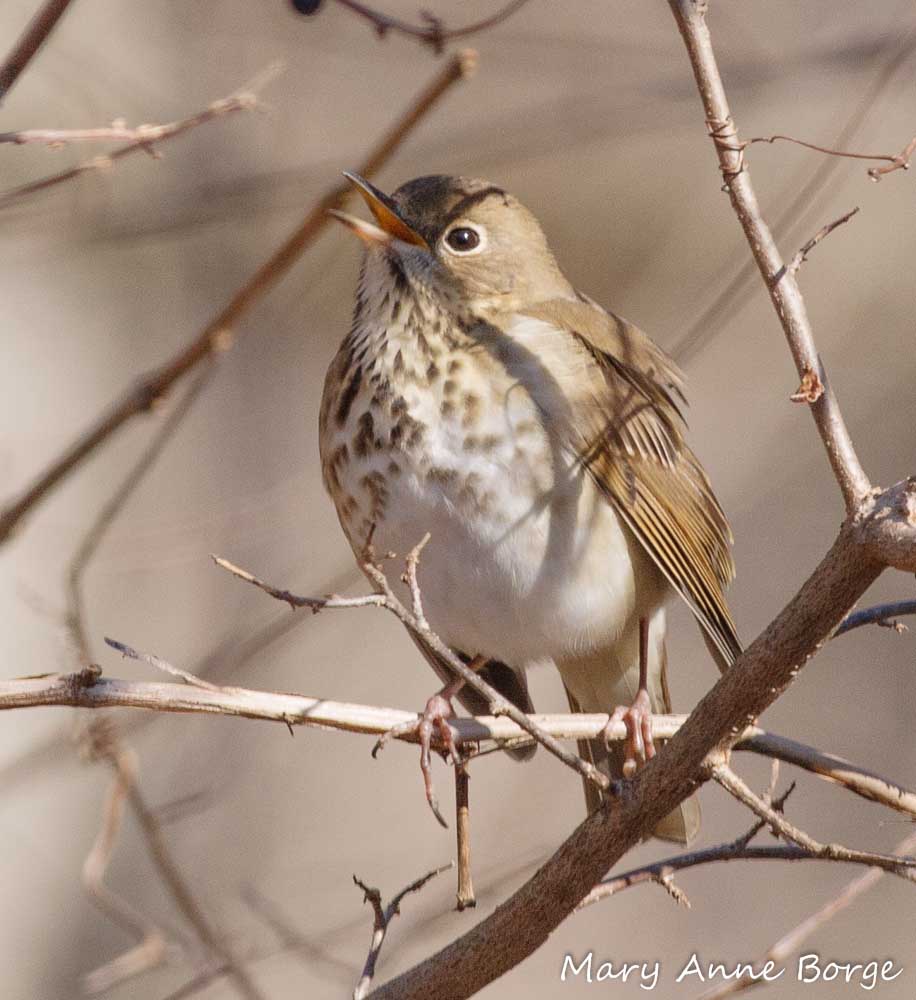
Hermit Thrush - one of the many bird species that eat Gray Dogwood fruits

Hermit Thrush – one of the many bird species that eat Gray Dogwood fruits

Gray Dogwood is native in the Canadian provinces of Manitoba, Ontario and Quebec, as far south in the United States as South Carolina, Kentucky, Arkansas, Nebraska, and Texas. It adapts well in many conditions. It prefers moist, well-drained soil, but can tolerate poor, compacted soils, and drought conditions. It likes sun, but it can also do well in part shade. It’s often found in woodland openings or open fields.

In landscaping, Gray Dogwood can be used alone in any location where a good-sized shrub is needed. Or even better, mixed with other species it brings visual and animal diversity to your property. Gray Dogwood combines well with Ninebark (Physocarpus opulifolius), American Hazelnut (Corylus americana), or Blackhaw Viburnum (Viburnum prunifolium), among others.

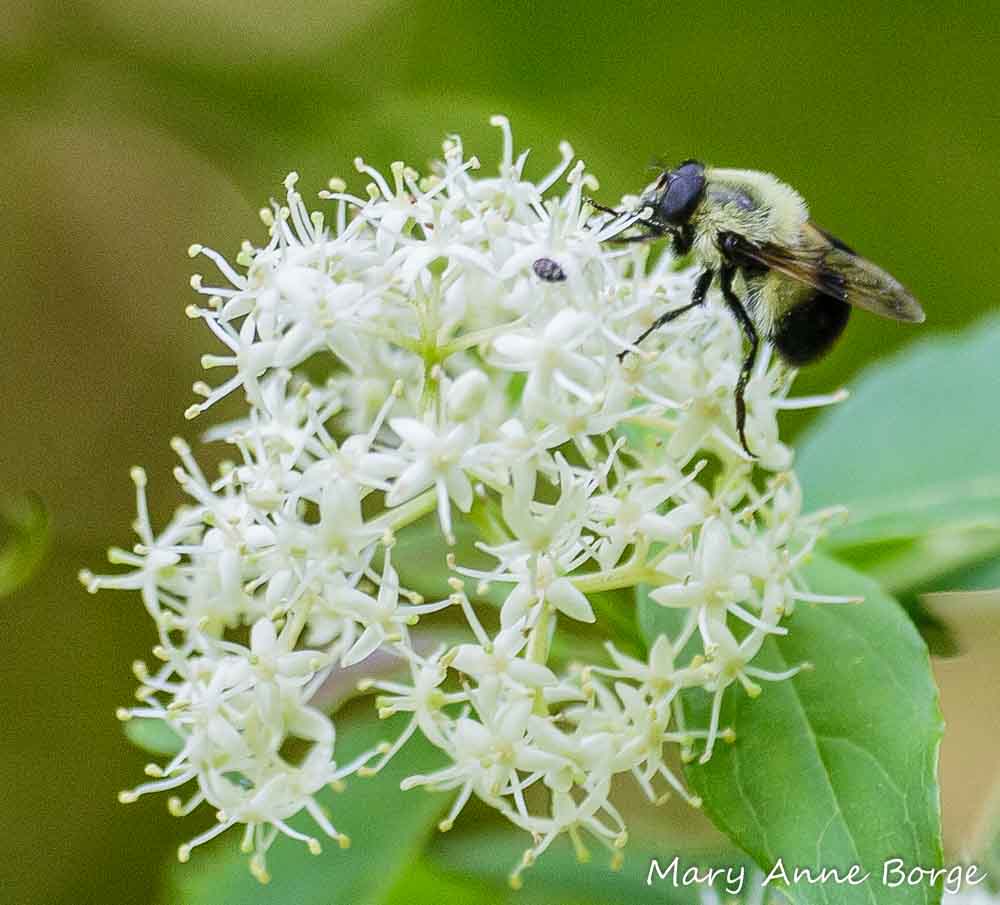
Gray Dogwood with Syrphid Fly, a Bumble Bee mimic.

Gray Dogwood with Syrphid Fly, a Bumble Bee mimic.

Gray Dogwood is great for birds, butterflies, bees, and many other critters – even people!

Resources

Wagner, David L.;  Caterpillars of Eastern North America, 2005.

Eastman, John.  The Book of Forest and Thicket.  1992.

Illinois Wildflowers


A Carpet of Spring Beauty, Woven by … Ants!

Trout Lily (Erythronium americanum )

Trout Lily (Erythronium americanum )

It’s breathtaking to watch the delicate spring wildflowers emerge from their blanket of leaves, bloom, develop and disperse fruit, all in a matter of a few short days or weeks.

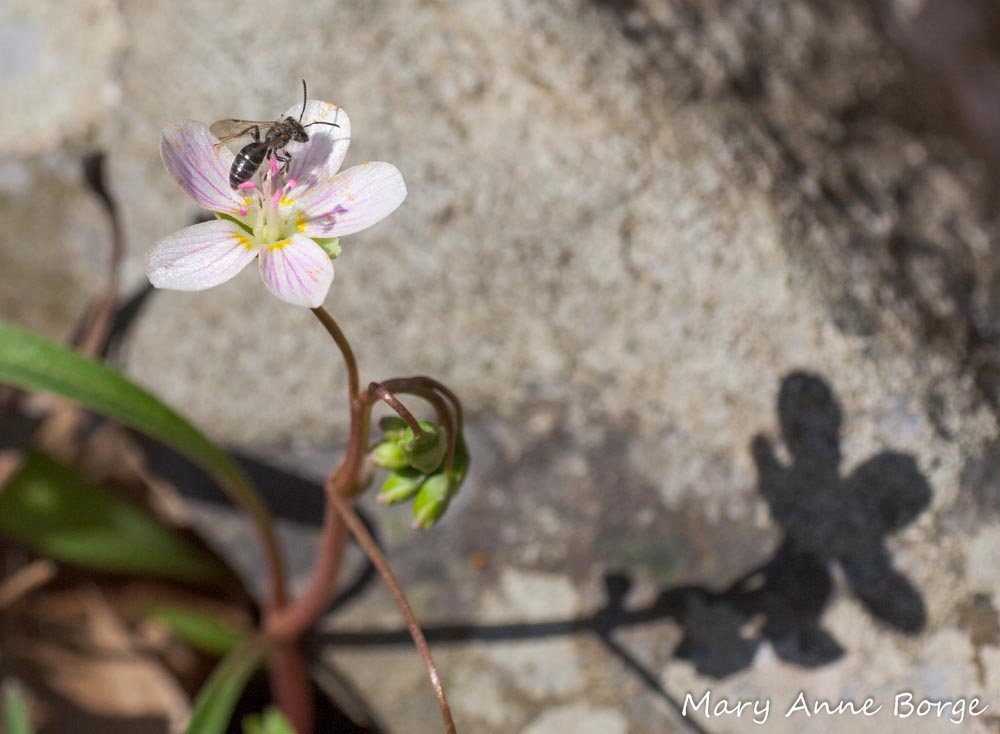
Spring Beauty (Claytonia virginica)

Spring Beauty (Claytonia virginica)

Although they look fragile, these are tenacious little plants, each focusing its efforts on perpetuating its species. They have evolved to have a wide range of flower structures and colors, some with scents, enticing many different insect species to assist them in pollination.

Dutchman's Breeches with Bumble Bee

Dutchman’s Breeches with Bumble Bee

There is one strategy that a surprising number of spring blooming native plants have evolved in common: seed dispersal by ants. Many ant species are omnivorous, that is, they’ll eat both plant and animal matter. But given a choice, many ant species tend to prefer animals, often other insects. Early in the spring there are not as many animal food sources (insects) available as there will be as the growing season progresses, so the ants are more likely to make do with plant-based food at this time.

Canada Violet (Viola canadensis)

Canada Violet (Viola Canadensis)

As many as thirty percent of the spring flowering herbaceous plant species in the forests of eastern North America have evolved to take advantage of this situation to benefit themselves. These species have evolved to provide food attached to their seeds to entice ants to disperse those seeds. This food, called an elaiosome, is a specialized fat body whose chemical composition more closely matches that of the insects that ants prefer than it does that of a seed.

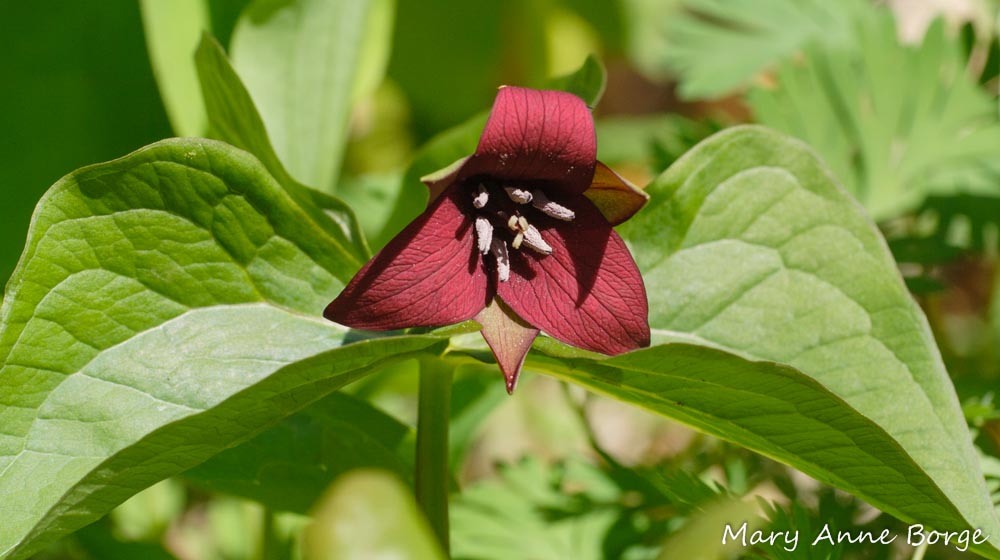
Red Trillium (Trillium erectum)

Red Trillium (Trillium erectum)

Ants harvesting trillium seeds

Ants harvesting trillium seeds

When a fruit opens to disperse its seeds, the elaiosomes are an instant attraction for ants. They take the seed with its attached elaiosome back to their nests for consumption there, but they just eat the elaiosome, their preferred food, and dispose of the seed on their trash pile. This tends to be an environment that is rich in nutrients, and will benefit the growth of the new plant. Just to make sure the ants don’t eat the seeds in addition to the elaiosome, some plant species have hard seed coatings that ants can’t really bite through.

Squirrel Corn (Dicentra canadensis)

Squirrel Corn (Dicentra Canadensis)

So this dispersal by ants, called myrmecochory, effectively plants the seeds. The new location is generally close enough to the parent plant to be a hospitable environment for growth, but far enough away to minimize competition for resources. It generally occurs within a very short time of the seeds becoming available. As a result, the seeds are protected from animals that might otherwise consume the them, which would give the seeds no chance to germinate and grow into a new plant.

Rue Anemone (Thalictrum thalictroides)

Rue Anemone (Thalictrum thalictroides)

This evolutionary adaptation is somewhat analogous to the strategy of plants that have evolved to surround their seeds with fleshy fruits to attract birds to assist them with seed dispersal. Given the fact that there are fewer birds available in early spring to help with seed dispersal, it makes sense that the early blooming plants evolved to partner instead with the ants for this service.

Round-lobed Hepatica (Hepatica nobilis)

Round-lobed Hepatica (Hepatica nobilis)

The plants featured in this post are just some of the species that share the evolutionary characteristic of seed dispersal by ants. Did you ever wonder how your violets or Spring Beauty managed to pop up in new locations in your lawn or garden? Thank an ant!

Bloodroot (Sanguinaria canadensis)

Bloodroot (Sanguinaria Canadensis)

Resources

Special thanks to Amy Mawby for letting me use her photo of ants harvesting trillium seeds.

Eastman, John. The Book of Forest and Thicket. 1992.

Gracie, Carol. Spring Wildflowers of the Northeast. 2012.

Insect Visitors of Illinois Wildflowers

Rico-Gray, Victor; Oliveira. Paulo S. The Ecology and Evolution of Ant-Plant Interactions. 2007.

Waldbauer, Gilbert. What Good Are Bugs? Insects in the Web of Life. 2003.

Spicebush or Forsythia?

For the past few weeks, Spicebush (Lindera benzoin) buds looked like they couldn’t wait to open.  Over the weekend when the temperatures reached 80°F in the latest round of weather whiplash, the buds burst open, resulting in a display of bright yellow starbursts lighting up the forest understory.

Spicebush (Lindera benzoin) in bloom, with ant seeking nectar

Spicebush (Lindera benzoin) in bloom, with ant seeking nectar

Spring temperatures have a big influence on the exact timing, but where I live in the mid-Atlantic United States, Spicebush typically blooms in late March or early April, at about the same time as forsythia.  Forsythia is also lovely for the ten days or so that it’s in bloom, but then it’s a little, well, boring, when compared to Spicebush.

Sometimes called Northern Spicebush or Common Spicebush, this shrub is native in the north from Maine to Ontario, Michigan, Iowa and Kansas, then its range extends south to Texas and throughout the southeastern United States to Florida. It can generally be found in woodlands, but works well as a landscape plant, too. Spicebush gets its common name from the spicy aroma emitted from its leaves and young branches when they are rubbed or crushed.

Where Spicebush is native, it has important relationships with animals that have evolved with it over the centuries. Many insects, including early butterflies, visit the flowers for nectar, but early solitary bees and flies are the primary pollinators.

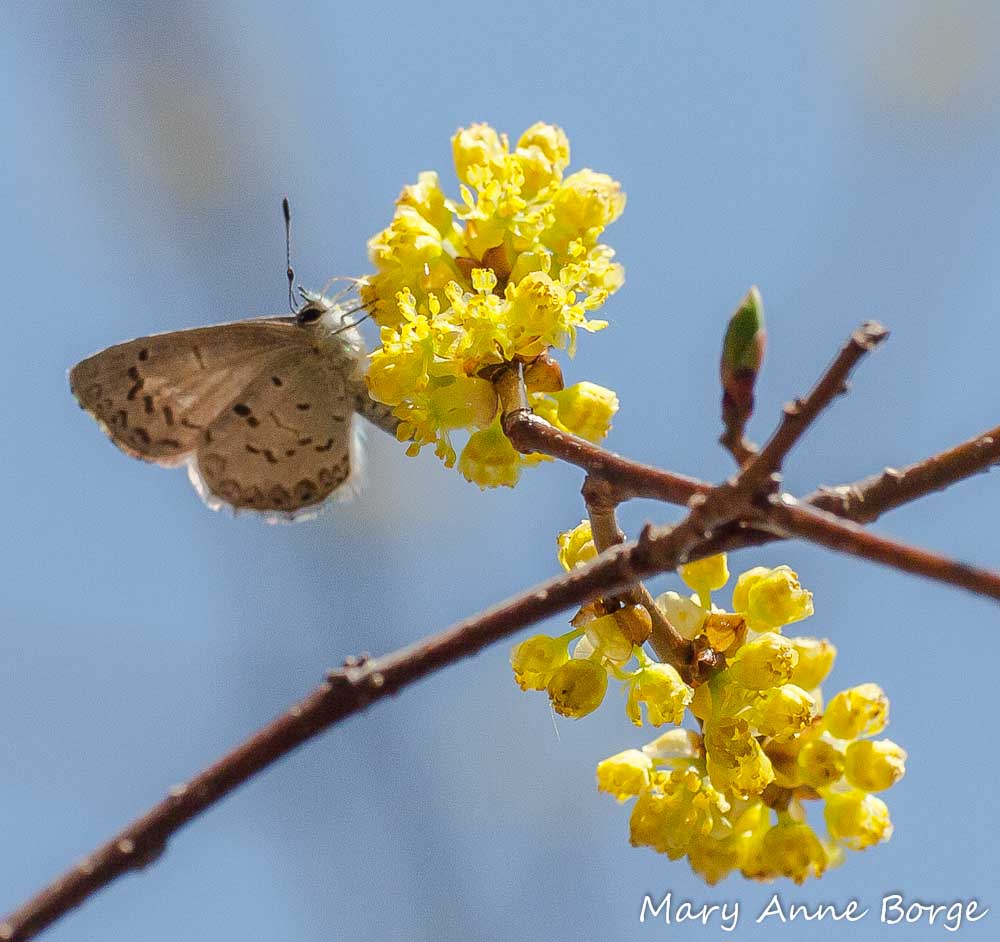
Spicebush (Lindera benzoin) with Spring Azure butterfly nectaring

Spicebush (Lindera benzoin) with Spring Azure butterfly nectaring

The flowers bloom before the leaves unfurl, making it easy for pollinators to find them. Spicebush has male and female flowers on separate plants.

Male Spicebush flowers; note yellow pollen like little balls at tips of stamens

Male Spicebush flowers; note yellow pollen like little balls at tips of stamens

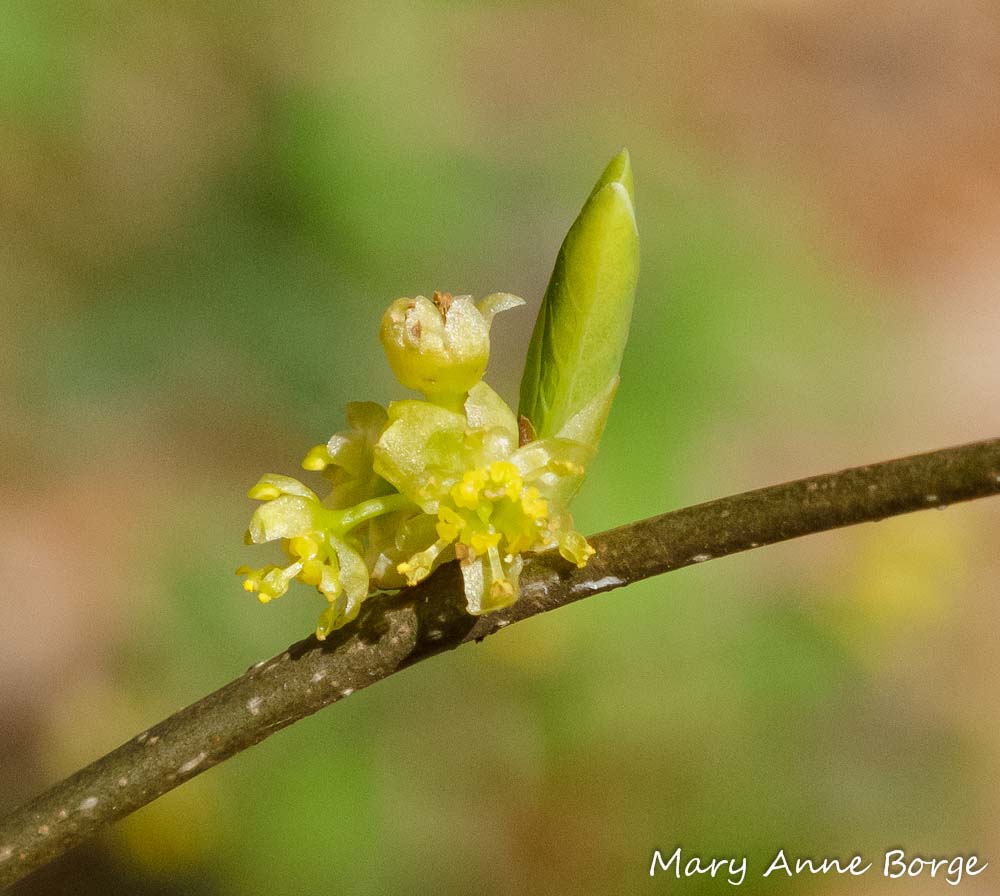
Female Spicebush flowers; note pistils protruding beyond the petals

Female Spicebush flowers; note pistils protruding beyond the petals

So if you are using them in your landscape, you will want a male to pollinate the female plants in order to see the bright red fruits that complement this shrub’s yellow fall foliage.

Spicebush (Lindera benzoin) fall fruit and foliage

Spicebush (Lindera benzoin) fall fruit and foliage

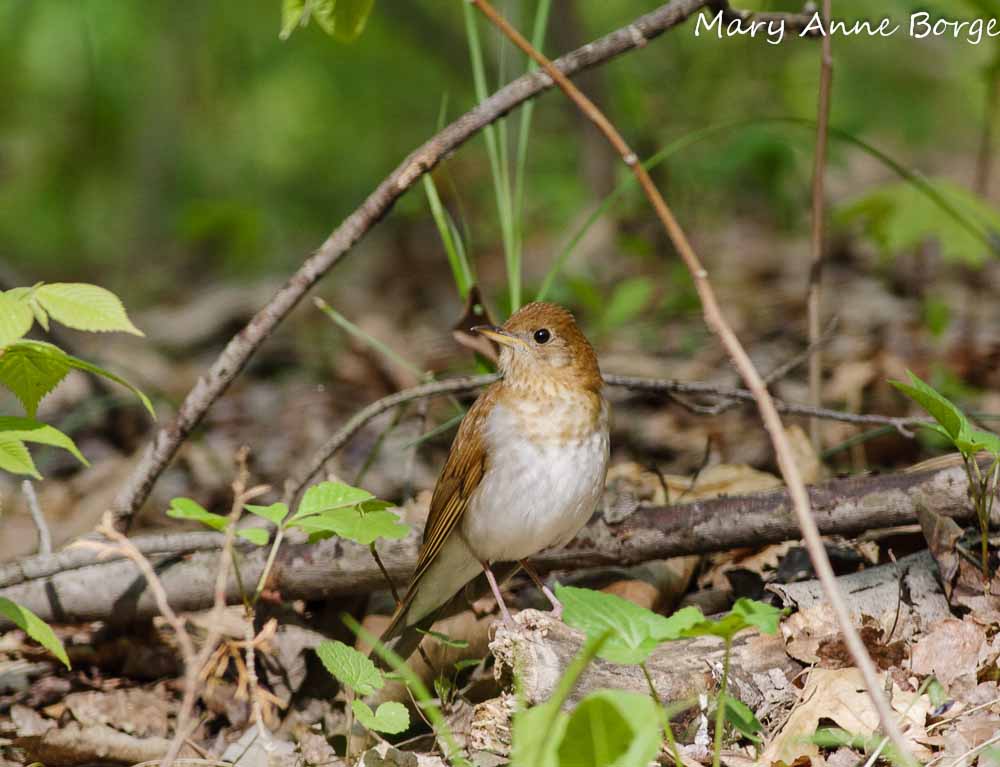
Many birds eat the fruit, but Veeries

Veery

Veery

and Wood Thrushes,

Wood Thrush

Wood Thrush

birds that are often found in the same habitat as Spicebush, are especially partial to them.

Spicebush Swallowtail butterflies are often seen nectaring on flowers in sunny locations,

Spicebush Swallowtail nectaring on Wild Bergamot (Monarda fistulosa)

Spicebush Swallowtail nectaring on Wild Bergamot (Monarda fistulosa)

but they can also be found in the woods in the vicinity of their namesake plant, Spicebush. This is because the primary food plants for Spicebush Swallowtail caterpillars are Spicebush (Lindera benzoin and in the southern U.S., also L. melissifolia) and the related Sassafras (Sassafras albidum), which is usually found in the same type of habitat. Without these plants we wouldn’t have this lovely butterfly, since its caterpillars can only survive on the leaves of a few plant species.

Female Spicebush Swallowtails lay their eggs singly on the underside of a leaf.

Spicebush Swallowtail egg

Spicebush Swallowtail egg

After the caterpillars hatch from the eggs, they depend on the leaves of these plants for both food and shelter. Each caterpillar eats a few leaves of a Spicebush during its development.

Spicebush Swallowtail caterpillar; notice the evidence of feeding on the leaf in the lower right corner

Spicebush Swallowtail caterpillar; notice the evidence of feeding on the leaf in the lower right corner

Looking for holes in leaves is one way to find these caterpillars.  But we’re not the only creatures who have figured out this strategy for locating them. Caterpillars and other insects are an important source of food for birds, especially when the birds are raising their young.  Some bird species also know enough to look for partially eaten leaves to point them to a tasty meal of caterpillar protein.

Tufted Titmouse, looking for a meal

Tufted Titmouse, looking for a meal

So the caterpillars have evolved to protect themselves by destroying the evidence of their dining experience. While I watched, this caterpillar crawled to the stem of the leaf it had been eating. It chewed through the stem, and the incriminating evidence, the partially eaten leaf, fell to the ground.

Spicebush Swallowtail caterpillar, destroying the evidence of its presence by chewing through the leaf stem

Spicebush Swallowtail caterpillar, destroying the evidence of its presence by chewing through the leaf stem

Spicebush Swallowtail caterpillars have other strategies to protect themselves from predators. In their earliest growth stages they look like bird droppings, a clever disguise to deter birds from eating them. As they grow, they take on the appearance of a snake, with false eye spots above their real head. This snake disguise is an effective deterrent to at least some of the birds that might otherwise eat the caterpillars, since snakes are the birds’ predators in their wintering grounds.

Black-Throated Blue Warblers may be put off by a snake-like disguised caterpillar

Black-Throated Blue Warblers may be put off by a snake-like disguised caterpillar

When they’re not eating, Spicebush Swallowtail caterpillars hide in leaf shelters that they create for themselves by spinning silk to pull two sides of a leaf together.

Spicebush Swallowtail caterpillar using its silk to create a leaf shelter

Spicebush Swallowtail caterpillar using its silk to create a leaf shelter

Spicebush is also a food plant for the caterpillars of a moth called the Tulip-tree Beauty,

Tulip-tree Beauty caterpillar on Spicebush (Lindera benzoin)

Tulip-tree Beauty caterpillar on Spicebush (Lindera benzoin)

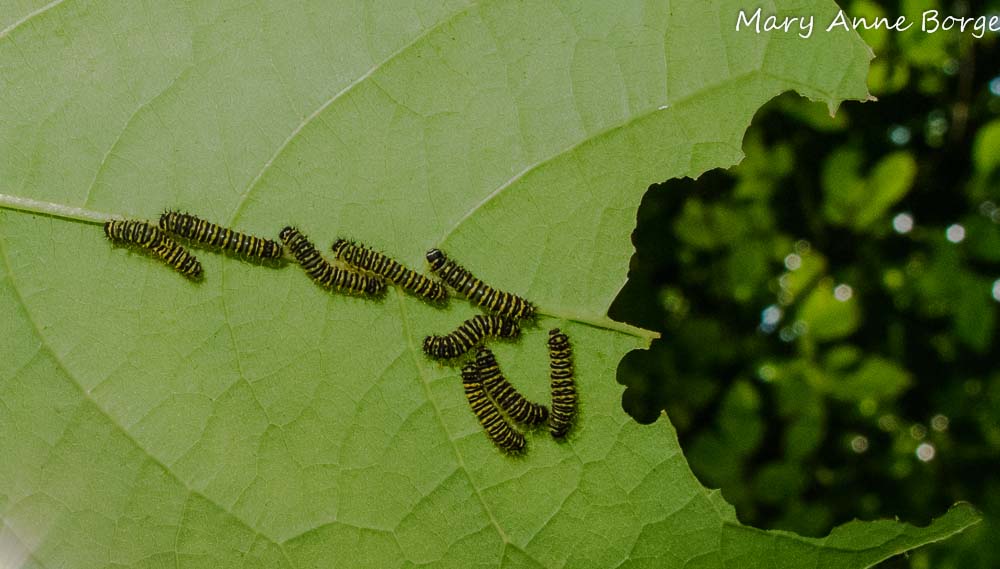
and one of the giant silk moths, the Promethea Moth.

Promethea Moth Caterpillars on Spicebush

Promethea Moth Caterpillars on Spicebush

Winter is a good time to look for Spicebush Swallowtail chrysalises and Promethea Moth cocoons, since these species overwinter as pupae.

Forsythia on the other hand, primarily a native of Asia, doesn’t support any of our native insects and birds in this way.  So I’m opting for Spicebush.

Spicebush (Lindera benzoin)

Spicebush (Lindera benzoin)

Related Posts

A Promethea Moth and the Awe-inspiring Power of Nature

Resources

Butterflies and Moths of North America
http://www.butterfliesandmoths.org/

Eastman, John. The Book of Forest and Thicket. 1992.

Illinois Wildflowers http://www.illinoiswildflowers.info/trees/plants/spicebush.htm

Natural History Museum Database of Leipidoptera Hostplants
http://www.nhm.ac.uk/research-curation/research/projects/hostplants/