Milkweed – It’s Not Just for Monarchs

One of the most well known associations between an animal and plant species is the relationship between Monarch butterflies and Milkweed.  Monarch butterflies may certainly be seen nectaring at various species of milkweeds…

Monarch nectaring on Common Milkweed (Asclepias syriaca)

Monarch nectaring on Common Milkweed (Asclepias syriaca)

Monarch nectaring on Butterflyweed (Asclepias tuberosa)

Monarch nectaring on Butterflyweed (Asclepias tuberosa)

Monarch nectaring on Swamp Milkweed (Asclepias incarnata)

Monarch nectaring on Swamp Milkweed (Asclepias incarnata)

but this isn’t unique – they also drink at a wide variety of other flower species.

Monarch nectaring on New York Ironweed (Vernonia noveboracensis)

Monarch nectaring on New York Ironweed (Vernonia noveboracensis)

It’s the dependency that Monarchs have on Milkweeds as the only food source for their caterpillars that makes this relationship so noteworthy. Monarchs, like many species of insects, have evolved to specialize in their larval (in this case caterpillar) food source in order to gain protection from predators through the chemicals they ingest from the plants they eat. Milkweeds contain cardiac glycosides, which are toxic to many species of birds and mammals. Plants have evolved these chemicals to protect themselves from being eaten, a strategy that has largely been successful for the plants. Plants are all about surviving and reproducing, to further the continued existence of their species.

Such a plan for protection is never completely foolproof, however. Monarchs, along with some other insect species, have evolved to be able to digest these plants and sequester the toxins in their bodies, making the insect unpalatable at best and toxic at worst to anyone inexperienced enough to attempt to eat them. As a reminder to bird or mammal predators who sample such an insect and survive to eat another meal, insects with these toxins have also evolved to have bright warning colors, an easy to remember signal to predators to beware before attempting such a meal again. In exchange for this protection obtained from eating Milkweeds, Monarchs are gambling that this food source will continue to be available. Without it, Monarchs won’t survive.

Monarch Caterpiller on Common Milkweed (Asclepias syriaca)

Monarch Caterpiller on Common Milkweed (Asclepias syriaca)

Monarch Caterpiller on Swamp Milkweed (Asclepias incarnata)

Monarch Caterpiller on Swamp Milkweed (Asclepias incarnata)

Butterflyweed (Asclepias tuberosa) with Monarch Caterpiller

Butterflyweed (Asclepias tuberosa) with Monarch Caterpiller

Monarchs are not alone in their use of Milkweeds. Their copious nectar offerings attract a broad range of butterflies to drink at their flowers, from Eastern Tiger Swallowtails,
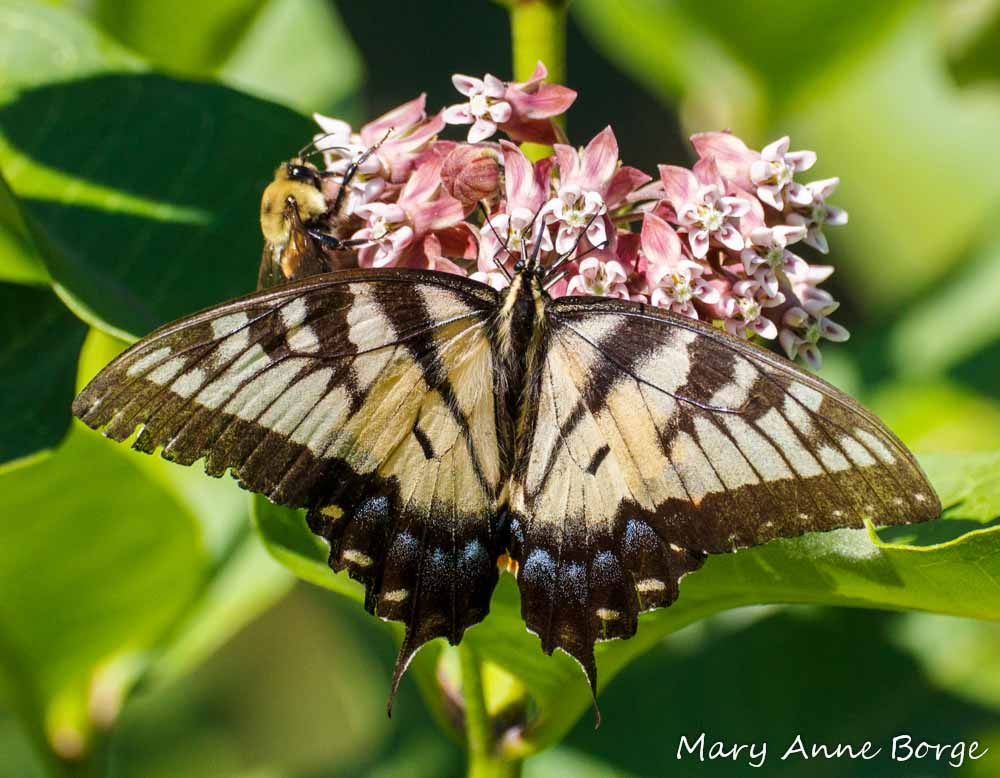
Eastern Tiger Swallowtail and Bumble Bee on Common Milkweed (Asclepias syriaca)

Eastern Tiger Swallowtail and Bumble Bee on Common Milkweed (Asclepias syriaca)

to the smallest skippers.

Least Skipper on Common Milkweed (Asclepias syriaca)

Least Skipper on Common Milkweed (Asclepias syriaca)

Swamp Milkweed (Asclepias incarnata)
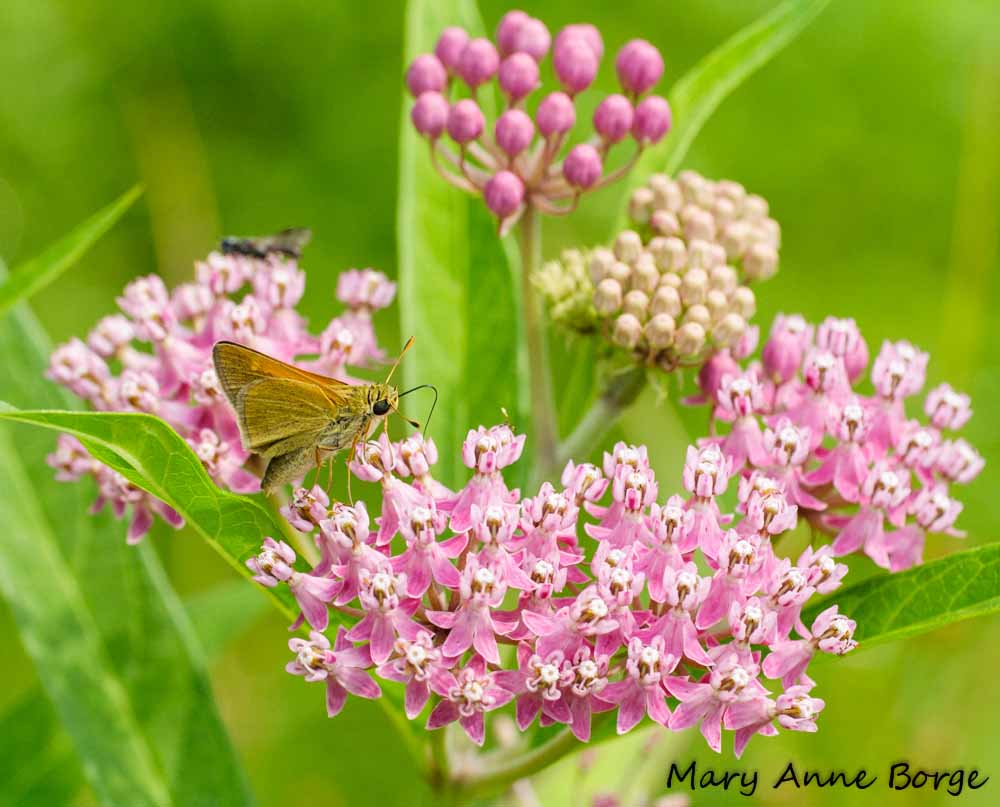
Tawny-edged Skipper on Swamp Milkweed (Asclepias incarnata)

Tawny-edged Skipper on Swamp Milkweed (Asclepias incarnata)

and Butterflyweed (Asclepias tuberosa)
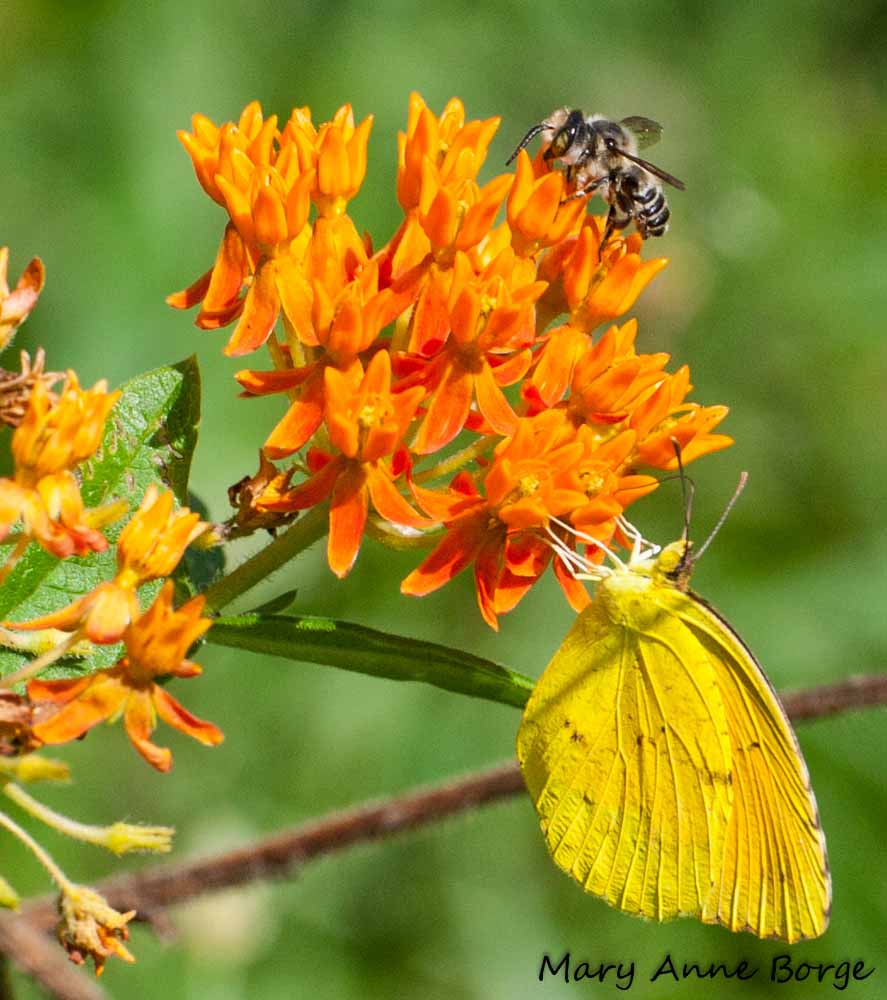
Sleepy Orange and Andrena bee on Butterflyweed (Asclepias tuberosa)

Sleepy Orange and Andrena bee on Butterflyweed (Asclepias tuberosa)

as well as other milkweed species are also favorites of butterflies, bees, and other insects that are nectar feeders, for their reliable, sweet, high energy food.

Butterflies benefit from the food offered by milkweeds, and in return they do help the plants with pollination, but they are not the most successful pollinators of milkweeds. Milkweeds have bundles of pollen, called pollinia, that are linked in pairs by a thin filament. This connector snags an insect appendage that is inserted in just the right spot in a flower. An insect has to approach the flower in a way that will engage the filament connecting the pollinia, and it must also be robust enough to remove the pollinia from the flower in order to assist the plant in cross pollination. The pollinia is carried by the insect to another flower, and inserted by the same mechanism.

Take a look at the Eastern Comma below. It’s perched on top of a flower, using its straw-like proboscis to sip nectar from a Common Milkweed (Asclepias syriaca) flower. With this approach, a butterfly isn’t that likely to be helping this Milkweed out with pollination.
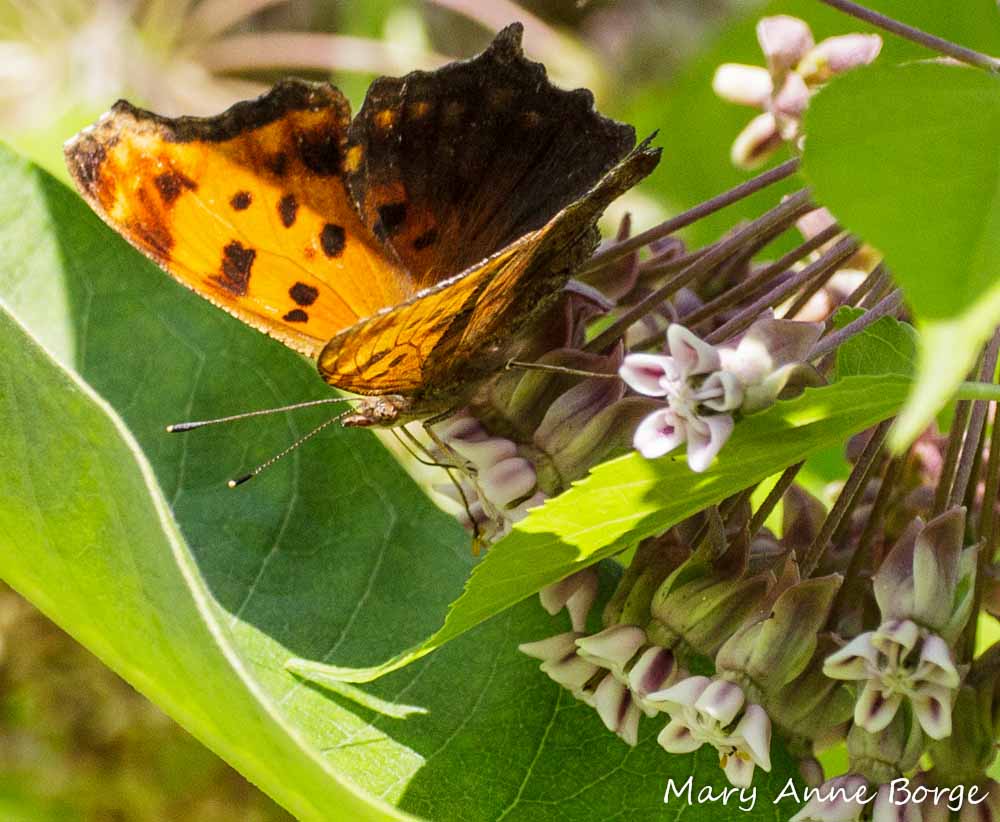
Eastern Comma on Common Milkweed (Asclepias syriaca)

Eastern Comma on Common Milkweed (Asclepias syriaca)

This Bumble Bee, on the other hand, is facing the flower, with its left front leg inserted in the very location where the pollinia are stored. This bee is engaging the pollen sacs, and has the heft to be able to escape from the flower with them clinging to its leg.
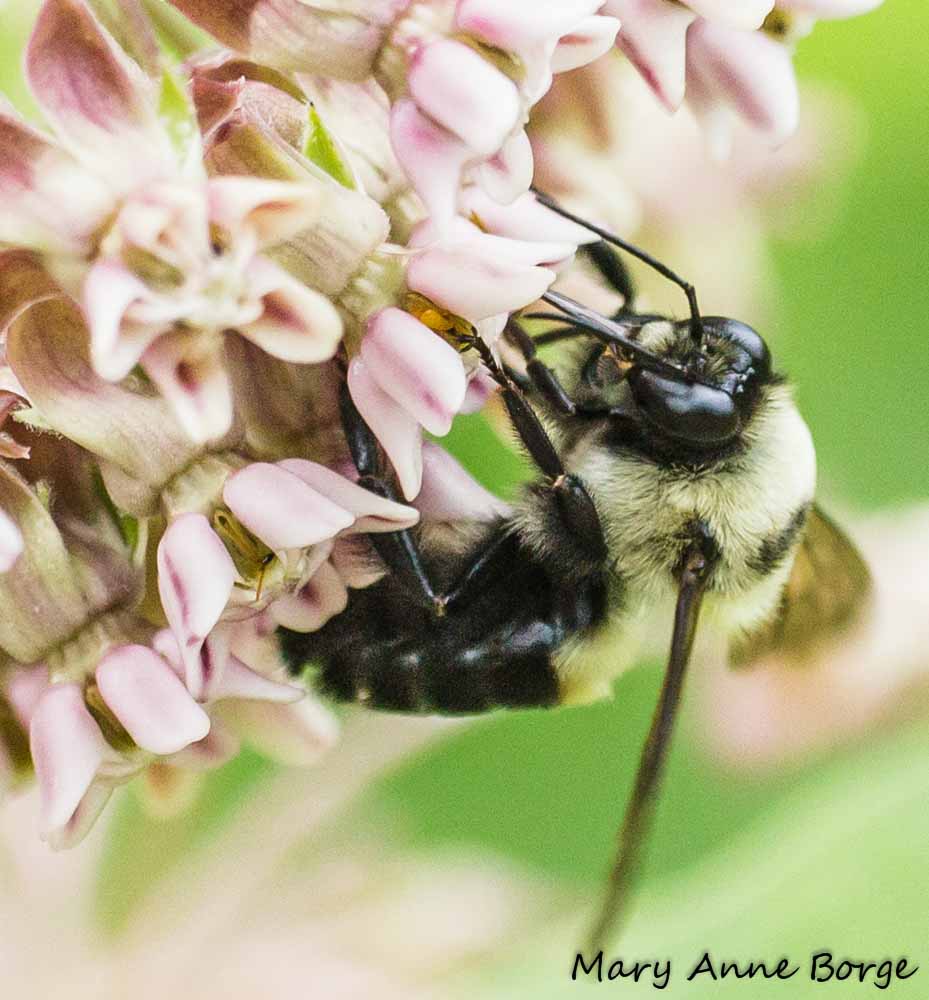
Bumble Bee engaging pollinia of Common Milkweed (Asclepias syriaca)

Bumble Bee engaging pollinia of Common Milkweed (Asclepias syriaca)

If you look carefully at the bee’s left front leg in the photo below, you can see the yellow pollinia attached to it.
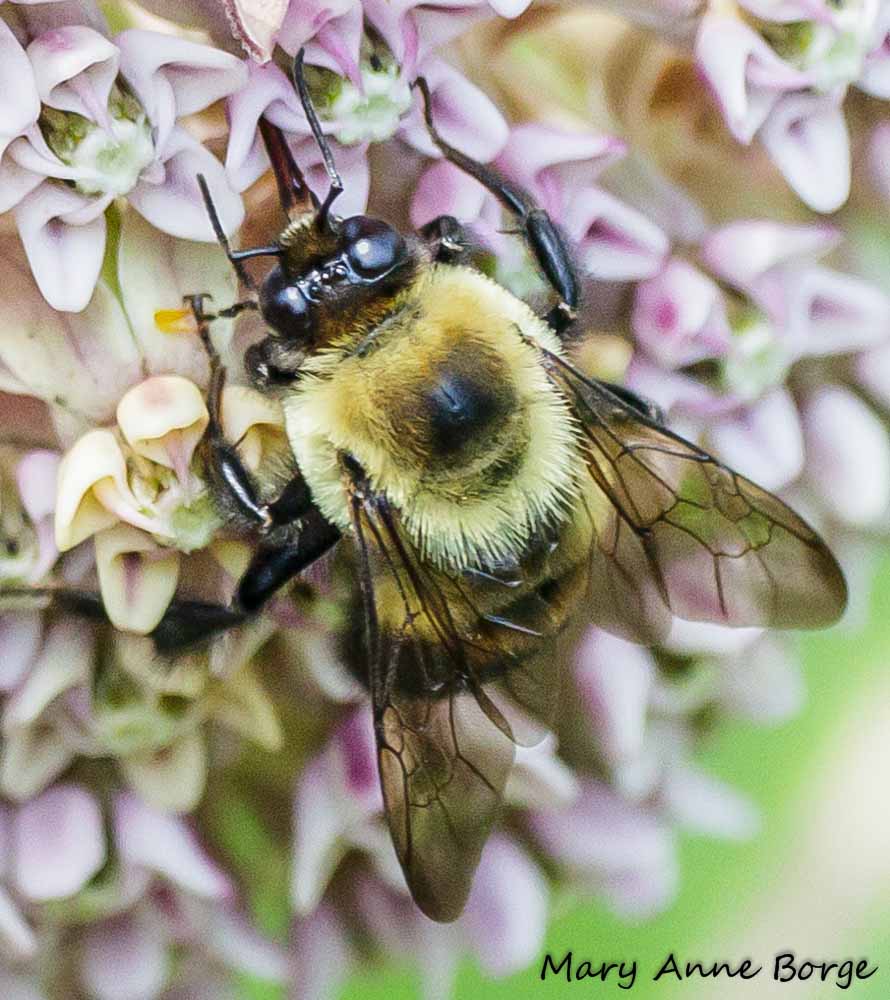
Bumble Bee with pollinia of Common Milkweed (Asclepias syriaca)

Bumble Bee with pollinia of Common Milkweed (Asclepias syriaca)

Large bees, such as Bumble Bees and Carpenter Bees, are among the most successful intermediaries in Milkweed pollination. Common Milkweed flowers release a potent fragrance to attract bees to assist them in their reproduction.

Many other insects take advantage of the nectar bounty offered by Milkweeds, including the Snowberry Clearwing Moth (Hemaris diffinis).
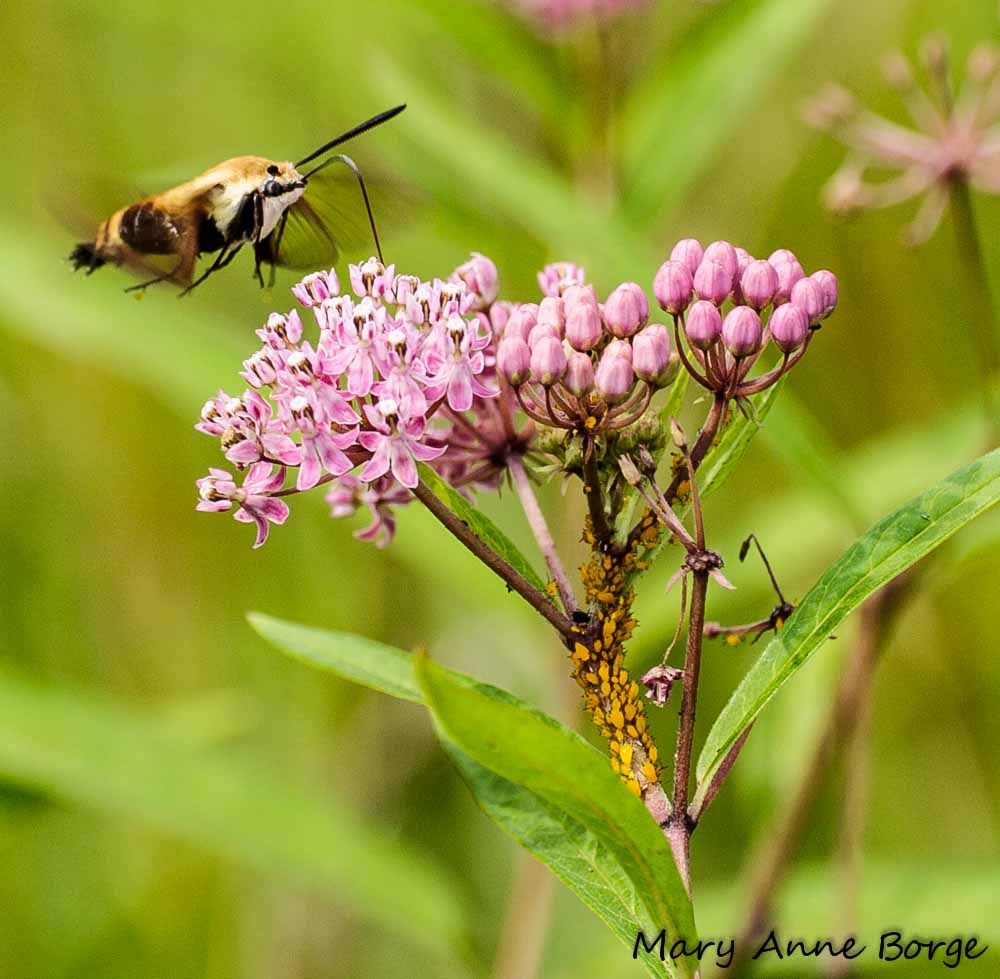
Snowberry Clearwing Moth (Hemaris diffinis) and Oleander Aphids (Aphis nerii) on Swamp Milkweed (Asclepias incarnata)

Snowberry Clearwing Moth (Hemaris diffinis) and Oleander Aphids (Aphis nerii) on Swamp Milkweed (Asclepias incarnata)

There’s another insect species dining on this Swamp Milkweed. Do you see the little yellow critters on the stem? You might be thinking, “Eeuuw! Aphids!” If so, you would be half right. These are Oleander Aphids (Aphis nerii), a species frequently found on Milkweeds. But you might want to re-think the “Eeuuw!” It turns out that aphids are an important part of the food chain.

Aphids rarely really harm a plant.  And they offer a sustainable food source in the form of honeydew, a sweet excrement that ants love. The ants protect aphids in exchange for this tasty meal. Ants are essential for aerating soil, decomposing plant matter, dispersing seeds, and in some cases protecting plants from other predators.

Ants tending aphids on Common Milkweed (Asclepias syriaca)

Ants tending aphids on Common Milkweed (Asclepias syriaca)

Aphids are also a food source for other insects. In the photo below, this Oleander Aphid is being parasitized by two predators at once! It’s being bitten in the butt (abdomen) by a Convergent Lady Beetle (Hippodamia convergens) larva, who plans to consume the aphid. Notice also the bulge on the lower left side of the aphid. That is likely the result of a braconid wasp parasitizing the aphid. The adult female wasp lays an egg inside the aphid, with its resulting offspring consuming the aphid from the inside, leaving an empty husk.  Insects could be the inspiration for zombie and vampire stories!(There’s a white squiggly thing on the lady beetle larva that I’m guessing may also be a predator, but so far I haven’t identified it.  If you know what it is, let me know!)

Lady Beetle larvae biting aphid that shows signs (bubble) of being parasitized by a braconid wasp.

Lady Beetle larva biting aphid that shows signs (bubble) of being parasitized by a braconid wasp.

If you’re really observant you may have noticed that this scene was taking place on half of a Common Milkweed leaf, with the right side of the leaf missing. Wondering how that happened?  It’s the way Milkweed Tussock Moth (Euchaetes egle) caterpillars feed, neatly chewing side by side, stopping at the midrib.
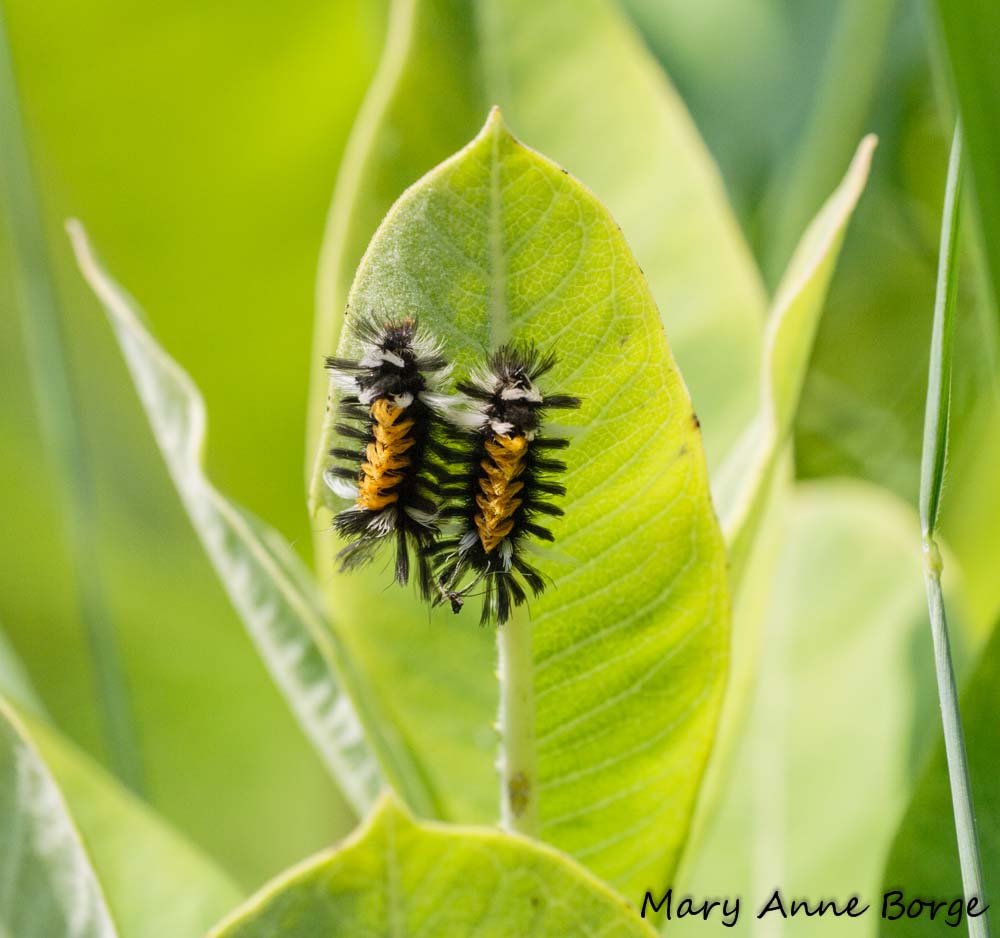
Milkweed Tussock Moth (Euchaetes egle) Caterpillers

Milkweed Tussock Moth (Euchaetes egle) Caterpillers

Another insect that feeds on milkweed leaves is the Red Milkweed Beetle (Tetraopes tetraophthalmus). This clever creature bites through the midrib of the leaf in a few spots near the leaf tip. This stops the milky latex-like sap from flowing to that part of the leaf, making it possible for the beetle to eat it without having its mouthparts glued together by the sticky substance.
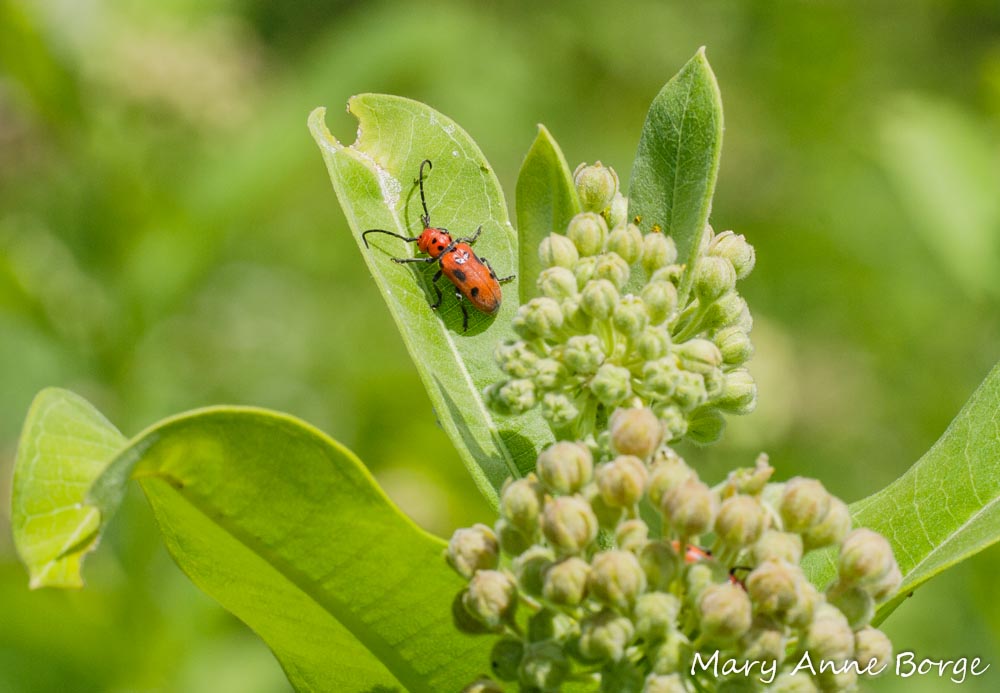
Red Milkweed Beetle (Tetraopes tetraophthalmus) on Common Milkweed

Red Milkweed Beetle (Tetraopes tetraophthalmus) on Common Milkweed

Even Milkweed seeds are a source of food for insects like the Small (Lygaeus kalmii) and Large (Oncopeltus fasciatus) Milkweed Bugs.  Adults may also consume nectar.

Swamp Milkweed with Large Milkweed Bugs (Oncopeltus fasciatus) , adults and nymphs
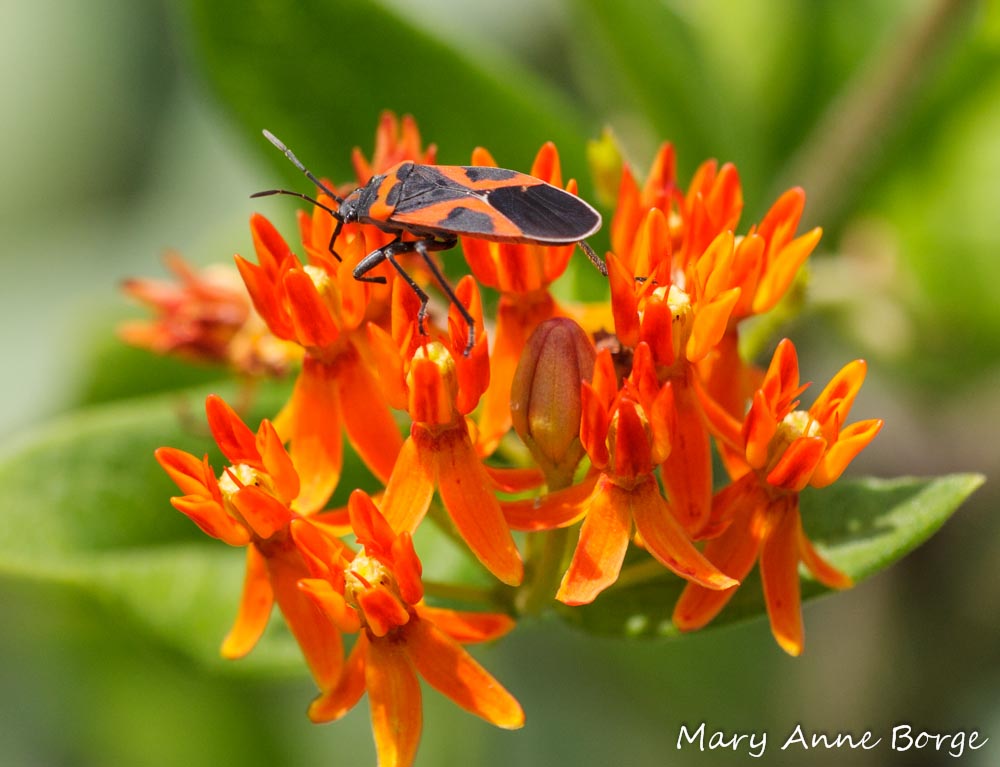
Swamp Milkweed with Large Milkweed Bugs (Oncopeltus fasciatus) , adults and nymphs

Small Milkweed Bug (Lygaeus kalmii) on Butterflyweed (Asclepias tuberosa)

Small Milkweed Bug (Lygaeus kalmii) on Butterflyweed (Asclepias tuberosa)

All of these insects sport bright colors that warn birds and mammals to avoid eating them. Insect and arthropod predators including the Lady Beetles, wasps, assassin bugs, spiders and Praying Mantises (or Mantids) are not put off, however. They may consume not just nectar feeders, but foliage and seed feeders, too.

Assassin Bug (Pselliopus cinctus) and Bumble Bee on Swamp Milkweed (Asclepias incarnata)

Assassin Bug (Pselliopus cinctus) and Bumble Bee on Swamp Milkweed (Asclepias incarnata)

Many of these predators are safe for birds and other predators to eat.  A large percentage of a bird’s diet consists of insects, especially when they are raising their young.
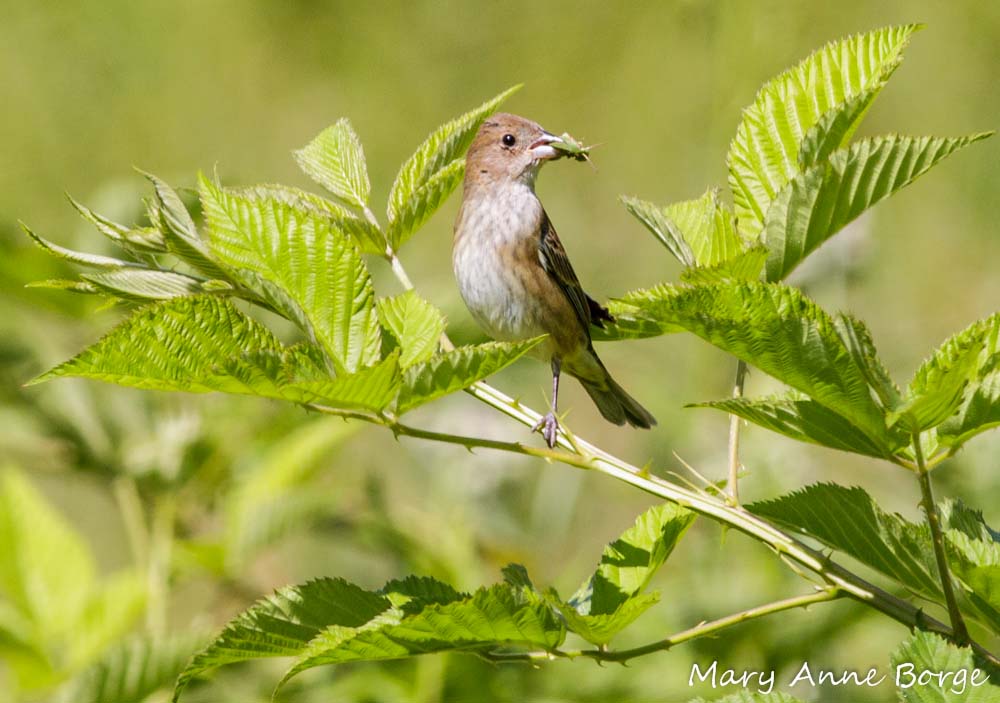
Female Indigo Bunting with lunch

Female Indigo Bunting with lunch

Birds also benefit from Milkweeds by using them as nesting material. The fluffy hairs attached to the seeds can make a soft lining for a Goldfinch nest.
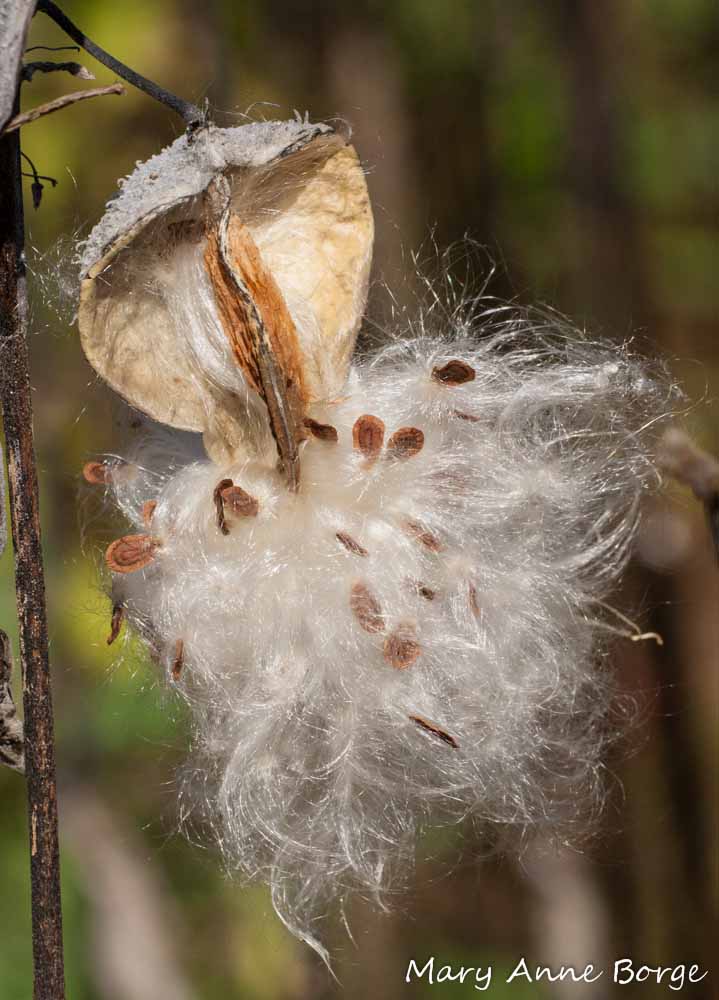
Common Milkweed (Asclepias syriaca) dispersing seeds

Common Milkweed (Asclepias syriaca) dispersing seeds

Most Milkweeds also have strong fibers in their stems that birds use to weave nests, including Northern Orioles
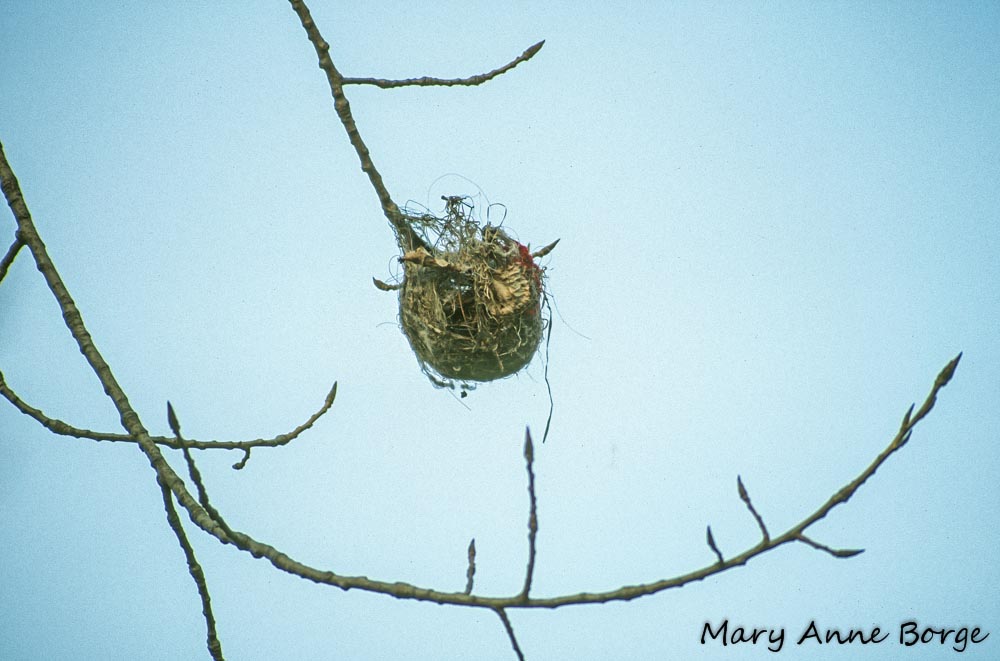
Northern Oriole Nest

Northern Oriole Nest

and Yellow Warblers.
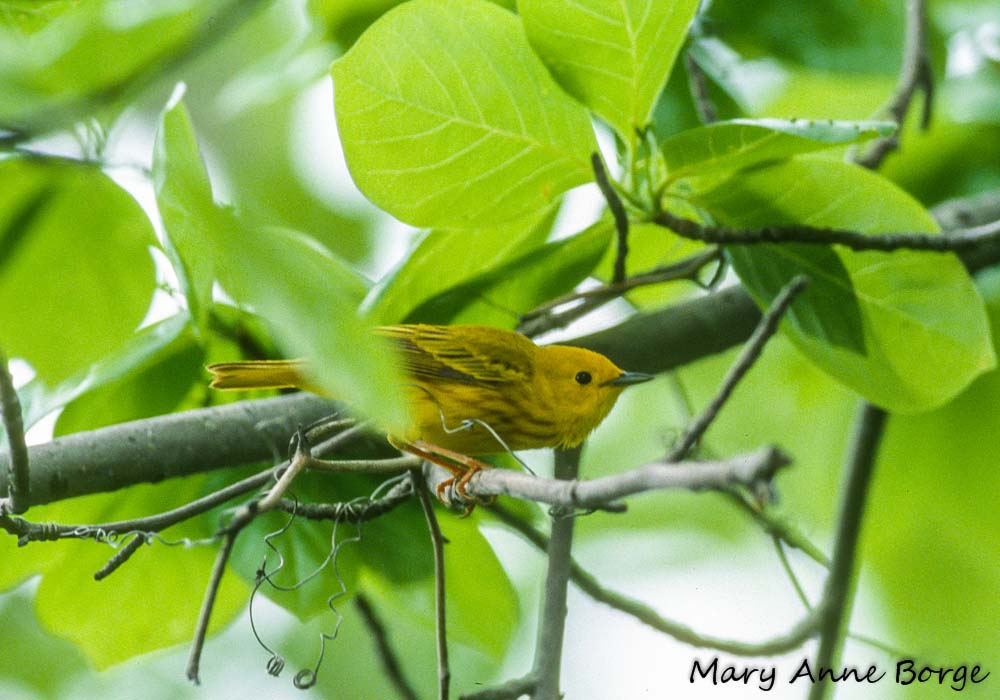
Yellow Warbler

Yellow Warbler

Milkweeds are essential to the continued survival of the Monarch butterfly. They are a copious nectar source for our beleaguered bee populations, and offer food to many other beneficial insects. They’re a source of insect protein and nest material for birds and other animals.  Milkweeds – they’re vital for Monarchs, and a whole host of other species, too.
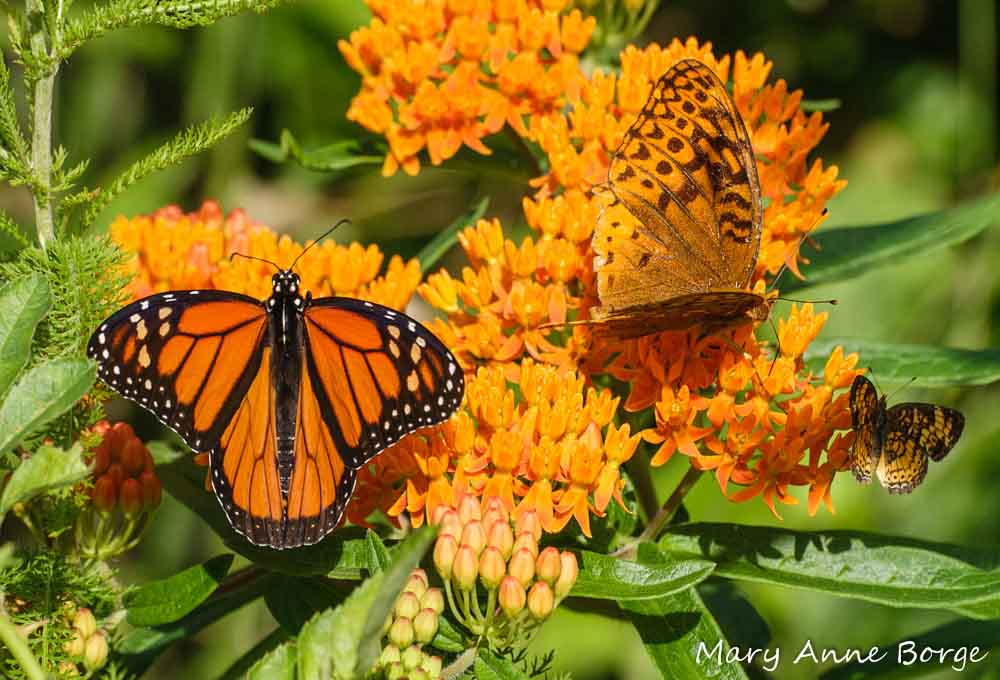
Butterflyweed with Monarch, Great Spangled Fritillary, and Pearl Crescent

Butterflyweed with Monarch, Great Spangled Fritillary, and Pearl Crescent

Resources

Eastman, John. The Book of Field and Roadside. 2003.

Eastman, John. The Book of Swamp and Bog. 1995.

Eaton, Eric R.; Kauffman, Ken. Kaufman Field Guide to Insects of North America. 2007.

Harrison, Hal H. Eastern Birds’ Nests. 1975

Tallamy, Douglas W. Bringing Nature Home, 2007,

USDA Plants Database

Sleepy Orange Butterflies are Back

Sleepy Orange butterflies are back at Bowman’s Hill Wildflower Preserve!

Sleepy Orange butterflies on Purple Coneflower (Echinacea purpurea)

Sleepy Orange butterflies on Purple Coneflower (Echinacea purpurea)

Sleepy Orange (Eurema nicippe) butterflies are a tropical species, present year-round from Central America through the southern tier of the United States. They may breed as far north as the southern tip of New Jersey, west to eastern Colorado, then dipping south to near Las Vegas, Nevada, but they are less common in the northern part of their range, and they are not thought to be able to survive the winter much farther north than North Carolina. Sleepy Orange is a species that likes to push the envelope of its territory, with individuals migrating each year to repopulate the northern areas.
So it’s pretty exciting to have Sleepy Oranges at Bowman’s Hill Wildflower Preserve, because it’s considered a rare ‘stray’ in Pennsylvania where the Preserve is located. It’s rare across the Delaware River in much of New Jersey, too. In 2012, ours was the only count circle in Pennsylvania or New Jersey to report Sleepy Oranges in the July 4th North American Butterfly Association Butterfly Count.

Even better, I have seen Sleepy Oranges at Bowman’s Hill Wildflower Preserve in 2006, 2008, and every year from 2010 through 2013, usually from July through September. Yesterday I counted 10 individuals.

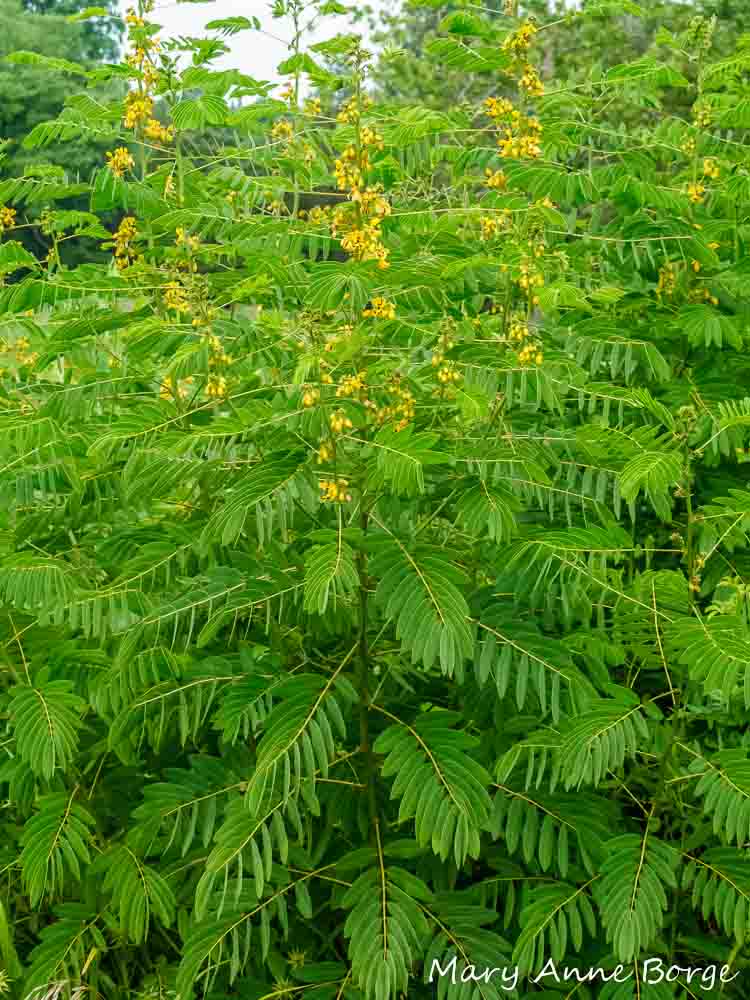
What brings them to the Preserve? Likely it’s the reliable presence of one of their favored caterpillar food plants, Wild Senna (Senna hebecarpa).

Wild Senna (Senna hebecarpa)

Wild Senna (Senna hebecarpa)

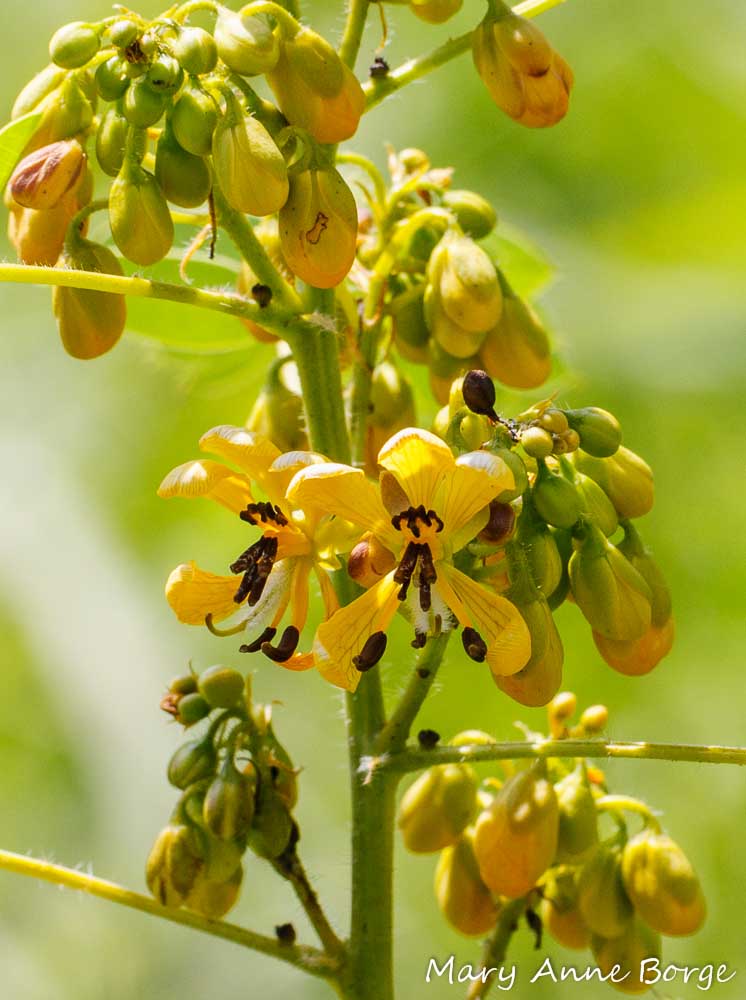
Wild Senna (Senna hebecarpa) flowers

Wild Senna (Senna hebecarpa) flowers

Only the presence of this food source has made it possible for Sleepy Oranges to breed at the Preserve. Sleepy Oranges also use other plants in this genus, and Partridge Pea (Chamaecrista fasciculata) and Wild Sensitive Plant (Chamaecrista nictitans) as food plants for their caterpillars. These plants are all pea family members, and contain alkaloids, chemicals that may have a bitter taste to some predators. Sennas also contain another chemical that has laxative properties. It is probable that Sleepy Oranges evolved to specialize on these plants because the chemicals they obtain from this diet offers some protection against predators.

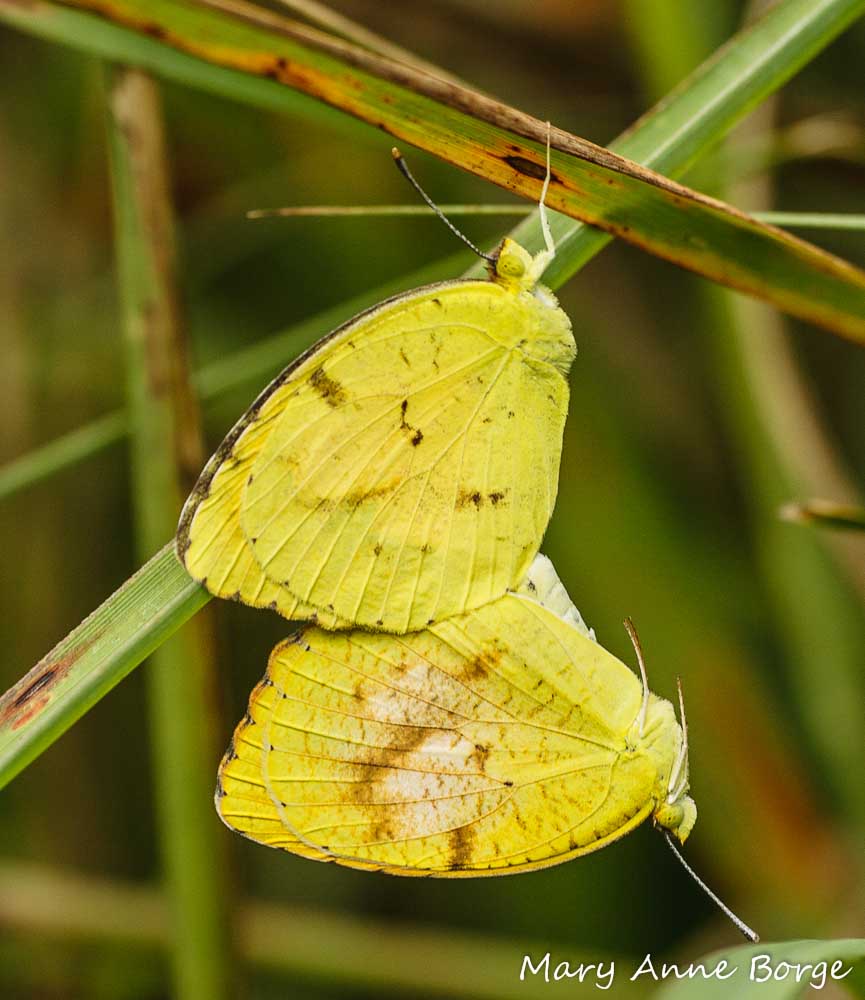
Sleepy Oranges Mating

Sleepy Oranges Mating

There are also plenty of nectar sources at the Preserve for the adult Sleepy Oranges, who are pretty eclectic in their tastes.

Female Sleepy Orange  on Tall Tickseed (Coreopsis triptera), 2013

Female Sleepy Orange on Tall Tickseed (Coreopsis triptera), 2013

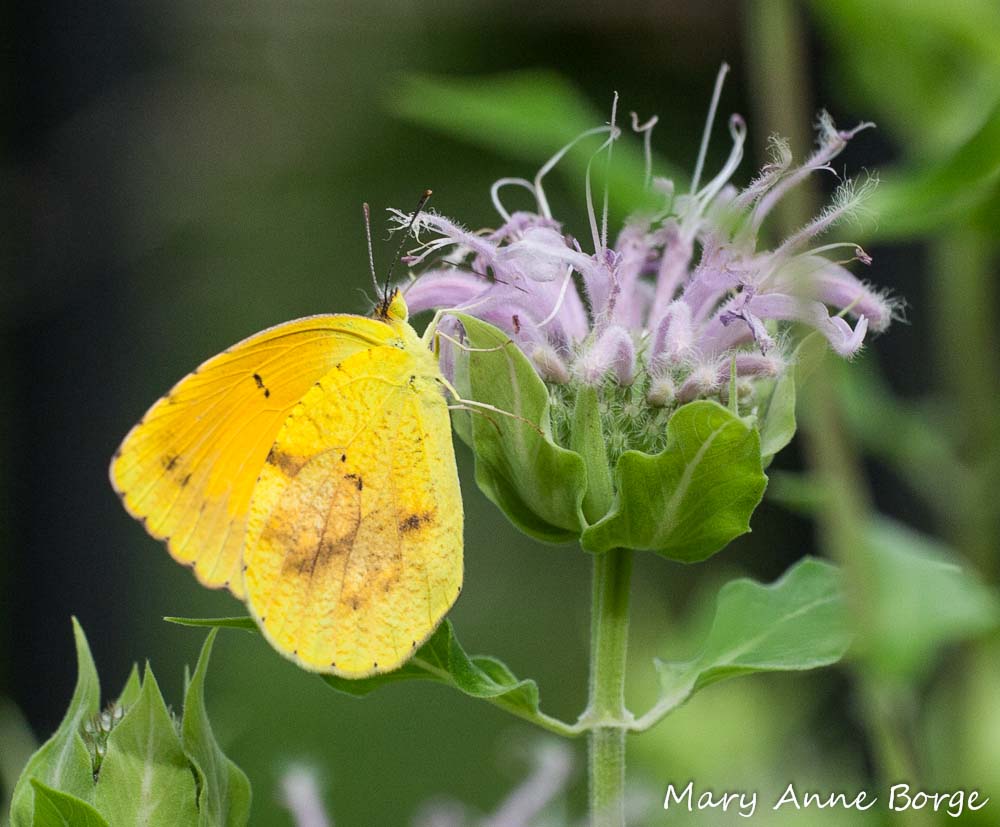
Sleepy Orange nectaring on Wild Bergamot (Monarda fistulosa), 2008

Sleepy Orange nectaring on Wild Bergamot (Monarda fistulosa), 2008

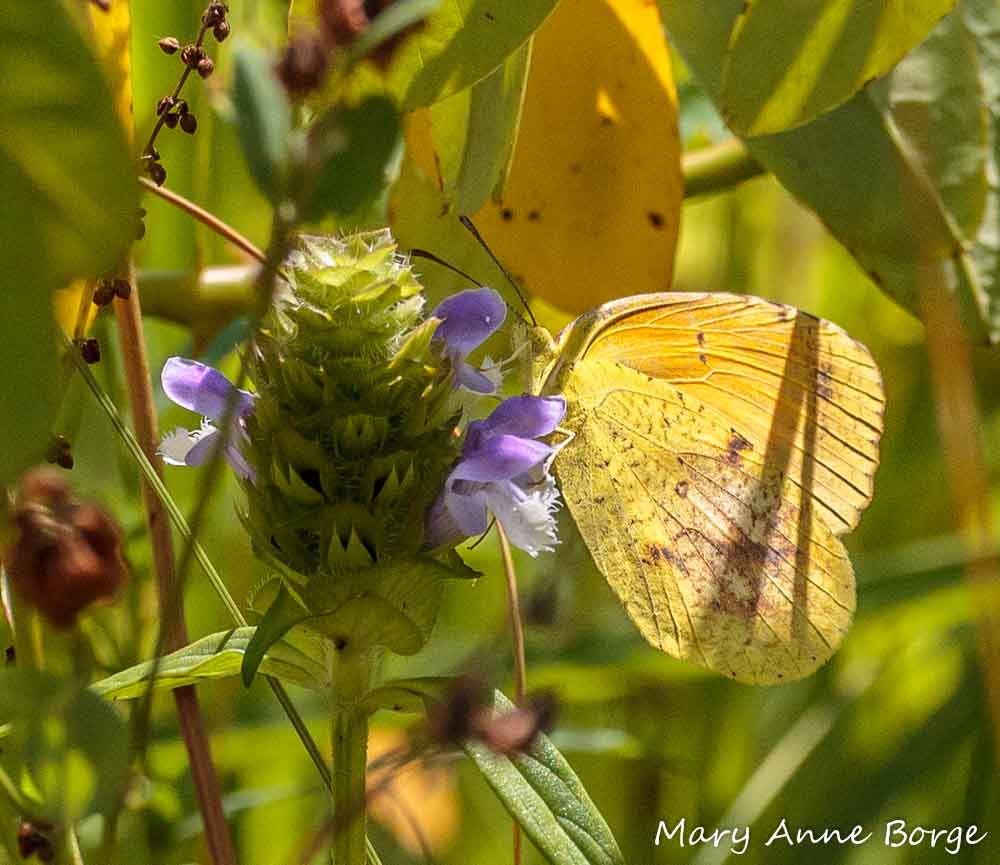
Sleepy Orange nectaring on Heal-all (Prunella vulgaris), 2011

Sleepy Orange nectaring on Heal-all (Prunella vulgaris), 2011

Sleepy Orange nectaring on Cardinal-flower (Lobelia cardinalis), 2012

Sleepy Orange nectaring on Cardinal-flower (Lobelia cardinalis), 2012

Males are also known to dine on minerals, although I usually see them drinking nectar.

Sleepy Orange on Field Thistle (Cirsium discolor), 2006

Sleepy Orange on Field Thistle (Cirsium discolor), 2006

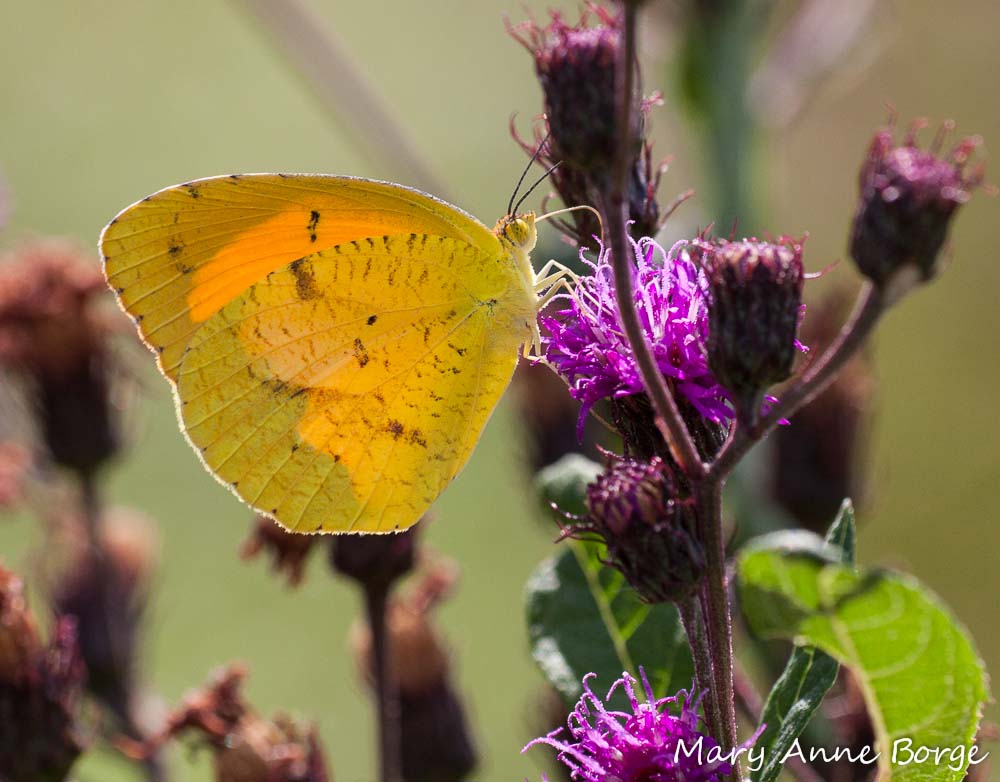
Wondering about this butterfly’s name? It’s not based on behavior, because this sprightly butterfly is very active. The photo below illustrates the characteristics that explain the origin of the name ‘Sleepy Orange’. The curved pattern of dark dots near the center of the upper edge of the forewing are thought to resemble a closed eye, resulting in ‘sleepy’, and the bright orange color, especially coming from the top (dorsal) side of the wing explains the rest. Sleepy Oranges overwinter as adults in the south; their winter color form is a darker red-orange.

Sleepy Orange nectaring on New York Ironweed (Vernonia noveboracensis), 2010

Sleepy Orange nectaring on New York Ironweed (Vernonia noveboracensis), 2010

Given the rarity of this butterfly species in the surrounding area, I can’t help but wonder how Sleepy Oranges have been consistently finding Bowman’s Hill Wildflower Preserve for the past several years. It seems unlikely that this primarily tropical species would be able to survive the winter here, but with warmer winter temperatures, who knows? There are some reports of a southern migration of these butterflies in the fall. Could some of the Preserve’s butterflies have flown far enough south to successfully overwinter, and genetically pass on the knowledge of this location to their offspring? Does the generation that overwinters as adults live long enough to make a return northward migration the following year? Is this location near the Delaware River just a favored migration route for Sleepy Oranges and once they see the food available here they decide to stay? Random chance?

If you have an explanation or theory for their consistent appearance here, I would love to hear it!

Female Sleepy Orange on her caterpillar food plant, Wild Senna (Senna hebecarpa), 2013

Female Sleepy Orange on her caterpillar food plant, Wild Senna (Senna hebecarpa), 2013

For more on Sleepy Oranges at Bowman’s Hill Wildflower Preserve, click Sleepy Oranges Overwintering in Pennsylvania.

Resources:

Brock, Jim P.; Kauffman, Ken. Kaufman Field Guide to Butterflies of North America. 2003.

Capon, Brian. Botany for Gardeners. 2005

Cech, Rick; Tudor, Guy. Butterflies of the East Coast. 2005.

Glassberg, Jeffrey. A Swift Guide to Butterflies of North America. 2012.

Glassberg, Jeffrey. Butterflies through Binoculars A Field Guide to Butterflies in the Boston-New York-Washington Region. 1993.

http://www.butterfliesandmoths.org/species/Abaeis-nicippe

http://www.gardenswithwings.com/facts-info/a0810MonarchMigration.html

http://www.learner.org/jnorth/tm/monarch/OtherMigrants.html

Bowman’s Hill Wildflower Preserve – Visitors at the Pond

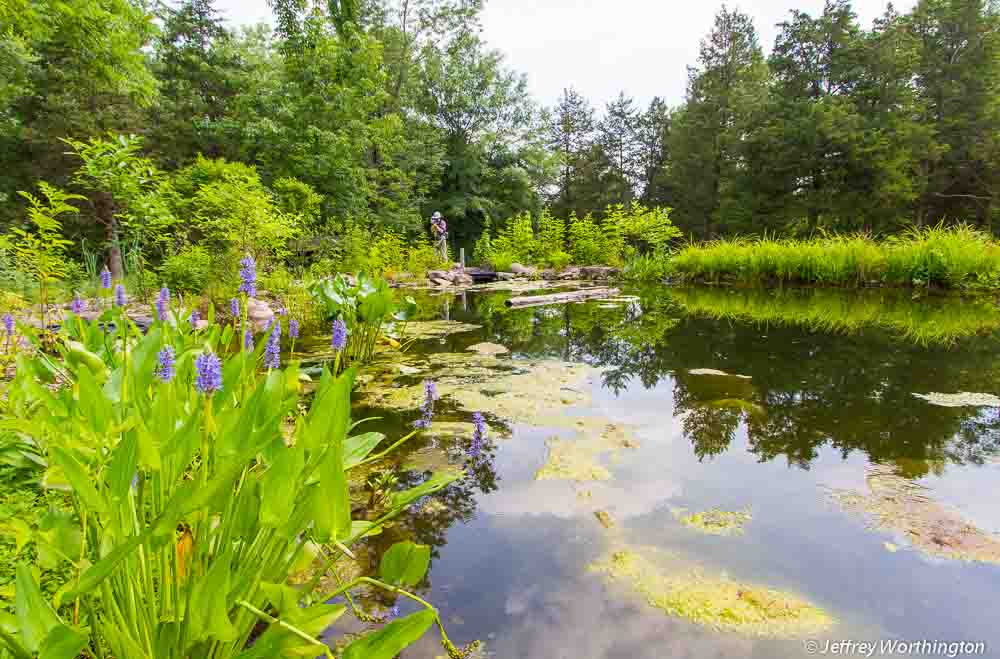
Plants are still filling in at the new pond at Bowman’s Hill Wildflower Preserve, but already the habitat is hospitable enough to tempt a variety of visitors.

New Pond at Bowman's Hill Wildflower Preserve

New Pond at Bowman’s Hill Wildflower Preserve

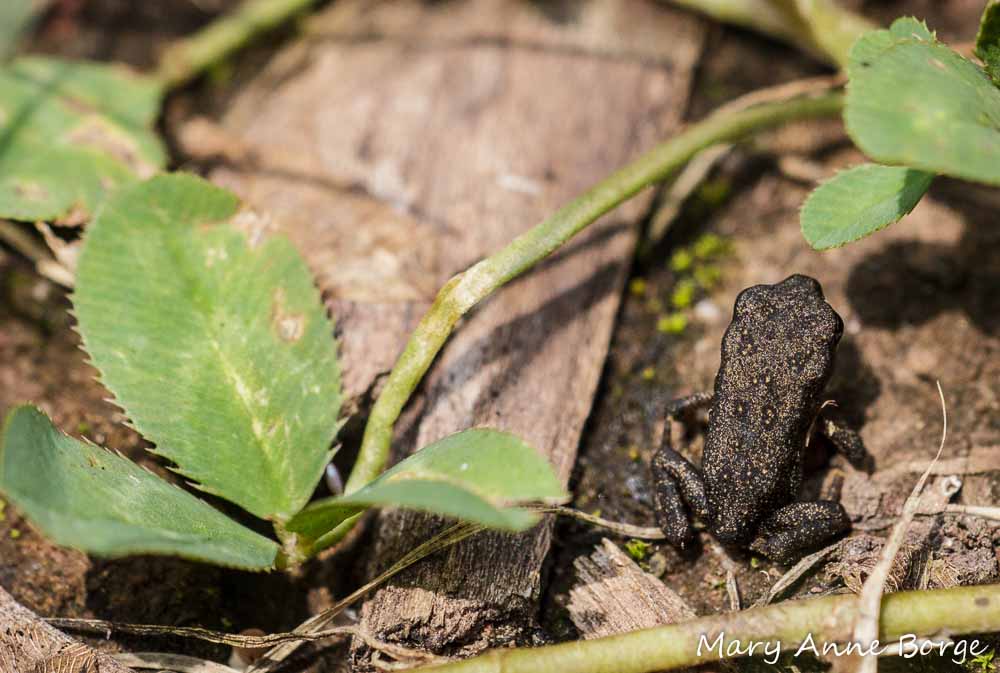
As you approach the pond’s edge, insect-sized American Toads (Bufo americanus) leap for shelter, escaping certain death from being squashed by a foot. They hide in the grasses, mulch, or under a plant leaf, hoping to remain unseen and unharmed. Compare the young American Toad with the clover leaves in this photo to get a sense of this tiny amphibian’s size.

American Toad

American Toad

Another not-fully-grown visitor along the pond’s edge is this pre-historic-looking Marbled Grasshopper (Spharagemon marmorata) nymph.

Marbled Grasshopper Nymph (Spharagemon marmorata)

Marbled Grasshopper Nymph (Spharagemon marmorata)

The flowers blooming near the pond’s edge are an attraction for many interesting animals.

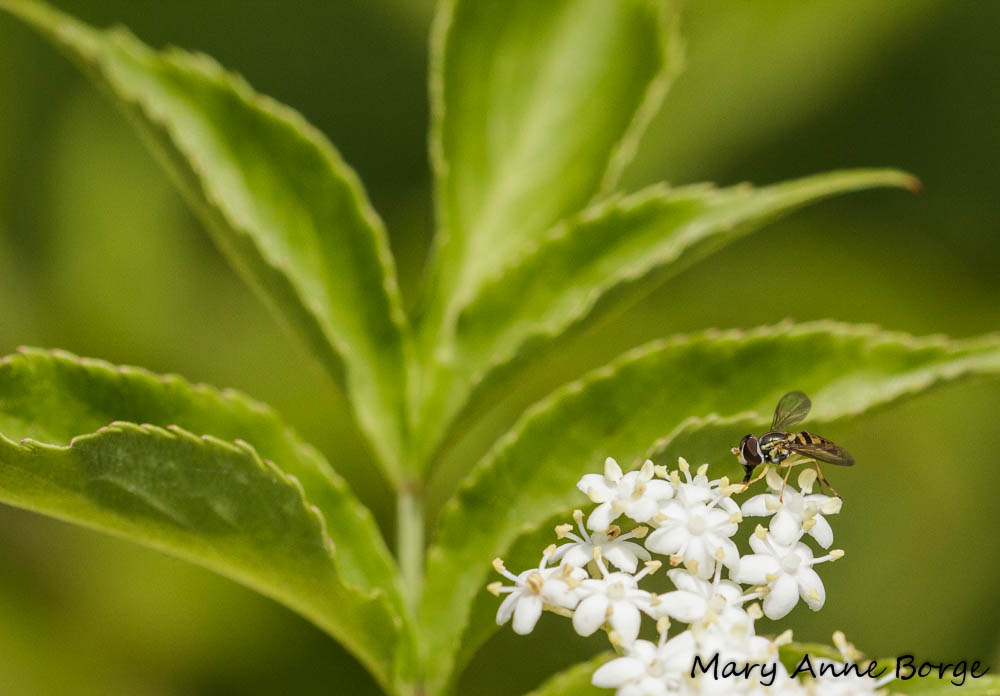
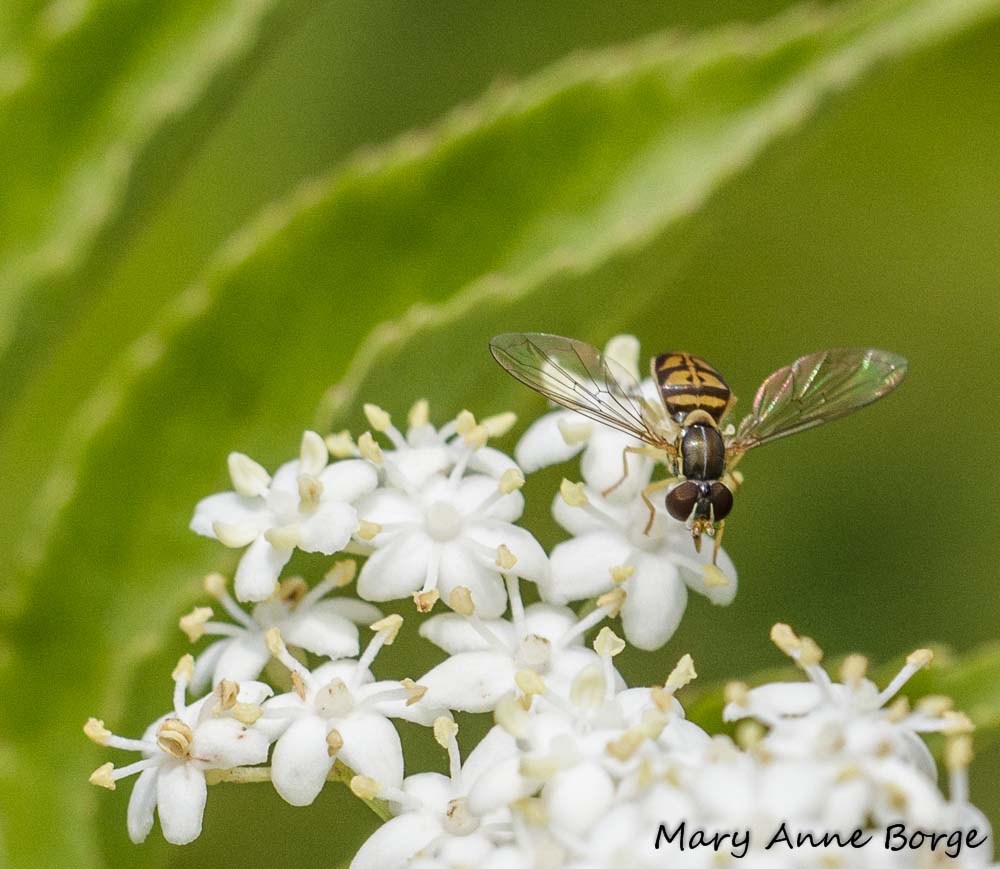
Elderberry (Sambucus canadensis) flowers don’t produce a lot of nectar, but they attract insects that feed on their pollen, like the wasp-mimicking Toxomerus marginatus feeding here. This fly species doesn’t have a common name other than Flower Fly or Hover Fly, terms used to describe species of the Syrphid (Syrphidae) family because they make their living feeding on and pollinating flowers, and many are able to hover continuously for long periods. Members of this insect family evolved to look like bees or wasps, since this threatening disguise helps them to avoid predators. They feed on nectar or pollen, but their visits to the Elderberry flowers for food for themselves will also result in pollination, producing dark blue fruit later in the season.

Hover or Flower Fly (Toxomerus marginatus)

Hover or Flower Fly (Toxomerus marginatus)

Hover or Flower Fly (Toxomerus marginatus)

Hover or Flower Fly (Toxomerus marginatus)

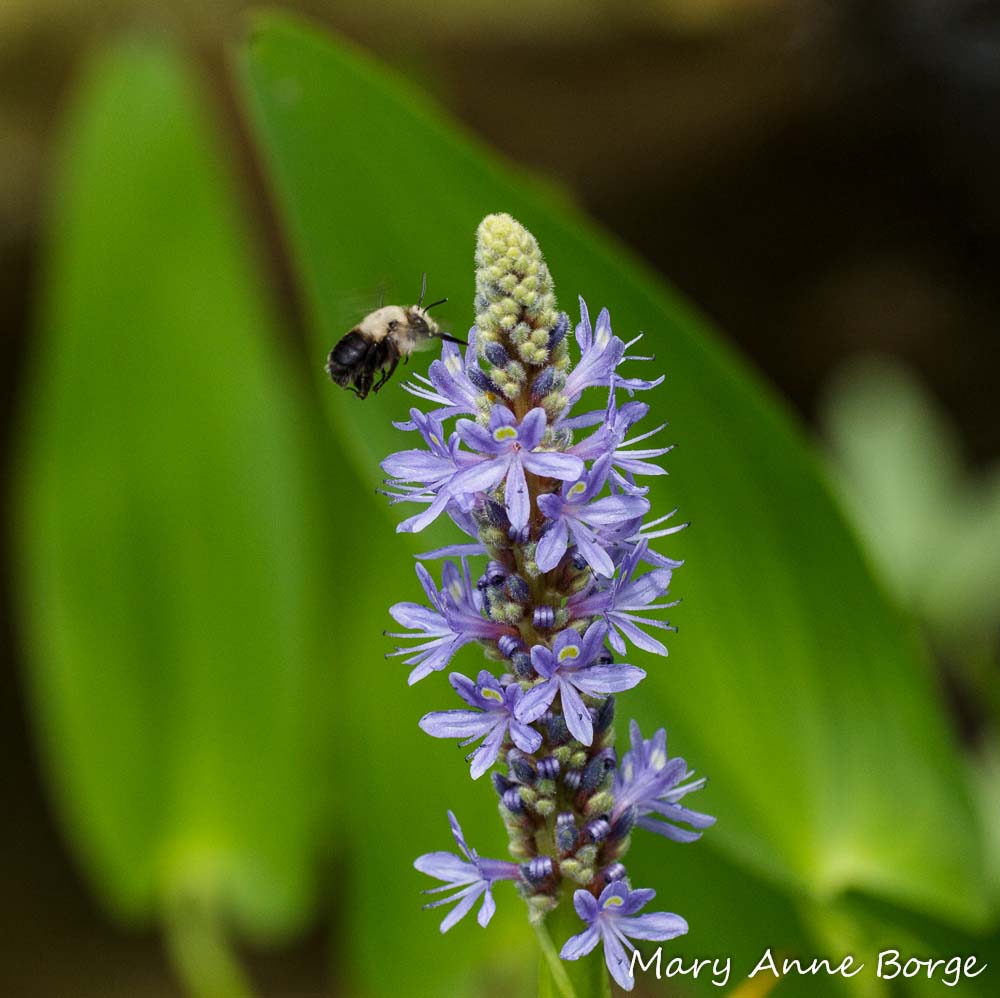
An aquatic plant, Pickerelweed’s (Pontederia cordata) bright spikes of purple flowers are primarily pollinated by Bumble Bee species,

Pickerelweed with Bumble Bee

Pickerelweed with Bumble Bee

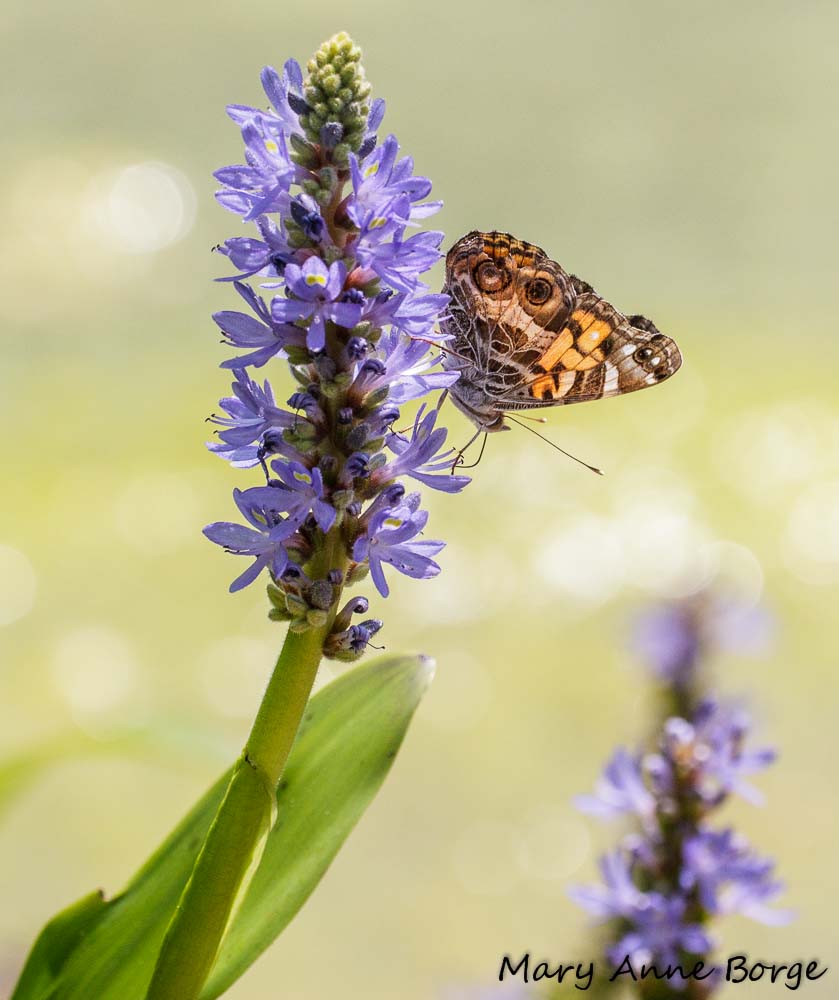
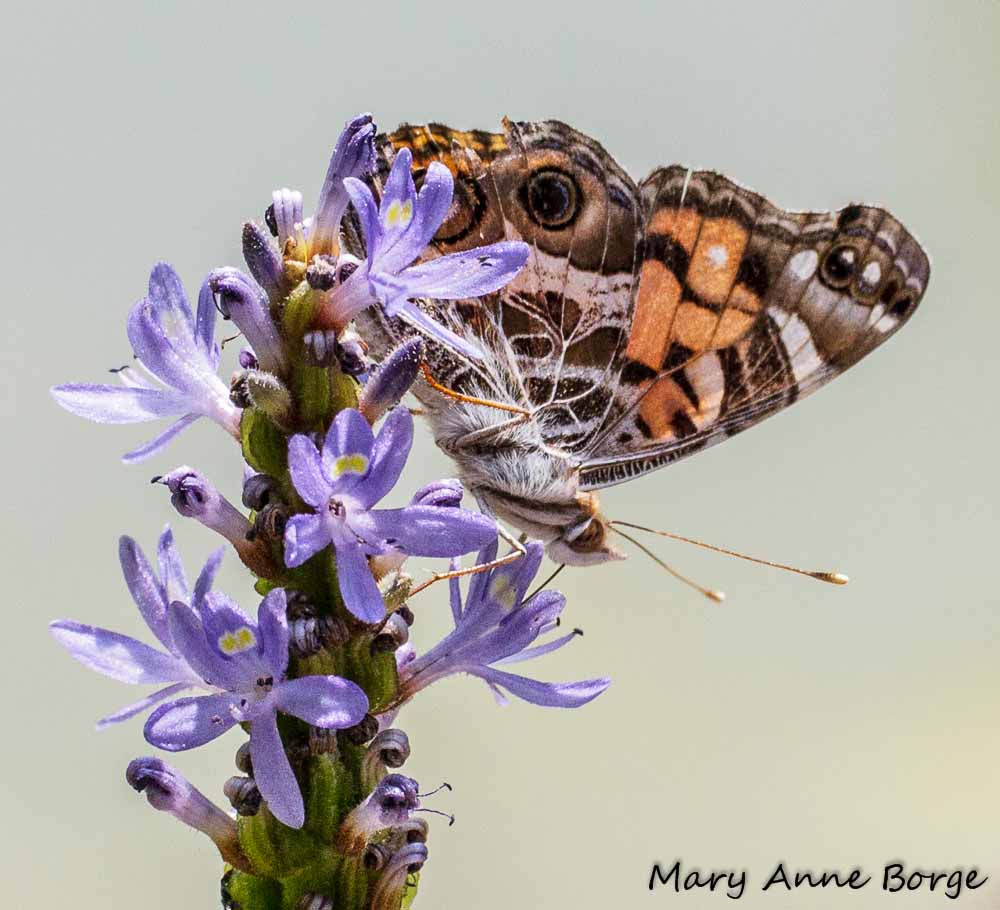
but they have many other visitors. Butterflies also enjoy their nectar, although their anatomy and feeding techniques are much less likely to result in pollination.

American Lady on Pickerelweed

American Lady on Pickerelweed

American Lady on Pickerelweed

American Lady on Pickerelweed

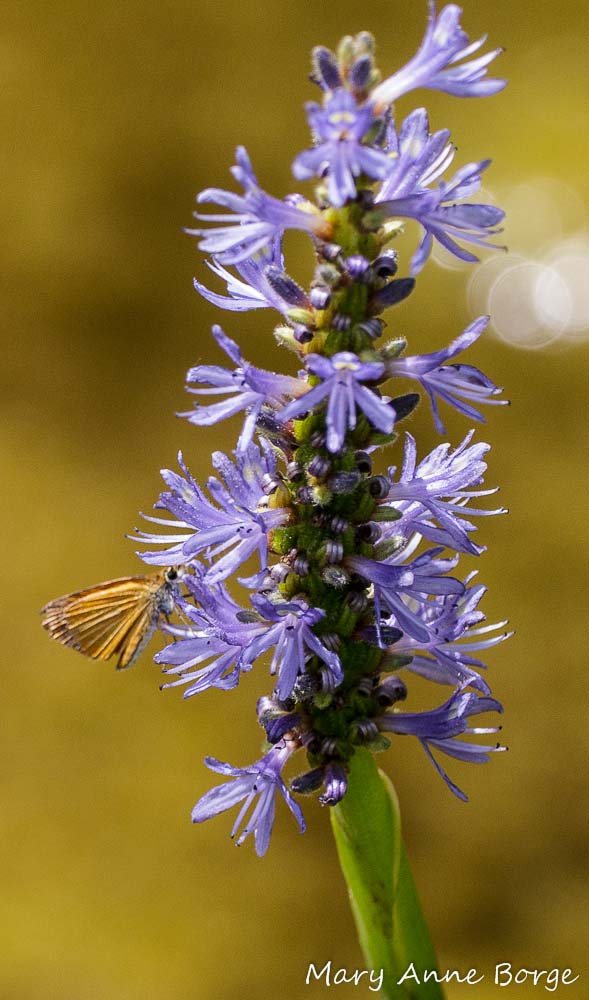
Least Skipper on Pickerelweed

Least Skipper on Pickerelweed

The airspace over the pond sees heavy air traffic from dragonflies and damselflies, constantly darting back and forth, feeding on other insects while both are in flight, and cruising for mates. What amazing flight navigation precision! Some females can be seen repeatedly touching the surface of the pond with the tip of their abdomen (the long slender body part that might look like a tail). This is how some dragonfly species lay their eggs.

The best chance to get a close look at these busy creatures is when they pause for a break on leaves, grasses or other plant matter or surfaces, while watching for potential mates or meals. Photography helps to enable a careful enough study to tell them apart.

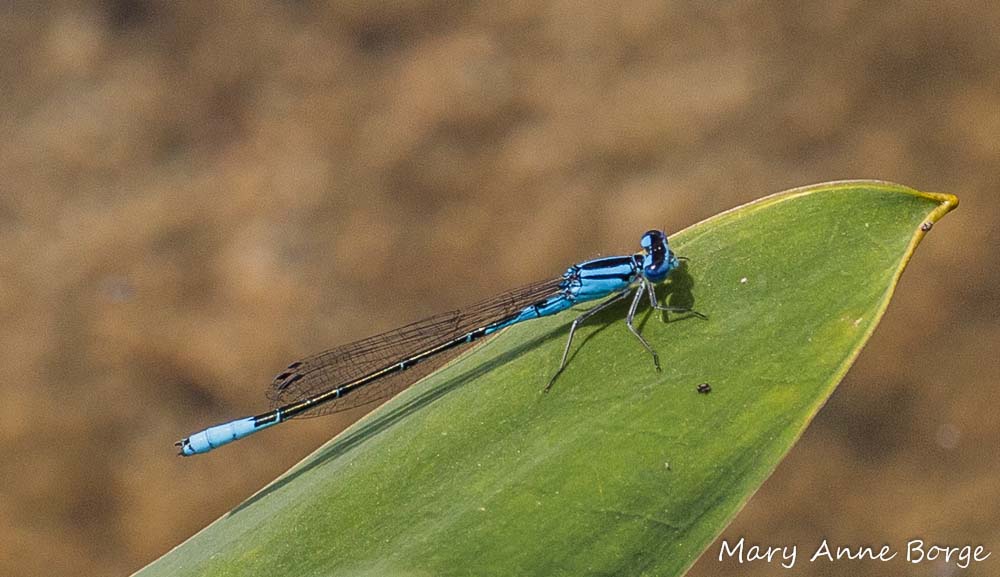
Damselflies characteristically hold their wings folded together above their body, or only slightly apart. They are usually small with slender abdomens, a wide head and big eyes. Two species of Bluets were present on a recent visit, an Azure Bluet,

Azure Bluet

Azure Bluet

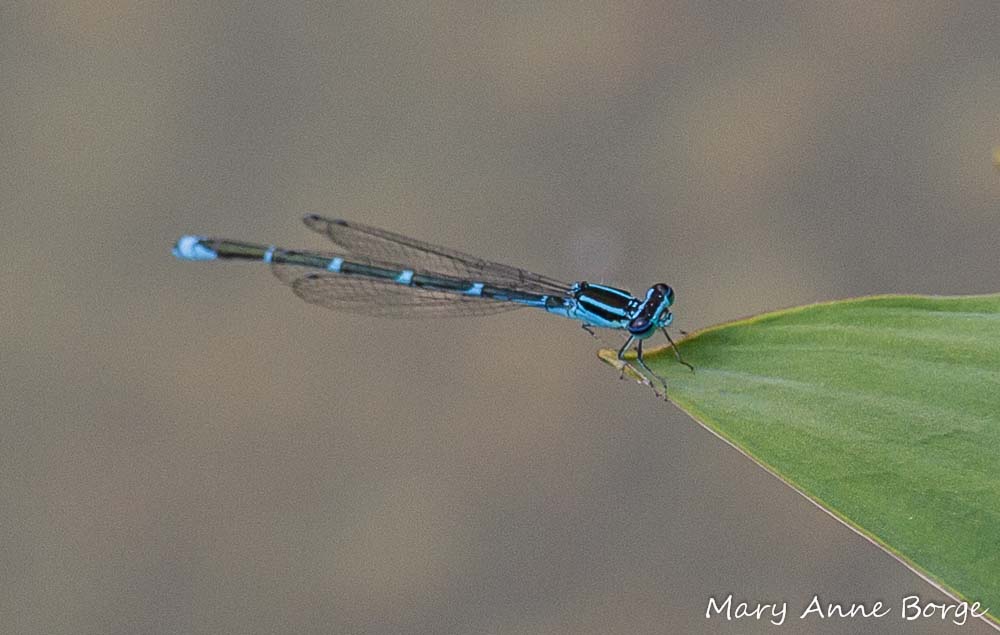
and a Stream Bluet.

Stream Bluet

Stream Bluet

Can you tell them apart? Look closely at the tips of their abdomens and count the number of segments that are blue, and check the width of the black and blue stripes on their thoraxes (the middle section of the insect, to which the wings are attached). Can you see any differences between the two damselflies in these characteristics or others?

Dragonflies generally hold their wings open, often perpendicular to their bodies, but at other angles, too. They are larger than damselflies and have stouter bodies, although different species vary quite a bit in size.

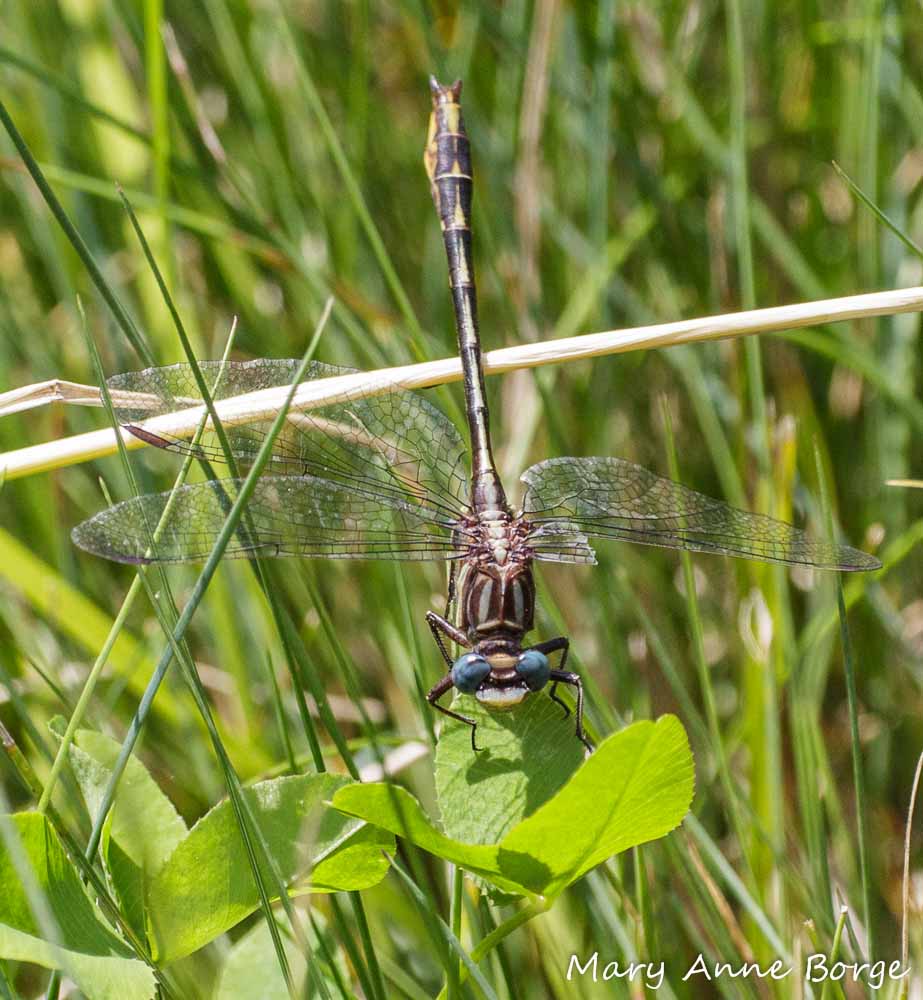
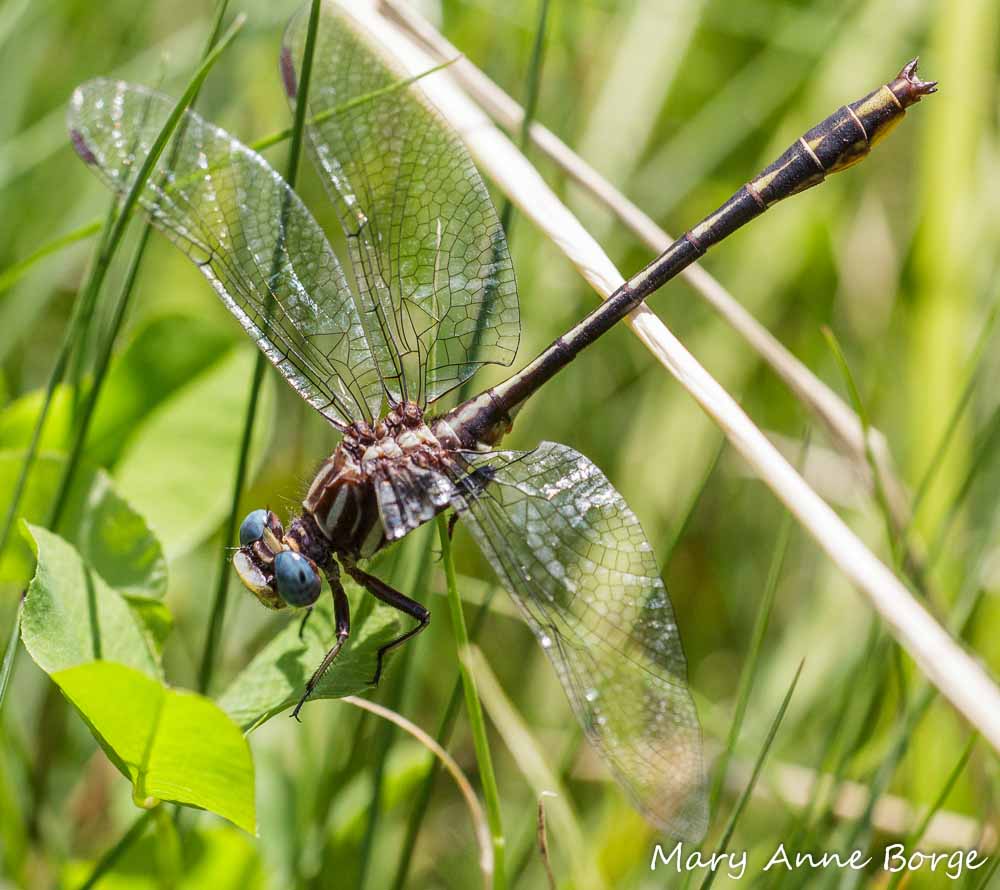
The dragonfly below is a Lancet Clubtail, resting on a clover leaf and some grasses. He’s missing a wing, probably the result of a recent encounter with an unsuccessful predator, possibly a bird, a frog, a spider, or another insect – even another dragonfly may have attempted to make him a meal.

Lancet Clubtail

Lancet Clubtail

Lancet Clubtail

Lancet Clubtail

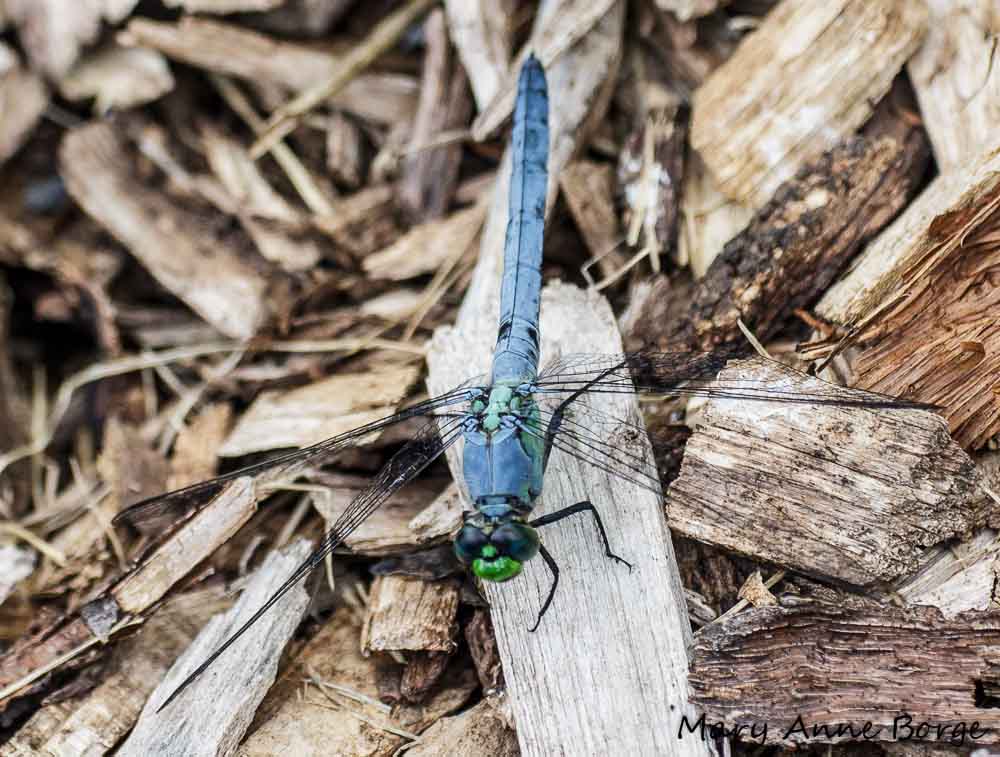
Eastern Pondhawks, like the male pictured here, are among the dragonflies that are voracious predators of other dragonflies.

Eastern Pondhawk

Eastern Pondhawk

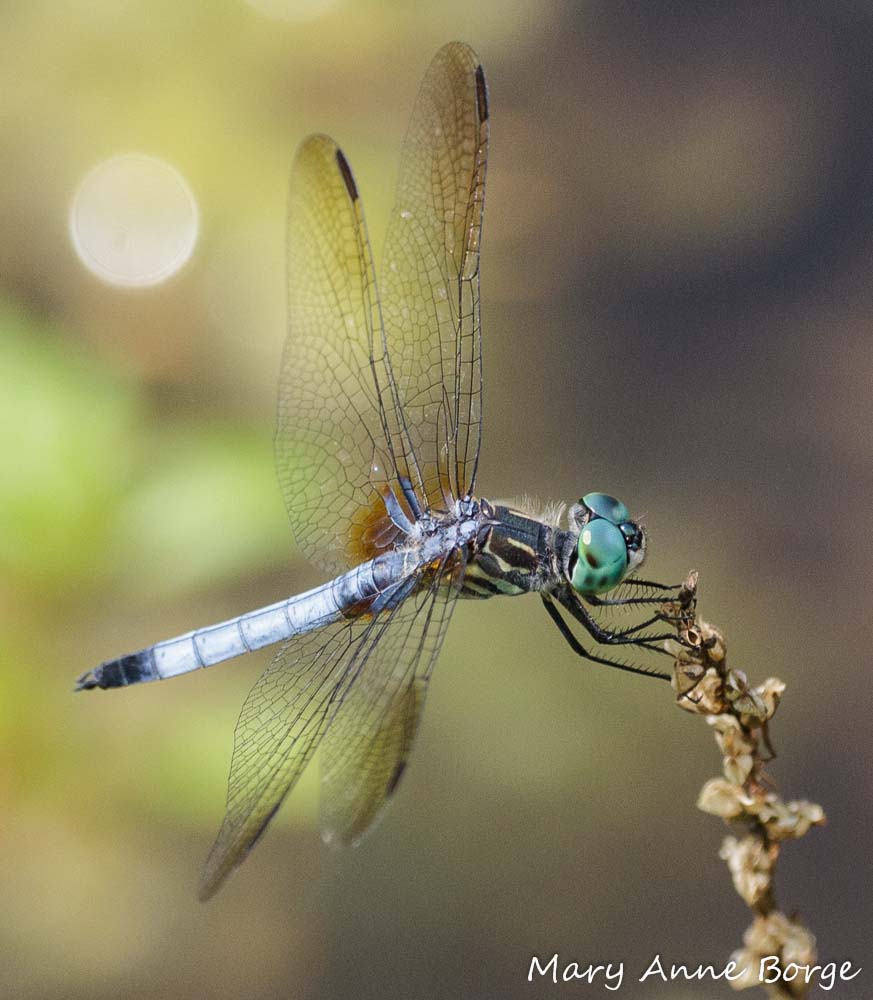
Male Blue Dashers spend a lot of time perching on vegetation, looking for a meal or a mating opportunity.

Blue Dasher

Blue Dasher

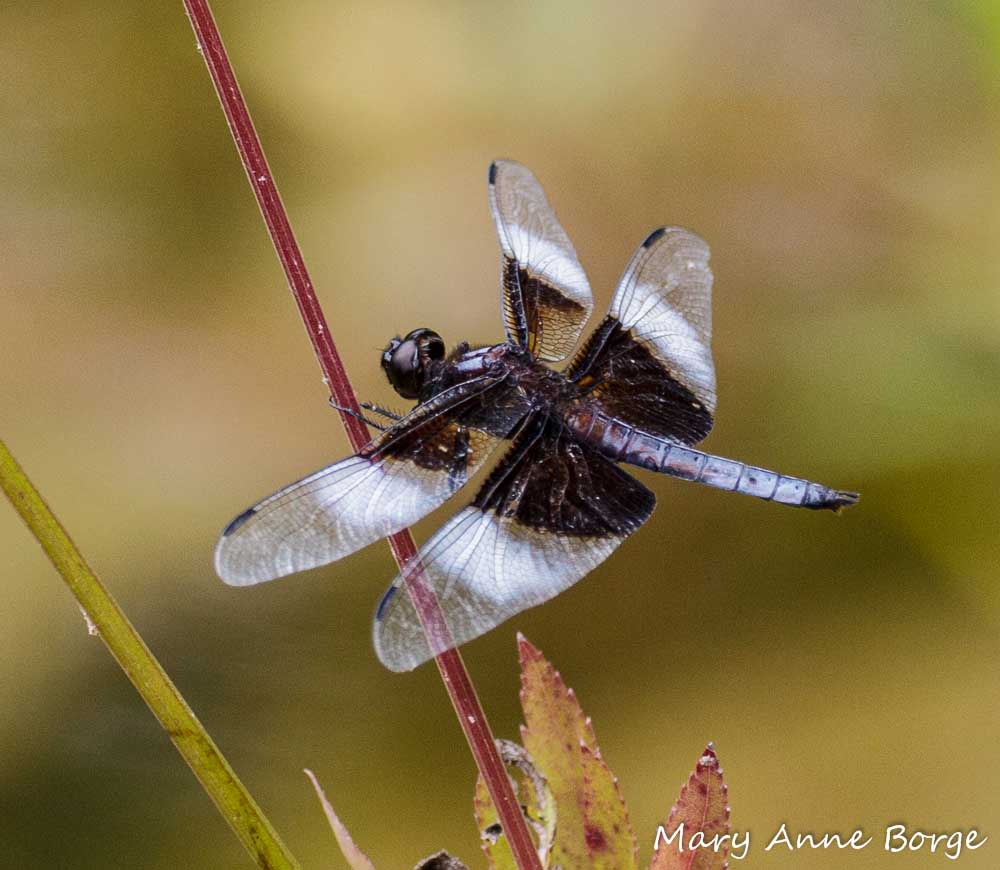
A male Widow Skimmer showed a preference for a Golden Alexanders flower stem as his perch, returning to it after each flight,

Widow Skimmer

Widow Skimmer

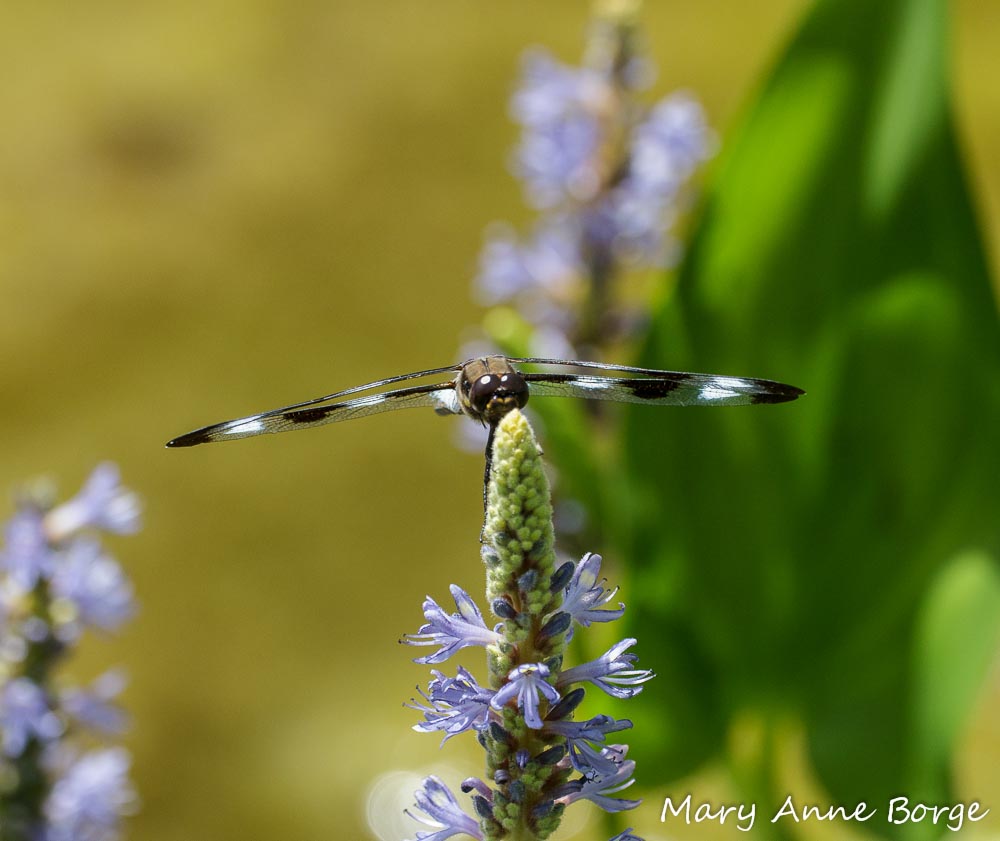
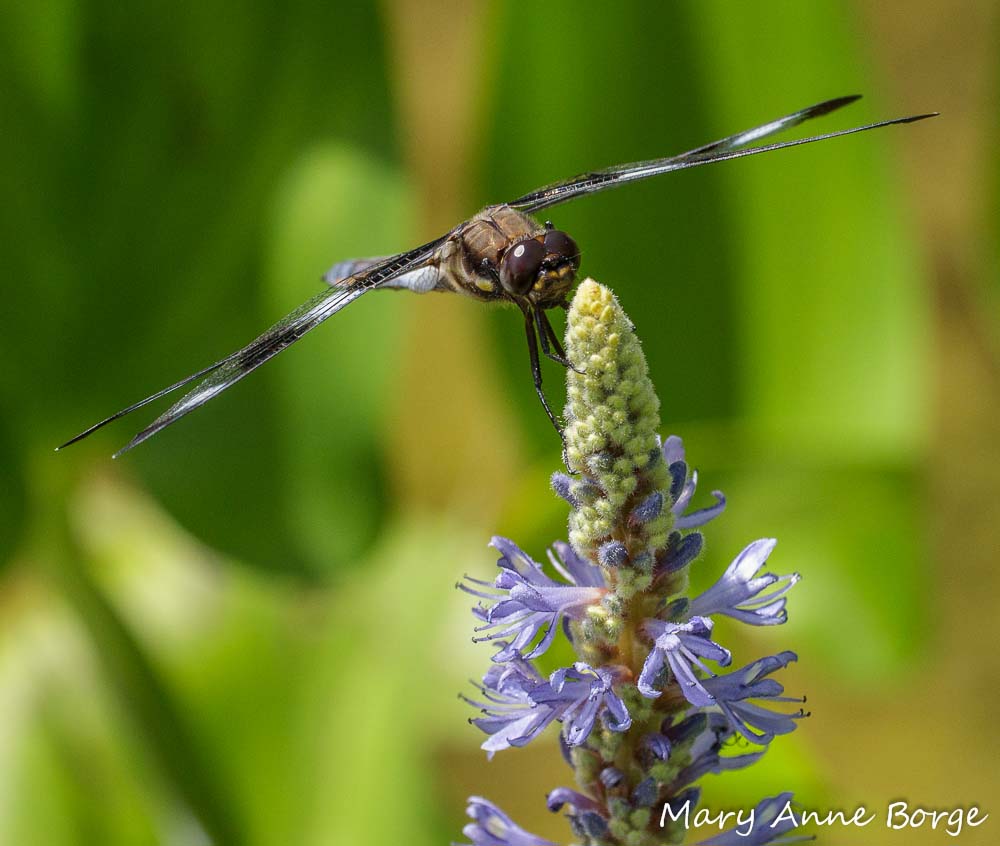
While Pickerelweed provided a favorite perch for this male Twelve-spotted Skimmer.

Twelve-spotted Skimmer on Pickerelweed

Twelve-spotted Skimmer on Pickerelweed

Twelve-spotted Skimmer on Pickerelweed

Twelve-spotted Skimmer on Pickerelweed

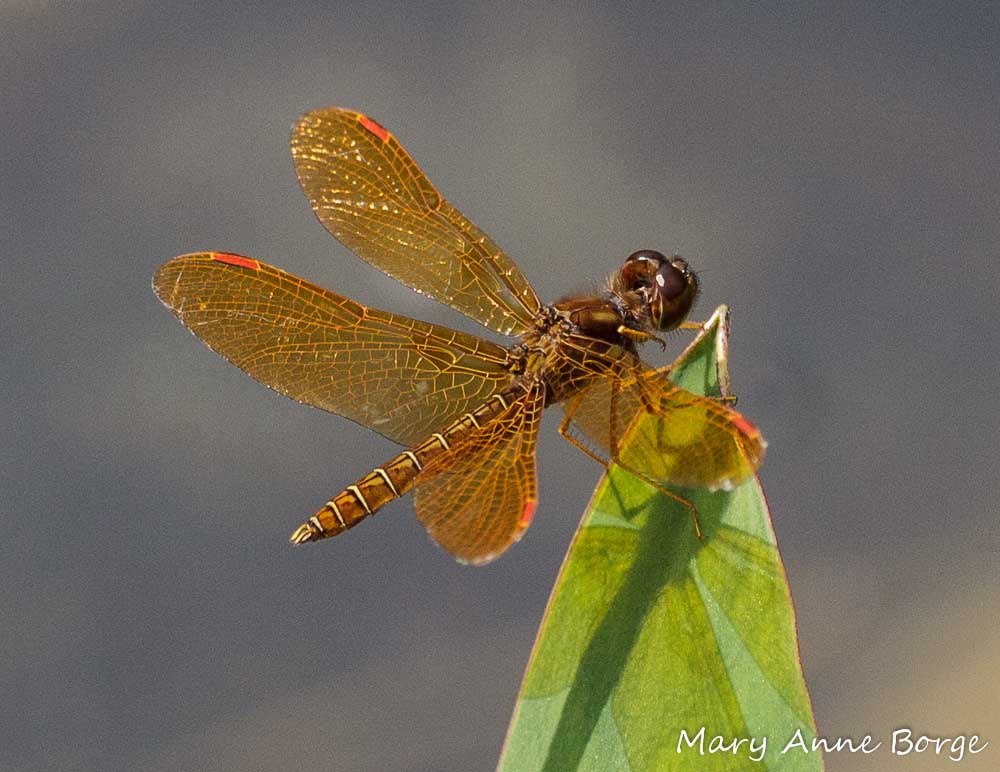
While I watched, Pickerelweed also played an important role in the courtship of a pair of Eastern Amberwings. I spotted a male first, perched a few inches above the water’s surface.

Male Eastern Amberwing, perching

Male Eastern Amberwing, perching

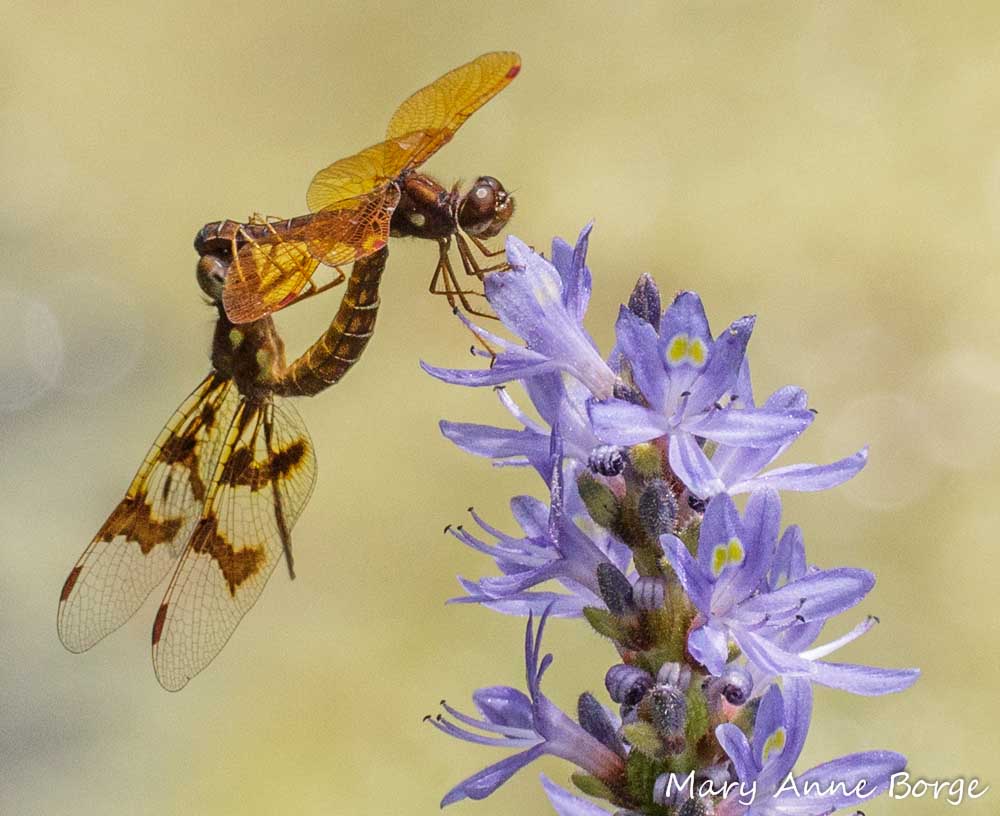
A few minutes later, I saw this pair mating at their rendezvous spot, the tip of a Pickerweed flower spike.

Eastern Amberwings Mating

Eastern Amberwings Mating

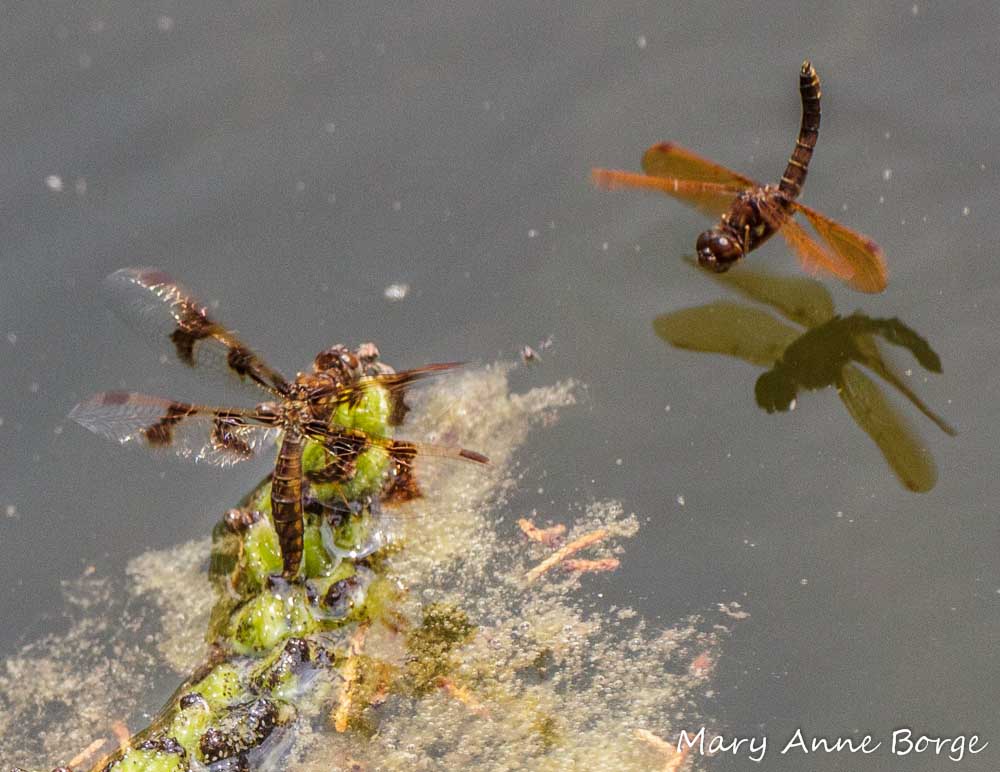
After a few seconds they parted. The male then led the female to a partially submerged cluster of Pickerelweed fruit, where she proceeded to lay eggs (oviposit), tapping the surface of the water while the male hovered nearby, preventing other males from undoing his efforts.

Female Eastern Amberwing laying  eggs (left) with male standing guard (right)

Female Eastern Amberwing laying eggs (left) with male standing guard (right)

Quite a show for such a new habitat!

The Pond at Bowman's Hill Wildflower Preserve, with photographer

The Pond at Bowman’s Hill Wildflower Preserve, with photographer

Resources

Barlow, Allen E.;  Golden, David M.;  Bangma, Jim.  Field Guide to Dragonflies and Damselflies of New Jersey.  2009.

Bugguide.net

Eastman, John.  The Book of Swamp and Bog.  1995.

Eaton, Eric R.; Kauffman, Ken.  Kaufman Field Guide to Insects of North America.  2007.

Nikula, Blair;  Loose, Jennifer L.;  Burne, Matthew R.  A Field Guide to the Dragonflies and Damselflies of Massachusetts.  2003.

Paulson, Dennis.  Dragonflies and Damselflies of the East.  2011.

Ruby-throated Hummingbirds are Back!

In late April we started to have occasional visits from Ruby-throated Hummingbirds, once every few days. Male hummers were first on the scene,

Male Ruby-throated Hummingbird

Male Ruby-throated Hummingbird

followed by visits from females about a week later. Continue reading

A Butterfly Garden that Embraces the Shade – Spring

Spring Azure nectaring on Virginia Sweetspire

Spring Azure nectaring on Virginia Sweetspire

Our townhouse has a southern exposure, with deciduous trees and the garden on the south, east and west sides, and a common wall with another home to the north. From November through early April, with the leaves off the trees we get a lot of sun, helping to keep the house warm and the heating bills low. As the leaves unfold, the house and garden is well shaded, minimizing the need for air conditioning. “Passive solar”, courtesy of nature, free for the taking. We love the trees.

In nature, different species need to spend parts of their lives at different levels of the forest, some at or below ground level, some just above it, some a few feet higher in shrubs, and others in the trees, even all the way to the tree canopy. So the strategy for our garden is to have a broad diversity of plants mimicking a small slice of deciduous woodland, with a mix of trees, shrubs, and herbaceous plants including perennials, ferns and sedges.

Having a good mix like this accommodates a wide variety of interesting residents, including butterflies, birds, bees, moths, spiders, wasps, flower flies, ants, tree crickets, katydids, and others I’m still trying to identify. A good mix of critters means that they’ll all help keep each other in balance, with no one species dominating, and no need for chemical intervention.

Bad-wing Moth with white form of Common Blue Violet

Bad-wing Moth with white form of Common Blue Violet

During the winter months we enjoy the silhouettes of the trees, shrubs and spent perennials, and the birds that visit them. In March the transition to spring begins, with buds swelling and leaves beginning to emerge from the soil. By April the first flowers appear, at multiple layers in the garden.

Before the trees unfold their leaves, among the first blossoms to appear are those of Red Maple, Northern Spicebush, and Golden Ragwort. Although Mourning Cloaks generally prefer sap, I have actually seen them nectaring on Red Maple flowers. Spring Azures are pretty eclectic in their beverage tastes, even sipping from the starburst yellow flowers of Spicebush.

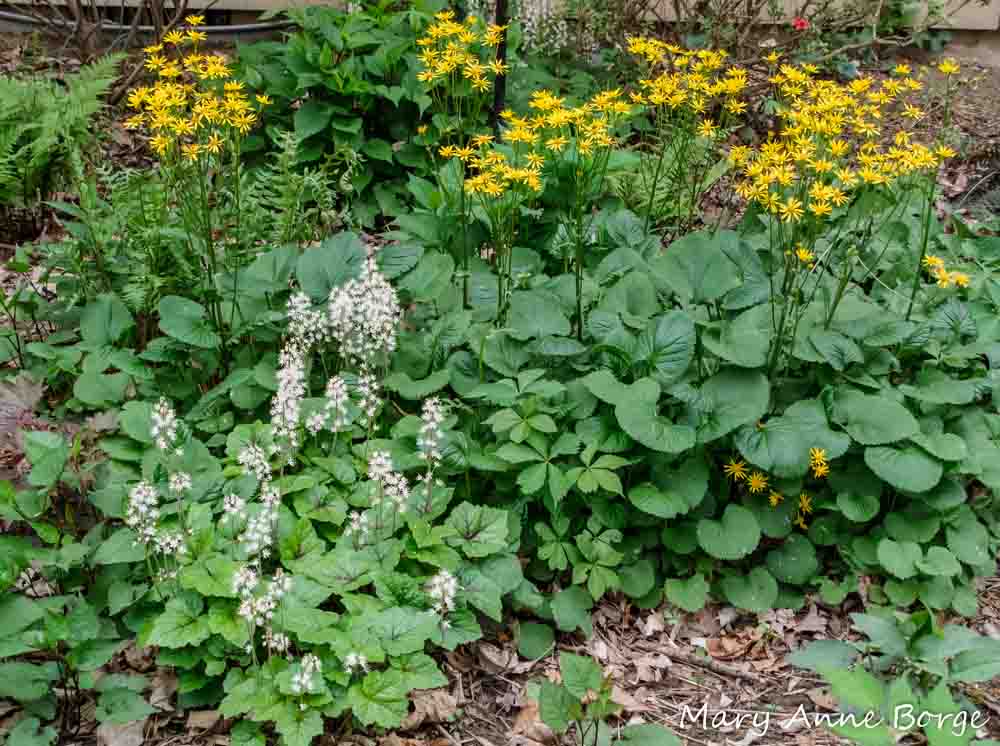
Heartleaf Foamflower, Green and Gold, Creeping Phlox and Canadian Wildginger quickly join the mix, while Virginia Creeper leaves begin to unfurl, adding to the ground cover.

Spring Garden - Foamflower, Golden Ragwort, Virginia Creeper, Christmas Fern

Spring Garden – Foamflower, Golden Ragwort, Virginia Creeper, Christmas Fern

As the days warm in April, violets begin to bloom. We have three well-established species: a white form of Common Blue Violet, the purple Schrank Alpine Violet, and Striped Cream Violet. They are spreading with the aid of ants, who eat the tasty elaiosome attached to violet seeds and then discard the seeds, effectively planting them. Last year a friend gave us a species with interesting lobed leaves, Early Blue Violet. All are available for fritillaries to lay their eggs nearby in late summer so their caterpillars, after spending the winter in leaf litter, can feed on them as both begin to grow in spring.

By late April or early May, Golden Zizia, Spotted Geranium, and Greek Valerian are all in bloom. Black Swallowtails may use Golden Zizia as caterpillar food plants, although they are also very willing to use the parsley and dill we grow in pots on the kitchen patio.

Spring Azure nectaring on Spotted (or Wild)Geranium

Spring Azure nectaring on Spotted (or Wild)Geranium

May brings blossoms at all levels of our woodland garden. Tuliptrees flower as high as their canopy, attracting bees with their copious nectar. Flowering Dogwood’s white bracts and Blackhaw Viburnum’s large round clusters of tiny white flowers light up the understory.

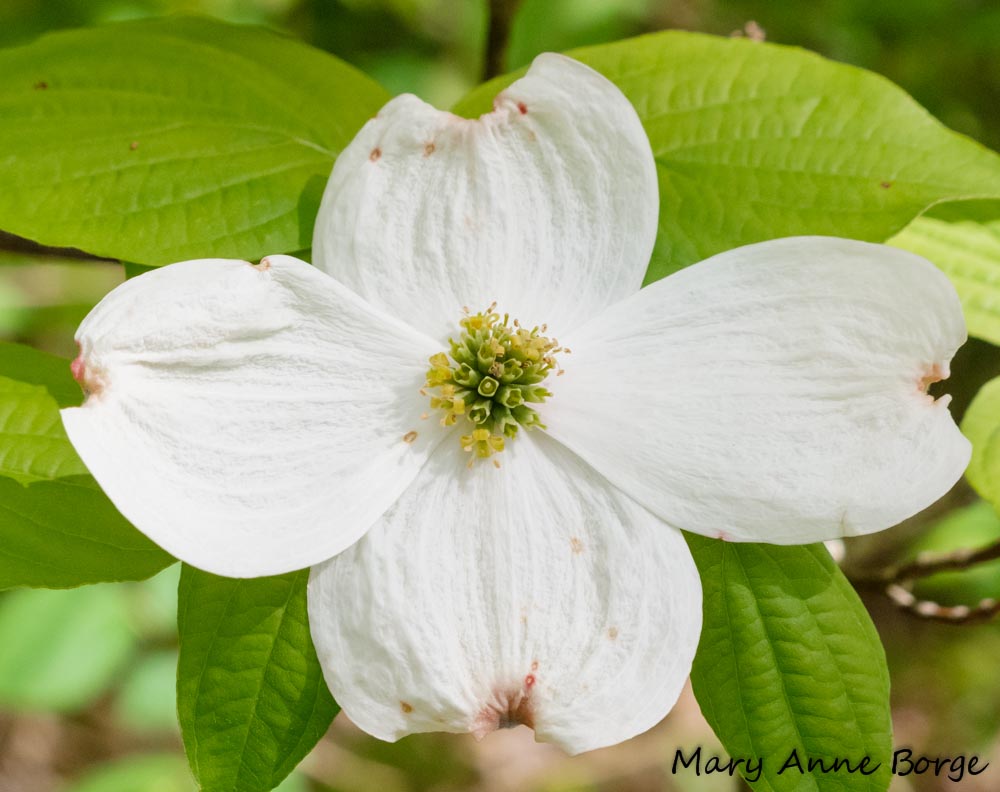
Flowering Dogwood

Flowering Dogwood

The shrub layer is graced with Gray Dogwood, Mountain Laurel, and Virginia Sweetspire. Many Azure butterflies favor dogwood and viburnum flower buds as caterpillar food sources, and will lay their eggs there. Ants protect Azure caterpillars from predators in exchange for the sweet honeydew they excrete.

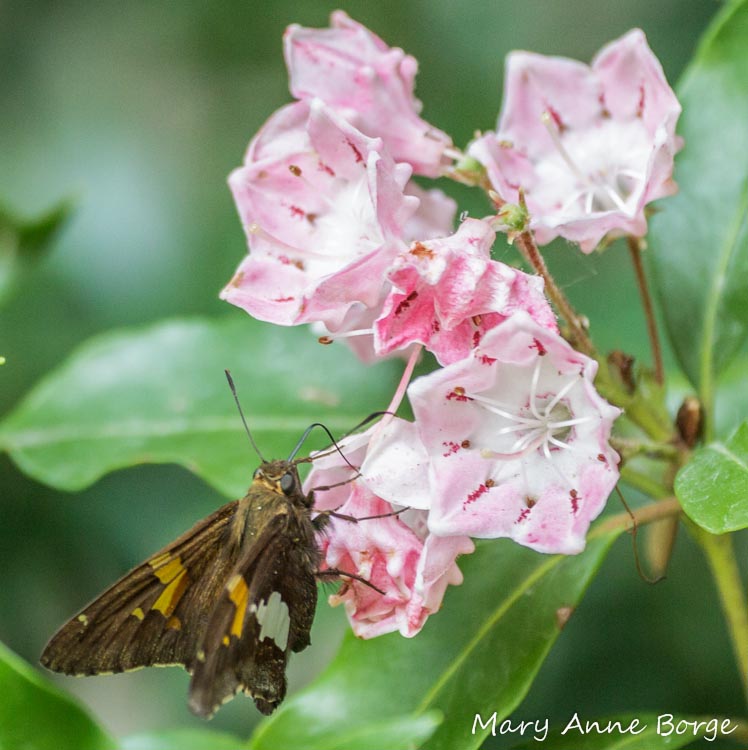
Silver-spotted Skipper nectaring on Mountain Laurel

Silver-spotted Skipper nectaring on Mountain Laurel

Leaves of White Baneberry (a.k.a. Doll’s Eyes) and Common Ladyfern, Marginal Woodfern, Christmas and Northern Maidenhair Ferns are now available for perching or basking platforms. The male Zabulon Skipper pictured here is working to attract a mate.

Zabulon Skipper posing for a prospective mate

Zabulon Skipper posing for a prospective mate

While I watched him, when another butterfly flew by, regardless of species – Red Admirals, anglewings or swallowtails – he chased them away. With mission accomplished, he returned to a horizontal perching platform provided by White Baneberry leaves or the tips of a Christmas Fern frond, both along the edge of the moss path that curves through the garden. They offer the perfect elevation and exposure for the skipper to show himself off to prospective mates.

The secret is to choose plants that are naturally adapted to a woodland environment. They’ll be happy with the soil, moisture, and available light with minimal intervention from you, and no chemical fertilizers. Most of these perennials bloom for about 6-8 weeks, although Green and Gold may bloom throughout the summer if you deadhead. The shrubs usually flower for 2-3 weeks. After a warm winter, blooming may begin weeks earlier than usual. This past January I saw Golden Alexander in bud – a little scary!

So there is plenty of interest in the garden in spring. But what will bloom in the shade of summer and fall? And what butterflies will visit? Stay tuned!

See below for a list of scientific names for the plants featured in this post:

Red Maple (Acer rubrum)
Northern Spicebush (Lindera benzoin)
Golden Ragwort (Packera aurea)
Heartleaf Foamflower (Tiarella cordifolia)
Creeping Phlox (Phlox stolonifera)
Green and Gold (Chrysogonum virginianum)
Canadian Wildginger, Wild Ginger (Asarum canadense)
Common Blue Violet (Viola sororia)
Schrank Alpine Violet, Labrador Violet, American Dog Violet (Viola labradorica)
Striped Cream Violet (Viola striata)
Early Blue Violet (Viola palmata)
Golden Zizia (Zizia aurea)
Spotted Geranium (Geranium maculatum)
Greek Valerian (Polemonium reptans)
Tuliptree (Liriodendron tulipifera)
Flowering Dogwood (Cornus florida)
Blackhaw (Viburnum prunifolium)
Gray Dogwood (Cornus racemosa)
Mountain Laurel (Kalmia latifolia)
Virginia Sweetspire (Itea virginica)
White Baneberry, Doll’s Eyes (Actaea pachypoda)
Common Ladyfern (Athyrium filix-femina)
Christmas Fern (Polystichum acrostichoides)
Marginal Woodfern (Dryopteris marginalis)
Northern Maidenhair Fern (Adiantum pedatum)

Note:  This is part 2 of a 3 part series.  To see part 1, click here: A Butterfly Garden that Embraces the Shade.  For Part 3, click here:  Embracing the Shade:  Summer and Fall

This article was also published in the Spring 2013 issue of Butterfly Gardener, a publication of the North American Butterfly Association.