Bowman’s Hill Wildflower Preserve – Visitors at the Pond

Plants are still filling in at the new pond at Bowman’s Hill Wildflower Preserve, but already the habitat is hospitable enough to tempt a variety of visitors.
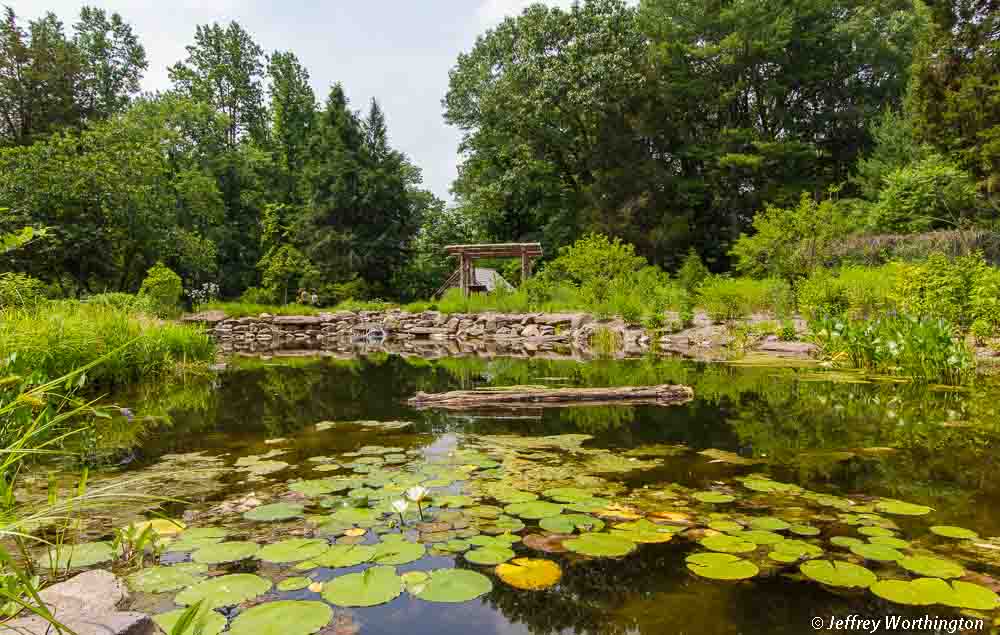
New Pond at Bowman's Hill Wildflower Preserve

New Pond at Bowman’s Hill Wildflower Preserve

As you approach the pond’s edge, insect-sized American Toads (Bufo americanus) leap for shelter, escaping certain death from being squashed by a foot. They hide in the grasses, mulch, or under a plant leaf, hoping to remain unseen and unharmed. Compare the young American Toad with the clover leaves in this photo to get a sense of this tiny amphibian’s size.
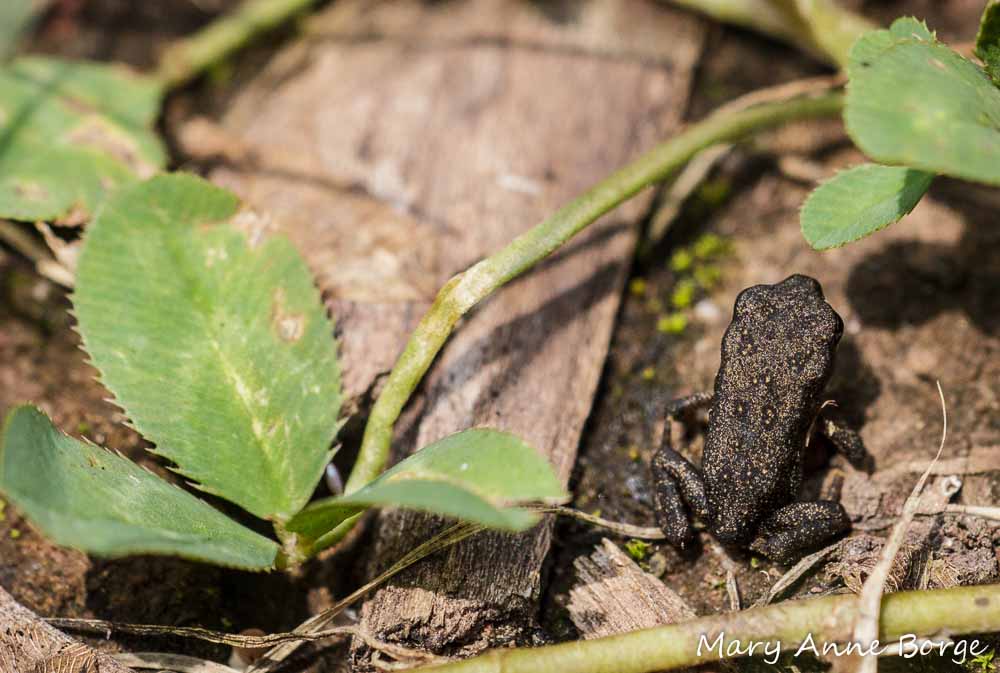
American Toad

American Toad

Another not-fully-grown visitor along the pond’s edge is this pre-historic-looking Marbled Grasshopper (Spharagemon marmorata) nymph.

Marbled Grasshopper Nymph (Spharagemon marmorata)

Marbled Grasshopper Nymph (Spharagemon marmorata)

The flowers blooming near the pond’s edge are an attraction for many interesting animals.

Elderberry (Sambucus canadensis) flowers don’t produce a lot of nectar, but they attract insects that feed on their pollen, like the wasp-mimicking Toxomerus marginatus feeding here. This fly species doesn’t have a common name other than Flower Fly or Hover Fly, terms used to describe species of the Syrphid (Syrphidae) family because they make their living feeding on and pollinating flowers, and many are able to hover continuously for long periods. Members of this insect family evolved to look like bees or wasps, since this threatening disguise helps them to avoid predators. They feed on nectar or pollen, but their visits to the Elderberry flowers for food for themselves will also result in pollination, producing dark blue fruit later in the season.
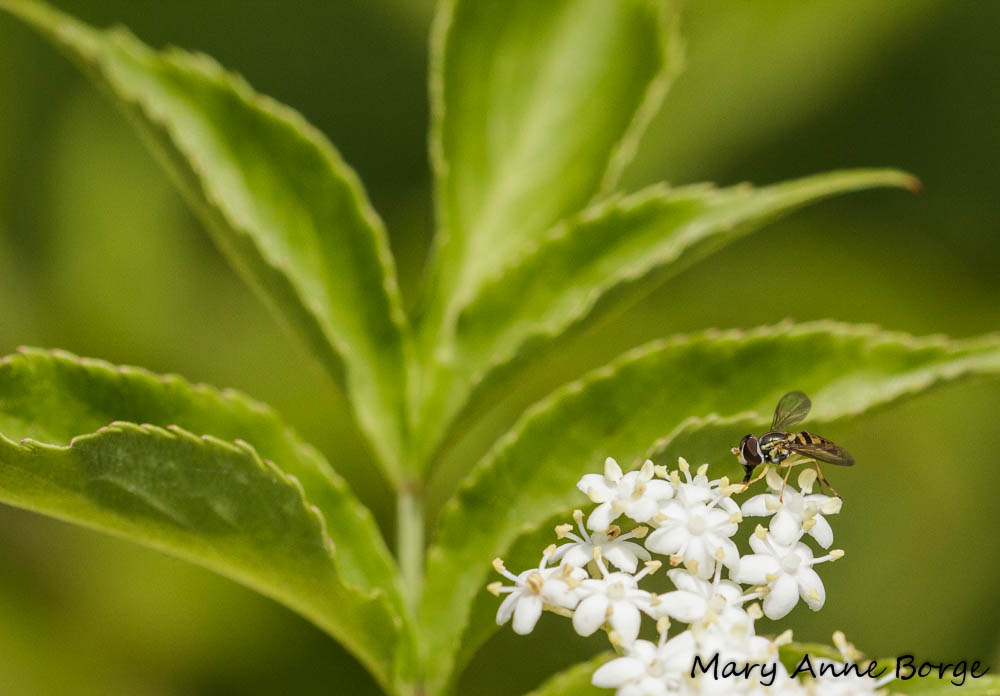
Hover or Flower Fly (Toxomerus marginatus)
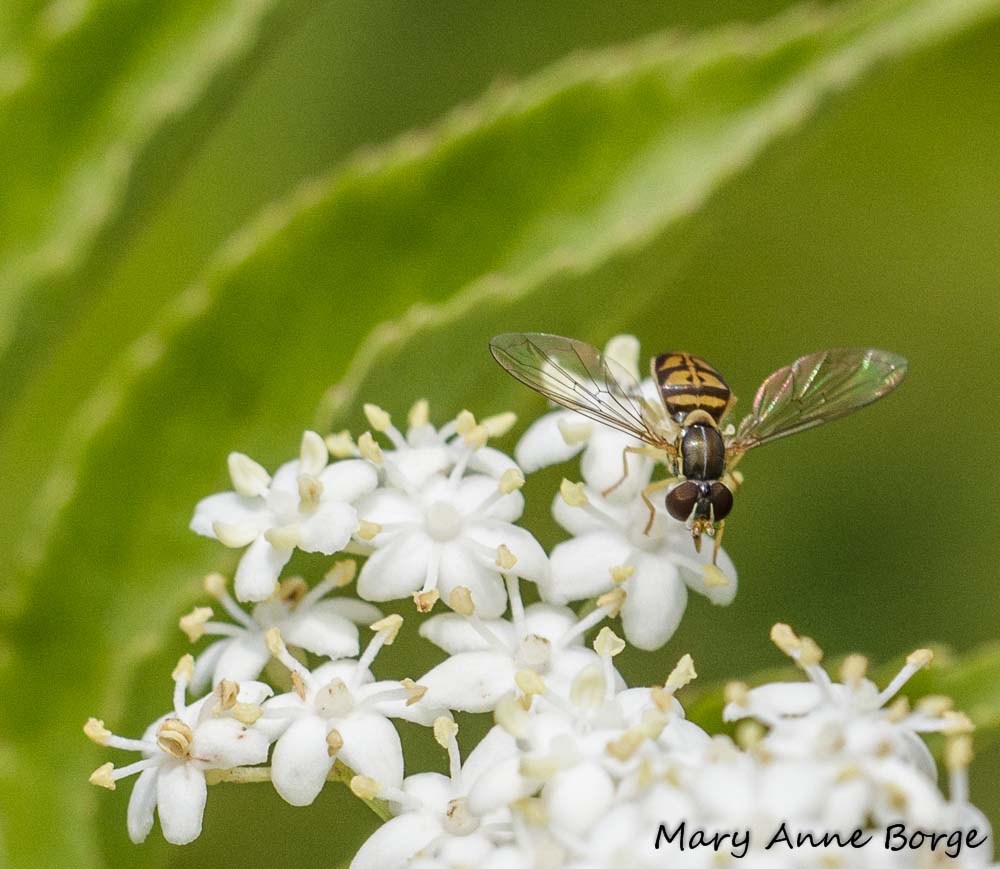
Hover or Flower Fly (Toxomerus marginatus)

Hover or Flower Fly (Toxomerus marginatus)

Hover or Flower Fly (Toxomerus marginatus)

An aquatic plant, Pickerelweed’s (Pontederia cordata) bright spikes of purple flowers are primarily pollinated by Bumble Bee species,
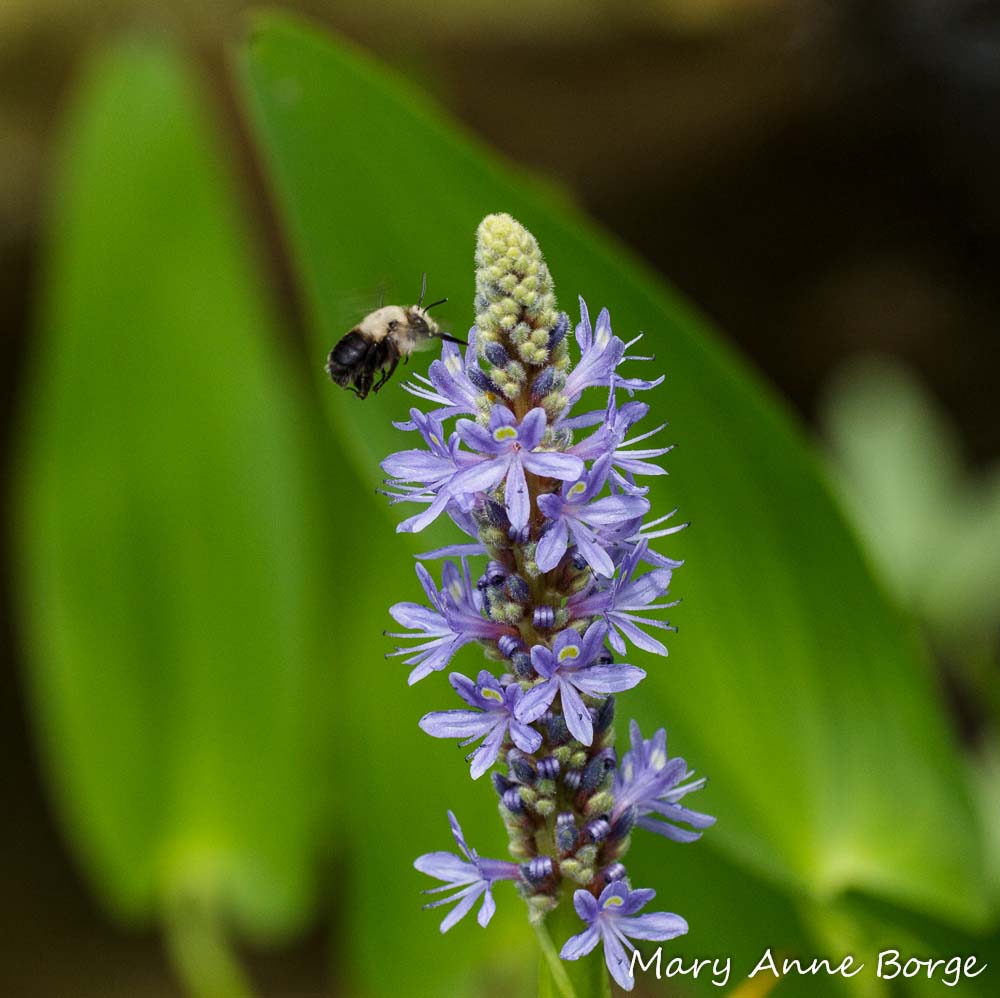
Pickerelweed with Bumble Bee

Pickerelweed with Bumble Bee

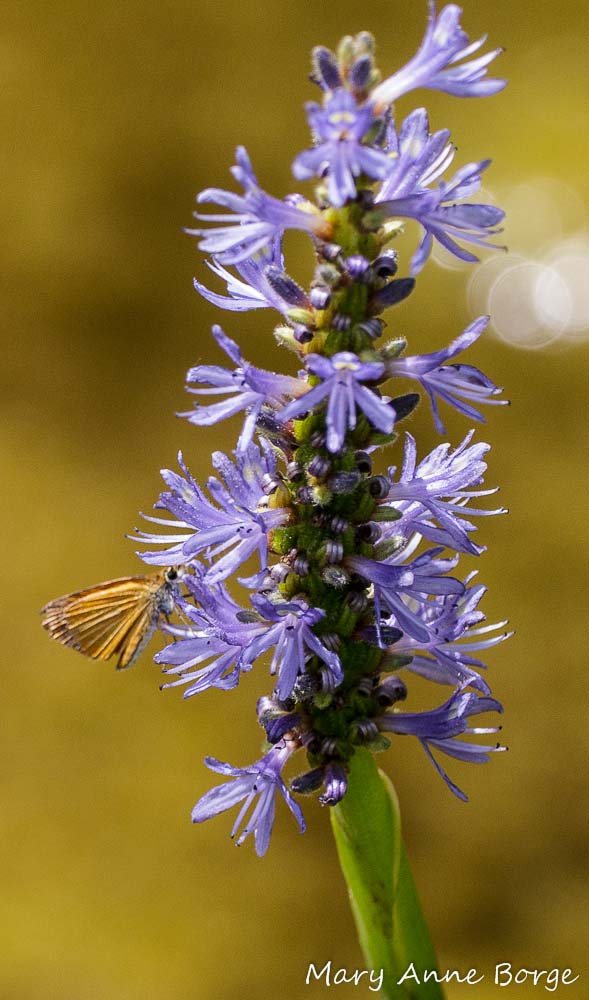
but they have many other visitors. Butterflies also enjoy their nectar, although their anatomy and feeding techniques are much less likely to result in pollination.
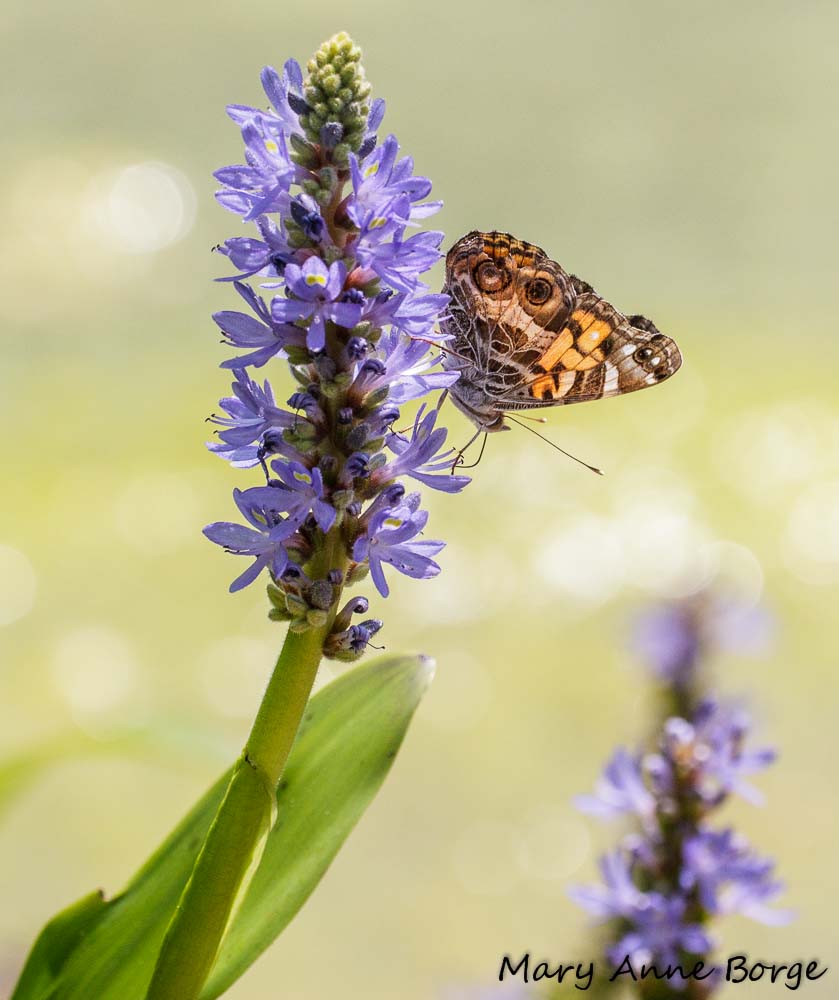
American Lady on Pickerelweed
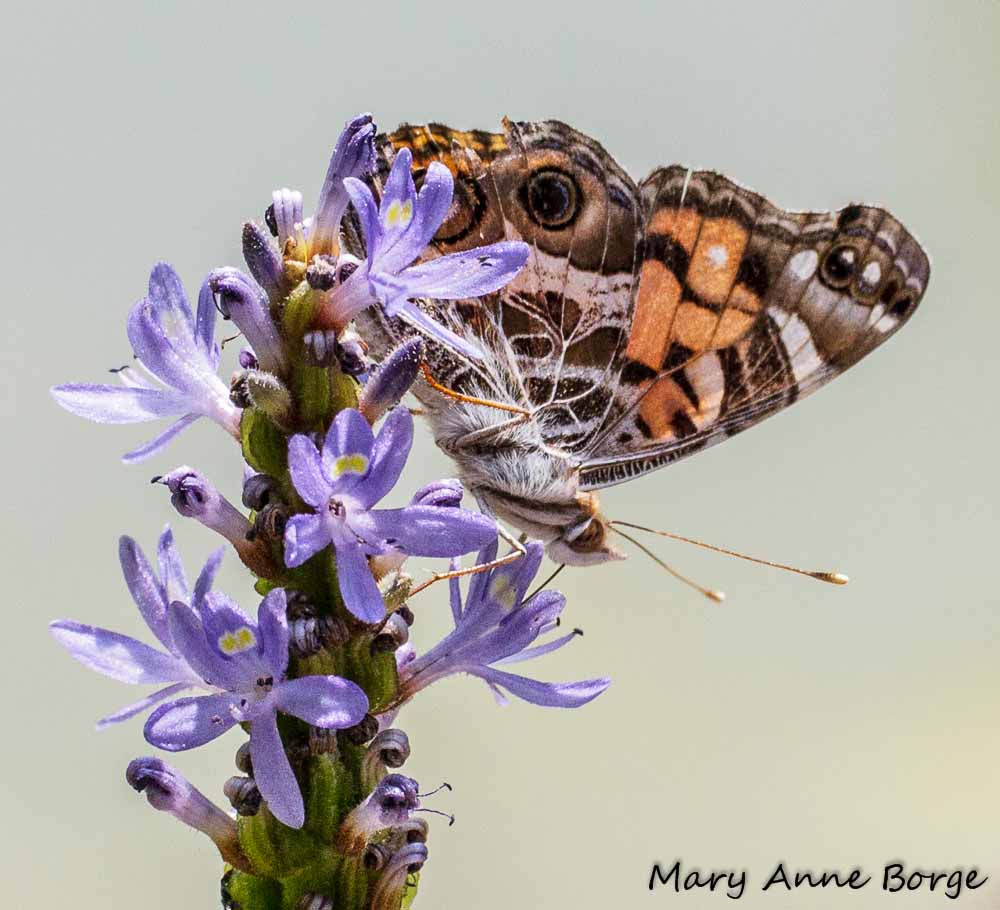
American Lady on Pickerelweed
American Lady on Pickerelweed

American Lady on Pickerelweed

Least Skipper on Pickerelweed

Least Skipper on Pickerelweed

The airspace over the pond sees heavy air traffic from dragonflies and damselflies, constantly darting back and forth, feeding on other insects while both are in flight, and cruising for mates. What amazing flight navigation precision! Some females can be seen repeatedly touching the surface of the pond with the tip of their abdomen (the long slender body part that might look like a tail). This is how some dragonfly species lay their eggs.

The best chance to get a close look at these busy creatures is when they pause for a break on leaves, grasses or other plant matter or surfaces, while watching for potential mates or meals. Photography helps to enable a careful enough study to tell them apart.

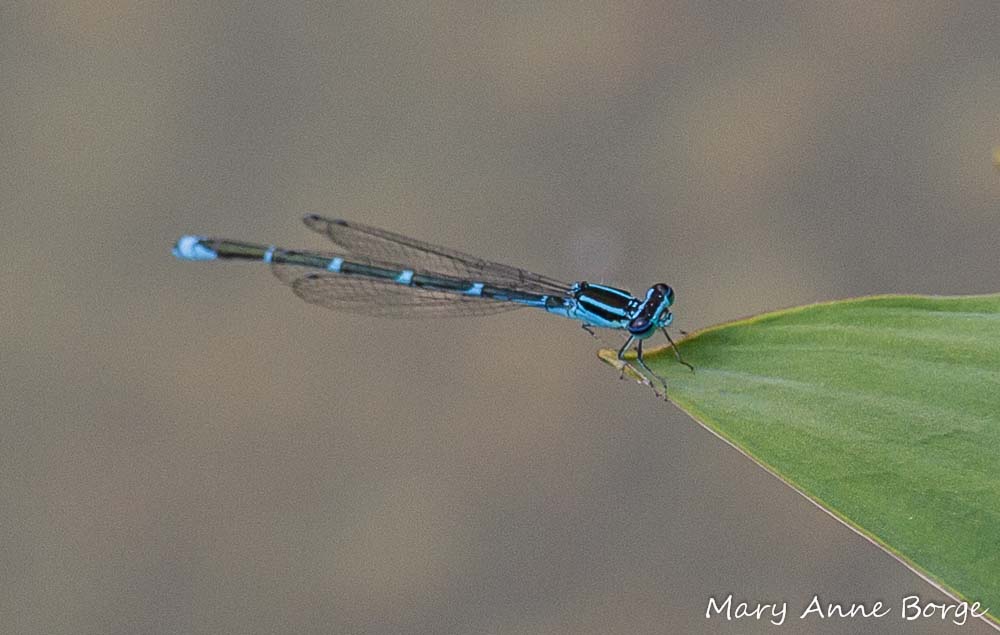
Damselflies characteristically hold their wings folded together above their body, or only slightly apart. They are usually small with slender abdomens, a wide head and big eyes. Two species of Bluets were present on a recent visit, an Azure Bluet,
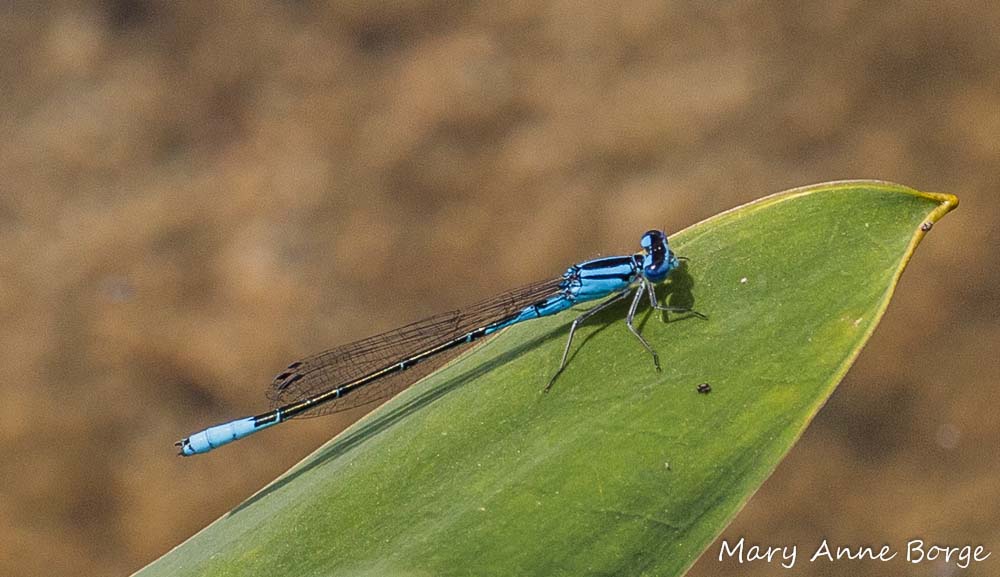
Azure Bluet

Azure Bluet

and a Stream Bluet.

Stream Bluet

Stream Bluet

Can you tell them apart? Look closely at the tips of their abdomens and count the number of segments that are blue, and check the width of the black and blue stripes on their thoraxes (the middle section of the insect, to which the wings are attached). Can you see any differences between the two damselflies in these characteristics or others?

Dragonflies generally hold their wings open, often perpendicular to their bodies, but at other angles, too. They are larger than damselflies and have stouter bodies, although different species vary quite a bit in size.

The dragonfly below is a Lancet Clubtail, resting on a clover leaf and some grasses. He’s missing a wing, probably the result of a recent encounter with an unsuccessful predator, possibly a bird, a frog, a spider, or another insect – even another dragonfly may have attempted to make him a meal.
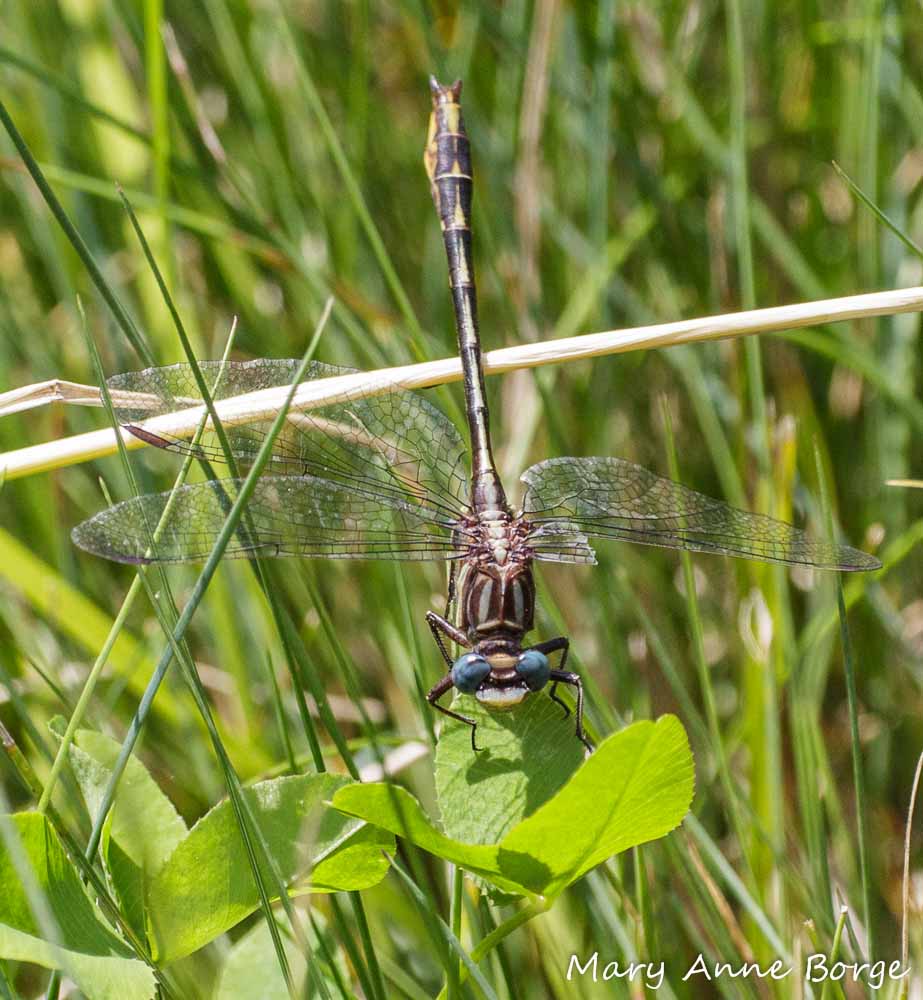
Lancet Clubtail
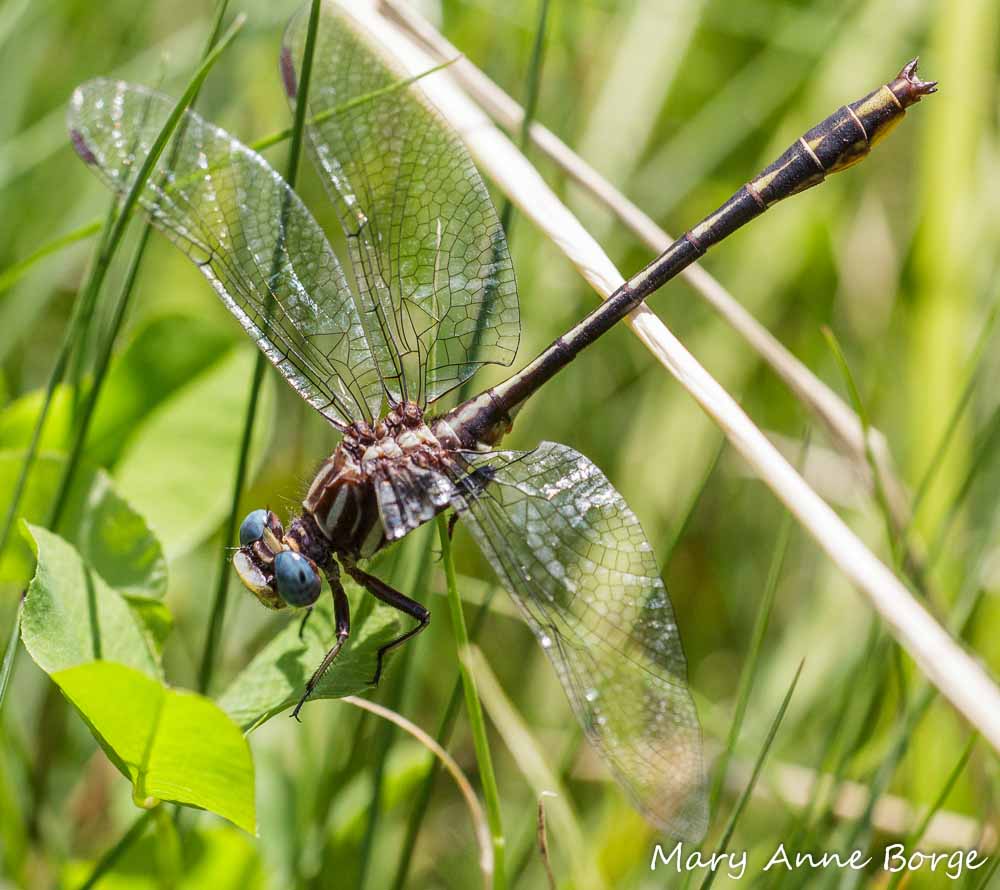
Lancet Clubtail

Lancet Clubtail

Lancet Clubtail

Eastern Pondhawks, like the male pictured here, are among the dragonflies that are voracious predators of other dragonflies.
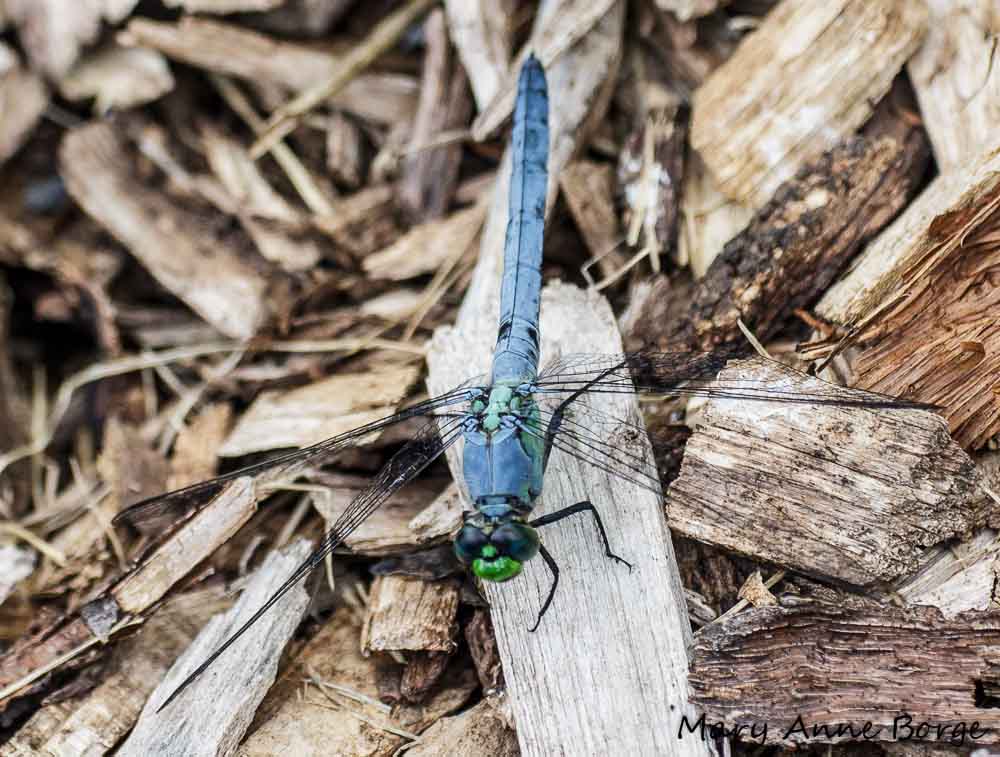
Eastern Pondhawk

Eastern Pondhawk

Male Blue Dashers spend a lot of time perching on vegetation, looking for a meal or a mating opportunity.
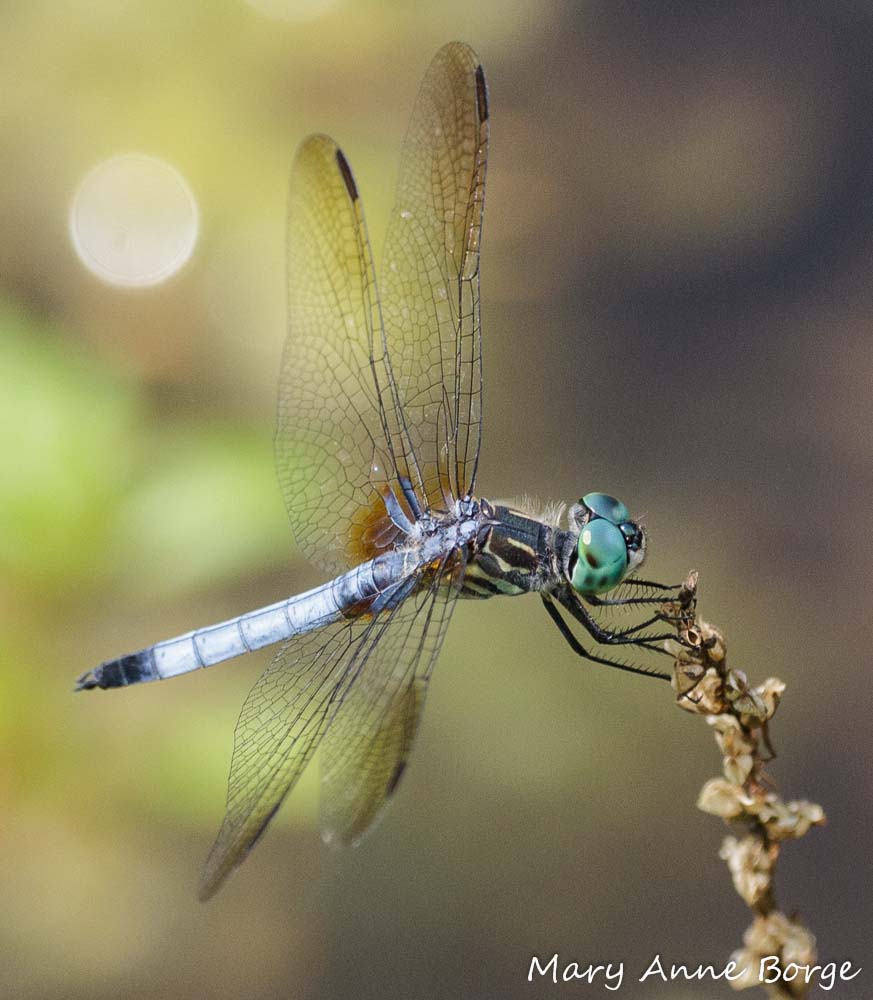
Blue Dasher

Blue Dasher

A male Widow Skimmer showed a preference for a Golden Alexanders flower stem as his perch, returning to it after each flight,
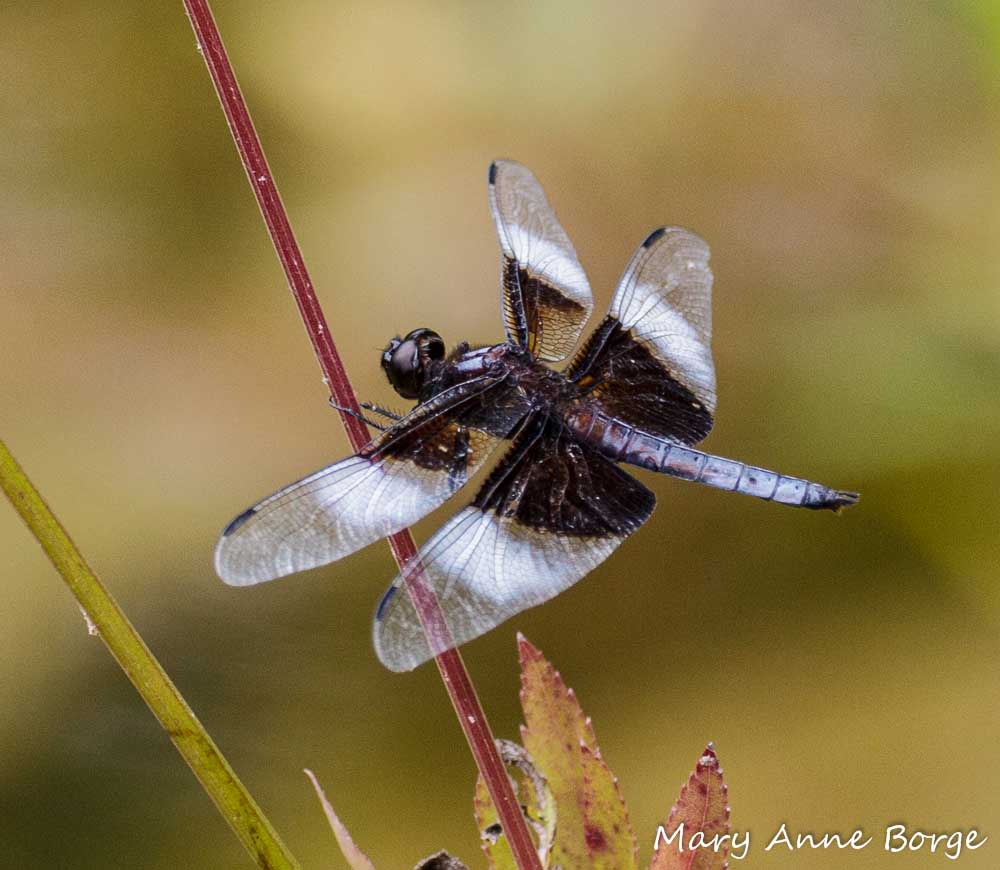
Widow Skimmer

Widow Skimmer

While Pickerelweed provided a favorite perch for this male Twelve-spotted Skimmer.
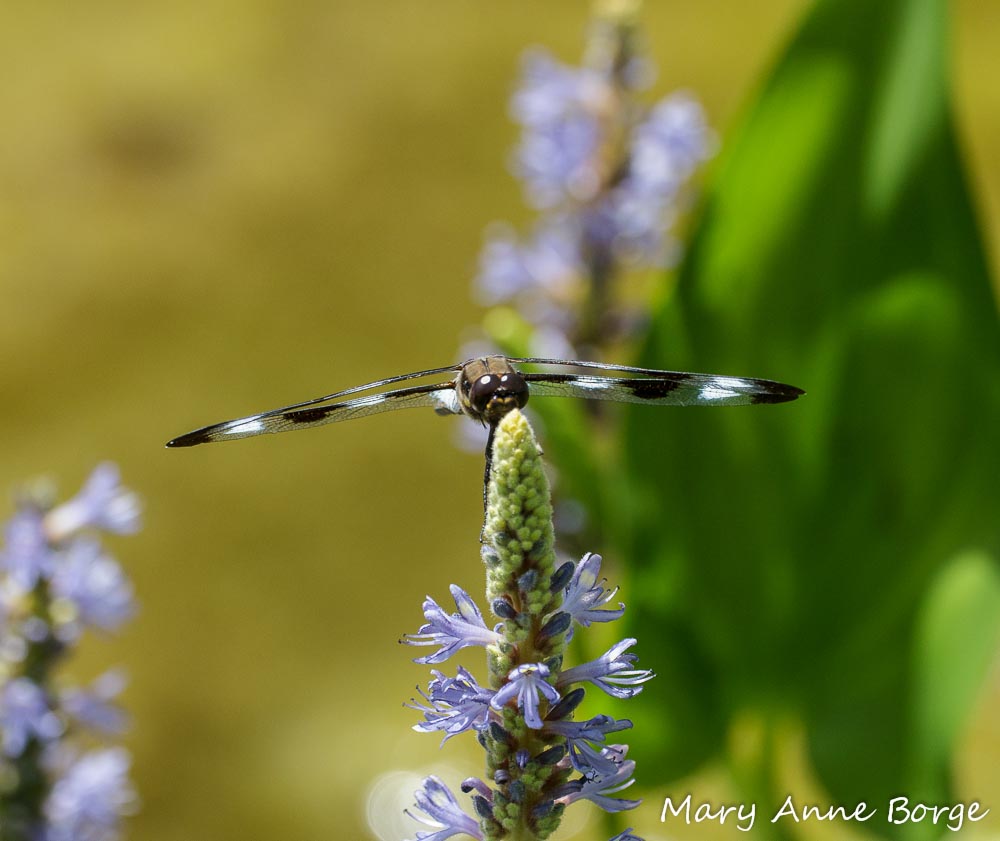
Twelve-spotted Skimmer on Pickerelweed
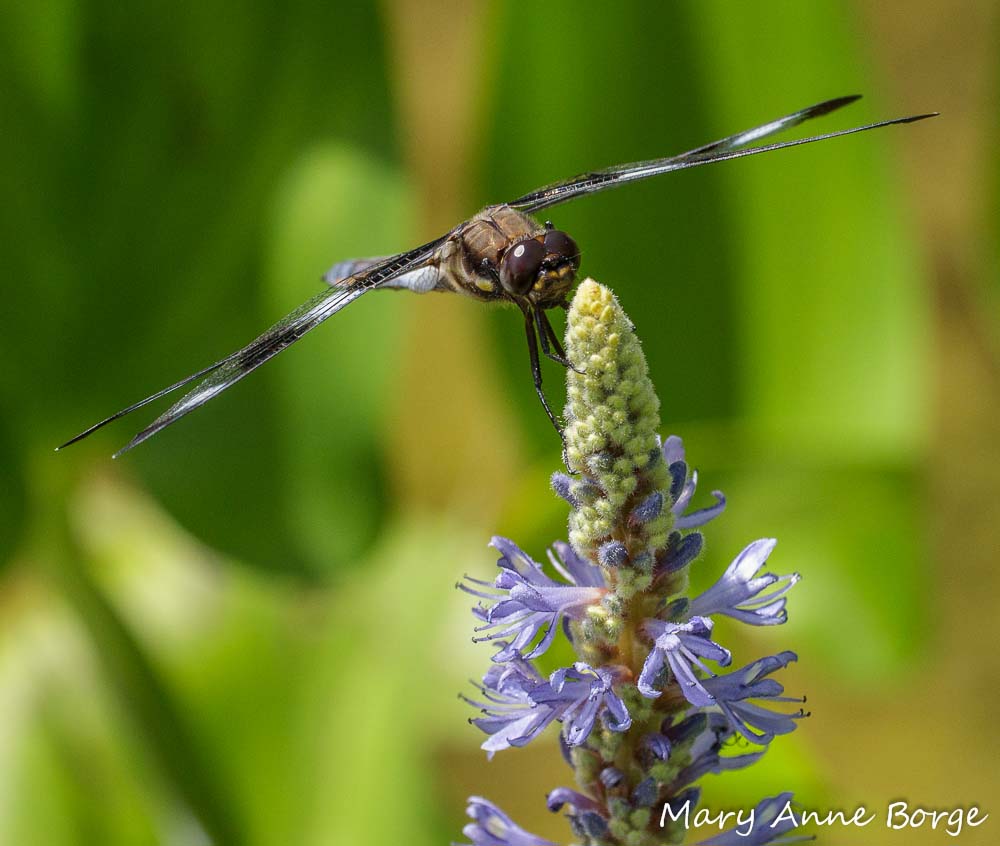
Twelve-spotted Skimmer on Pickerelweed

Twelve-spotted Skimmer on Pickerelweed

Twelve-spotted Skimmer on Pickerelweed

While I watched, Pickerelweed also played an important role in the courtship of a pair of Eastern Amberwings. I spotted a male first, perched a few inches above the water’s surface.
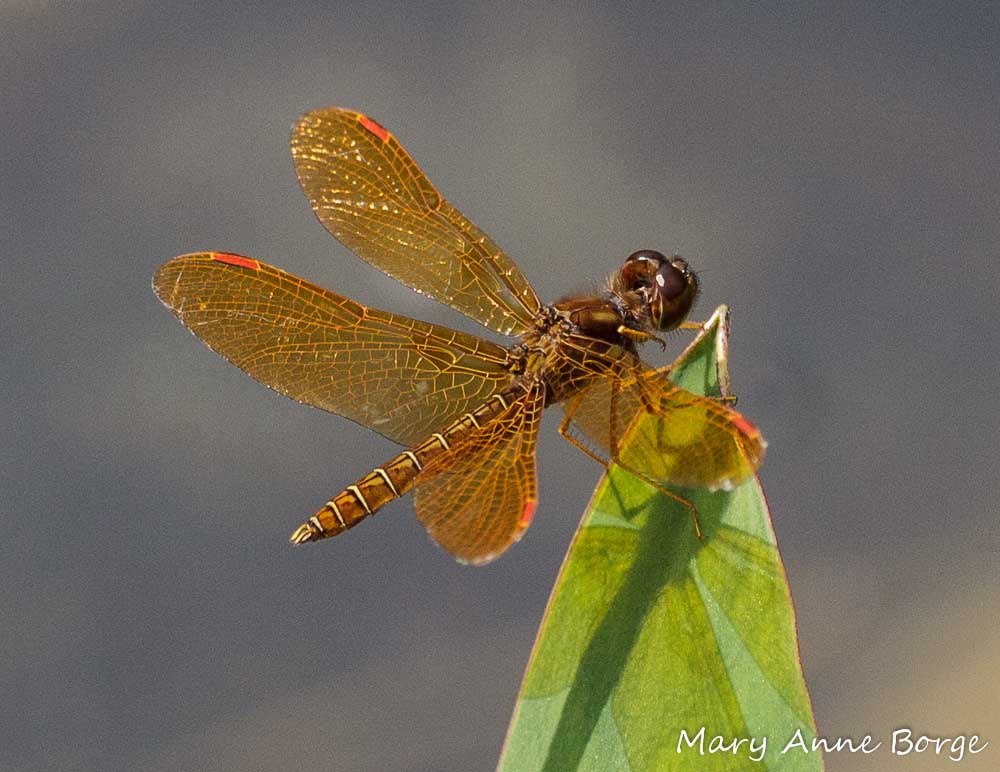
Male Eastern Amberwing, perching

Male Eastern Amberwing, perching

A few minutes later, I saw this pair mating at their rendezvous spot, the tip of a Pickerweed flower spike.
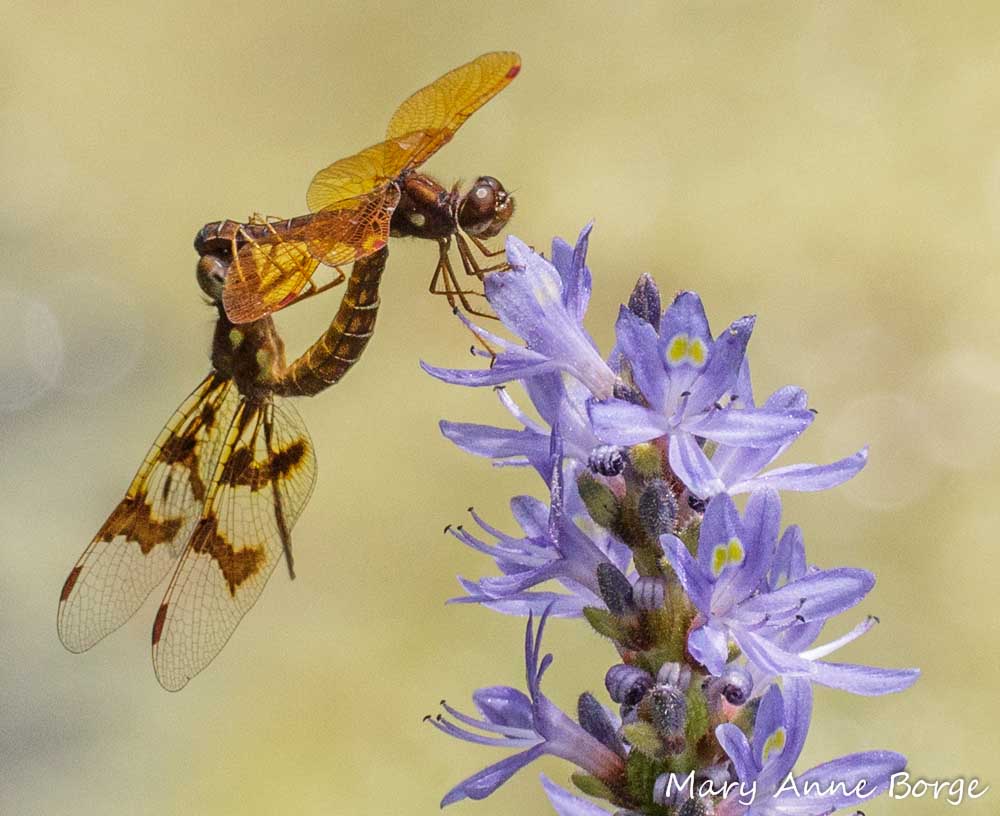
Eastern Amberwings Mating

Eastern Amberwings Mating

After a few seconds they parted. The male then led the female to a partially submerged cluster of Pickerelweed fruit, where she proceeded to lay eggs (oviposit), tapping the surface of the water while the male hovered nearby, preventing other males from undoing his efforts.
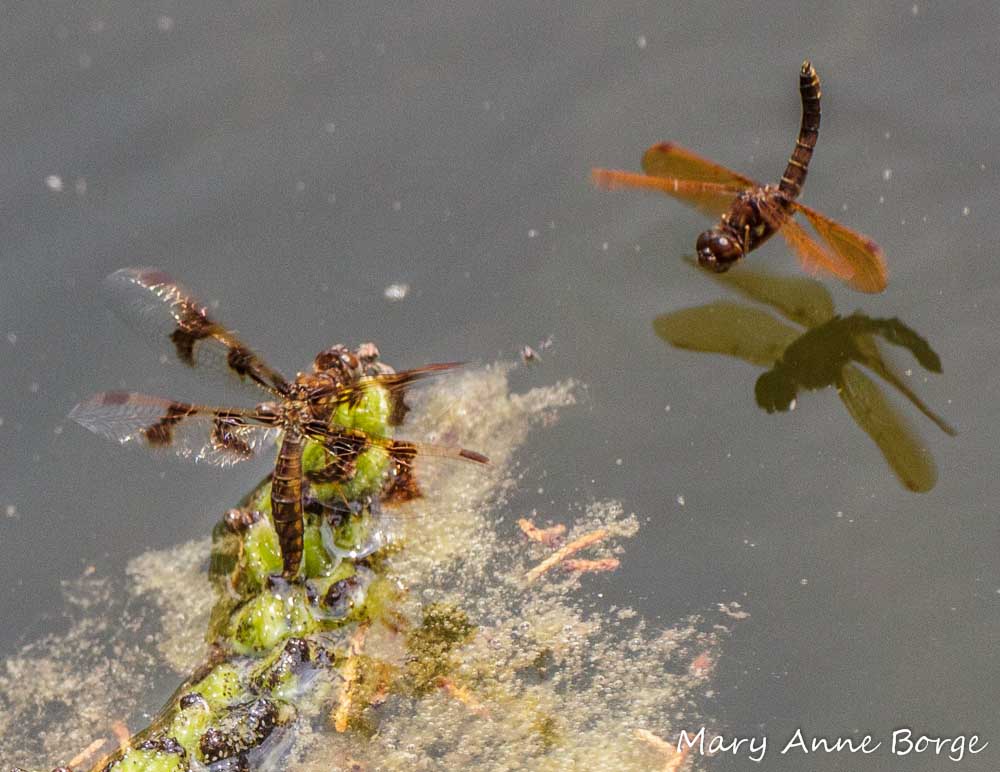
Female Eastern Amberwing laying  eggs (left) with male standing guard (right)

Female Eastern Amberwing laying eggs (left) with male standing guard (right)

Quite a show for such a new habitat!
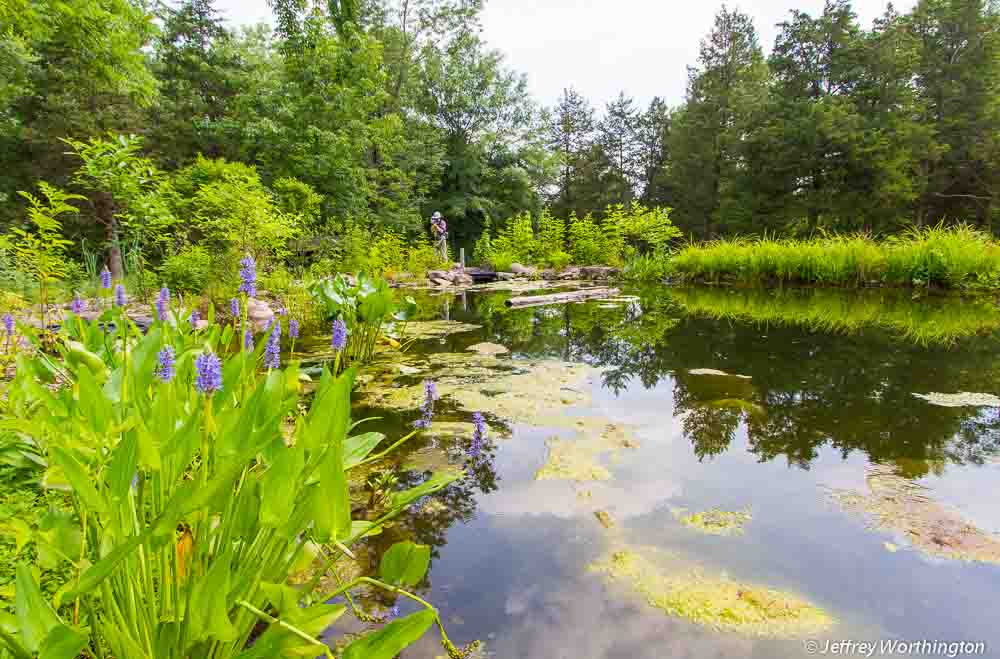
The Pond at Bowman's Hill Wildflower Preserve, with photographer

The Pond at Bowman’s Hill Wildflower Preserve, with photographer

Resources

Barlow, Allen E.;  Golden, David M.;  Bangma, Jim.  Field Guide to Dragonflies and Damselflies of New Jersey.  2009.

Bugguide.net

Eastman, John.  The Book of Swamp and Bog.  1995.

Eaton, Eric R.; Kauffman, Ken.  Kaufman Field Guide to Insects of North America.  2007.

Nikula, Blair;  Loose, Jennifer L.;  Burne, Matthew R.  A Field Guide to the Dragonflies and Damselflies of Massachusetts.  2003.

Paulson, Dennis.  Dragonflies and Damselflies of the East.  2011.

Ruby-throated Hummingbirds are Back!

In late April we started to have occasional visits from Ruby-throated Hummingbirds, once every few days. Male hummers were first on the scene,

Male Ruby-throated Hummingbird

Male Ruby-throated Hummingbird

followed by visits from females about a week later. Continue reading

A Butterfly Garden that Embraces the Shade – Spring

Spring Azure nectaring on Virginia Sweetspire

Spring Azure nectaring on Virginia Sweetspire

Our townhouse has a southern exposure, with deciduous trees and the garden on the south, east and west sides, and a common wall with another home to the north. From November through early April, with the leaves off the trees we get a lot of sun, helping to keep the house warm and the heating bills low. As the leaves unfold, the house and garden is well shaded, minimizing the need for air conditioning. “Passive solar”, courtesy of nature, free for the taking. We love the trees.

In nature, different species need to spend parts of their lives at different levels of the forest, some at or below ground level, some just above it, some a few feet higher in shrubs, and others in the trees, even all the way to the tree canopy. So the strategy for our garden is to have a broad diversity of plants mimicking a small slice of deciduous woodland, with a mix of trees, shrubs, and herbaceous plants including perennials, ferns and sedges.

Having a good mix like this accommodates a wide variety of interesting residents, including butterflies, birds, bees, moths, spiders, wasps, flower flies, ants, tree crickets, katydids, and others I’m still trying to identify. A good mix of critters means that they’ll all help keep each other in balance, with no one species dominating, and no need for chemical intervention.

Bad-wing Moth with white form of Common Blue Violet

Bad-wing Moth with white form of Common Blue Violet

During the winter months we enjoy the silhouettes of the trees, shrubs and spent perennials, and the birds that visit them. In March the transition to spring begins, with buds swelling and leaves beginning to emerge from the soil. By April the first flowers appear, at multiple layers in the garden.

Before the trees unfold their leaves, among the first blossoms to appear are those of Red Maple, Northern Spicebush, and Golden Ragwort. Although Mourning Cloaks generally prefer sap, I have actually seen them nectaring on Red Maple flowers. Spring Azures are pretty eclectic in their beverage tastes, even sipping from the starburst yellow flowers of Spicebush.

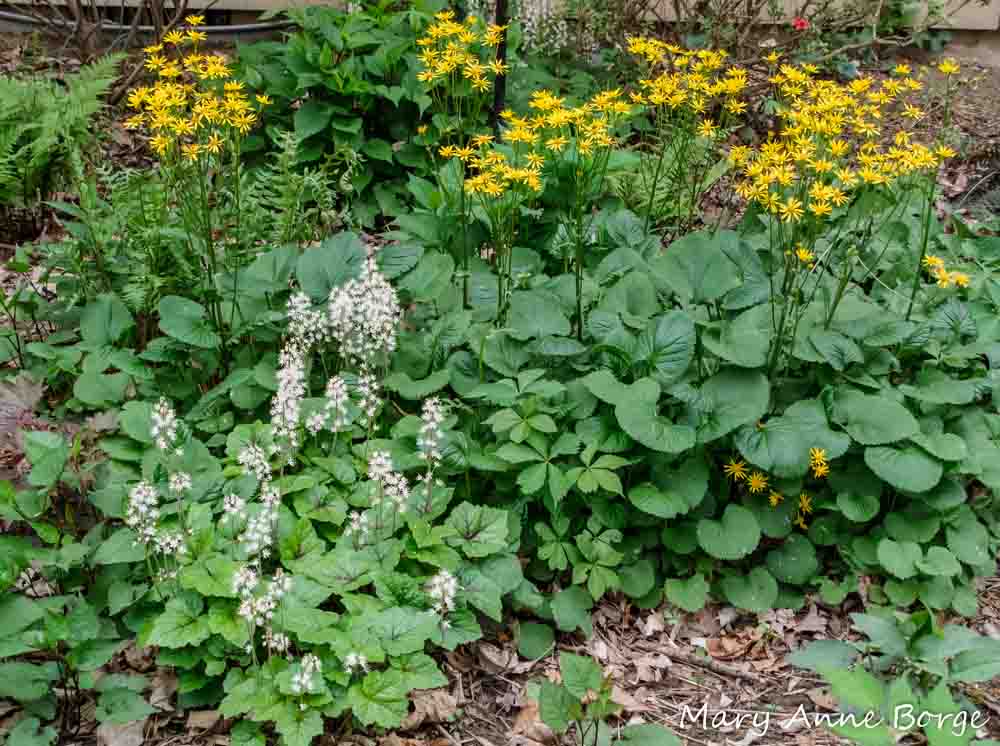
Heartleaf Foamflower, Green and Gold, Creeping Phlox and Canadian Wildginger quickly join the mix, while Virginia Creeper leaves begin to unfurl, adding to the ground cover.

Spring Garden - Foamflower, Golden Ragwort, Virginia Creeper, Christmas Fern

Spring Garden – Foamflower, Golden Ragwort, Virginia Creeper, Christmas Fern

As the days warm in April, violets begin to bloom. We have three well-established species: a white form of Common Blue Violet, the purple Schrank Alpine Violet, and Striped Cream Violet. They are spreading with the aid of ants, who eat the tasty elaiosome attached to violet seeds and then discard the seeds, effectively planting them. Last year a friend gave us a species with interesting lobed leaves, Early Blue Violet. All are available for fritillaries to lay their eggs nearby in late summer so their caterpillars, after spending the winter in leaf litter, can feed on them as both begin to grow in spring.

By late April or early May, Golden Zizia, Spotted Geranium, and Greek Valerian are all in bloom. Black Swallowtails may use Golden Zizia as caterpillar food plants, although they are also very willing to use the parsley and dill we grow in pots on the kitchen patio.

Spring Azure nectaring on Spotted (or Wild)Geranium

Spring Azure nectaring on Spotted (or Wild)Geranium

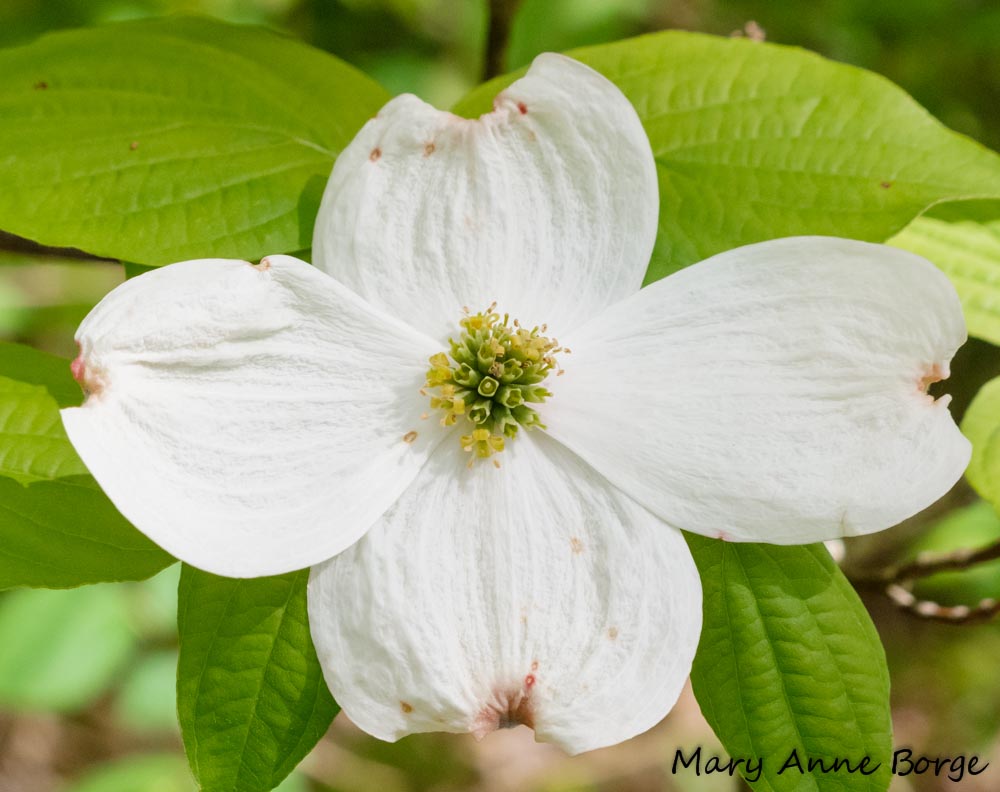
May brings blossoms at all levels of our woodland garden. Tuliptrees flower as high as their canopy, attracting bees with their copious nectar. Flowering Dogwood’s white bracts and Blackhaw Viburnum’s large round clusters of tiny white flowers light up the understory.

Flowering Dogwood

Flowering Dogwood

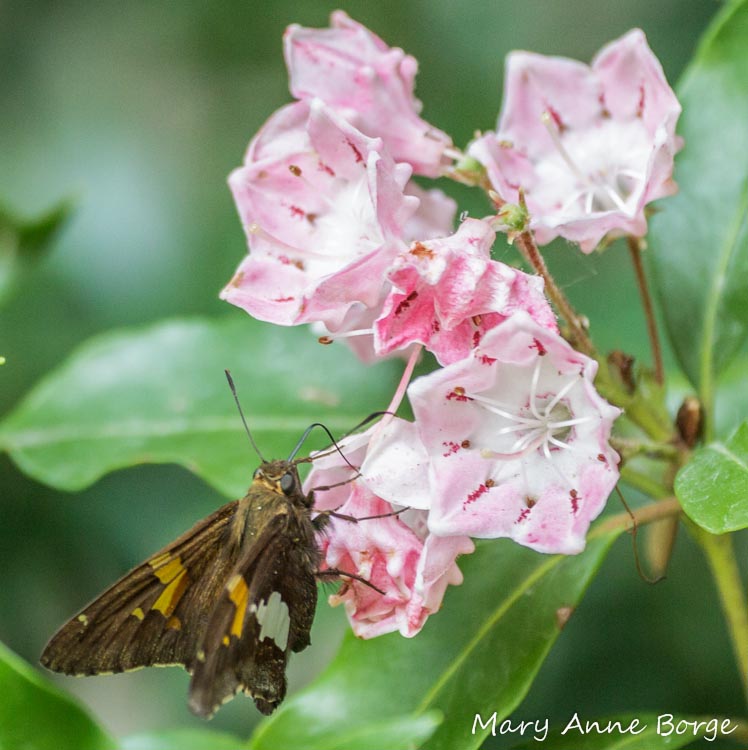
The shrub layer is graced with Gray Dogwood, Mountain Laurel, and Virginia Sweetspire. Many Azure butterflies favor dogwood and viburnum flower buds as caterpillar food sources, and will lay their eggs there. Ants protect Azure caterpillars from predators in exchange for the sweet honeydew they excrete.

Silver-spotted Skipper nectaring on Mountain Laurel

Silver-spotted Skipper nectaring on Mountain Laurel

Leaves of White Baneberry (a.k.a. Doll’s Eyes) and Common Ladyfern, Marginal Woodfern, Christmas and Northern Maidenhair Ferns are now available for perching or basking platforms. The male Zabulon Skipper pictured here is working to attract a mate.

Zabulon Skipper posing for a prospective mate

Zabulon Skipper posing for a prospective mate

While I watched him, when another butterfly flew by, regardless of species – Red Admirals, anglewings or swallowtails – he chased them away. With mission accomplished, he returned to a horizontal perching platform provided by White Baneberry leaves or the tips of a Christmas Fern frond, both along the edge of the moss path that curves through the garden. They offer the perfect elevation and exposure for the skipper to show himself off to prospective mates.

The secret is to choose plants that are naturally adapted to a woodland environment. They’ll be happy with the soil, moisture, and available light with minimal intervention from you, and no chemical fertilizers. Most of these perennials bloom for about 6-8 weeks, although Green and Gold may bloom throughout the summer if you deadhead. The shrubs usually flower for 2-3 weeks. After a warm winter, blooming may begin weeks earlier than usual. This past January I saw Golden Alexander in bud – a little scary!

So there is plenty of interest in the garden in spring. But what will bloom in the shade of summer and fall? And what butterflies will visit? Stay tuned!

See below for a list of scientific names for the plants featured in this post:

Red Maple (Acer rubrum)
Northern Spicebush (Lindera benzoin)
Golden Ragwort (Packera aurea)
Heartleaf Foamflower (Tiarella cordifolia)
Creeping Phlox (Phlox stolonifera)
Green and Gold (Chrysogonum virginianum)
Canadian Wildginger, Wild Ginger (Asarum canadense)
Common Blue Violet (Viola sororia)
Schrank Alpine Violet, Labrador Violet, American Dog Violet (Viola labradorica)
Striped Cream Violet (Viola striata)
Early Blue Violet (Viola palmata)
Golden Zizia (Zizia aurea)
Spotted Geranium (Geranium maculatum)
Greek Valerian (Polemonium reptans)
Tuliptree (Liriodendron tulipifera)
Flowering Dogwood (Cornus florida)
Blackhaw (Viburnum prunifolium)
Gray Dogwood (Cornus racemosa)
Mountain Laurel (Kalmia latifolia)
Virginia Sweetspire (Itea virginica)
White Baneberry, Doll’s Eyes (Actaea pachypoda)
Common Ladyfern (Athyrium filix-femina)
Christmas Fern (Polystichum acrostichoides)
Marginal Woodfern (Dryopteris marginalis)
Northern Maidenhair Fern (Adiantum pedatum)

Note:  This is part 2 of a 3 part series.  To see part 1, click here: A Butterfly Garden that Embraces the Shade.  For Part 3, click here:  Embracing the Shade:  Summer and Fall

This article was also published in the Spring 2013 issue of Butterfly Gardener, a publication of the North American Butterfly Association.

Spring Comes to the Sourlands

Insects and reptiles are waking up, birds are gathering nesting materials, and early wildflowers are covering the forest floor. Spring has finally arrived!

Spring Beauty (Claytonia virginica)

Spring Beauty (Claytonia virginica)

Several friends mentioned seeing a dark butterfly with yellow or cream borders, wondering what it was. These early flying beauties are Mourning Cloaks.

Mourning Cloak (Nymphalis antiopa)

Mourning Cloak (Nymphalis antiopa)

Antifreeze-like chemicals called glycerols in their blood enable Mourning Cloaks to survive the winter as adults, using loose bark, other crevices in trees, or a pile of branches to shelter from the elements. They are able to raise their body temperatures by shivering, enabling them to generate enough warmth to fly in cool temperatures. They often drink sap, but will also nectar at flowers. I have seen them feeding on Red Maple flowers (Acer rubrum).  On a walk on one of our favorite trails in the Sourlands the other day, we saw two spiraling skyward together.

With the exception of a few summer-like days, the temperatures have been warm enough for flowers to emerge and bloom, but cool enough to preserve the blossoms for many days. Early spring wildflowers flowers are gracing the trails and hillsides. These delicate but tenacious plants manage to push their way through their winter blanket of fallen leaves, like this Spring Beauty (Claytonia virginica).

Spring Beauty (Claytonia virginica)

Spring Beauty (Claytonia virginica)

Bloodroot (Sanguinaria canadensis) carpeted the woodland floor over the past week or two.

Bloodroot (Sanguinaria canadensis)

Bloodroot (Sanguinaria canadensis)

Bloodroot (Sanguinaria canadensis)

Wild Leek (Allium trioccum), also called Ramps, are gathering energy from the sun, preparing to produce their flowers many weeks from now.

Wild Leek (Allium trioccum)

Wild Leek (Allium trioccum)

 Cut-leaved Toothwort (Cardamine concatenata)

Cut-leaved Toothwort (Cardamine concatenata)

Cut-leaved Toothwort (Cardamine concatenata)

and Rue Anemone (Thalictrum thalictroides)

Rue Anemone (Thalictrum thalictroides)

Rue Anemone (Thalictrum thalictroides)

are beginning to bloom.

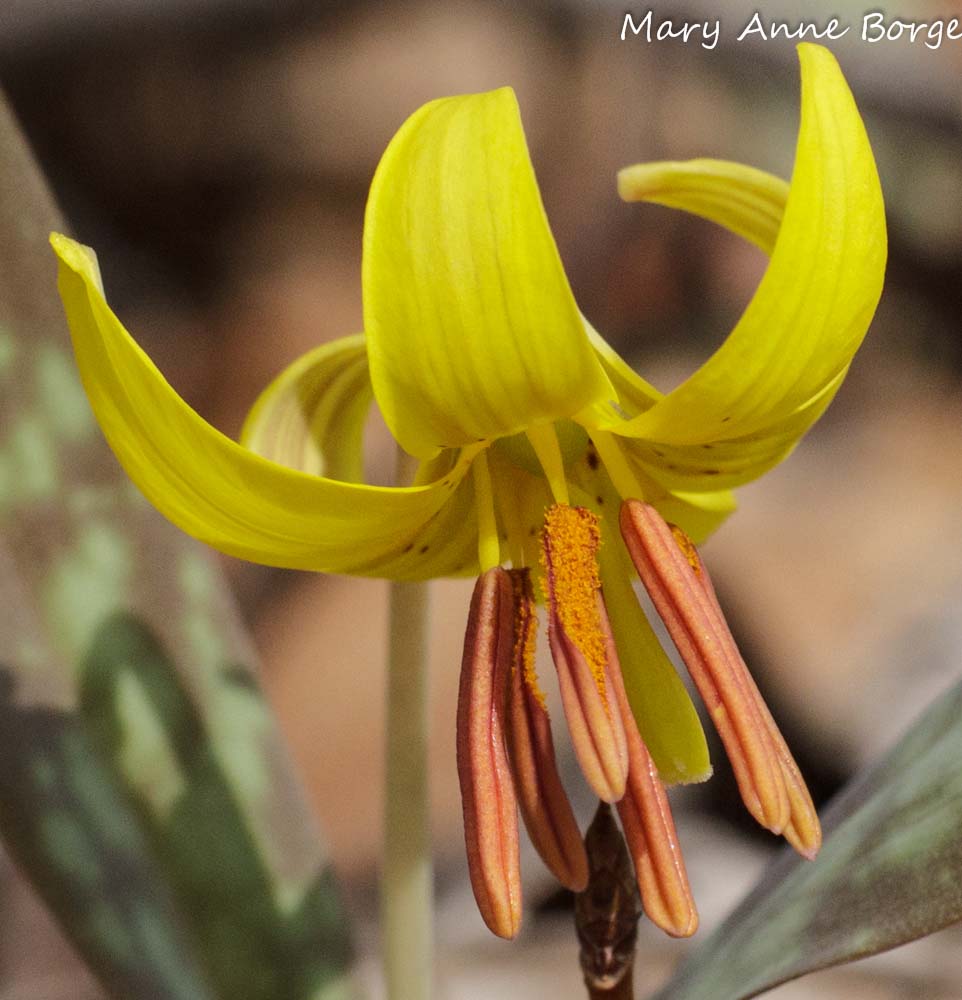
This lovely Trout Lily (Erythronium americanum) exuberantly flung out its leaves, welcoming the sun’s energy while beckoning potential pollinators with its brightly colored flowers.

Trout Lily (Erythronium americanum)

Trout Lily (Erythronium americanum)

In order to protect their pollen from the elements, Trout Lily flowers face downward until they are pollinated, then they rise upright. To leverage its chances of reproductive success, another strategy Trout Lily employs is to open half of its anthers one day, offering the rest the next. In the photo below, you can see three of the flower’s six anthers splitting open to release their pollen.

Trout Lily (Erythronium americanum), orange anthers opening to reveal pollen

Trout Lily (Erythronium americanum), orange anthers opening to reveal pollen

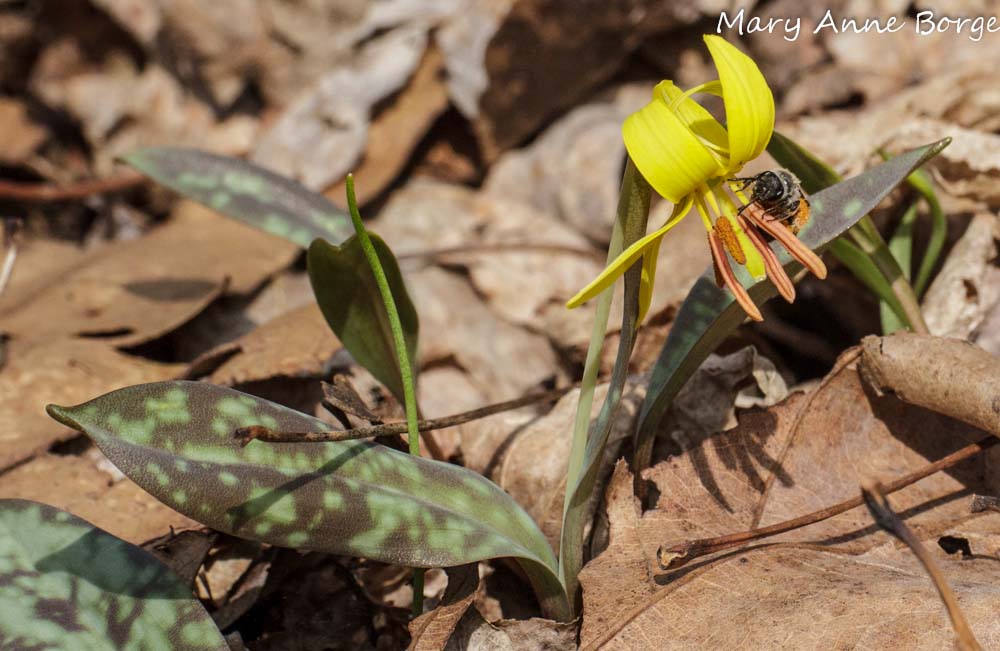
A Mining Bee, probably Andrena erythronii, is the pollinator visiting the Trout Lily below.

Trout Lily (Erythronium americanum) with Mining Bee, probably Andrena erythronii

Trout Lily (Erythronium americanum) with Mining Bee, probably Andrena erythronii

The female members of this bee species collect pollen and nectar to feed their larvae, storing this food on the hairs (called scopae) on her upper rear legs until she can return with this bounty to provision her brood cells. Andrena erythronii specializes on Trout Lilies, but it is able to use the pollen and nectar of other plants to feed its young if Trout Lilies are unavailable.

Trout Lily (Erythronium americanum) with Mining Bee, probably Andrena erythronii, gathering pollen

Trout Lily (Erythronium americanum) with Mining Bee, probably Andrena erythronii, gathering pollen

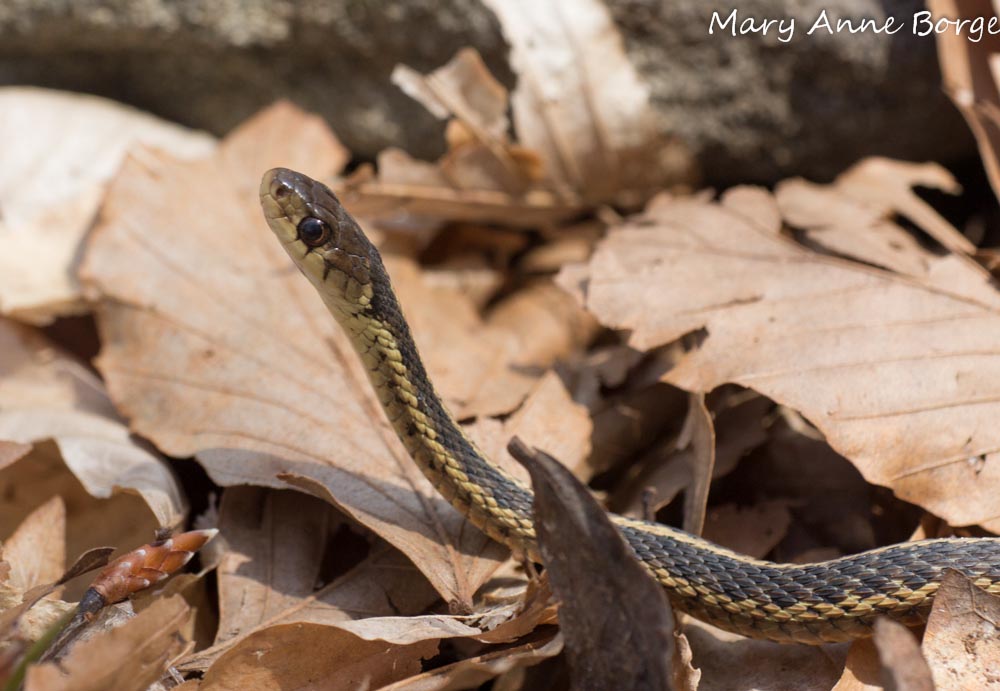
Other critters are emerging from their winter slumbers. As I walked, I saw Garter Snakes basking in the sun.  This one stood its ground as I carefully moved around it.

Garter Snake (Thamnophis sirtalis)

Garter Snake (Thamnophis sirtalis)

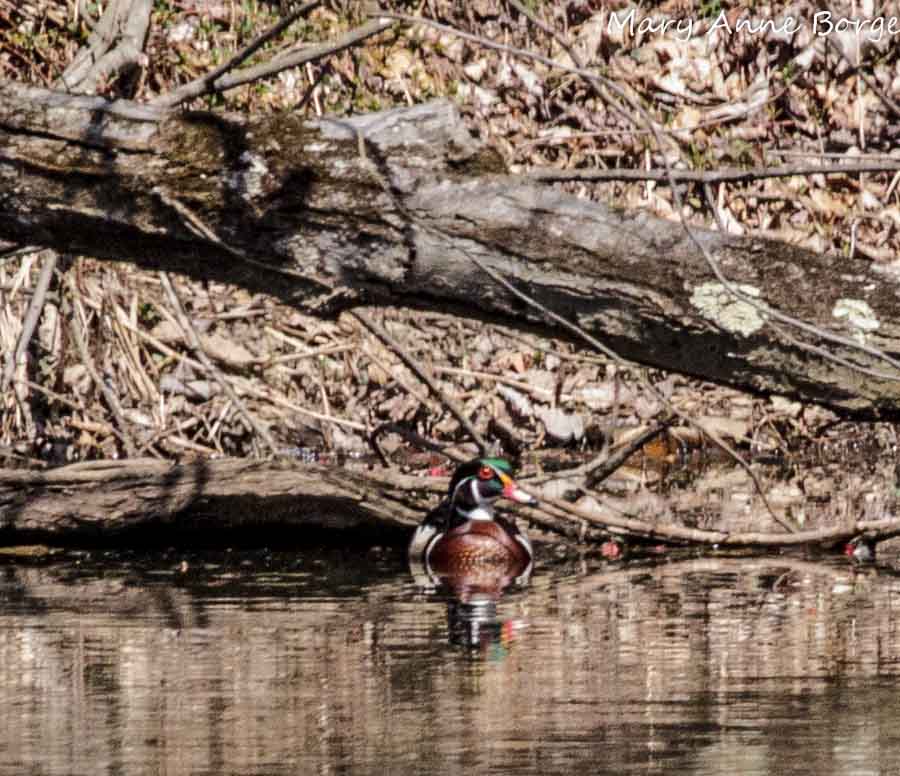
Wood Ducks hid in the shadows of a pond’s edge.

Wood Duck (Aix sponsa)

Wood Duck (Aix sponsa)

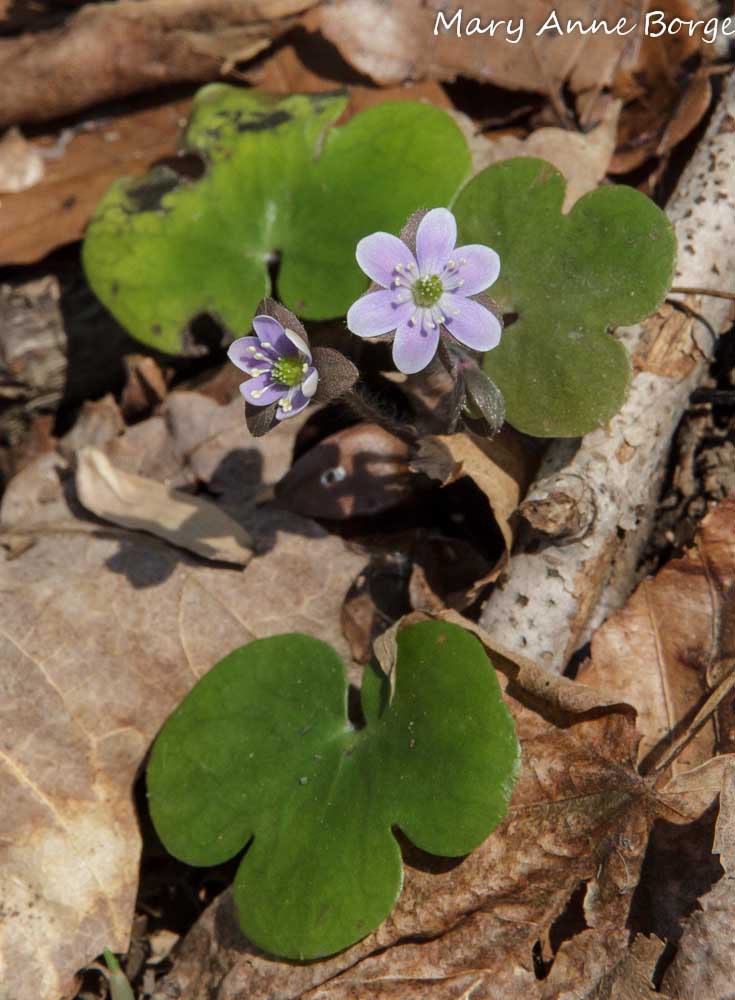
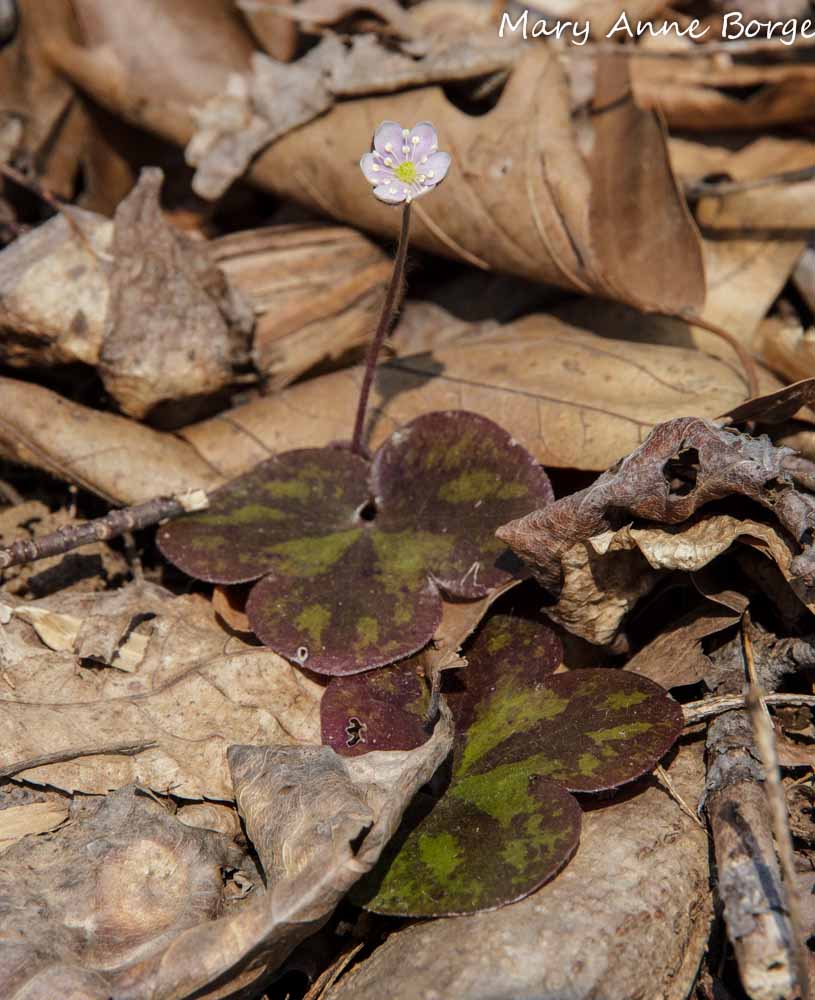
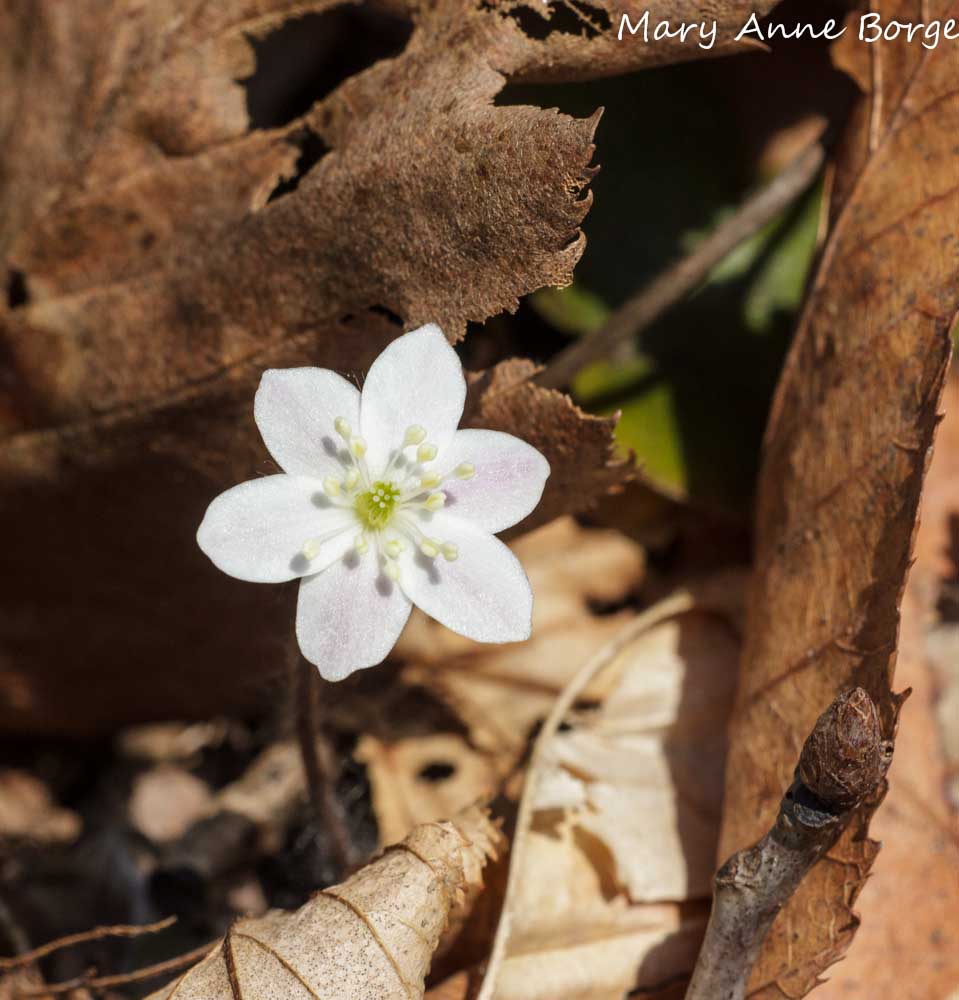
A special treat for me was seeing Round-lobed Hepatica (Hepatica Americana; synonym Anemone americana) growing from rock crevices and through leaf litter, in colors ranging from deep violet to pure white.

Round-lobed Hepatica (Hepatica Americana; synonym Anemone americana)

Round-lobed Hepatica (Hepatica Americana; synonym Anemone americana)

Round-lobed Hepatica (Hepatica Americana; synonym Anemone americana) showing last year's leaves

Round-lobed Hepatica (Hepatica Americana; synonym Anemone americana) showing last year’s leaves

Round-lobed Hepatica (Hepatica Americana; synonym Anemone americana) showing last year's leaves

Round-lobed Hepatica (Hepatica Americana; synonym Anemone americana) showing last year’s leaves

Round-lobed Hepatica (Hepatica Americana; synonym Anemone americana) with fresh leaves

Round-lobed Hepatica (Hepatica Americana; synonym Anemone americana) with fresh leaves

Round-lobed Hepatica (Hepatica Americana; synonym Anemone americana) with mottled leaves

Round-lobed Hepatica (Hepatica Americana; synonym Anemone americana) with mottled leaves

Round-lobed Hepatica (Hepatica Americana; synonym Anemone americana) with mottled leaves

Round-lobed Hepatica (Hepatica Americana; synonym Anemone americana) with mottled leaves

Round-lobed Hepatica (Hepatica Americana; synonym Anemone americana)

Round-lobed Hepatica (Hepatica Americana; synonym Anemone americana)

Round-lobed Hepatica (Hepatica Americana; synonym Anemone americana)

Round-lobed Hepatica (Hepatica Americana; synonym Anemone americana)

Resources

Cech, Rick; Tudor, Guy.  Butterflies of the East Coast.  2005.

Eaton, Eric R.; Kauffman, Ken. Kaufman Field Guide to Insects of North America. 2007.

Gracie, Carol.  Spring Wildflowers of the Northeast. 2012.

Mader, Eric; Shepherd, Matthew; Vaughan, Mace; Black, Scott Hoffman; LeBuhn, Gretchen. Attracting Native Pollinators: Protecting North America’s Bees and Butterflies. 2011.

Insect Visitors of Illinois Wildflowers

A Butterfly Garden that Embraces the Shade

Winter doesn't want to quit!

Winter doesn’t want to quit!

Feeling like spring will never arrive? Let’s fantasize a little. Let’s think about gardens in bloom.  And butterflies.  We’ll soon be seeing them.  Really!
When you think about a butterfly garden, shade may not be the first attribute that comes to mind.  But really, maybe it should be. Or at least it should be one of the first.

Ok, maybe not shade for shade’s sake, but for the food plants that cast it.

When you think about it, many butterflies rely on woody species – trees or shrubs – as food plants for their caterpillars.  For example, of the six species of swallowtail butterflies that are possible where I live in New Jersey, four require trees or shrubs as food plants, and one uses a shade tolerant vine.  Most of the hairstreaks, many of the azure and brushfoot species, and the Hackberry and Tawny Emperor all require trees or shrubs as their caterpillar food plants.

Hackberry Emperor

Hackberry Emperor

Other butterflies have evolved to use shade tolerant herbaceous species like violets, Black Cohosh, and Golden Alexanders as food plants.  So a shade garden can be a really valuable asset to the butterflies in the neighborhood.

Violets

Violets

My husband and I chose our house because we like the natural woods that surround us on two sides, preserved 24 years ago by the developer.  Even though we live in a townhouse community at the edge of a small town, the woods give us the illusion of living in the country.  We love the trees for their own beauty as it evolves through the seasons. And we love the birds they bring to feast on the fruits and insect protein that are abundant here.

Tufted Titmouse in Blackhaw Viburnum (Viburnum prunifolium)

Tufted Titmouse in Blackhaw Viburnum (Viburnum prunifolium)

Carolina Wren

Carolina Wren

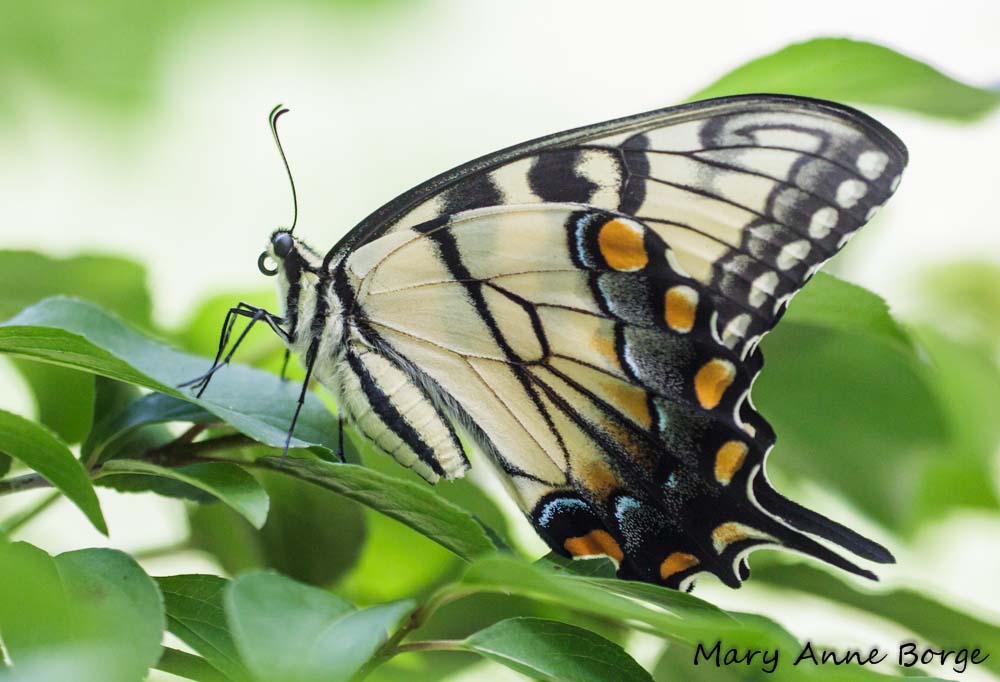
Somewhat to our surprise, we found we also had butterflies. As we learned more about them, we realized we had some very desirable territory for butterflies, and other critters, too. Finally, I understood when I saw an Eastern Tiger Swallowtail flitting high up in the White Ash or Tuliptrees, that it was a female laying her eggs on their leaves.

Tuliptree (Liriodendron tulipifera) blossom

Tuliptree (Liriodendron tulipifera) blossom

Eastern Tiger Swallowtail

Eastern Tiger Swallowtail

The Mourning Cloak may have been drawn here because of the elm trees in the woods behind the house.

Mourning Cloak nectaring at Red Maple (Acer rubrum) blossoms

Mourning Cloak nectaring at Red Maple (Acer rubrum) blossoms

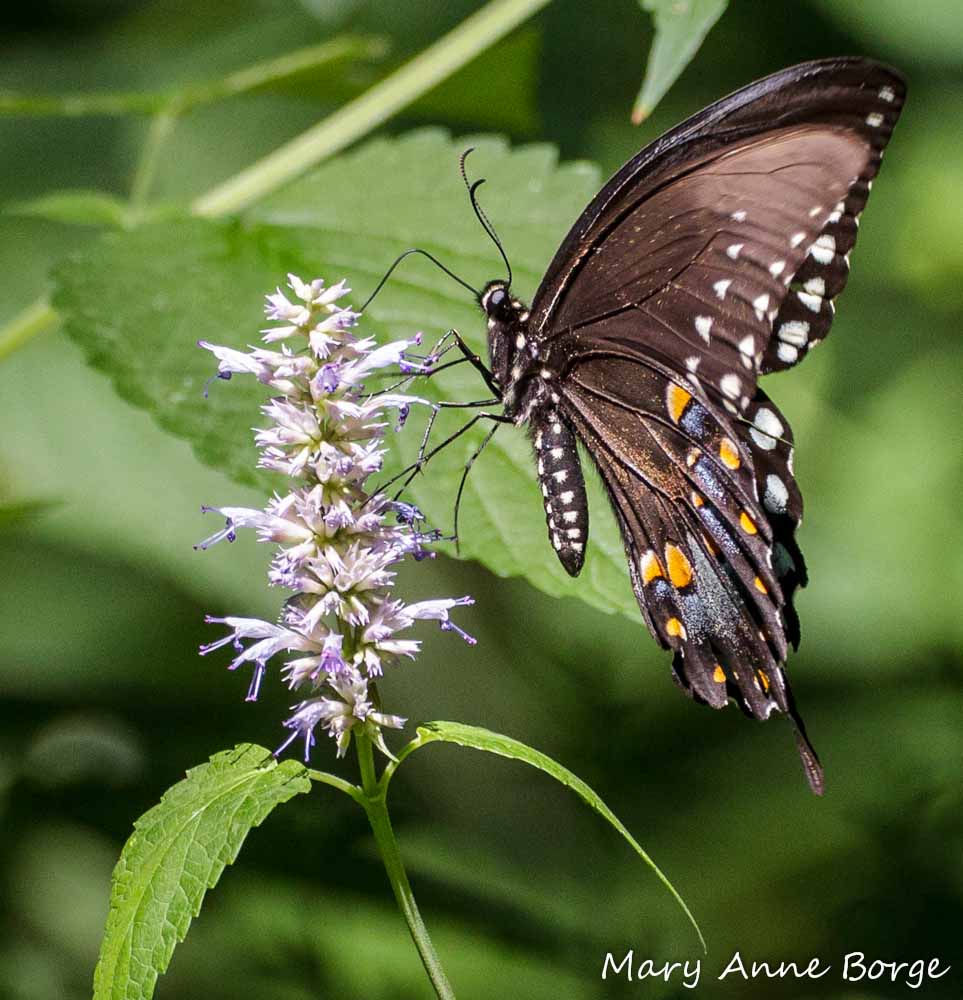
Why were Spicebush Swallowtails visiting our woodland garden? It’s the food plants, silly; their namesake Spicebush is present here, and so are Sassafras trees, which they are also willing to use.

Spicebush Swallowtail with Purple Giant Hyssop (Agastache scrophulariifolia)

Spicebush Swallowtail with Purple Giant Hyssop (Agastache scrophulariifolia)

The birds and butterflies have a somewhat mutually beneficial relationship. It’s true that the birds may be interested in eating the butterflies sometime during their lives, but on the plus side, birds keep insect predators of butterflies in check.  As a bonus, birds also provide dietary supplements for butterflies that are inclined to dine on mineral sources.  The Silver-spotted Skipper pictured here is sipping the nutritious offerings conveniently left by one of the local birds in the form of its droppings.

Silver-spotted Skipper getting minerals from bird droppings

Silver-spotted Skipper getting minerals from bird droppings

After stoking up, this little butterfly was off, maybe in search of an appropriate place to lay her eggs, like a near-by Black Locust tree.

Red Maple, White Ash, Sassafras, Flowering Dogwood, Blackhaw Viburnum, and a Crab Apple all grow in the common area along side our house.  As the trees grew over the years, they shaded out the lawn surrounding them.

Before the shade garden

Before the shade garden

Moss developed where grass once grew.  Chickadees plucked the moss until their beaks were full, gathering the soft lush material to line their nests. This was great!

Chickadee in Blackhaw Viburnum (Viburnum prunifolium)

Chickadee in Blackhaw Viburnum (Viburnum prunifolium)

So we decided to embrace the shade. It was futile trying to maintain a lawn that disappeared by July every year.  We got permission from our homeowners’ association to plant a shade garden under the trees and in place of the lawn that once grew next to them. This was a win for our association, since money would no longer have to be spent fruitlessly reseeding, fertilizing and mowing the lawn, or more accurately, the mud.

Now we have a constantly changing display of blossoms, ferns, sedges, foliage, and fruits. We took advantage of the moss, encouraging it to cover a winding path through the garden. There is always something blooming from about mid-April to the end of November; sometimes longer if the Witch-hazel is especially happy.  After that, the fruits offer visual appeal for us, and food for our local residents.  The birds love the new habitat, and we have more butterflies than ever, enjoying nectar and other food sources, and looking for a place to start the next generation.

Our wildlife-friendly shade garden

Our wildlife-friendly shade garden

I have my desk facing a second floor window so I can be easily distracted by birds, or watch a female Spicebush Swallowtail pause on a Sassafras leaf to lay an egg, then float down to lay another on the Spicebush that entices her below.

In future episodes, I’ll tell you more about the plants here and the critters we see enjoying them.

Note:  This is part one of a 3 part series.  For part 2, click here, A Butterfly Garden that Embraces the Shade – Spring.  For part 3, click here,  Embracing the Shade:  Summer and Fall

This article was adapted from one that was published in the Winter 2012 issue of Butterfly Gardener, a publication of the North American Butterfly Association.