Romance in the Meadow – Baltimore Checkerspots

Warning!  Before you read any further, I should warn you that some of the content of this post is for mature audiences only.

On May 18 I joined a group from the American Entomological Society to do an insect survey at Bowman’s Hill Wildflower Preserve. As we fanned out across the meadow, one of the participants found dozens of caterpillars feeding on plants in the wet part of the meadow.

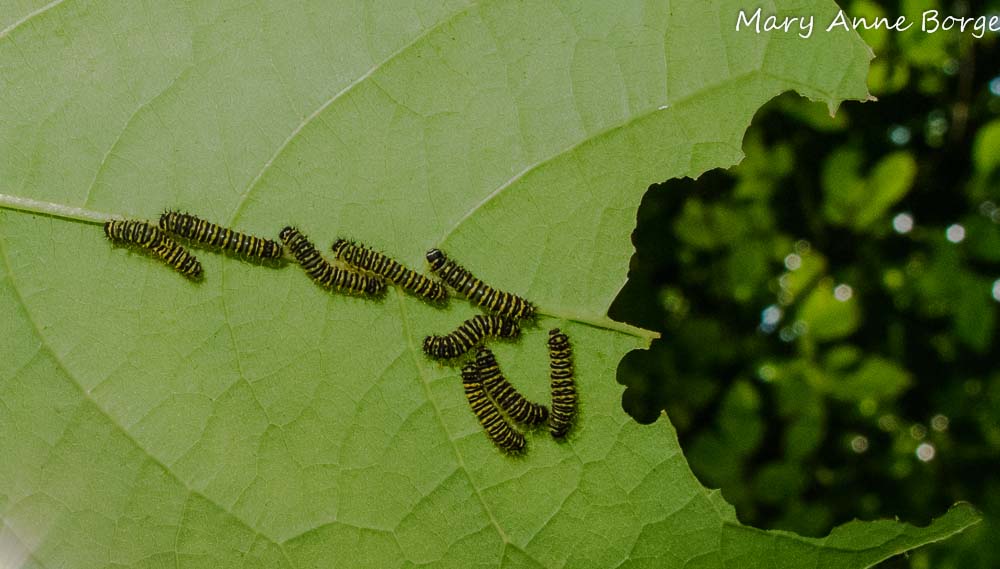
Baltimore Checkerspot caterpillars on Turtlehead (Chelone glabra)

Baltimore Checkerspot caterpillars on Turtlehead (Chelone glabra)

They turned out to be Baltimore Checkerspot (Euphydryas phaeton) caterpillars eating the leaves of Turtlehead (Chelone glabra).
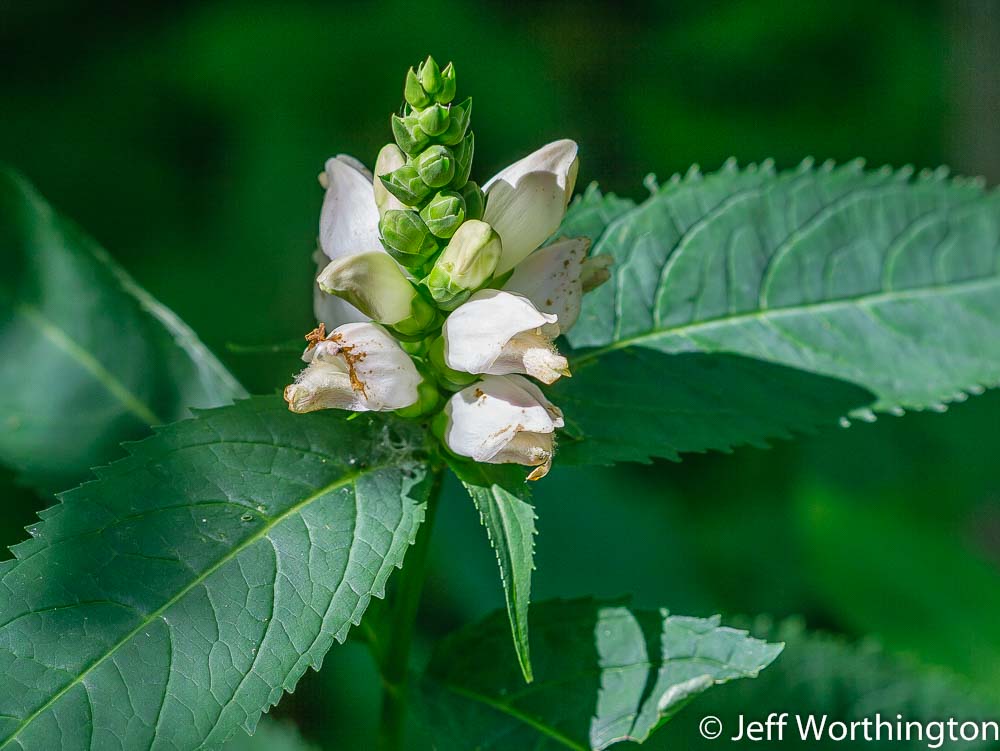
Turtlehead (Chelone glabra)

Turtlehead (Chelone glabra)

Baltimore Checkerspots are reported to use a few different species of plants as food for their caterpillars, particularly in their later growth stages.  But their preferred food plant is Turtlehead. This plant contains iridoid glycoside chemicals which enhance the caterpillars’ growth and makes them distasteful to birds. Both the caterpillars and the resulting adult butterflies benefit from this protection, and their bright black, white, and orange coloration act as a warning to advertise their toxicity to potential predators. It helps to fend off attempts to eat them.
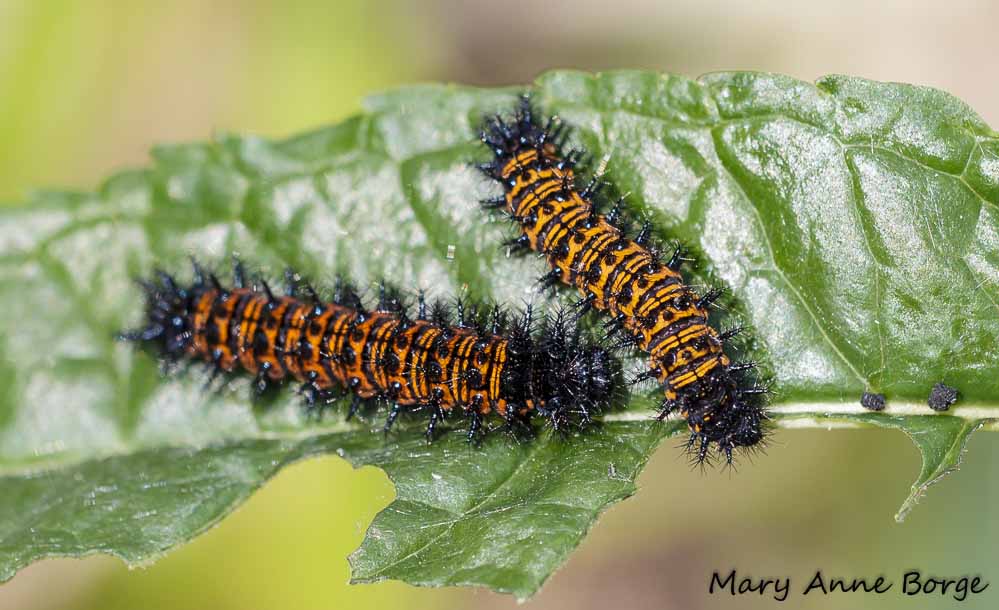
Baltimore Checkerspot caterpillars on Turtlehead (Chelone glabra)

Baltimore Checkerspot caterpillars on Turtlehead (Chelone glabra)

Given the early date, the caterpillars were almost certainly individuals that had spent the winter there in the meadow.

On June 16, almost a month after the initial caterpillar sighting, I saw two adult Baltimore Checkerspot butterflies for the first time, not far from where we saw the caterpillars.
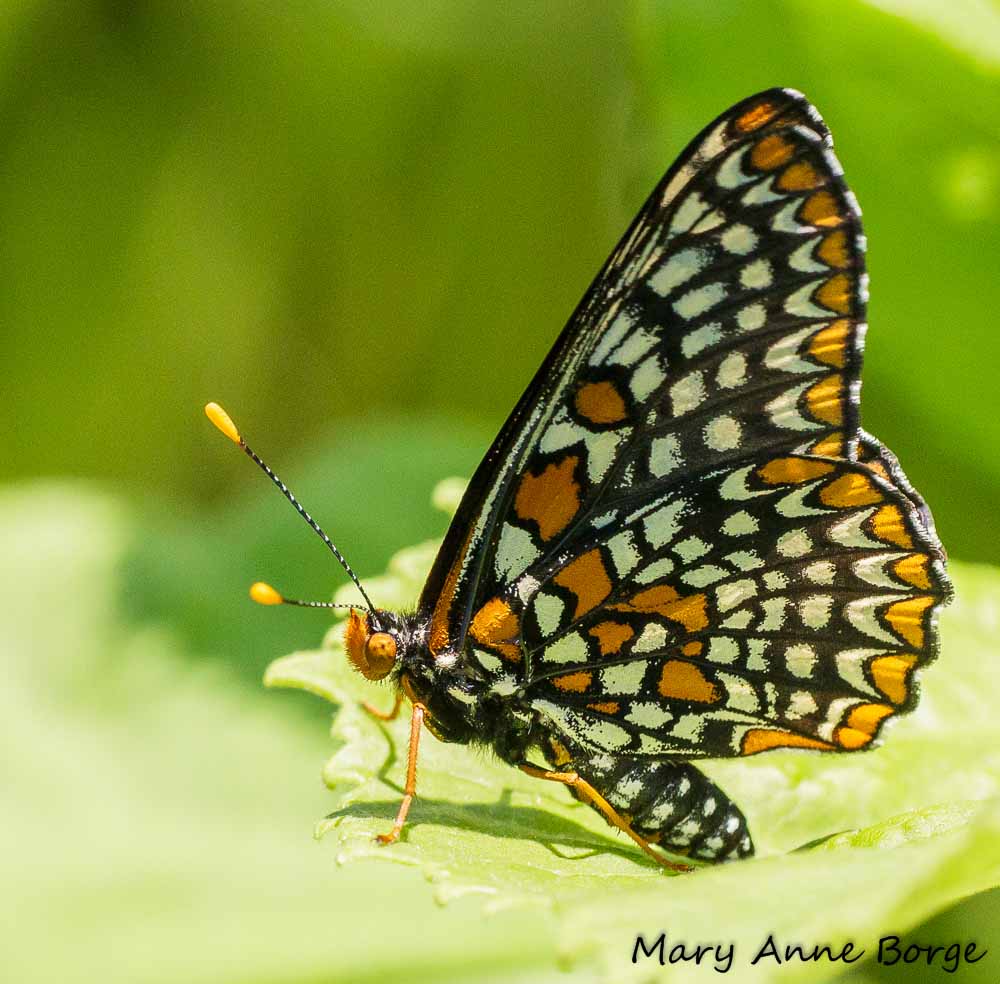
Baltimore Checkerspot
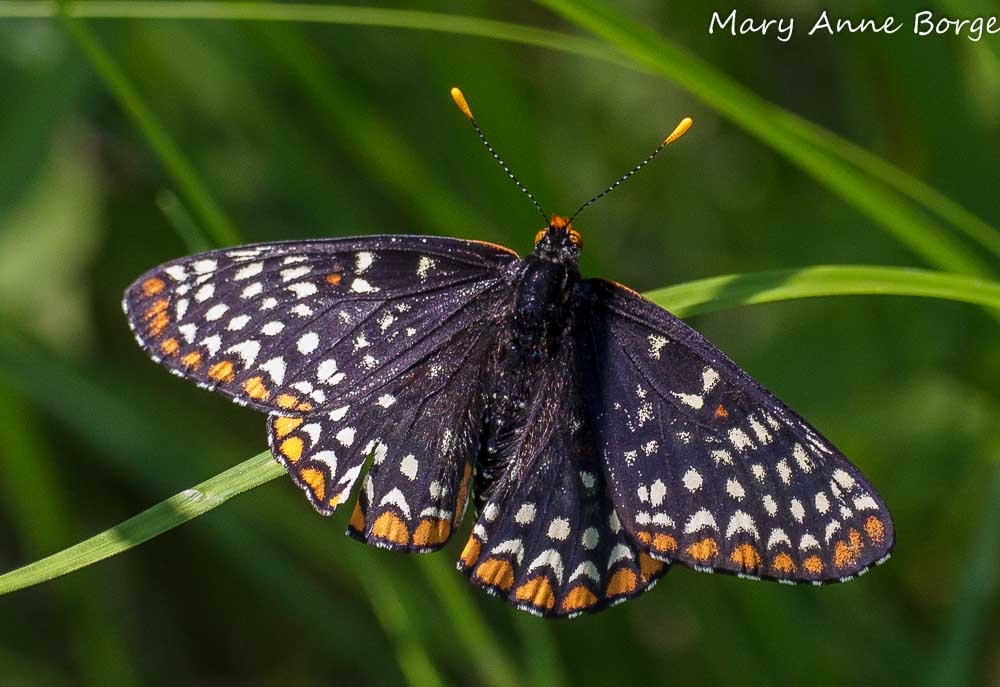
Baltimore Checkerspot

Baltimore Checkerspot

Baltimore Checkerspot

A week later, there were at least 10 individuals in the same general vicinity. They spent most of their time perching fairly low to the ground, either basking or advertising for a potential mate. Most flights were short and fairly low.
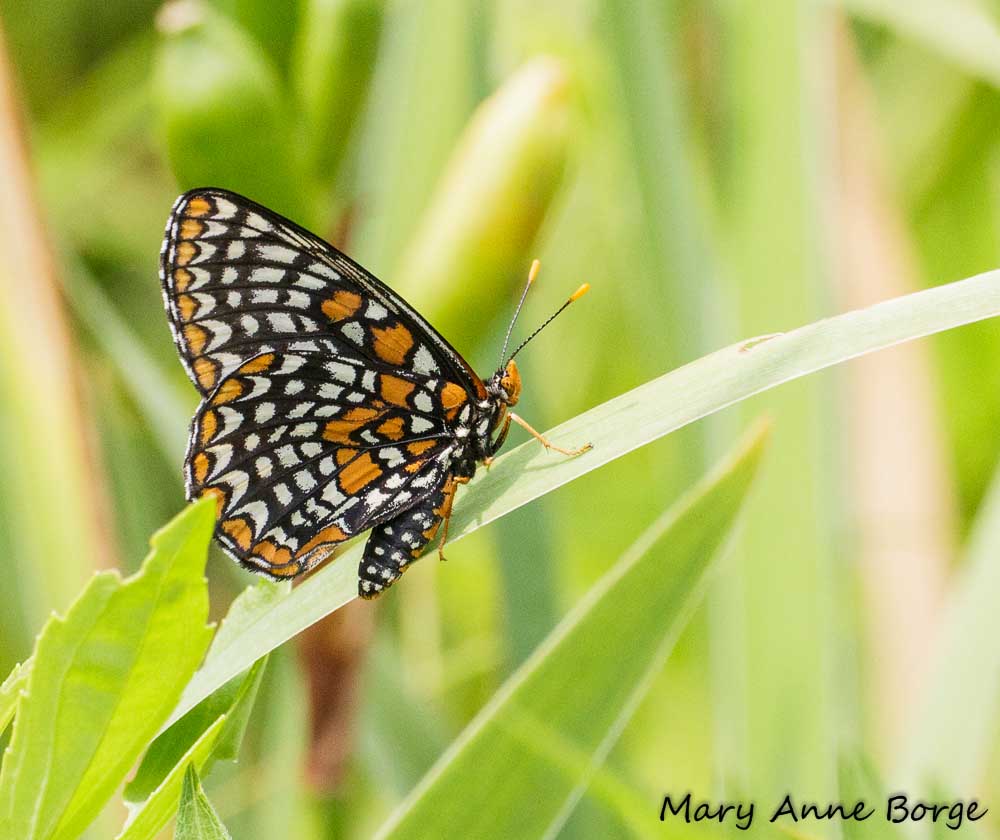
Baltimore Checkerspot

Baltimore Checkerspot

Occasionally I saw a butterfly drinking nectar from Indian Hemp (Apocynum cannabinum) or White Clover (Trifolium repens).
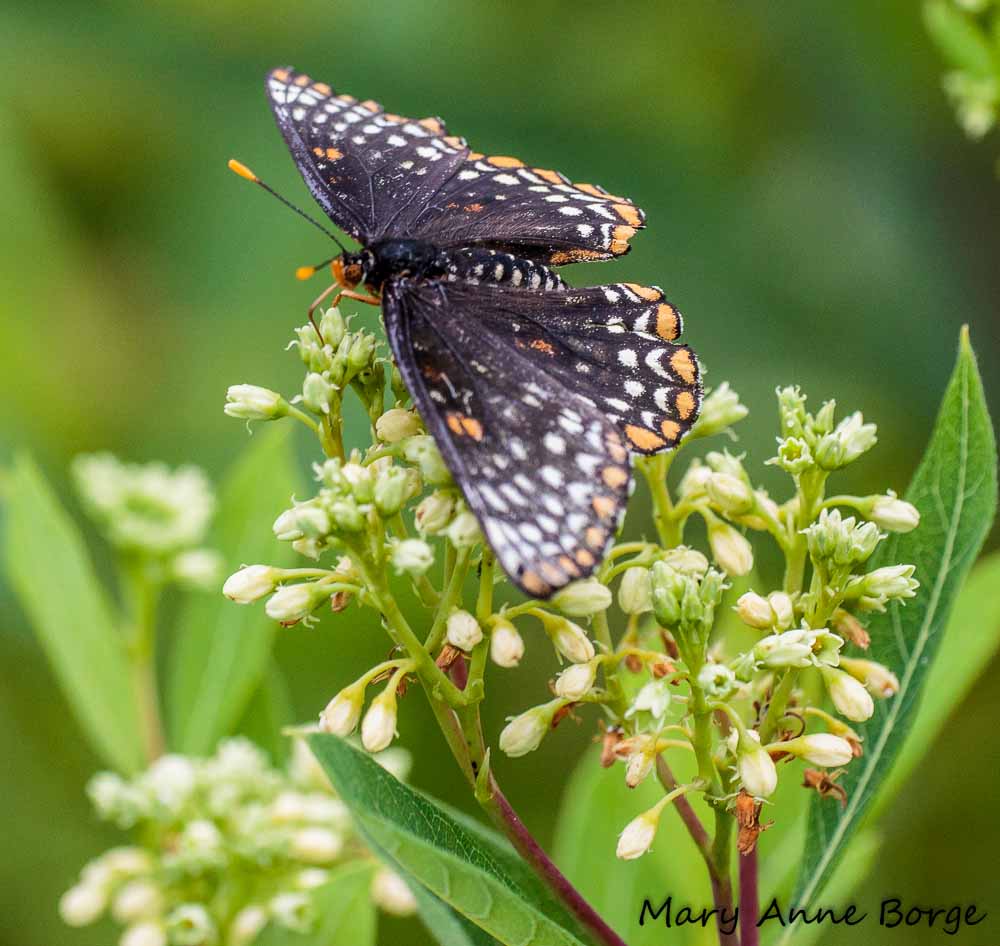
Baltimore Checkerspot drinking nectar from Indian Hemp (Apocynum cannabinum)

Baltimore Checkerspot drinking nectar from Indian Hemp (Apocynum cannabinum)

Baltimore Checkerspot drinking nectar from White Clover (Trifolium repens)

Baltimore Checkerspot drinking nectar from White Clover (Trifolium repens)

Ok, this is where things start to get a little racy.

Eventually I spotted a pair of butterflies deep in the meadow foliage, mating.
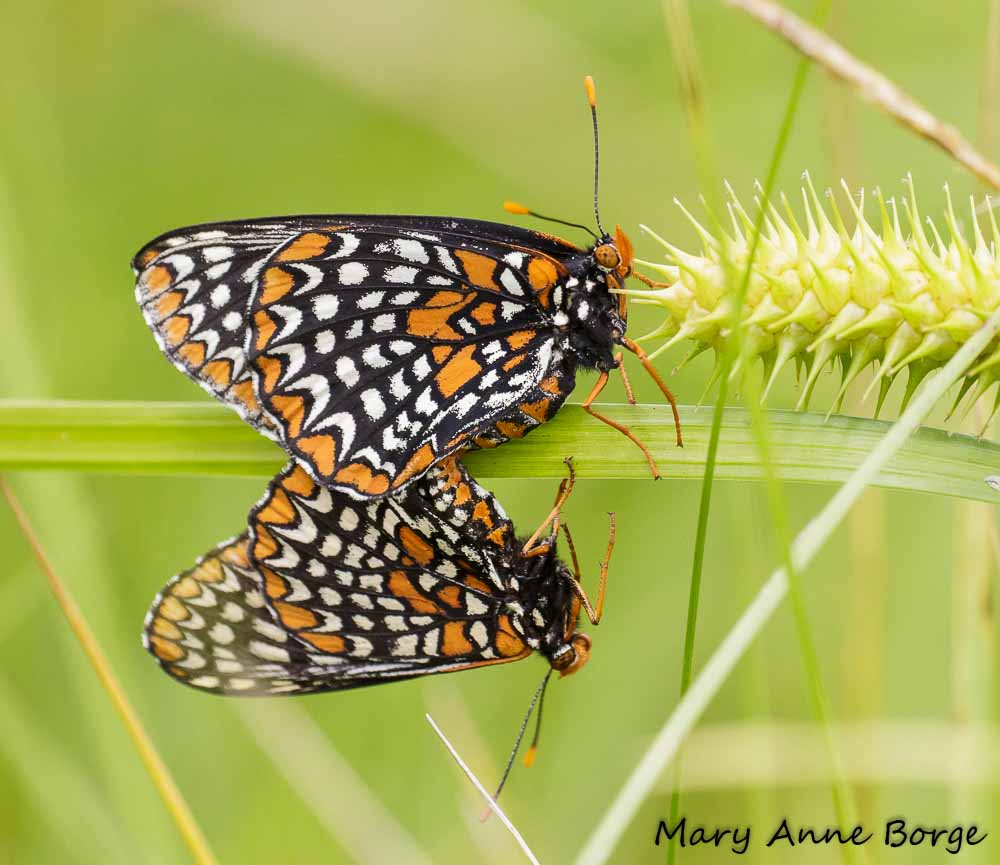
Baltimore Checkerspots, mating

Baltimore Checkerspots, mating

They gradually moved higher on the sedge to which they were clinging, changing positions, taking turns being on top. They were intent on their goal.
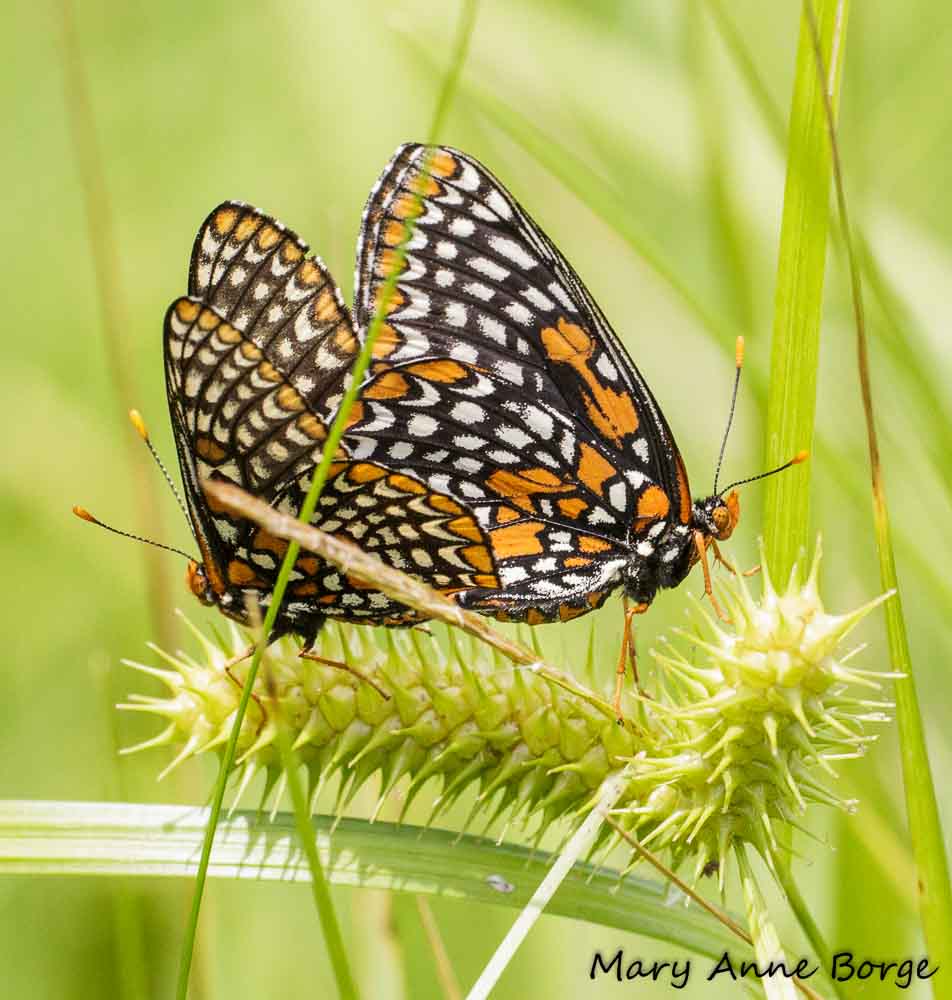
Baltimore Checkerspots, mating
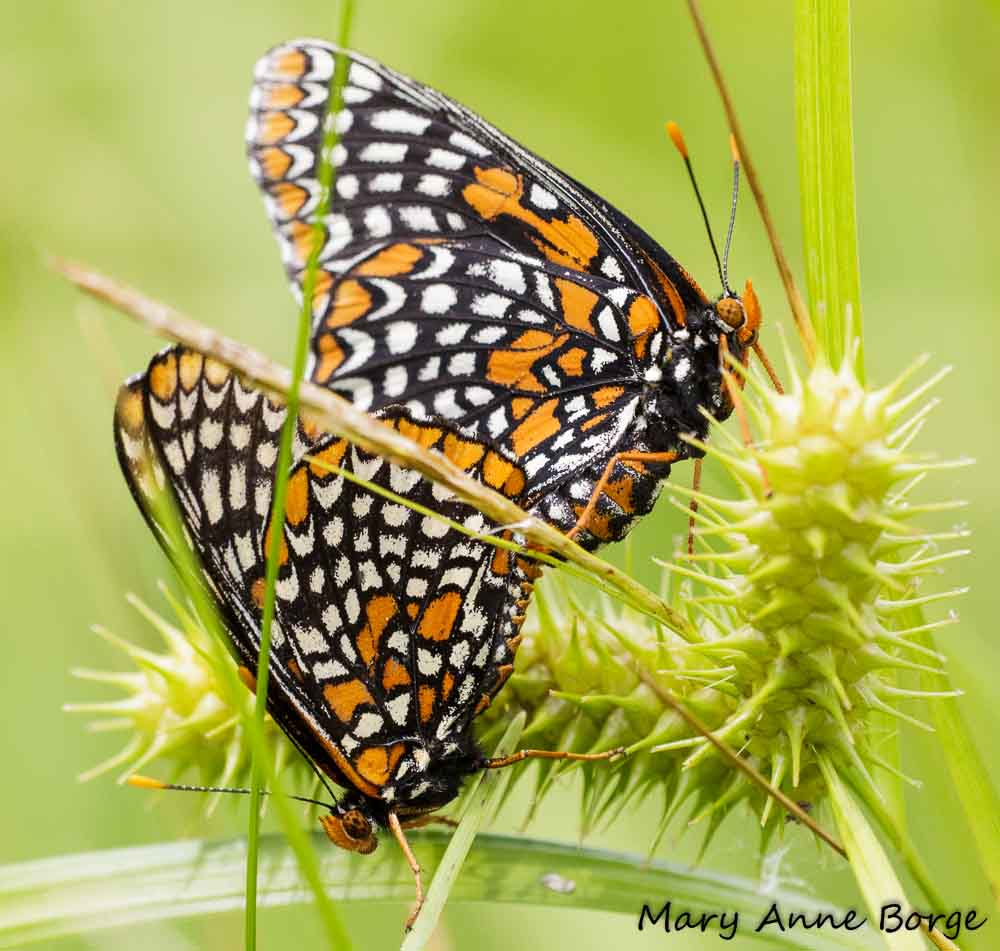
Baltimore Checkerspots, mating

Baltimore Checkerspots, mating

Baltimore Checkerspots, mating

Several times another butterfly, I’m guessing a male, tried to break up the happy couple.
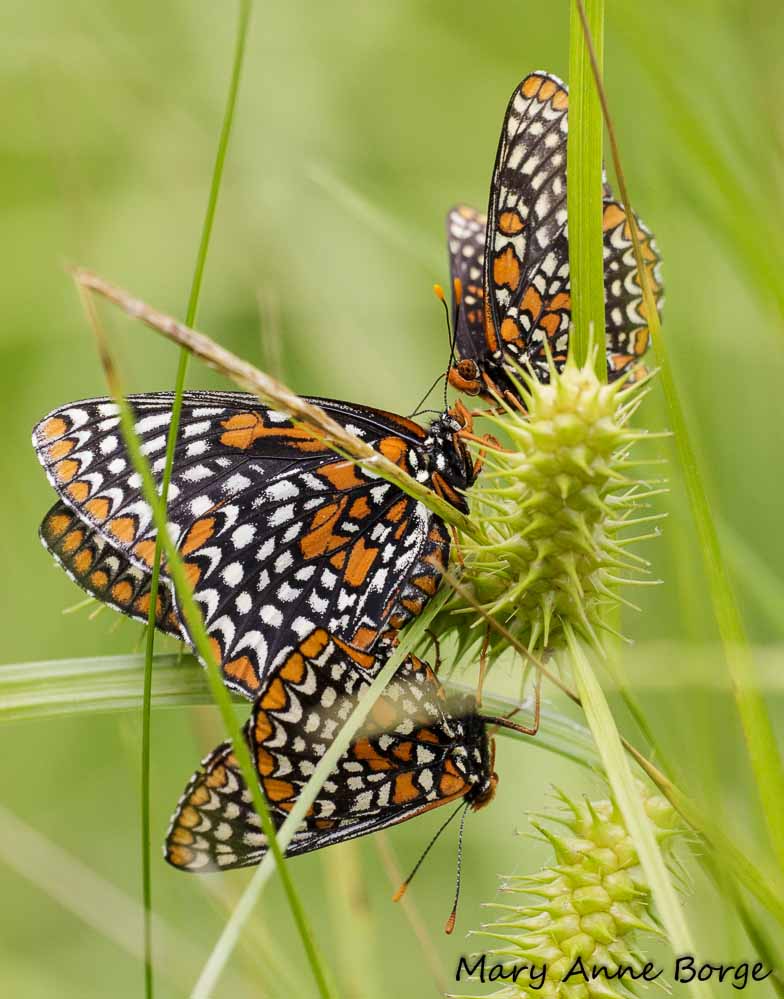
Baltimore Checkerspots, mating, with interloper

Baltimore Checkerspots, mating, with interloper

They indicated their disinterest to him by flapping their wings.
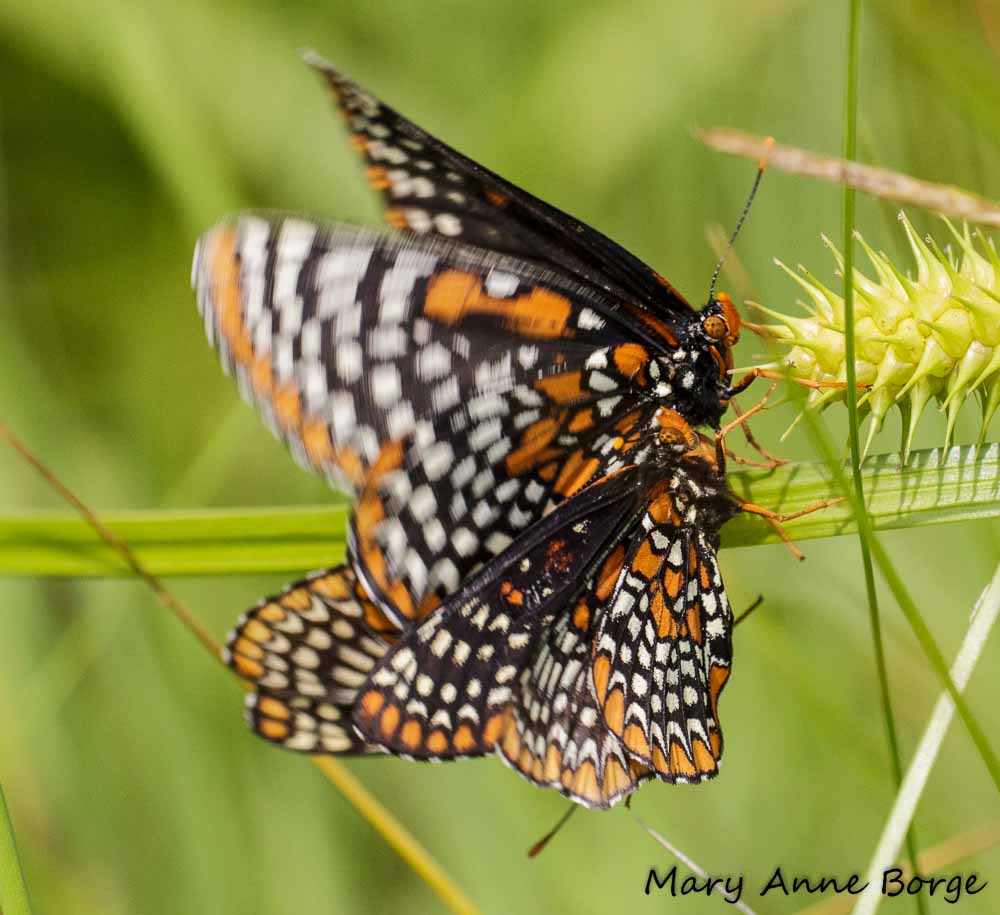
Baltimore Checkerspots, mating, with interloper

Baltimore Checkerspots, mating, with interloper

When he persisted, they steadfastly ignored the intruder.
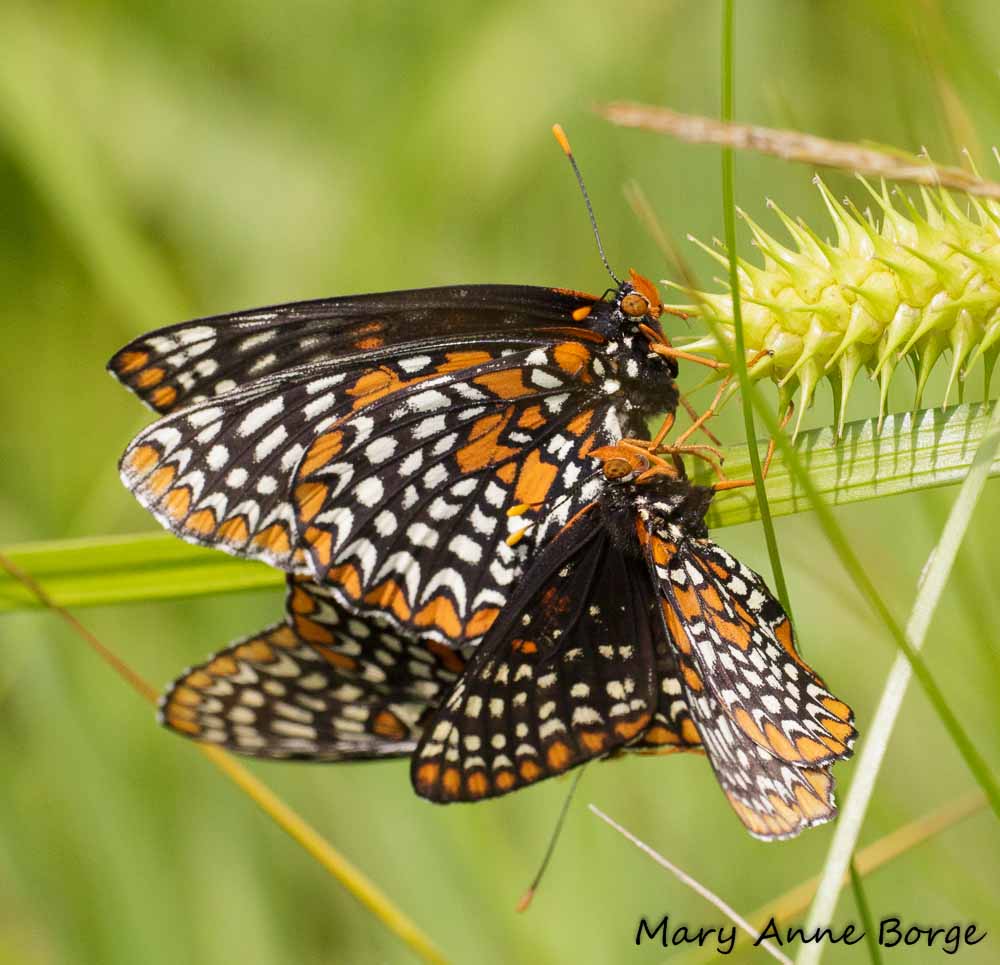
Baltimore Checkerspots, mating, with interloper

Baltimore Checkerspots, mating, with interloper

It was an hour and fifteen minutes between the first and last photos I took of this mating pair. They were already engaged when I encountered them, and they were still at it when I finally had to leave. (!)

They were not the only couple that managed to meet up. I did spot another example of splendor in the grass a bit further along the trail.
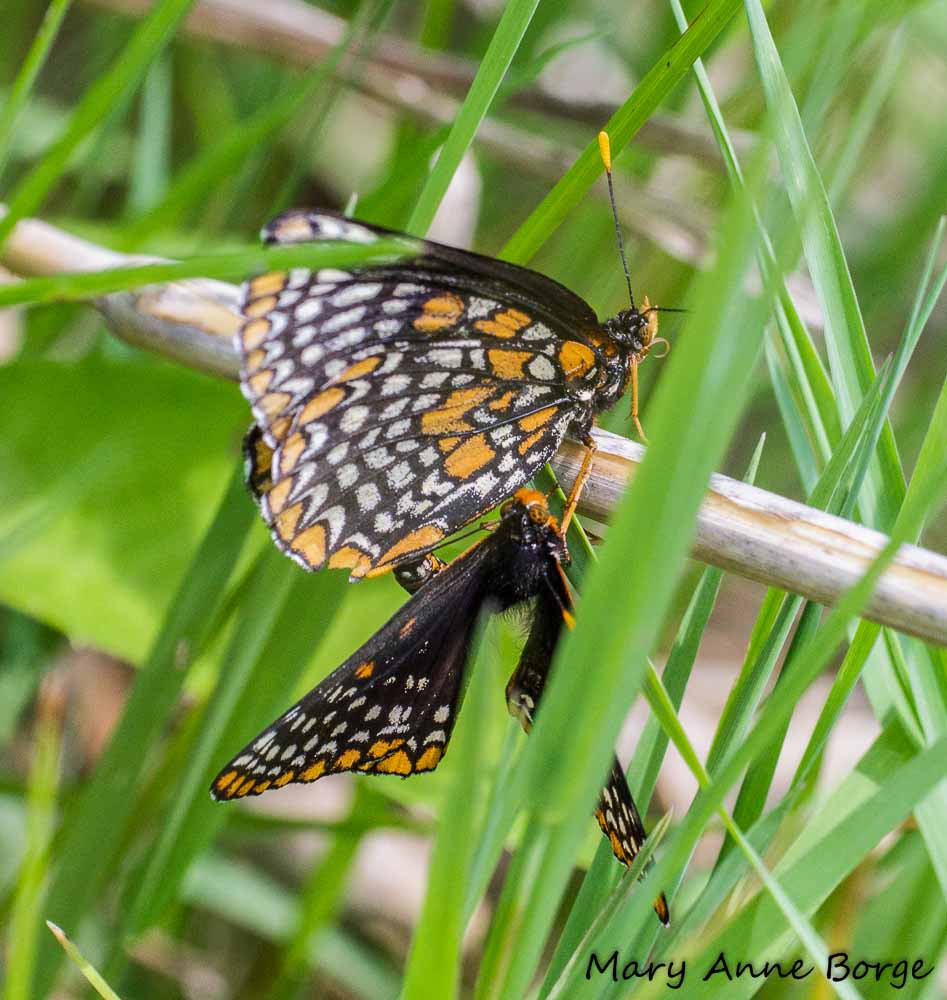
Baltimore Checkerspots, mating

Baltimore Checkerspots, mating

When I went back to check the Turtlehead where the initial caterpillar sighting took place, there were several females laying eggs (ovipositing). Looks like the Preserve will see another generation of Baltimore Checkerspots.
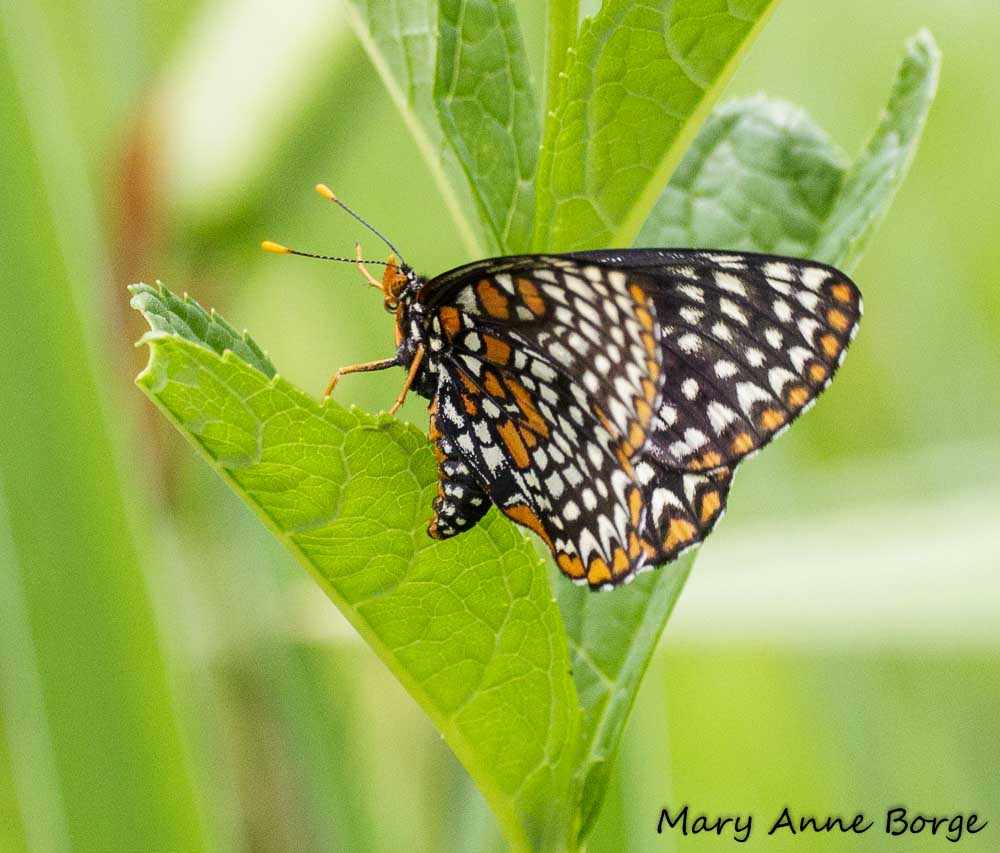
Baltimore Checkerspots, laying eggs (ovipositing)

Baltimore Checkerspots, laying eggs (ovipositing)

Resources

Cech, Rick; Tudor, Guy. Butterflies of the East Coast. 2005.

Glassberg, Jeffrey. Butterflies through Binoculars A Field Guide to Butterflies in the Boston-New York-Washington Region. 1993.

Scott, James A. The Butterflies of North America. 1986.
Butterflies of Massachusetts

Gray Dogwood for Butterflies, Bees and Birds

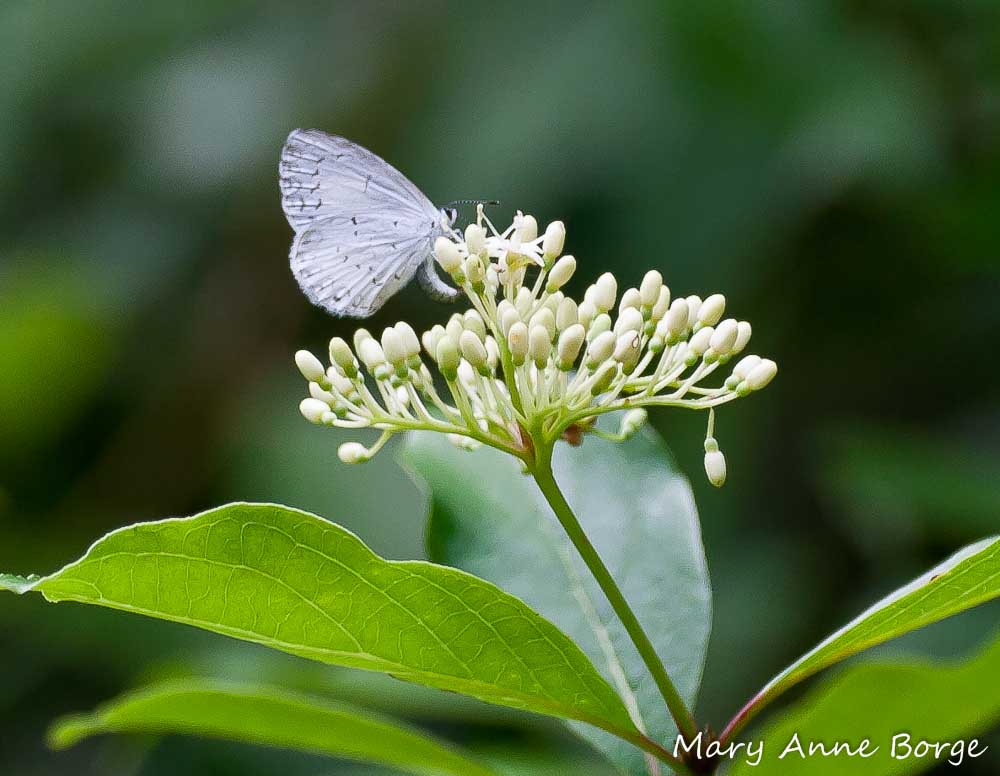
This Spring Azure butterfly is laying her eggs on the flower buds of a Gray Dogwood (Cornus racemosa), taking advantage of the nourishment this shrub provides her offspring. Dogwoods are among the favored plants of this butterfly’s caterpillars, helping to ensure that you’ll continue to see the sprightly Azure on a regular basis.
Azure butterfly laying an egg on Gray Dogwood (Cornus Racemosa) flowers

Azure butterfly laying an egg on Gray Dogwood (Cornus Racemosa) flowers

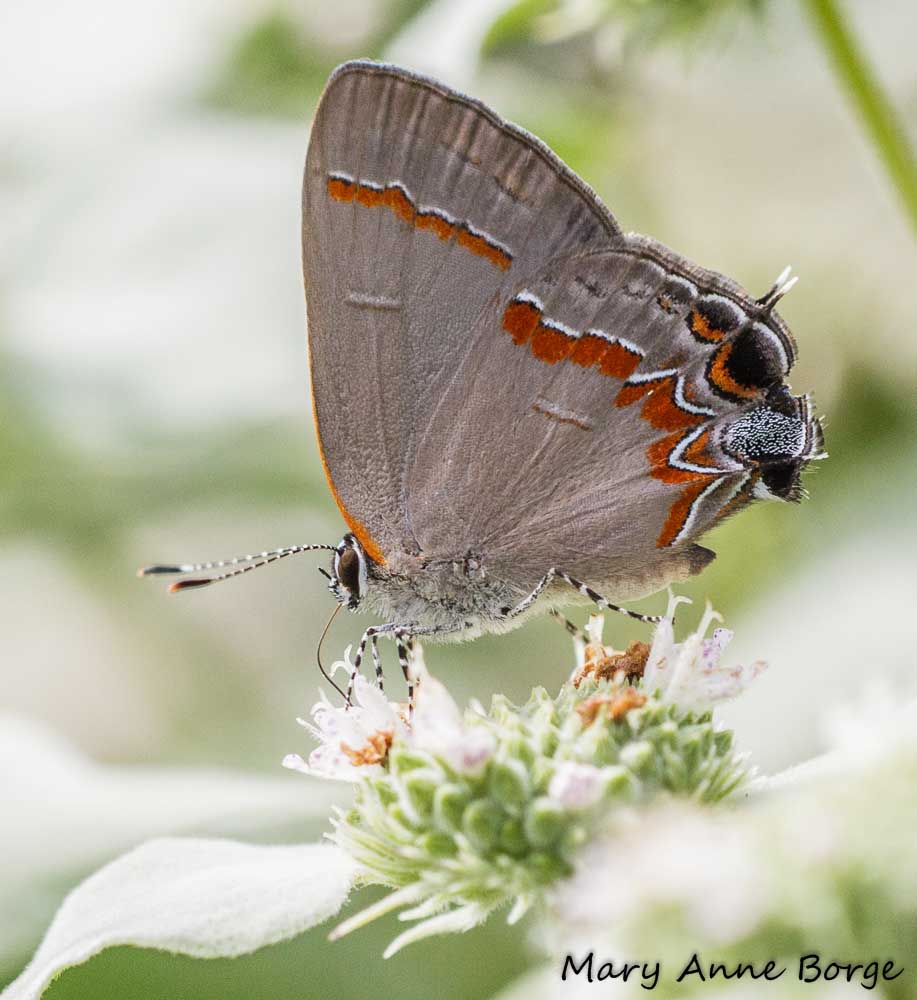
Nearby, a Red-banded Hairstreak drank the nectar offered by the profusion of lovely flowers.

Red-banded Hairstreak, different day, on Short-toothed Mountain Mint (Pycnanthemum muticum)

Red-banded Hairstreak, different day, on Short-toothed Mountain Mint (Pycnanthemum muticum)

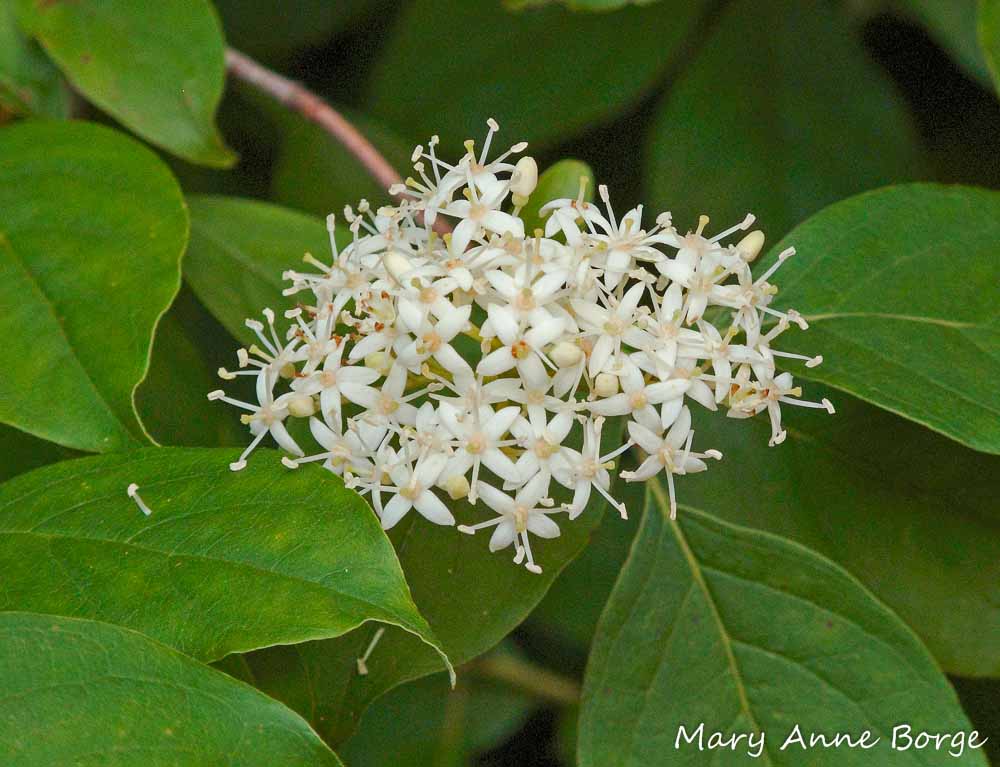
Blooming for a period of a few weeks in late May to mid June, Gray Dogwood is a relative of the more familiar Flowering Dogwood (Cornus florida), but Gray Dogwood is a shrub, growing to a maximum height of 12-15 feet (about 3.5-4.5 meters). The flowers and leaves of Gray Dogwood show typical characteristics of this family of plants.

Each delicate flower has four petals, arranged symmetrically in a cross shape. The leaves are opposite each other along the branches, with arched veins curving toward the tip of the leaf on both sides of the midrib. The common name, Gray Dogwood, refers to the color of the bark, which is usually a light gray. The species name, racemosa, describes the half-sphere arrangement of the creamy white flower clusters.

Gray Dogwood (Cornus racemosa)

Gray Dogwood (Cornus racemosa)

The flowers’ nectar attracts an array of busy pollinators, including bees, beetles and butterflies. Even better, Gray Dogwood provides the female Azure butterfly a place to lay her eggs. Several moth species use the dogwoods as food plants for their caterpillars, including the beautiful Polyphemus Moth.

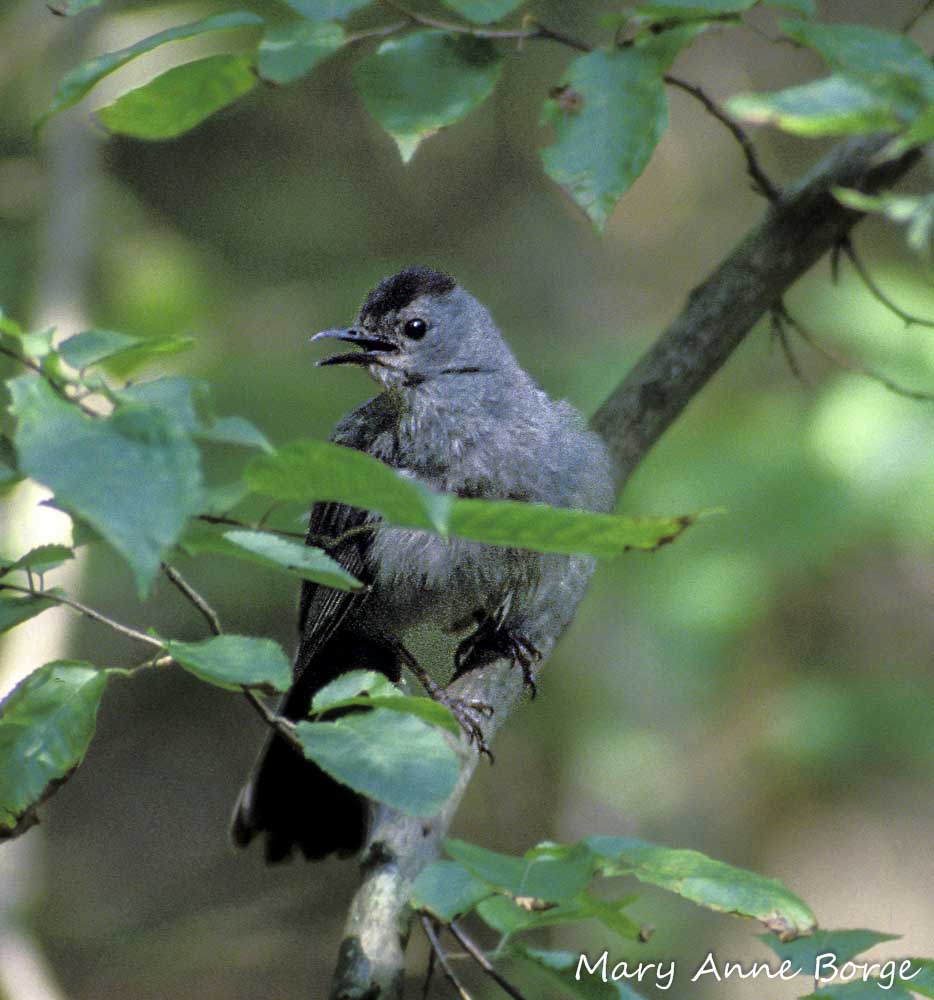
Birds that like to nest in the shrub layer look favorably on Gray Dogwood when they’re shopping for real estate. Northern Cardinals, Goldfinches, Catbirds and Yellow Warblers are some of the birds that covet the features offered by Gray Dogwood.

A young Gray Catbird

A young Gray Catbird

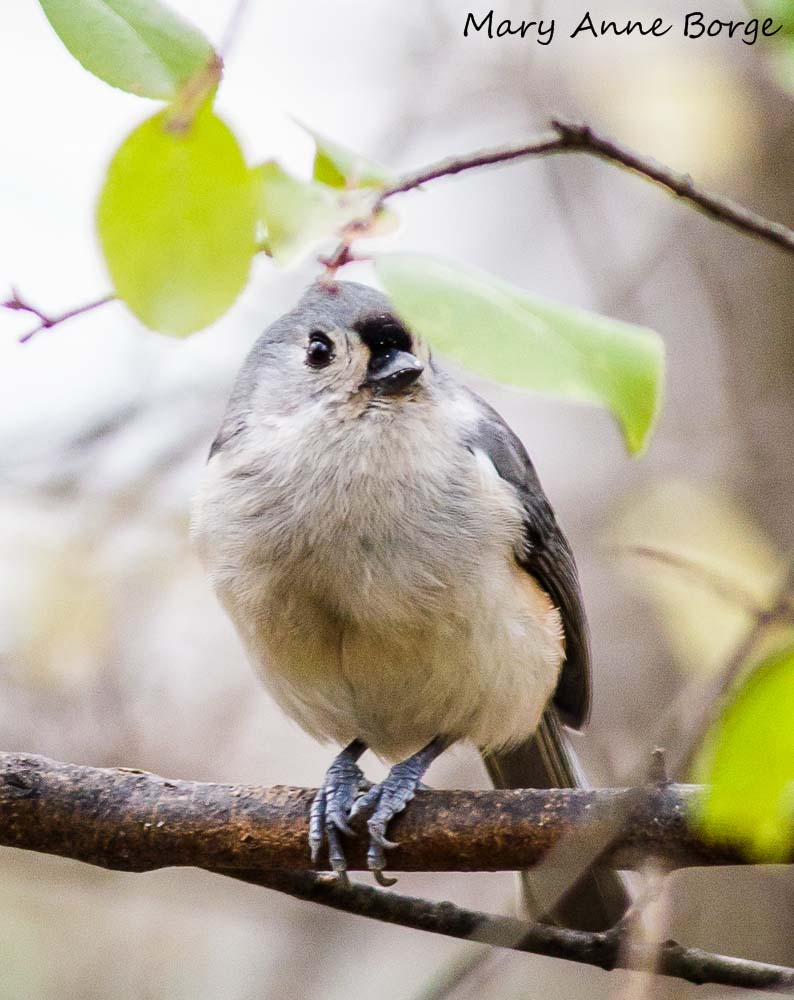
The multi-stemmed shrub with its sturdy branches offers a safe nesting place, with food right on the premises. During nesting season, the pollinators and any caterpillar progeny offer the protein necessary to raise healthy young birds. Newly fledged Chickadees and Titmice may also browse Gray Dogwood for a quick bite, or take refuge in its sturdy branches.

Tufted Titmouse

Tufted Titmouse

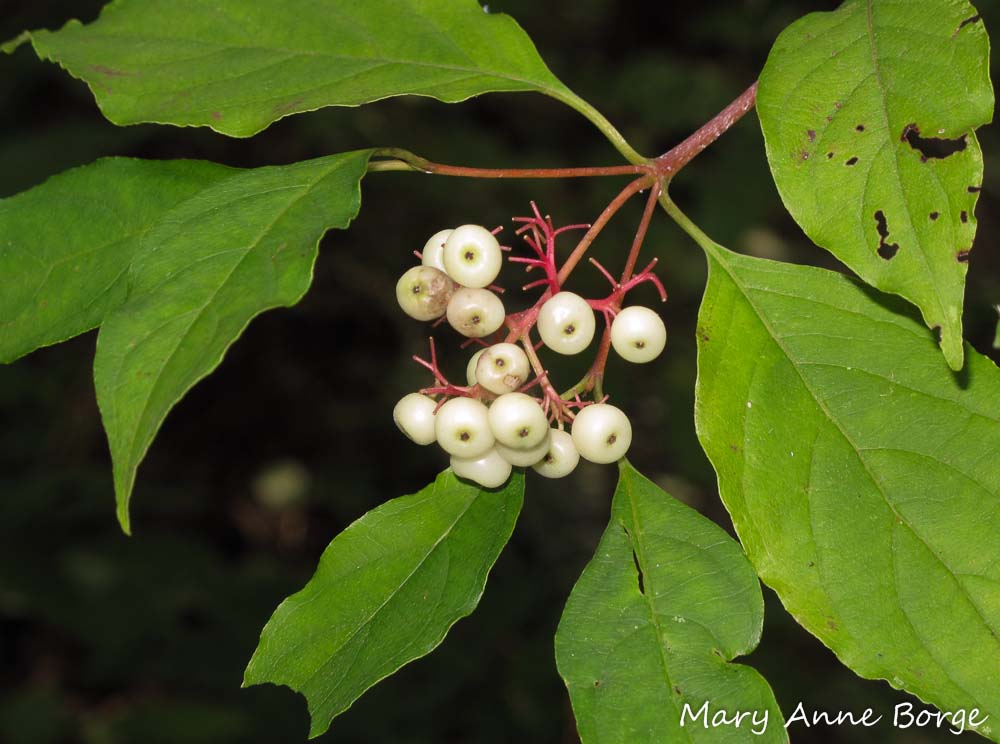
Flowers that are successfully pollinated by butterflies, bees or other insects will produce a round white berry-like fruit called a drupe. The fruit appears on a platform of bright red stems, called pedicels, beckoning the local bird population to stop for a meal. Birds find the fruit irresistibly delectable, eating it as soon as it ripens in late summer for a jolt of energy. Squirrels, chipmunks and other mammals also enjoy the tasty bounty.

Gray Dogwood fruit

Gray Dogwood fruit

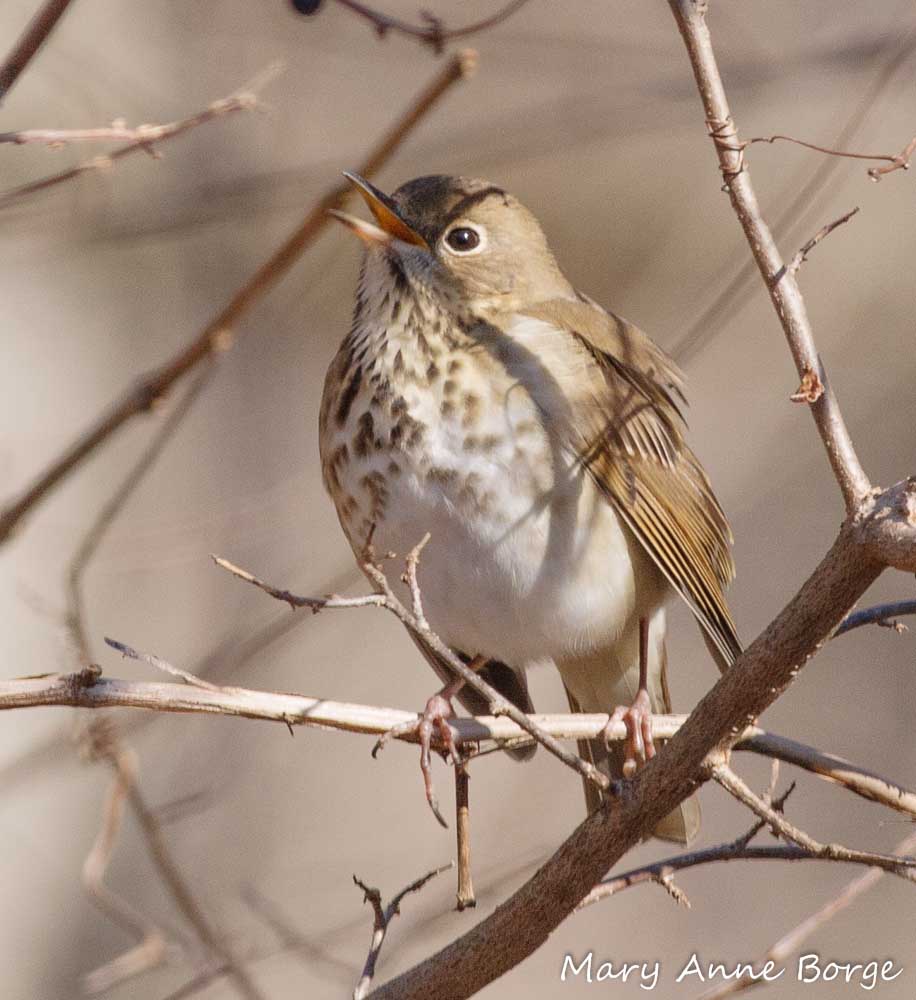
For your viewing pleasure, the red fruit platforms remain for weeks even after the fruit is snapped up by resident and migrating birds. As fall approaches, Gray Dogwood’s leaves turn from deep green to a regal reddish-purple. In winter, its branches shelter the birds that live with us year-round.

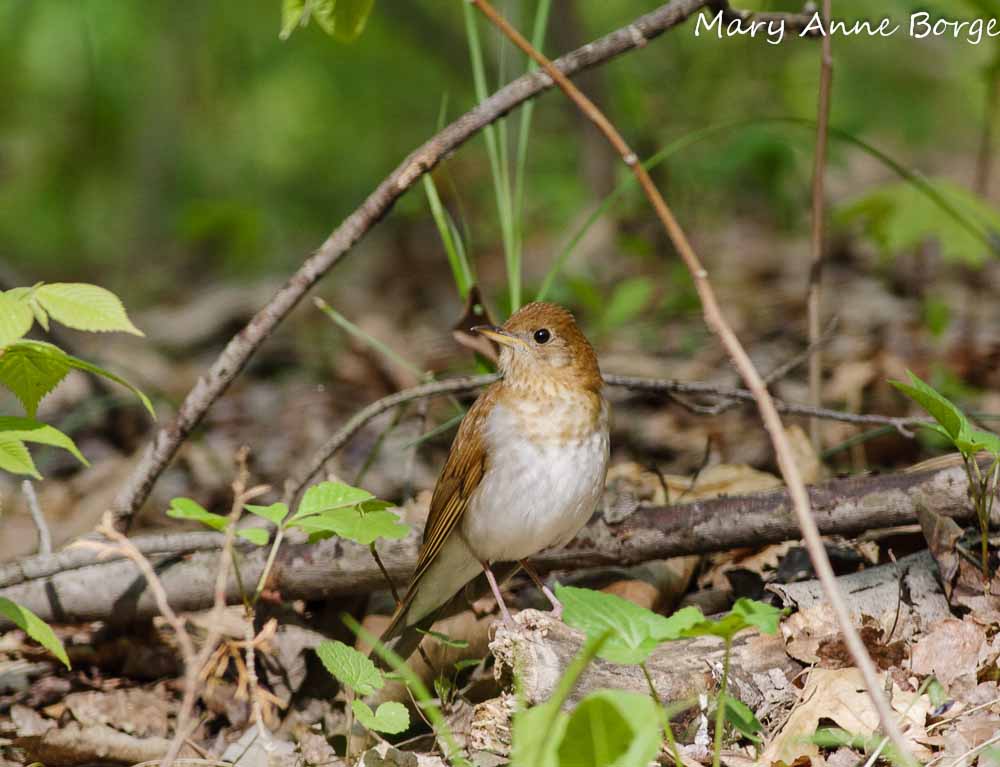
Hermit Thrush - one of the many bird species that eat Gray Dogwood fruits

Hermit Thrush – one of the many bird species that eat Gray Dogwood fruits

Gray Dogwood is native in the Canadian provinces of Manitoba, Ontario and Quebec, as far south in the United States as South Carolina, Kentucky, Arkansas, Nebraska, and Texas. It adapts well in many conditions. It prefers moist, well-drained soil, but can tolerate poor, compacted soils, and drought conditions. It likes sun, but it can also do well in part shade. It’s often found in woodland openings or open fields.

In landscaping, Gray Dogwood can be used alone in any location where a good-sized shrub is needed. Or even better, mixed with other species it brings visual and animal diversity to your property. Gray Dogwood combines well with Ninebark (Physocarpus opulifolius), American Hazelnut (Corylus americana), or Blackhaw Viburnum (Viburnum prunifolium), among others.

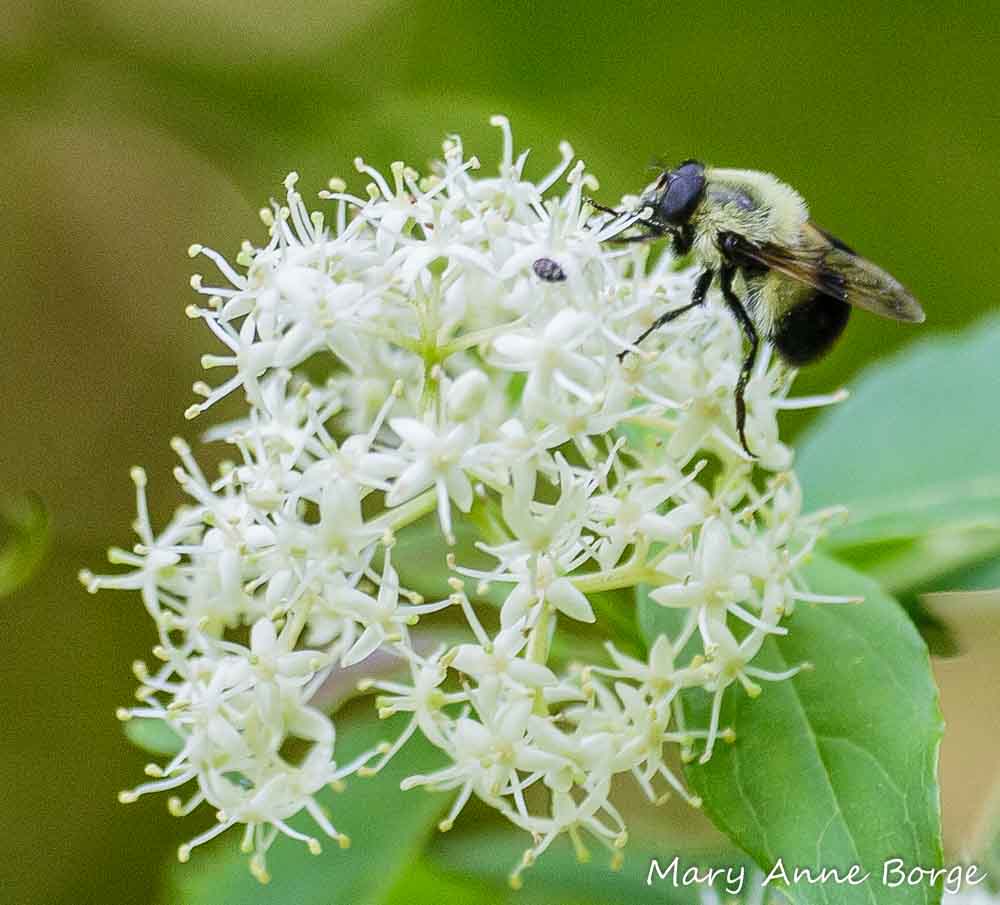
Gray Dogwood with Syrphid Fly, a Bumble Bee mimic.

Gray Dogwood with Syrphid Fly, a Bumble Bee mimic.

Gray Dogwood is great for birds, butterflies, bees, and many other critters – even people!

Resources

Wagner, David L.;  Caterpillars of Eastern North America, 2005.

Eastman, John.  The Book of Forest and Thicket.  1992.

Illinois Wildflowers


Spicebush or Forsythia?

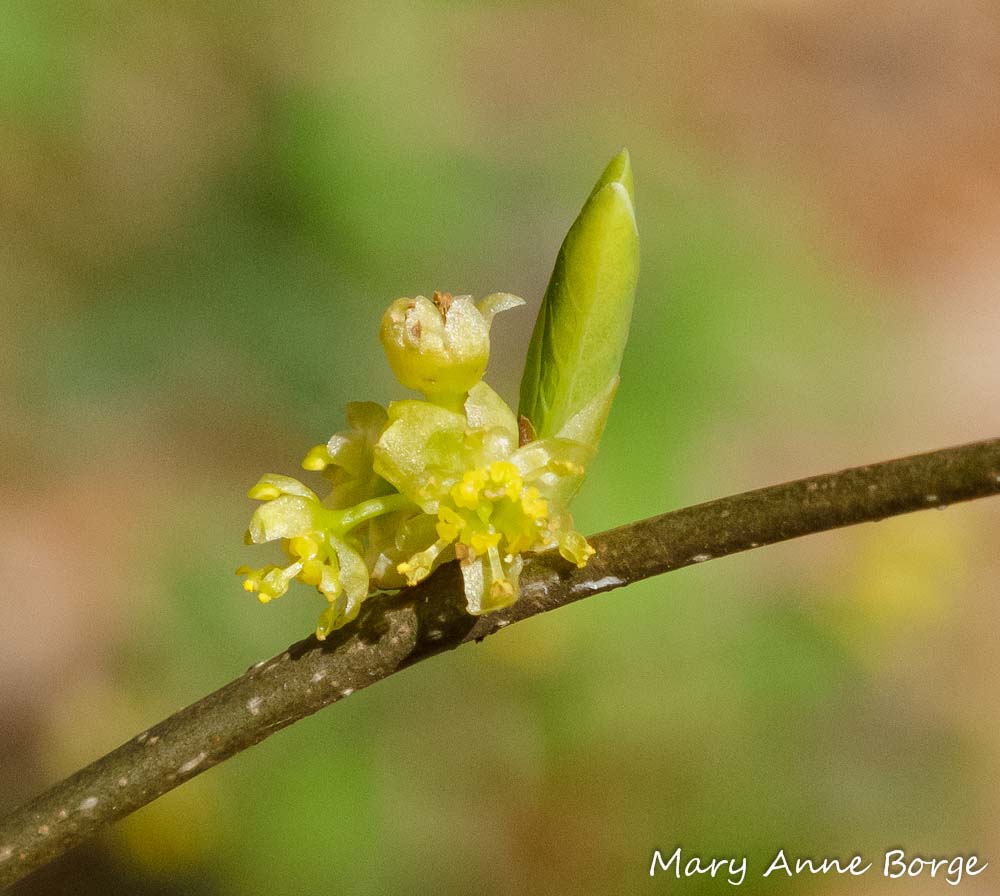
For the past few weeks, Spicebush (Lindera benzoin) buds looked like they couldn’t wait to open.  Over the weekend when the temperatures reached 80°F in the latest round of weather whiplash, the buds burst open, resulting in a display of bright yellow starbursts lighting up the forest understory.

Spicebush (Lindera benzoin) in bloom, with ant seeking nectar

Spicebush (Lindera benzoin) in bloom, with ant seeking nectar

Spring temperatures have a big influence on the exact timing, but where I live in the mid-Atlantic United States, Spicebush typically blooms in late March or early April, at about the same time as forsythia.  Forsythia is also lovely for the ten days or so that it’s in bloom, but then it’s a little, well, boring, when compared to Spicebush.

Sometimes called Northern Spicebush or Common Spicebush, this shrub is native in the north from Maine to Ontario, Michigan, Iowa and Kansas, then its range extends south to Texas and throughout the southeastern United States to Florida. It can generally be found in woodlands, but works well as a landscape plant, too. Spicebush gets its common name from the spicy aroma emitted from its leaves and young branches when they are rubbed or crushed.

Where Spicebush is native, it has important relationships with animals that have evolved with it over the centuries. Many insects, including early butterflies, visit the flowers for nectar, but early solitary bees and flies are the primary pollinators.

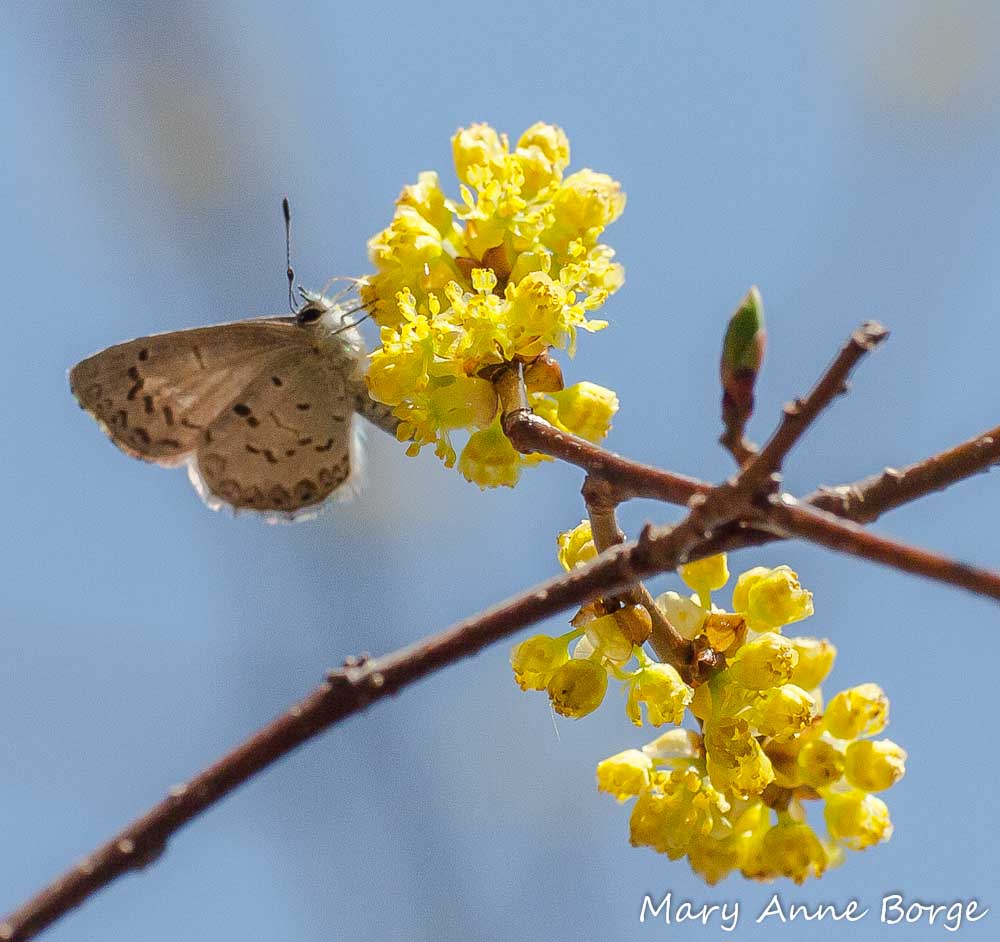
Spicebush (Lindera benzoin) with Spring Azure butterfly nectaring

Spicebush (Lindera benzoin) with Spring Azure butterfly nectaring

The flowers bloom before the leaves unfurl, making it easy for pollinators to find them. Spicebush has male and female flowers on separate plants.

Male Spicebush flowers; note yellow pollen like little balls at tips of stamens

Male Spicebush flowers; note yellow pollen like little balls at tips of stamens

Female Spicebush flowers; note pistils protruding beyond the petals

Female Spicebush flowers; note pistils protruding beyond the petals

So if you are using them in your landscape, you will want a male to pollinate the female plants in order to see the bright red fruits that complement this shrub’s yellow fall foliage.

Spicebush (Lindera benzoin) fall fruit and foliage

Spicebush (Lindera benzoin) fall fruit and foliage

Many birds eat the fruit, but Veeries

Veery

Veery

and Wood Thrushes,

Wood Thrush

Wood Thrush

birds that are often found in the same habitat as Spicebush, are especially partial to them.

Spicebush Swallowtail butterflies are often seen nectaring on flowers in sunny locations,

Spicebush Swallowtail nectaring on Wild Bergamot (Monarda fistulosa)

Spicebush Swallowtail nectaring on Wild Bergamot (Monarda fistulosa)

but they can also be found in the woods in the vicinity of their namesake plant, Spicebush. This is because the primary food plants for Spicebush Swallowtail caterpillars are Spicebush (Lindera benzoin and in the southern U.S., also L. melissifolia) and the related Sassafras (Sassafras albidum), which is usually found in the same type of habitat. Without these plants we wouldn’t have this lovely butterfly, since its caterpillars can only survive on the leaves of a few plant species.

Female Spicebush Swallowtails lay their eggs singly on the underside of a leaf.

Spicebush Swallowtail egg

Spicebush Swallowtail egg

After the caterpillars hatch from the eggs, they depend on the leaves of these plants for both food and shelter. Each caterpillar eats a few leaves of a Spicebush during its development.

Spicebush Swallowtail caterpillar; notice the evidence of feeding on the leaf in the lower right corner

Spicebush Swallowtail caterpillar; notice the evidence of feeding on the leaf in the lower right corner

Looking for holes in leaves is one way to find these caterpillars.  But we’re not the only creatures who have figured out this strategy for locating them. Caterpillars and other insects are an important source of food for birds, especially when the birds are raising their young.  Some bird species also know enough to look for partially eaten leaves to point them to a tasty meal of caterpillar protein.

Tufted Titmouse, looking for a meal

Tufted Titmouse, looking for a meal

So the caterpillars have evolved to protect themselves by destroying the evidence of their dining experience. While I watched, this caterpillar crawled to the stem of the leaf it had been eating. It chewed through the stem, and the incriminating evidence, the partially eaten leaf, fell to the ground.

Spicebush Swallowtail caterpillar, destroying the evidence of its presence by chewing through the leaf stem

Spicebush Swallowtail caterpillar, destroying the evidence of its presence by chewing through the leaf stem

Spicebush Swallowtail caterpillars have other strategies to protect themselves from predators. In their earliest growth stages they look like bird droppings, a clever disguise to deter birds from eating them. As they grow, they take on the appearance of a snake, with false eye spots above their real head. This snake disguise is an effective deterrent to at least some of the birds that might otherwise eat the caterpillars, since snakes are the birds’ predators in their wintering grounds.

Black-Throated Blue Warblers may be put off by a snake-like disguised caterpillar

Black-Throated Blue Warblers may be put off by a snake-like disguised caterpillar

When they’re not eating, Spicebush Swallowtail caterpillars hide in leaf shelters that they create for themselves by spinning silk to pull two sides of a leaf together.

Spicebush Swallowtail caterpillar using its silk to create a leaf shelter

Spicebush Swallowtail caterpillar using its silk to create a leaf shelter

Spicebush is also a food plant for the caterpillars of a moth called the Tulip-tree Beauty,

Tulip-tree Beauty caterpillar on Spicebush (Lindera benzoin)

Tulip-tree Beauty caterpillar on Spicebush (Lindera benzoin)

and one of the giant silk moths, the Promethea Moth.

Promethea Moth Caterpillars on Spicebush

Promethea Moth Caterpillars on Spicebush

Winter is a good time to look for Spicebush Swallowtail chrysalises and Promethea Moth cocoons, since these species overwinter as pupae.

Forsythia on the other hand, primarily a native of Asia, doesn’t support any of our native insects and birds in this way.  So I’m opting for Spicebush.

Spicebush (Lindera benzoin)

Spicebush (Lindera benzoin)

Related Posts

A Promethea Moth and the Awe-inspiring Power of Nature

Resources

Butterflies and Moths of North America
http://www.butterfliesandmoths.org/

Eastman, John. The Book of Forest and Thicket. 1992.

Illinois Wildflowers http://www.illinoiswildflowers.info/trees/plants/spicebush.htm

Natural History Museum Database of Leipidoptera Hostplants
http://www.nhm.ac.uk/research-curation/research/projects/hostplants/

Signs of Spring – Mining Bees

After a long, snowy winter, signs of spring are everywhere. Starting early each morning, birds are singing, woodpeckers are drumming, and in the woods, you may hear a chorus of Spring Peepers or Wood Frogs. At our backyard feeder the other day I saw a male Goldfinch that had almost completed his change to summer plumage.

American Goldfinch

American Goldfinch

Chickadees are excavating nesting holes. Many birds have paired up for the mating season, both our year-round residents, and winter visitors who are getting ready to head back north to their breeding grounds.

Male and female Green-winged Teal at Abbott Marshlands

Male and female Green-winged Teal at Abbott Marshlands

Pair of Blue-winged Teal at Abbott Marshlands

Pair of Blue-winged Teal at Abbott Marshlands

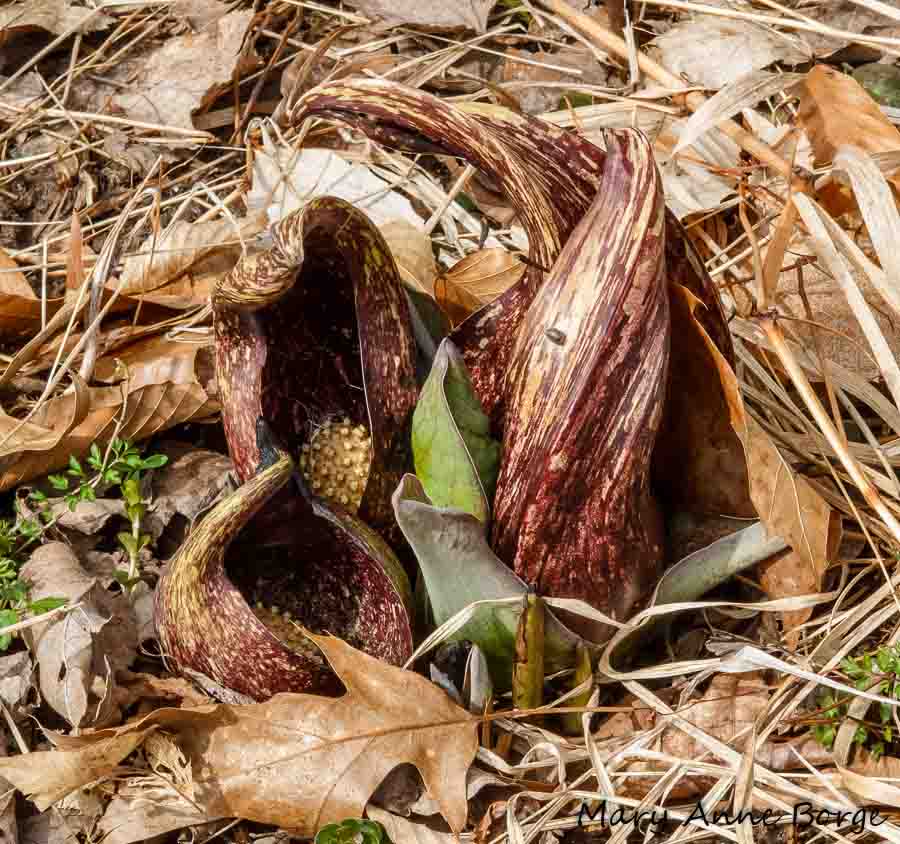
Skunk Cabbage (Symplocarpus foetidus) has been blooming for weeks, American Hazelnut ( Corylus Americana) joined in about March 19, and even Red Maples are in flower. Snow trillium and Hepatica are blooming, too.

Skunk Cabbage at Bowman's Hill Wildflower Preserve

Skunk Cabbage at Bowman’s Hill Wildflower Preserve

Change is rapid this time of year. Spring ephemerals that were not even visible one day are a few inches above ground, some with buds, two or three days later. It’s amazing to think that these delicate plants easily work their way through their winter blanket of fallen leaves. This natural covering still provides warmth on cool spring nights, as it helps preserve moisture and prevent competing plants from taking hold in the soil, even after these spring flowers fully emerge.

Virginia Bluebells emerging from their winter blanket of leaves at Bowman's Hill Wildflower Preserve

Virginia Bluebells emerging from their winter blanket of leaves at Bowman’s Hill Wildflower Preserve

Insects are out and about. I saw my first butterflies of the season this week – 3 anglewing sightings, probably all Eastern Commas, flitting about with only rare breaks. Can you spot the well-camouflaged butterfly in this photo?

Anglewing butterfly, probably Eastern Comma

Anglewing butterfly, probably Eastern Comma

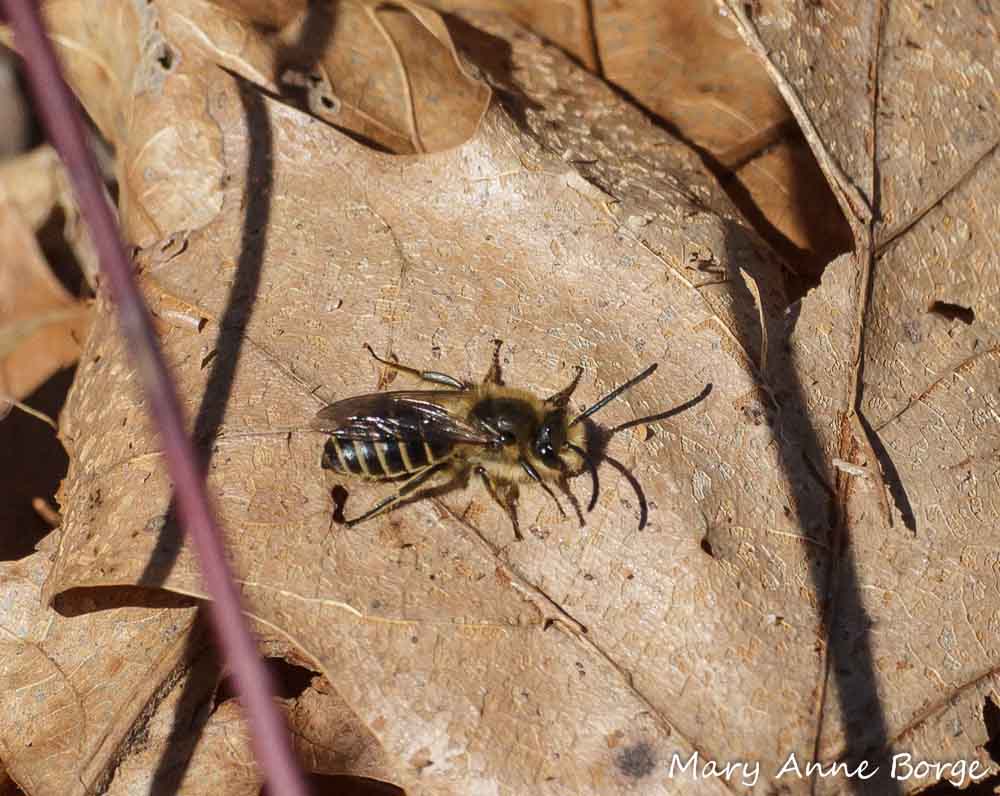
Mining Bees (Andrena sp.) were very active this week, flying just above the leaf litter, moving steadily back and forth, occasionally taking a break.

Mining Bee (Andrena sp.) at Abbott Marshlands

Mining Bee (Andrena sp.) at Abbott Marshlands

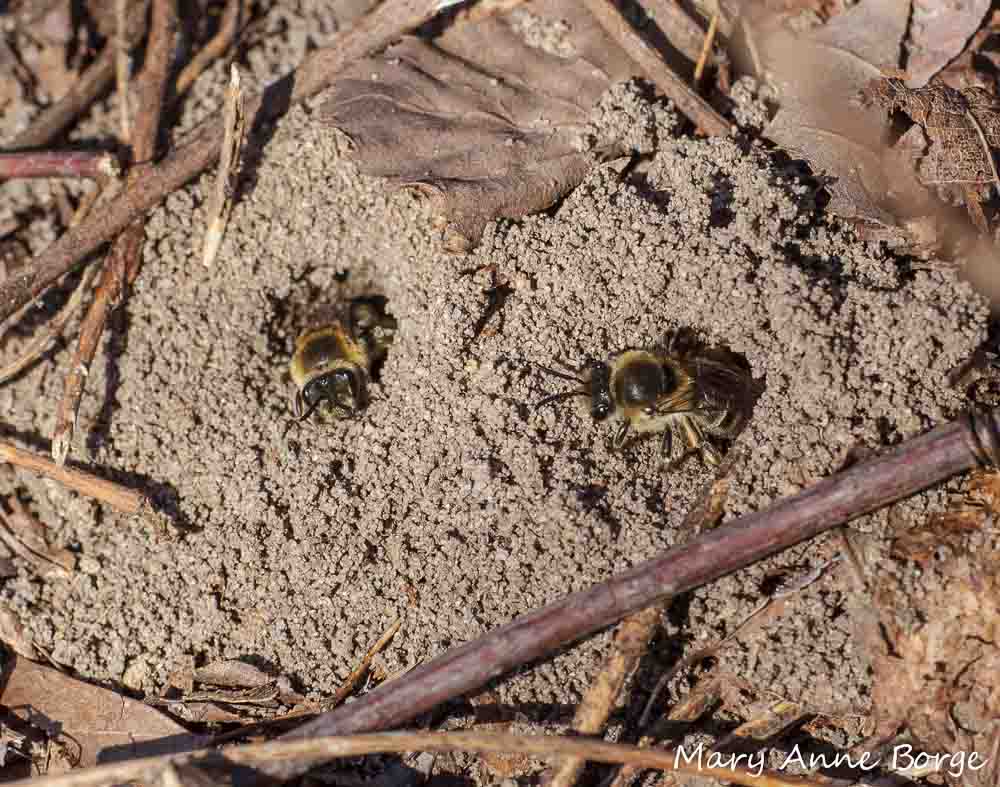
Mining Bees are solitary. This means that each female excavates her own nest, lays her eggs in brood cells in the nest, and provisions them with food. In the case of Mining Bees, nests are excavated in the ground, a practice that gives this family its common name. Above ground, the nest entrances look a lot like the entrance to some ant colonies, but with bigger holes.

Although each female bee has her own nest, Mining bees often excavate their nests in close proximity to each other, in large aggregations of bees. At Abbott Marshlands, there were dozens of Mining Bee nest holes along and beyond the edges of the trail. Aggregations can be much larger still.

Mining Bees (Andrena sp.) at Abbott Marshlands

Mining Bees (Andrena sp.) at Abbott Marshlands

The bees in the picture above reminded me of two neighbors sitting on their front porches chatting. While I watched, another bee came in flying low right over them. The bee on the right ducked into her nest, but the bee on the left was receptive to the male bee’s advances.

Mining Bees (Andrena sp.) mating at Abbott Marshlands

Mining Bees (Andrena sp.) mating at Abbott Marshlands

There are about 400 species of Andrena bees in North America alone, hundreds more worldwide. They are abundant in spring, with many species foraging for food on a single plant species, or a few closely related species of plants. One species, Andrena erigeniae, relies almost exclusively on the pollen of Spring Beauty (Claytonia virginica, C. caroliniana) as food for their offspring. Another species, Andrena erythronii, specializes on Trout Lily (Erythronium americanum) as a food source to provision its brood cells for its larvae. Many Mining Bee species look very similar to each other, so sometimes the easiest way to tell them apart is by the plant on which they are foraging.

The Mining Bees I saw at Abbott Marshlands were near a location where there is a lot of Spring Beauty, and just a bit farther down the trail, a large colony of Trout Lily. It should be only a few more days before they start to bloom. Which flowers will these bees visit?

Resources

Eaton, Eric R.; Kauffman, Ken. Kaufman Field Guide to Insects of North America. 2007.

Gracie, Carol. Spring Wildflowers of the Northeast. 2012.

Mader, Eric; Shepherd, Matthew; Vaughan, Mace; Black, Scott Hoffman; LeBuhn, Gretchen. Attracting Native Pollinators: Protecting North America’s Bees and Butterflies. 2011.

Insect Visitors of Illinois Wildflowers http://www.illinoiswildflowers.info/flower_insects/files/oligoleges.htm


Sleepy Orange Butterflies Overwintering in Pennsylvania

As I write this, it’s 30°F and snowing lightly, with snow, ice and rain predicted for the next few days.  It’s December in New Jersey.  Oddly, I like winter.  So what am I doing thinking about butterflies?

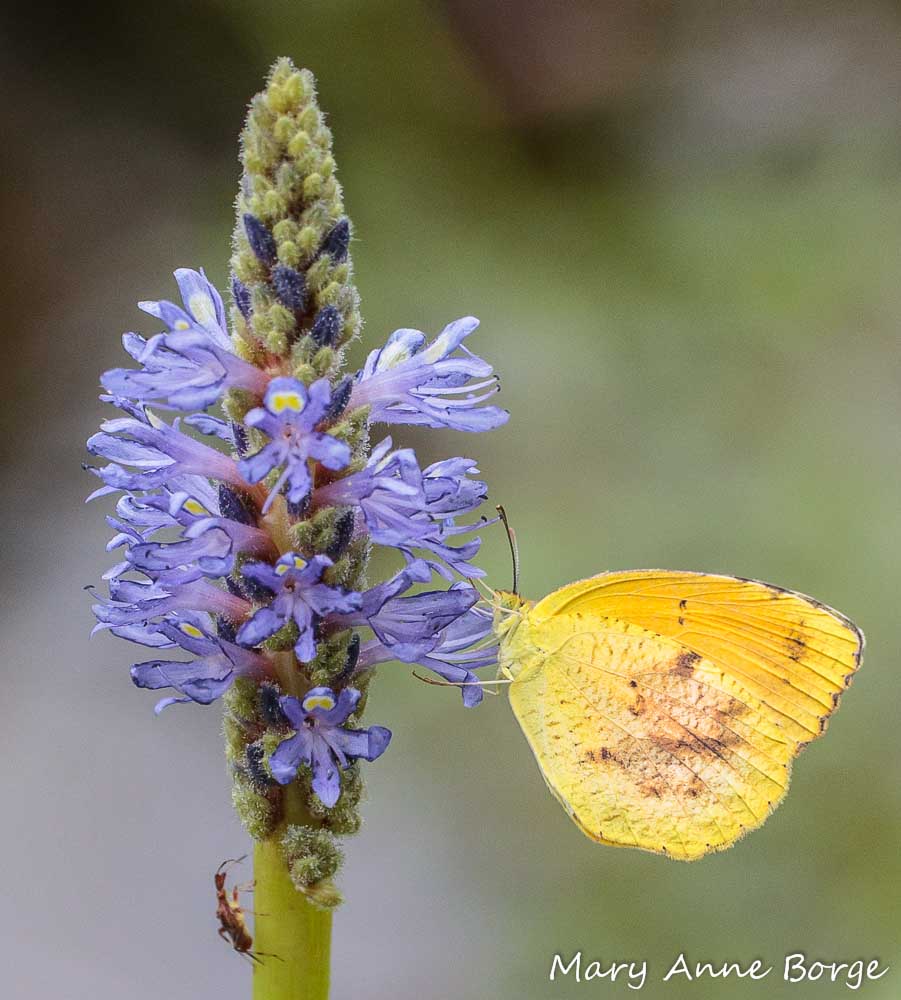
Sleepy Orange Nectaring on Pickerelweed (Pontederia cordata)

Sleepy Orange Nectaring on Pickerelweed (Pontederia cordata)

Since summer I’ve been puzzling over the fact that a butterfly species that is primarily tropical, the Sleepy Orange (Eurema nicippe or Abaeis Nicippe), has been seen regularly in summer across the Delaware River at Bowman’s Hill Wildflower Preserve, just south of New Hope, Pennsylvania.  (See Sleepy Orange Butterflies are Back)  This species is not thought to overwinter farther north than North Carolina.  How is it that Sleepy Oranges have consistently been at the Preserve for the past four summers, and before that in 2006 and 2008?

Is it random chance?  Are they successfully overwintering here?  Or have they evolved to be able to migrate south in the fall and back north in the summer, returning to the same location?  Inquiring minds want to know (ok, I want to know), so I gave myself the assignment of observing them throughout the fall to see if I could learn anything that could help answer this question.

Throughout August the Sleepy Oranges could be seen mating, with the females taking the lead in selecting the location, usually on or near their favorite caterpillar food plant, Wild Senna (Senna hebecarpa).

Sleepy Oranges mating on Wild Senna

Sleepy Oranges mating on Wild Senna

Naturally, this activity was followed by the females laying eggs.

Sleepy Orange laying an egg (ovipositing)

Sleepy Orange laying an egg (ovipositing)

Their efforts were pretty successful, treating me to many caterpillar

Sleepy Orange Caterpillar

Sleepy Orange Caterpillar

and chrysalis sightings throughout September.

Sleepy Orange Chrysalis

Sleepy Orange Chrysalis

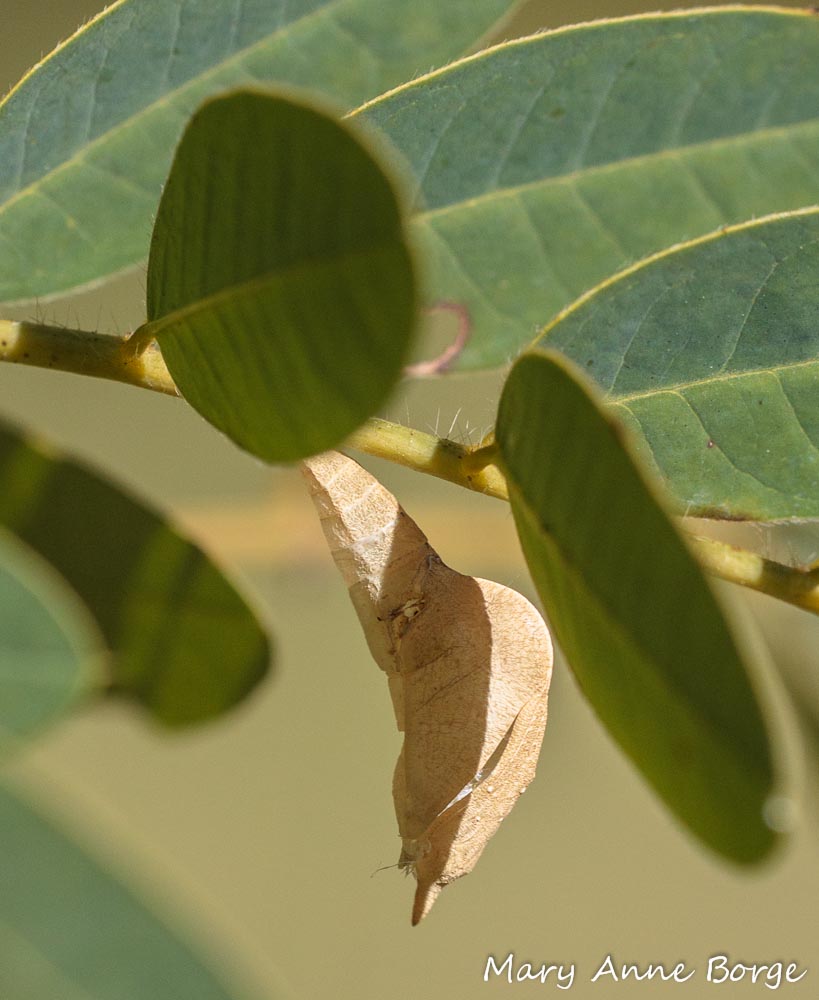
Empty Sleepy Orange Chrysalis - the butterfly has already emerged

Empty Sleepy Orange Chrysalis – the butterfly has already emerged

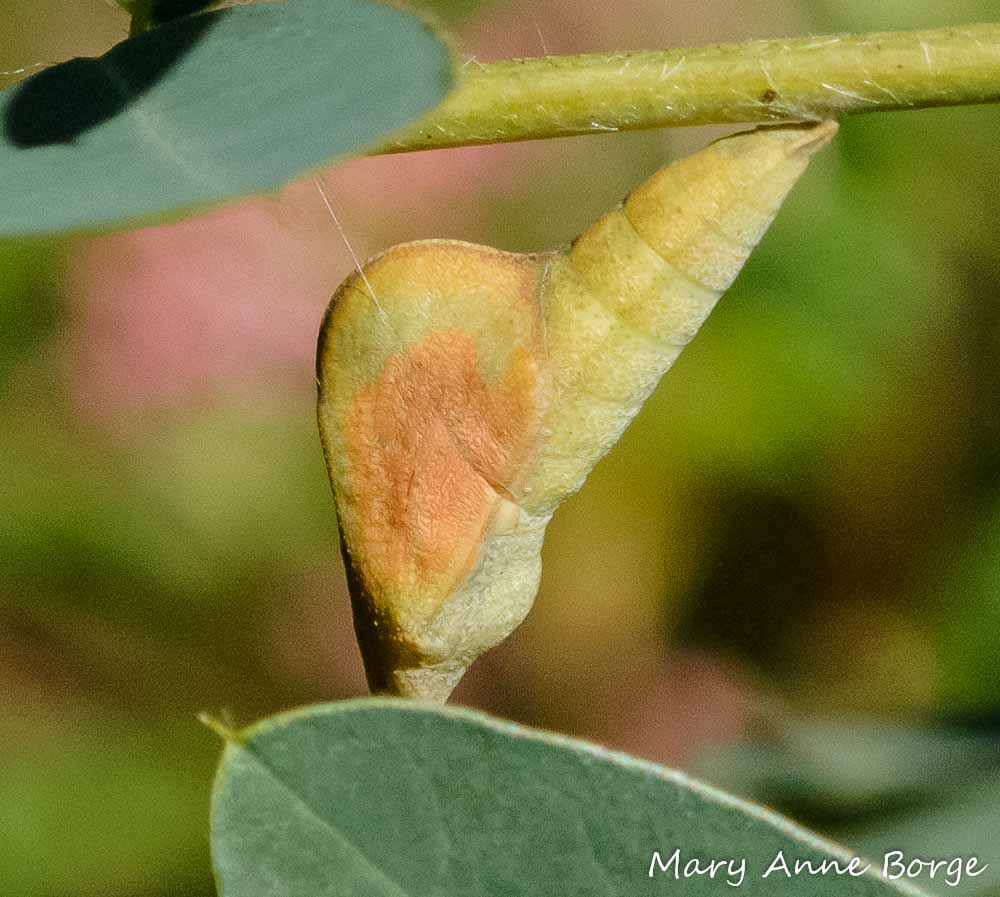
The chrysalises masqueraded perfectly as leaflets loosing their chlorophyll and changing to shades of tan, yellow and orange.

By late September, I still saw fresh-looking adult butterflies in their summer coloration form.

Sleepy Orange, summer color form

Sleepy Orange, summer color form

In the south, where Sleepy Oranges are known to overwinter as adults in reproductive diapause, they have a different, darker coloration for this overwintering generation. I observed my first individual with this coloration at the Preserve on September 24.

Sleepy Orange, winter color form

Sleepy Orange, winter color form

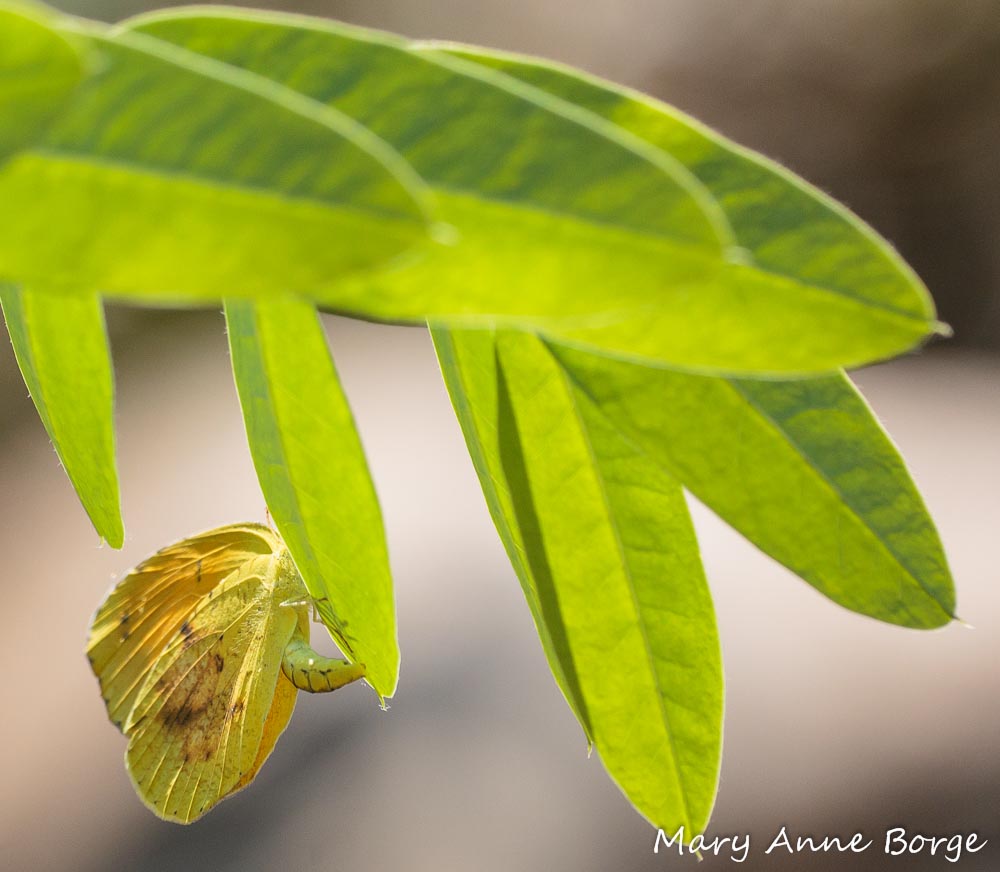
This butterfly had just emerged from its chrysalis.  The tan leaf-like thing hanging behind and between the two leaves to the right of this butterfly is the recently vacated chrysalis, positioned perfectly as if it were a leaflet.

Empty Sleepy Orange Chrysalis

Empty Sleepy Orange Chrysalis

Throughout October, every time I looked on a warm enough day I eventually saw adult Sleepy Oranges.  They usually made their appearance by flying up from the ground, first one butterfly, then two, maybe three or four, flying constantly, circling around each other, flitting back and forth, until they disappeared back down to the grasses and fallen leaves on the ground.  I no longer saw mating, caterpillars or chrysalises.

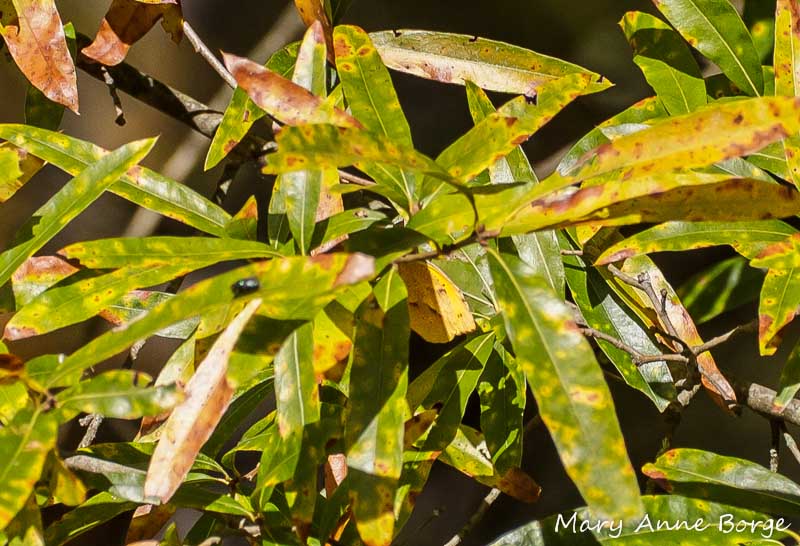
Occasionally a Sleepy Orange basked from a tree branch, safe in the camouflage of the changing fall leaves.

Sleepy Orange basking on Willow Oak - Can you see the butterfly?

Sleepy Orange basking on Willow Oak – Can you see the butterfly?

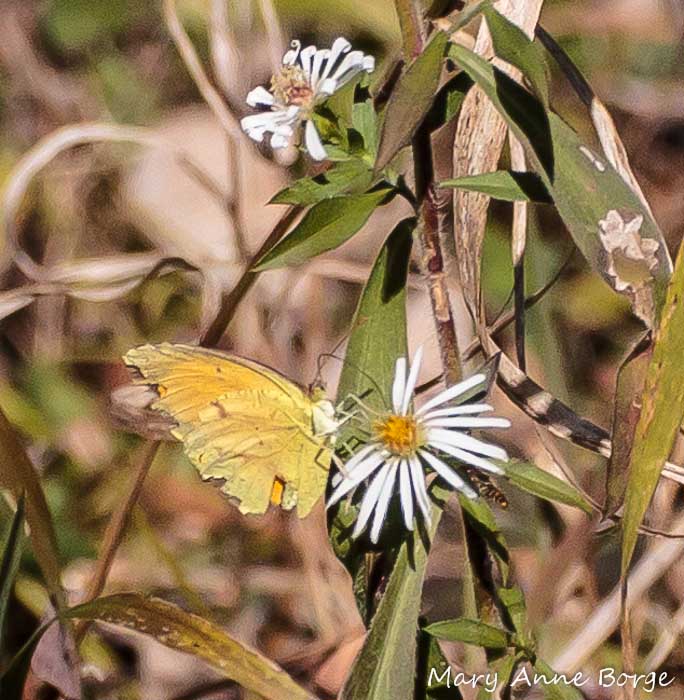
Only very rarely did I see them nectaring, although they may have been feeding more than I was able to observe, possibly on blossoms of young plants at nearly ground level, like this aster.

Sleepy Orange nectaring on aster

Sleepy Orange nectaring on aster

The spot where I saw the butterflies most frequently is a small meadow area with lots of young plants (including Wild Senna, their caterpillar food plant) and exposure to afternoon sun.

My last sighting of an adult was on November 2, a mild sunny day with a high in the mid-60s.  Given the current temperatures, I’m pretty sure that will be my last sighting until next year.

So it appears that the Sleepy Oranges are at least attempting to overwinter here, probably as adults, and probably in the shelter of the plants and fallen leaves on the ground.  Lets see if they’re successful.  This fall and winter is starting out a bit colder than normal, so even if they have survived the winter here in the past, it doesn’t necessarily mean they’ll make it this year.  I hope they do!

Even if they do overwinter here, it doesn’t exclude the possibility that they might also have a second strategy that involves migration.

I’ll keep you posted.

Sleepy Orange, winter form

Sleepy Orange, winter form

Resources:

Cech, Rick; Tudor, Guy.  Butterflies of the East Coast.  2005.